Category Archives: Uncategorized

An agenda for R&D for democracy

In The American Political Science Review, Henry Farrell, Hugo Mercier, and Melissa Schwartzberg (2022) challenge two influential views.

One view paints a “despairing picture” of democratic reasoning. It assembles evidence that individuals demonstrate “ignorance and incompetence” about political matters, while groups “invariably” suffer from “conformity,” “affective polarization,” “the rejection of countervailing arguments from nongroup members, and backfire effects.”

The other view holds that deliberating groups are wiser than individuals because they can pool intelligence and combine perspectives.

Farrell, Mercier & Schwartzberg argue that both theories generalize too much. Some democratic processes work out well; some do not. They cite recent “interactionist” research in psychology. “Instead of looking to the (supposedly invariant) cognitive limitations of ordinary citizens as skeptics do, an interactionist approach suggests that we should investigate the social context of decisions—how groups are structured—to understand when group identity and social pressure can distort or swamp problem solving [or not].”

Farrell and his colleagues use Elinor Ostrom as a model or inspiration for this agenda. Ostrom did not emphasize the main question of deliberative democratic theory, which is something like this: How should we debate and reach conclusions about contested matters, such as public policies? Instead, she asked how people should coordinate their individual behavior to achieve outcomes that they all endorse. Whereas democratic processes involve reasoning and discussion, many of the examples that interested Ostrom were about quiet work, e.g., digging irrigation canals or editing Wikipedia articles. Still, she confronted a similar situation to the one that Farrell et al. describe in democratic theory today.

When Ostrom got started, a dominant view held that individuals cannot coordinate effectively without external compulsion: the “tragedy of the commons” problem, articulated most famously by Garrett Hardin. Mancur Olson (1971) argued that sometimes voluntary coordination succeeds, and the key variable is the size of the group. Small voluntary groups can function; large ones cannot. Ostrom absorbed that claim as part of a much more ambitious research agenda. She strove to identify aspects of groups that vary and then explored which variables affect the quality of outcomes. The size of groups turned out to be relatively insignificant, not even appearing on her list of “design principles.”

If I may say so, I adopt a very similar position to Farrell and colleagues in my new book, What Should We Do? A Theory of Civic Life (2022). I summarize Ostrom’s agenda in chapter 3 and then turn to deliberative processes. Like Farrell and colleagues, I argue that we should approach deliberative democracy much as Ostrom addressed coordination. We should experiment and test which specific conditions make discussions go well. I argue that Ostrom’s school of political economy should pay more attention to deliberation about values, because that is a necessary activity of groups. (In many of Ostrom’s cases, there is no dispute about values.) I also discuss nonviolent social movements, but that is a different topic.

When the argument is stated as in Farrell, Mercier & Schwartzberg, I anticipate two difficult but fruitful questions.

First, how should we identify successes and failures so that we can decide which democratic processes work? After all, people often disagree about what constitutes a success. One option is to use obvious cases of failure, when everyone would regard the outcome as suboptimal. We can ask why that happened. But this approach shifts the research away from debates about principles and goals toward purely instrumental problems, like how to preserve common resources, which Ostrom and her many colleagues already studied. The more controversial the topic becomes, the less we already know about how to structure conversations about it–although I would cite literature that Farrell et al. don’t mention, such as work by John Gastil, Archon Fung, Tina Nabatchi and Matt Leighninger, Celina Su, and others. These authors have identified variables that affect conversational quality, such as the method of recruiting or admitting participants, the nature of the facilitation, and the stakes of the discussion. Still, the problem of identifying success remains. (They do mention essential work by Michael Neblo et al.)

Second, what should be done with the findings? This research has implications for the design of governments and other big institutions. The US Constitution already requires jury trials; the Constitution of India requires every village to have an empowered annual meeting. Knowing more about the conditions that make discussions go well can help us to understand whether such provisions are optimal and what other rights and institutions we should add.

But I think the main audience will be civil society. Voluntary groups–including those that seek to influence governments–are best positioned to experiment with formats for discussion. They have more flexibility than governments, they can change more easily, and their sheer number and variety creates more opportunities.

Sources: Farrell, H., Mercier, H., & Schwartzberg, M. (2022). Analytical Democratic Theory: A Microfoundational Approach. American Political Science Review, 1-6; Ostrom, Elinor (1990). Governing the commons: The evolution of institutions for collective action. Cambridge University Press, Olson, Mancur (1991), The Logic of Collective Action, Harvard University Press. See also: don’t let the behavioral revolution make you fatalistic; how political talk relates to its context; this is what deliberative democracy looks like; why study real-life deliberation?; the legacy of Elinor Ostrom and the Bloomington School; etc.
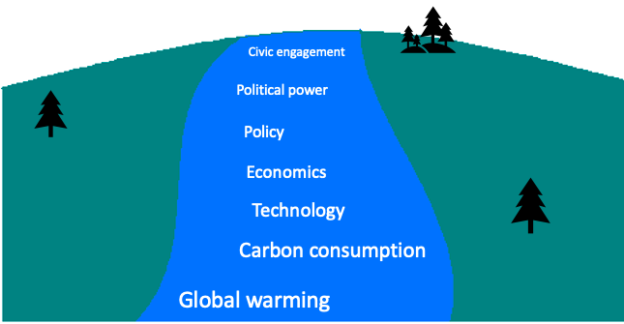
the major shift in climate strategy

One way to look at the climate crisis: Billions of people are using machines that burn carbon to accomplish their goals, and the carbon is heating the atmosphere. Different technologies could accomplish the same or better goals with less carbon, but they are not widely available.

Let’s move a step upstream. Why are our technologies bad? Answer: the price of carbon is too low. Although we pay to extract and transport carbon, burning it is free. The price is too low to reflect the social cost and too low for acceptable outcomes.

When people consume too much of something, you can ban them from using it or tax it. Actually, “you” can’t do either, but governments can enact laws that ban or tax carbon. What we can do is to advocate for such laws. Given the global nature of the problem, many governments would have to enact and actually enforce these laws. However, the record so far is very poor.

To understand why the policy record is so weak, we need to move another step upstream. Policies result from the interplay of political interests. In a mixed economy (with both a market and a government), businesses are powerful interests. Much of their power comes not from explicit pressure and advocacy but from their pivotal role in the economy. They produce the goods and jobs that political leaders want. Many businesses are currently wedded to producing or consuming carbon. They do not even have to say–because most leaders already believe–that reducing carbon will cost jobs.

Although these sentences describe a capitalist mixed economy, other systems are not necessarily preferable in these respects. For instance, the USSR had a disastrous environmental record because its government, too, was influenced by interests that depended on carbon and pollution. They just tended to be (technically) within the public sector. And in countries like the USA, the carbon-dependent interests are not limited to for-profit companies. Unions, federal agencies, and elected representatives from carbon-intensive districts have often contributed to the problem.

Moving upstream to this political level helps to explain why we don’t already have carbon taxes even if they would be optimal. It also suggests a different policy response: subsidize interests that benefit from decarbonization until they grow more powerful than the interests that benefit from burning carbon. The favored interests will include companies but also unions, geographical communities, and looser groupings, such as users of public transportation.

This is what the new climate bills do–not only the Inflation Reduction Act, but also the CHIPS and Science Act, which, as Robinson Meyers notes, directs large sums to climate R&D. These investments could start a virtuous cycle by empowering interests that reduce carbon, which will then demand favorable policies, perhaps including a carbon tax. Michael Ross summarizes important research that supports this strategy in this thread.

By the way, the same logic should also influence how we assess the details of the legislation. For instance, if you want to spend money as efficiently as possible to decarbonize, you should not restrict the funds to US-based companies, as the new bills do. You should buy renewable energy, technologies, etc. from the lowest bidder. But if you are trying to strengthen interests that support decarbonization, then the protectionist aspects of these laws makes sense. You want to strengthen local special interests, which can then become domestic lobbies. If the Europeans and others are angry about our protectionism, let them invest in EU companies.

I endorse this strategy but would want to keep two critiques in mind–coming from opposite ends of the ideological spectrum. Public choice economists in the Virginia School will be alarmed about enhancing the influence of any special interests over government. Such interests will favor themselves in the narrowest possible ways, leading to policies that are opaque and inefficient and that constantly change, preventing individuals and firms from making plans. Being generally libertarian, the Virginia School wants less government rather than more. However, given a government of any size, they would hate a strategy that empowers interests to lobby and allows bureaucrats to make discretionary choices. They would much prefer a carbon tax because it is transparent, universal, and predictable.

From the other end of the spectrum, Marxist political economists will think of the interests that receive subsidies not as individual investors and bureaucrats who want to feather their own private nests but rather as capitalist institutions that will seek to preserve a fundamentally unjust economic system. If the recent laws work, they will mitigate climate change while preserving capitalism, which is problematic from the left.

Both criticisms are worth serious and ongoing consideration. However, simplistic versions of both negate the role of democratic self-governance. We can discuss and act so that the money is spent well. Then the political economy will be substantially democratic rather than corruptly bureaucratic or narrowly capitalistic.

I always want to move one more stage upstream from policy, asking what you can I should do as well as what the government should do. (My new book is all about that.) One reason is existential: you and I are people, not “the government” (even if you happen to work for a government agency–or even if your name is Joseph R. Biden). Whoever we may be, our primary responsibility is to allocate our own ideas and energies well. But we are wiser and more effective when we do that in groups rather than as individuals.

The other reason is analytical. The government is not an unmoved mover. It is in midstream, as much an object of influence as an influencer. For that reason, it is rarely valuable to ask what it should do without having a strategy for what we should do to affect it. And while we are asking what we should do to affect any given government, we should also consider other means of change.

In concrete terms, the new laws create opportunities and obligations for civic action. Most importantly, we (you and I) must make sure the money is well spent. A new transit line will not automatically reduce carbon; it will only benefit the environment if people ride it a lot. And that requires a thoughtful and responsive design for the transit. New institutional arrangements like the National Climate Bank, which will receive $27 billion (including $8 billion earmarked for “disadvantaged communities”) under the Inflation Reduction Act will provide opportunities for public participation, whether that engagement is cooperative and welcome or adversarial.

Most of the money will ultimately flow to firms: that is the nature of a capitalist economy. Subsidies and contracts for businesses create opportunities for entrepreneurs to found better companies, for employees to make their existing firms work well, and for consumers to demand accountability.

A new agenda has also emerged for citizens who want to advocate for federal policy. The recent laws authorize spending but do not appropriate the necessary funds. I think the appropriation is safe for 2022-23 because the congressional leadership is onboard, but we will need to advocate appropriations every subsequent year. We must also keep an eye on implementation of these laws, and we should be especially attuned to opportunities to expand civic capacity, because civic engagement is far upstream. One approach is to invest in groups that organize and train people to work together for the environment. Mary Ellen Sprenkel, President and CEO of The Corps Network, says:

Though it is reassuring to witness our country’s largest investment to date to address the climate crisis, we are disappointed this package does not include support for a Civilian Climate Corps. The Inflation Reduction Act includes funding to restore coastlines, accelerate green manufacturing, make homes more efficient, and strengthen the resilience of our infrastructure. These are laudable investments, but who will do these projects? Who will rebuild and reinforce our coasts, install resource-saving implements in homes, build green infrastructure in our cities?

Let’s work on that next.

See also: what if climate change isn’t a tragedy of the commons?; A Civic Green New Deal; the Green New Deal and civic renewal; the cultural change we would need for climate justice (from 2014); and Tisch College’s Civic Green website.

Arachne

A fourth story (see the other three here):

I scuttle up the line on slender legs.
One limb pulls silk smoothly from my belly
While another glues it at the right point.
Repeat, no thoughts needed; the design is
Encoded in my nerves, automated.

But Athena has left me memories,
As punishment. While the other spiders
(Disgusting creatures, close up) just spin and weave,
I spin, weave, regret, repeat, and weave
Regret right into the pattern of my web.

She didn't win, you know. She saw she'd lost
When she caught the looks on people's faces.
Her tapestry was very well woven,
Bright colors, nice detail, professional work.
No one liked it, though, because it said: "I rule."
It was a propaganda poster in wool:
"Athena," by Athena, with peons.

Mine was the opposite. I showed poor girls
Seized by man-gods: how they fought in terror.
I left the gods out, so my art was pure
Sympathy. I was on the side of us.

People had always loved to watch me work.
People, and nymphs, too: they came down from Tmolus
With their perfect bodies and empty heads
To see someone actually making things.

Their praise pleased, but it wasn't quite enough.
They couldn't understand the objects they liked.
They guessed Athena must have instructed me,
Because they had never struggled to learn.

I wanted Athena's attention--and got it
With my boasts, which floated up to the sky.
When an old hag came to refresh my manners,
I half-knew who that woman was. (Not quite.)
My curses and slurs surprised even me.
I think I was asking Athena to fight.

I was half pleased, then, to see the rags drop
Off her and her virginal, marmoreal 
Perfection irradiate my poor room,
Making the mortals and nymphs turn away.
Time to get weaving, then; let's see who's better.

She didn't have to weave well. She is divine.
She could do whatever she wanted with me,
Just like Idmon, my father, once Mother died
(My mother, whose name no one's recorded).

My famous weaving is what saved me from him.
My famous art, not Athena's. When she saw
It was better than hers--more popular, too--
She reasserted her authority.
She ripped my fabric to bits, grabbed my distaff
And started to beat me with it. My ear,
My kidney got a blow, my knees, my crown.

I grabbed some yarn I'd spun, thinking first to throw
It round the goddess' long white neck and pull.
Since hers was shockproof chryselephantine,
My own neck offered a better way out.
I made a noose and dropped it from a rafter.

Athena must have granted me respite
From my beating to prepare my suicide.
As for me, I wished to steal her victory.
My death would be my own doing, not hers.
I would make my story end as I chose.

They say the sight of me choking on my yarn
Stirred some pity deep in Pallas' breast
And she chose to spare me a rightful death,
Graciously granting me more time to weave.
But I say she made my body her art.

Sprinkling belladonna and henbane
On me made my hair fall out; strange words
Elongated my fingers into legs.
My thumbs, arms, and real legs shrank away.
My teeth consolidated into fangs.

Athena was loving her work. She hummed,
Chuckled, paused to admire the results, 
Muttered encouraging words to herself,
Calling herself "Athena" and "Clever girl."

She shrank me by pure will and watched me hurry
Up my own noose to a crack in the roof
Where I again began to spin and weave.
Now my pattern is hers. I watch it emerge.
I see what it is once my limbs have made it
Exactly the same as they've made it before.

This responds pretty closely to Ovid’s Metamorphoses, Book VI, 1-145. See also: the laughter of the gods; The Wedding of Peleus and Thetis

our expectations for Congress are too low

According to the New York Times‘ Peter Baker, “White House aides argue that the string of congressional victories—capped by the package of climate, health and tax provisions that finally cleared the Senate over the weekend—compares favorably to the two-year legislative record of most any other modern president, even perhaps F.D.R. and L.B.J.” In Politico, Ryan Lizza and Eugene Daniels also compare Biden to LBJ, citing the American Recovery Act ($1.9 trillion), the Infrastructure Investment and Jobs Act ($550 billion), the Chips and Science Act ($280 billion), and the Inflation Reduction Act: ($700 billion), for a nearly $3.5 trillion agenda. They also mention the votes that expanded NATO and addressed gun safety and toxic burn pits.

I think these recent accomplishments are noteworthy. I am not writing to dampen excitement about the story (Biden’s momentum) that dominated the political news before it was eclipsed by the search of Mar-a-Lago. However, comparing recent legislation to the 1930s or 1960s is ridiculous.

In 1964 alone, Congress passed the Civil Rights Act, launched the War on Poverty with a blizzard of programs, created Food Stamps, and authorized war in Vietnam. In 1965 alone, Congress passed the Elementary and Secondary Education Act and the Higher Education Act (still the frameworks for K-16 federal education policy); Medicare and Medicaid; the Voting Rights Act, the legislation that established HUD plus the Public Works and Economic Development Act; the laws creating the National Endowment for the Humanities and National Endowment for the Arts; the Hart-Celler Act, which transformed the demographics of the United States by allowing mass immigration; the Vocational Rehabilitation Act; and the Highway Beautification Act; plus major legislation against heart disease, cancer, stroke and automotive emissions.

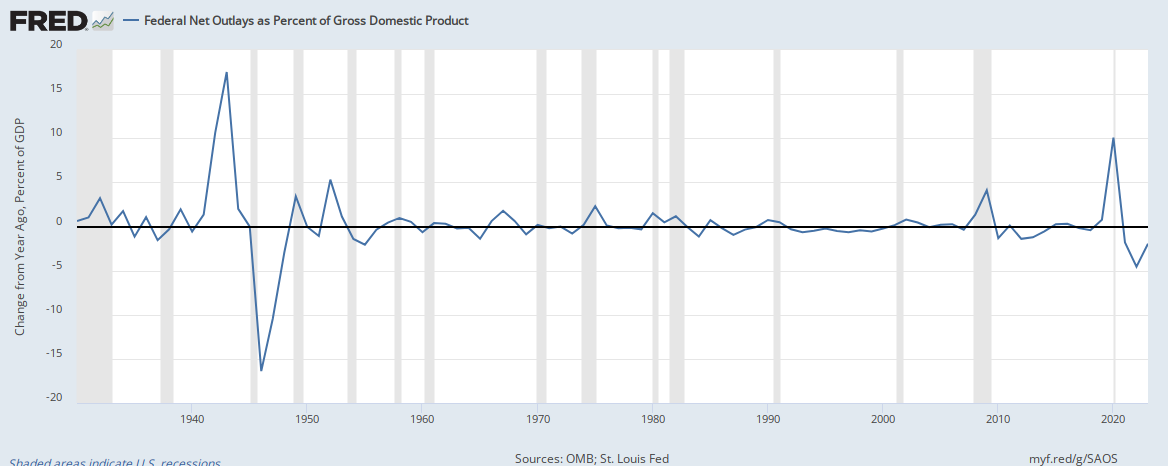
One indicator of the significance of the Biden laws is their cost, but one must adjust the sticker price for inflation, GDP, and/or population growth. Since the annual federal budget is usually about $4 trillion, $3.5 trillion over ten years (the Biden laws have various timeframes) equals roughly 10 percent of the annual federal budget, or two percent of GDP per year. Concentrating that much money on chosen priorities, such as climate, matters. But federal spending has often increased by more than two percent of GDP from one year to the next. In 2020, it grew by 10.5 percent due to spending that Trump signed and the economy’s contraction. A ten-year budget authorization can easily be changed before the decade is up.

In any case, cost is not the only relevant measure. The laws that FDR and LBJ signed created new institutions (such as Social Security or HUD) and new rights under federal law and revised the social contract, e.g., by getting the federal government involved in K-12 schools. These institutions, rights, and structures are mostly still in place today.

I do not believe that all the laws of the 1930s and 1960s were good–in fact, some were disastrous. I do not assume that the pace of change should typically match 1964-5. I certainly do not credit LBJ’s legislative successes to his personal skills. However, the public should be able to change the society (whether I happen to agree with the changes or not), and then we should be able to revisit our decisions. Elections should have regular and substantial consequences. Then democracy matters, leaders are held accountable, voters are empowered, and the public can learn from experience.

The election of 2020 certainly made a difference, as will those of 2022 and 2024. The Democratic victory blocked Republican goals and shifted federal spending priorities by up to $3.5 trillion over 10 years. This spending may enlarge constituencies that then reshape political power in the longer run. For example, the companies that produce subsidized renewable energy may prove as durable–for better and for worse–as the hospitals and pharmaceutical companies that have been federally subsidized since the 1960s.

However, the recent regulatory bills on guns and burn pits are ridiculously modest, and the spending is not as durable or significant as basic statutes are. Biden has not yet signed a statute comparable to the elements of the New Deal or Great Society–but then, neither have his predecessors for decades. For all his bluster, Trump signed basically no consequential laws other than big temporary spending increases that had Democratic support. Obama fought for and won some modest amendments to 1960s laws on health insurance. Bush II signed painstakingly negotiated amendments to the 1964 Elementary and Secondary Education Act and expanded domestic surveillance with the USA Patriot Act. Clinton signed the abolition of Aid to Families with Dependent Children and replaced it with Temporary Assistance for Needy Families and some related programs. Bush I signed no major statutes. This is a slim record for 30 years.

Overall, we expect too much of new presidents–who have limited power within a broken political system–but we expect too little of the system as a whole. Imagining that Biden’s legislative agenda rivals LBJ’s reveals how low are expectations have become.

See also: judicial activism when the legislative branch is broken; a different explanation of dispiriting political news coverage and debate etc.

the recurrent turn inward

Francis Bacon had a wonderfully pungent way of making points that have become commonplace in the era of scientific modernity. In the following passage, he denounces the previously dominant academic movement, Scholasticism, for speculating fruitlessly about empty questions instead of studying nature with empirical rigor and practical objectives:

Surely, like as many substances in nature which are solid do putrefy and corrupt into worms;—so it is the property of good and sound knowledge to putrefy and dissolve into a number of subtle, idle, unwholesome, and (as I may term them) vermiculate [like intestinal worms] questions, which have indeed a kind of quickness and life of spirit, but no soundness of matter or goodness of quality. This kind of degenerate learning did chiefly reign amongst the schoolmen [Scholastics], who having sharp and strong wits, and abundance of leisure, and small variety of reading, but their wits being shut up in the cells of a few authors (chiefly Aristotle their dictator) as their persons were shut up in the cells of monasteries and colleges, and knowing little history, either of nature or time, did out of no great quantity of matter and infinite agitation of wit spin out unto us those laborious webs of learning which are extant in their books.  For the wit and mind of man, if it work upon matter, which is the contemplation of the creatures of God, worketh according to the stuff and is limited thereby; but if it work upon itself, as the spider worketh his web, then it is endless, and brings forth indeed cobwebs of learning, admirable for the fineness of thread and work, but of no substance or profit. (Advancement of Learning (1605) I (iv) 5)

Many since Bacon have shared his impatience with philosophy as an idle and bootless pursuit. A common insult is “navel-gazing,” but Bacon heightens that critique by imagining philosophers looking beneath their navels at the disgusting worms within. As an alternative, he advocates “the contemplation of nature” and “the observations of experience” (I.V(1)6), which will yield secure and profitable knowledge.

One rejoinder is that natural science cannot address such crucial questions as “What is justice?” and “What is a good life?” A second response is that natural science makes fundamental but often unexamined assumptions about metaphysics and epistemology. Bacon and his successors would consider such issues fruitless, but Kant argues in the original preface to his Critique of Pure Reason that “it is in reality vain to profess indifference in regard to such inquiries, the object of which cannot be indifferent to humanity. Besides, these pretended indifferentists, however much they may try to disguise themselves by the assumption of a popular style and by changes on the language of the schools, unavoidably fall into metaphysical declarations and propositions, which they profess to regard with so much contempt” (Meiklejohn trans.)

Picking up a similar theme, Edmund Husserl wrote in 1929, “Daily practical living is naive. It is immersion in the already-given world, whether it be experiencing, or thinking, or valuing, or acting. … Nor is it otherwise in the positive sciences. They are naivetes of a higher level. They are the products of an ingenious theoretical technique; but the intentional performances from which everything ultimately originates remain unexplicated” (Cartesian Meditations, English trans. by Dorian Cairns).

Assuming we do want to ask philosophical questions, how can we avoid mere opinions and speculations? A recurrent suggestion is to turn back to the ones who form such opinions–ourselves–and to critically assess how we think and what we have a right to claim. Kant is the most famous proponent of this turn. He calls for a “critical inquiry into the faculty of reason,” which is “not so much occupied with objects as with the mode of our cognition of these objects.” However, my point in this post is that the same move has been made many times, and it is interesting to list and compare the approaches that have been attempted.

Instead of making direct claims about metaphysics, epistemology, or value, one could:

  1. Critically assess the experts who make or imply such claims and see whether they know what they are talking about. This is Socrates’ main business, as he describes it. He tests the poets, orators, politicians and others to see if they possess knowledge. For the most part, he is interested in the thoughts and methods of individuals who belong to social categories, such as poets, but a roughly similar approach is to critically investigate institutions that purport to generate knowledge, such as labs and clinics. This approach is common in Science and Technology Studies (STS) and the sociology of knowledge today.
  2. Investigate and clarify the rules of logic, on the premise that useful thoughts should be logical and that only some claims about the world will pass that test. Aristotle inaugurated this approach in Europe, although it had precedents, and it has also been influential in Asia.
  3. Critically investigate “reason,” understood as a faculty. This is Kant’s explicit approach, but Descartes and many others have begun in a similar way.
  4. Critically investigate language, on the theory that all complex, declarative thoughts take linguistic form. The “linguistic turn” was one of the main developments of the 20th century.
  5. Very closely attend to how we experience things, including the self that does the experiencing. This is the phenomenological approach, which Husserl called a “radical new beginning of philosophy” (op cit.) but which had obvious antecedents, including–as Husserl acknowledged–the Pali Cannon Canon in Buddhism.
  6. Study thinking as a natural activity of the brain and nervous system of homo sapiens–although it is tricky to do that without making the kinds of epistemological assumptions that people like Kant and Husserl attribute to empirical science.

(Nothing in this post is original, but I found it interesting to make the above list.) See also: is all truth scientific truth?; the progress of science; why social scientists should pay attention to metaphysics; etc.