Here are four common ways of talking about who should be engaged in decision-making or collective work. Each approach has significant drawbacks.
Definition
Who decides who they are?
Drawbacks
Stakeholders
People with specific, identifiable, relevant knowledge, power, commitment or vulnerability.
The organizers of a process identify the stakeholders.
The organizers retain power and discretion. The process favors people with special “stakes,” who may not represent everyone.
Citizens
All adults who are recognized by the authorities as full members of the jurisdiction, e.g., a country.
Normatively, all adult residents have claims to be citizens. In practice, the definition reflects power.
One person/one vote does not reflect the real distribution of influence and interests. Realistically, specific stakeholders will set the agenda. Also, people who are not citizens may have valid stakes.
Activists
Members of social movements who have obtained visibility and influence through their struggles.
Activists identify themselves. However, an individual may not be accepted by a given group and may not then be heard.
Since a movement is usually defined by its stance, it cannot represent people with alternative views or those who are neutral or agnostic.
The community
Members of an affected group who are outside of the system that organizes the process. For instance, the police consider civilians to be the community. Professors consider non-academics to be the community. For the state, the police and the university might be parts of the community.
Usually, someone with authority defines the community as an “other.”
The abstract idea of a community often devolves to leaders and staff of NGOs or social-movement activists. People who have formal titles may define themselves out of the community, which is a mistake.
The oppressed or marginalized, sometimes named “The People” in left-wing discourse.
Members of social groups who are and have been subject to violence, discrimination, dispossession, etc.
People with influence over the discourse–perhaps including those who are themselves oppressed. (But usually, powerful people do most of the talking.)
A negative definition can be patronizing. Defining someone else as oppressed does not empower them.
As a political philosopher by training, and now political scientist by appointment, I have long been privately embarrassed that I am not sure how to define “state,” “government,” “regime,” and “nation.” On reflection, these words are used differently in various academic contexts. To make things more complicated, the discussion is international, and we are often dealing with translations of words that don’t quite match up across languages.
For instance, probably the most famous definition of “the state” is from Max Weber’s Politics as Vocation (1919). He writes:
Staat ist diejenige menschliche Gemeinschaft, welche innerhalb eines bestimmten Gebietes – dies: das „Gebiet“, gehört zum Merkmal – das Monopol legitimer physischer Gewaltsamkeit für sich (mit Erfolg) beansprucht.
[The] state is the sole human community that, within a certain territory–thus: territory is intrinsic to the concept–claims a monopoly of legitimate physical violence for itself (successfully).
Everyone translates the keyword here as “state,” not “government.” But this is a good example of how words do not precisely match across languages. The English word “government” typically means the apparatus that governs a society. The German word commonly translated as “government” (“der Regierung“) means an administration, such as “DieRegierung von Joe Biden” or a Tory Government in the UK. (In fact, later in the same essay, Weber uses the word Regierung that way while discussing the “typical figure of the ‘grand vizier'” in the Middle East.) Since “government” has a wider range of meanings in English, it wouldn’t be wrong to use it to translate Weber’s Staat.
Another complication is Weber’s use of the word Gemeinschaft inside his definition of “the State.” This is a word with such specific associations that it is occasionally used in English in place of our vaguer word “community.” A population is not a Gemeinschaft, but a tight association can be. Thus to translate Weber’s phrase as “A state is a community …” is misleading.
For Americans, a “state” naturally means one of our fifty subnational units, but in Germany those are Länder (cognate with “lands”). The word “state” derives from the Latin status, which is as “vague a word as ratio, res, causa” (Paul Shorey, 1910) but can sometimes mean a constitution or system of government. Cognates of that Latin word end up as L’État, el Estado and similar terms that have a range of meanings, including the subnational units of Mexico and Brazil. In 1927, Mussolini said, “Tutto nello Stato, niente al di fuori dello Stato, nulla contro lo Stato (“Everything in the State, nothing outside the State, nothing against the State”). I think he basically meant that he was in charge of everything he could get his hands on. Louis XIV is supposed to have said “L’État c’est moi,” implying that he was the government (or the nation?), but that phrase may be apocryphal; an early documented use of L’État to mean the national government dates to 1799. In both cases, the word’s ambiguity is probably one reason it was chosen.
“Regime” can have a negative connotation in English, but political theorists typically use it to mean any government plus such closely related entities as the press and parties and prevailing political norms and traditions. Regimes can be legitimate, even excellent.
If these words are used inconsistently in different contexts, then we can define them for ourselves, as long as we are clear about our usage. I would tend to use the words as follows:
A government: either the legislative, executive, and judicial authority of any entity that wields significant autonomous political power (whether it’s territorial or not), or else a specific group that controls that authority for a time. By this definition, a municipality, the European Union, and maybe even the World Bank may be a government.
(A definitional challenge is deciding what counts as “political” power. A company, a church, a college, an insurgent army, or a criminal syndicate can wield power and can use some combination of legislative, executive, and/or judicial processes to make its own decisions. Think of canon law in the Catholic Church or an HR appeals processes inside a corporation. Weber would say that the fundamental question is whether an entity’s power depends on its own monopolistic use of legitimate violence. For instance, kidnapping is a violent way to extract money, but it does not pretend to be legitimate and it does not monopolize violence. Taxation is a political power because not paying your taxes can ultimately land you, against your will, in a prison that presents itself as an instrument of justice. Not paying a private bill can also land you in jail, but that’s because the government chooses to enforce contracts. Your creditor is not a political entity; the police force is. However, when relationships between a government and private entities are close, or when legitimacy is controversial, or when–as is typical–governments overlap, these distinctions can be hard to maintain and defend.)
A state: a government plus the entities that it directly controls, such as the military, police, or public schools. For example, it seems most natural to say that a US government controls the public schools, but not that a given school is part of the government. Instead, it is part of the state. Likewise, an army can be in tension with the government, yet both are components of the state.
A regime: the state plus all non-state entities that are closely related to it, e.g., political parties, the political media, and sometimes the national clergy, powerful industries, etc. We can also talk about abstract characteristics, such as political culture and values, as components of a regime. A single state may change its regime, abruptly or gradually.
A country: a territory (not necessarily contiguous) that has one sovereign state. It may have smaller components that also count as governments but not as countries.
A nation: a category of people who are claimed (by the person who is using this word) to deserve a single state that reflects their common identity and interests. Individuals can be assigned to different nations by different speakers.
A nation-state: a country with a single functioning and autonomous state whose citizens widely see themselves as constituting a single nation. Some countries are not nations, and vice-versa. People may disagree about whether a given country is a nation-state, depending on which people they perceive to form a nation.
We’re leaving Granada tomorrow after living here for three months. My limited Spanish and a certain shyness have prevented me from learning a lot about contemporary life here. I feel better informed about the distant past than the present. Nevertheless, I’ll venture a few observations and hypotheses.
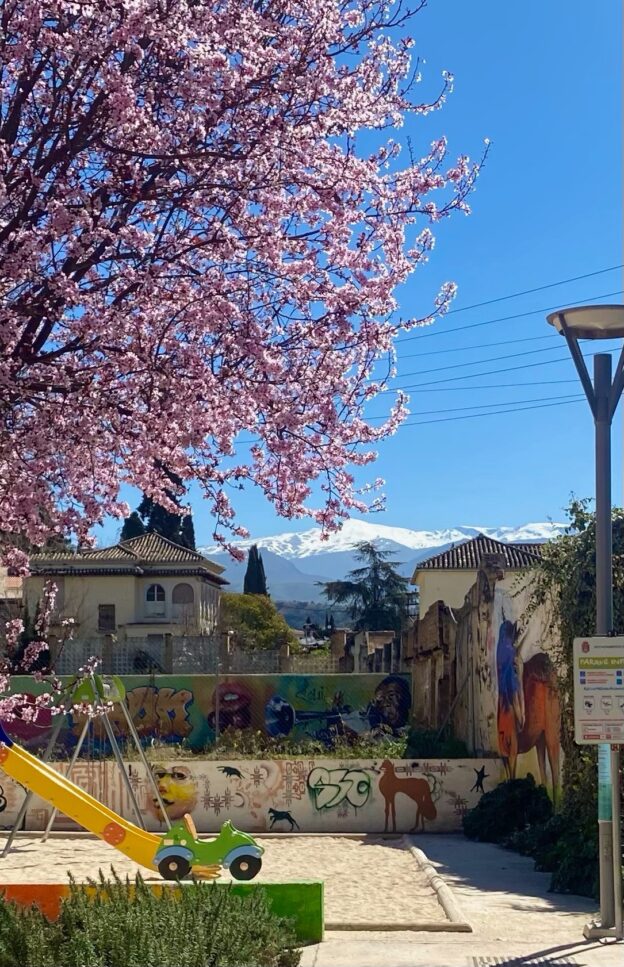
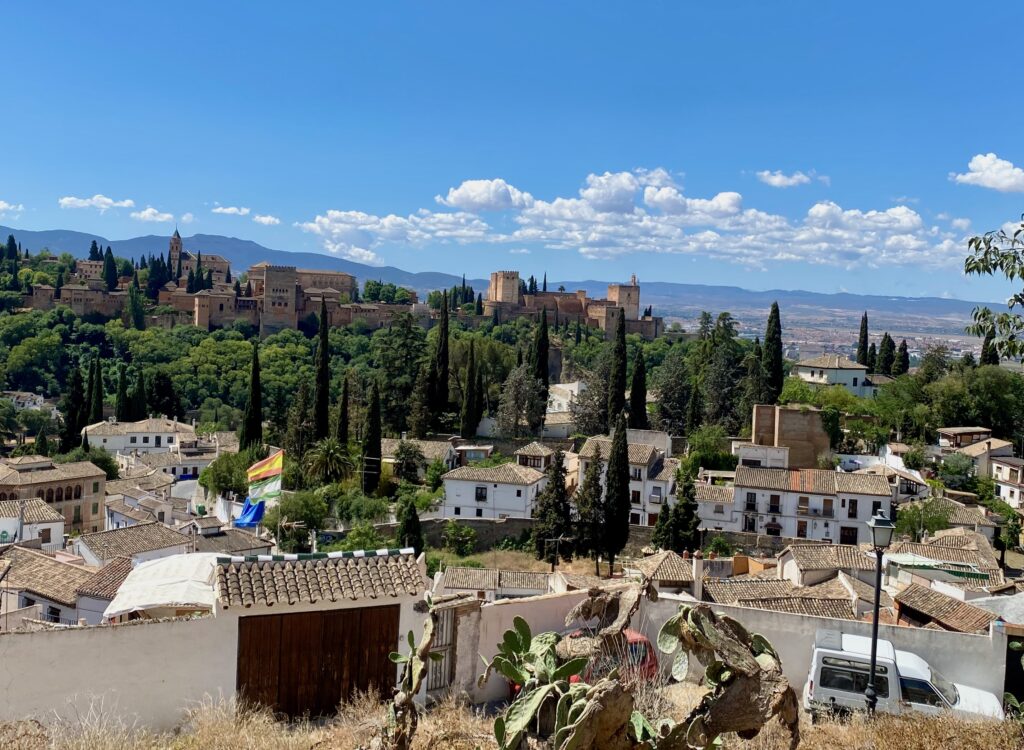
For those who have not seen it, the most salient feature of Granada is its beauty. The castle-palace of the Alhambra caps one hill, but around that romantic building are bigger summits, and the snow-capped Sierra Nevadas form the backdrop. Whitewashed houses with flowering gardens and little squares cascade down the hill of the Albaizin, where we lived. On the plain below are fine boulevards, marble-paved squares, and baroque domes.
Granada is not a big city. The population of the municipality is only 230,000. Although some legally protected green space has been lost, farmland and wooded hills remain in view. The university enrolls about 60,000 students, not concentrated on one campus but distributed through several neighborhoods. Numerous foreign students either visit the university or study Spanish in private schools. As a result, the population is quite youthful and informal. Hardly a business suit is seen.
Since three million people visit the Alhambra each year, the city is full of tourists. A substantial portion are Spanish, but Granada also draws people from the rest of the world, ranging from backpackers to bourgeois families to big tour groups. And there are many expats and some refugees. No particular foreign language dominates.
Andalusia is still fairly poor and dominated by agriculture. The region’s per capita GDP is $18,500, similar to Sicily’s and much lower than $42,000 for the EU as a whole. Many rural people moved to Granada in the postwar period and settled in neighborhoods like El Zaidin, where, apparently, conditions were at first pretty rough. I have walked through every part of the city proper and found all the streets pleasant: bustling, clean, safe, and well served by public transportation (including a brand-new subway line) and other facilities. Perhaps some of the apartments are small.
Rural life usually feels far away, but not always. We could regularly hear a burro bray from our house, and once we watched a man herd his goats up a nearby street.
Granada retains a small-town feel under the surface. On the bus that I often used to take home, the older clientele would frequently greet each other by name. People walk their dogs off-leash and leave them to wait outside of stores. Many enjoy a paseo in the late afternoon.
For me, a rough indicator of globalization is the variety of food. In Granada’s supermarkets, virtually all of the ingredients are meant for Andalusian dishes or Italian-style pizza and pasta. Except in the biggest “Ipermercado” and one little shop owned by a South Asian man, stores typically offer a single shelf with a few bottles of soy sauce and some “Old El Paso”-brand seasoning as their only foreign ingredients. Likewise, 98 percent of the city’s many restaurants offer Andalusian menus with very similar dishes. The situation is completely different in Madrid, where one can buy ingredients or cooked meals from anywhere in the world.
The previous paragraph is not a complaint. For one thing, Spanish food is good! Besides, we enjoyed being immersed in a place with a distinct culture. I do think Granada might be behind the curve (for better and worse) on globalization. That doesn’t mean it is unsophisticated, although some Castilians and Catalans may think so. For instance, the city boasts at least 14 independent bookstores, presumably serving the university community. It seems characteristic of Granada that these stores stock many new books for serious readers, yet almost every volume is in Spanish, and most are by Spanish authors. The same was true at the extensive annual book fair. One gets a sense of mild insularity–and pride.
There is a long and rich literary tradition of describing Granada as melancholy. As I wrote recently, Richard Wright observed Granada and all of Andalusia as fanatically Catholic, haunted by history, and static. I am reminded of how writers use the Turkish word hüzün (meaning something like “communal sadness”) to describe Istanbul. In both cases, outsiders are inspired by the tragic remains of past grandeur. In both cases, some local people adopt the visitors’ melancholy as their own. And both descriptions mislead.
In fact, Granada can give an impression of frivolity and subversiveness. Spanish people from other regions like to visit the city for pre-wedding parties. They dress in crazy matching costumes and tease the blindfolded fiancés. Although they are generally segregated into “hen” and “stag” groups, you see individuals expressing various gender identities. For every nun in a habit, there must be a hundred young people with tattoos and piercings. The graffiti art by El Niño de las Pinturas and others is well-known.
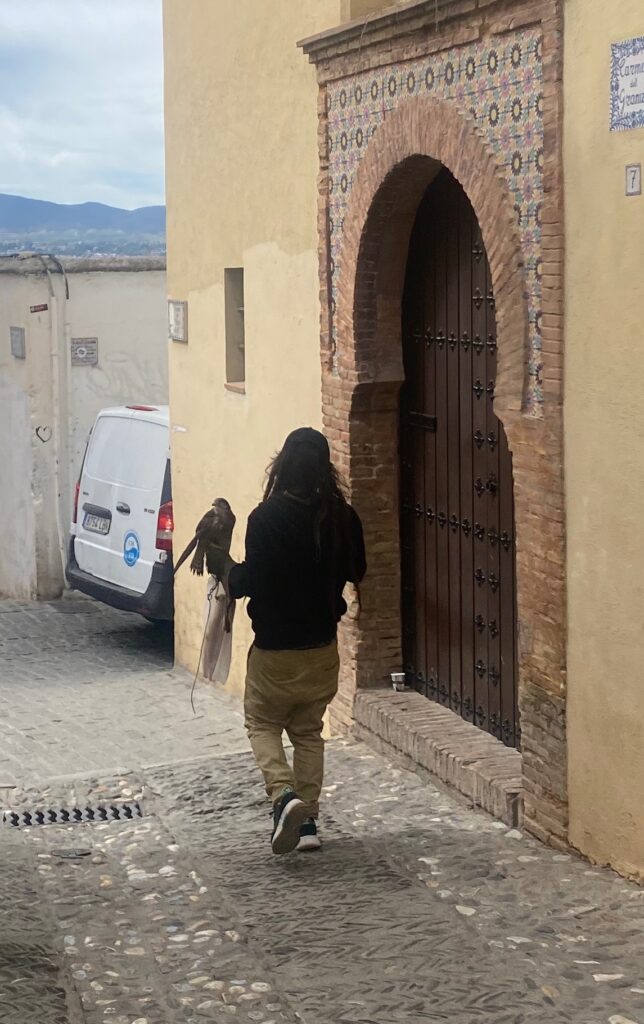
The first thing that Castilians say about Granada is that the Arab-Islamic heritage is strong there. They are not wrong. In our neighborhood, the layout, the surrounding walls, and the water system all date to the Emirate of Granada; and at the bottom of our hill, the Guadalquivir is simply the Wadi al-Kabir: the Big River.* More subtly, the streets are still repaved with black and white stones, a continuous practice since the Arab period; and even modern doors often have rows of iron studs that, in medieval times, would have been painted to indicate that the owner had accomplished the Hajj. Under our living room is a cistern, an aljibe, that is part of the irrigation system of Arab origin.
But I want to complicate this impression. First, the influence of Arab Islamic culture is far deeper in other places than many people realize. In English, there are about 900 words of Arabic origin, including “sugar” and “alcohol,” and there are about 4,000 in Spanish. Not only in Granada, but also in Chile and Texas, people use a lot of Arabic words. Americans eat meals in courses, wear lighter colors during the summer, and do many other things as a result of the customs of Arab al-Andalus.
Also, some of the explicitly Arabic influences in Andalusia are probably “invented traditions,” in Eric Hobsbawm’s phrase.
For instance, it’s worth experiencing an “Andalusian hammam” or Arab bath. That tradition dates all the way back to 1988. The Alcaicería is the city’s “bazaar” neighborhood, a warren of quaint shops. It burned to the ground in 1843, and the architecture you see there today is a Victorian fantasy of the Middle East. The Alhambra is one of the world’s greatest expressions of classical Arab culture, yet it probably consists of a selection of medieval buildings that had various owners and functions. Ferdinand and Isabella seized, heavily renovated and modified, and connected these buildings to form one renaissance-style palace, and then the rest of the neighborhood gradually vanished. The Alhambra has never stopped being transformed by ambitious architects who are responsible for things like the incongruous Victorian roofs and everything about its lovely gardens.
Arab and Romani/Gitano influences were as important for Granada’s modernists, Lorca and Manuel de Falla, as they have been for its folk arts, like flamenco. But this is not simply a case of the past influencing the present. For one thing, Arabs and Romani constitute living communities in Granada. In 2003, the Moroccan immigrant community of almost 5,000 people opened a beautiful new mosque across from the Alhambra, and Romani still dominate the Sacromonte district.
When audiences cry ¡Olé! to appreciate a flamenco dancer, they may be saying wa Ilâh (“by God”) in Arabic. Or that may be a false etymology that persisted as a myth because it sounded so romantic. In short, there is a long and complex history here of assimilation, appropriation, “othering,” ambivalence, celebration, nostalgia, and sheer invention. Andalusians have been hybrid and have been choosing to present themselves as hybrid ever since the Emirate.
Sad to leave Granada, I think of the last sultan, “Boabdil” (actually, Muhammad XII), and his famous “Moor’s Sigh” as he turned to face the Alhambra for the last time. Or of Carlos Cano’s lyrics:
Deep in the cistern, what should appear But the sadness that killed Boabdil the emir. And I left it under the shadow of an almond tree On my way to the mountains of Guajar-Faragüit.
To see whether, during the time of honey, There was a flowering of the light of thought, And whether the town will recover its color, That old-time Berber green-and-white.
Oh, country children, Tender spikelets, Go and run to tell the earth
That the poor wait for her at dawn. At dawn, old earth, at dawn…
[my translation]
En el fondo de un aljibe me encontré la tristeza que matara al rey Boabdil. Y a la sombra de un almendro la dejé por los montes de Guajar-Faragüit.
Por ver si cuando el tiempo de la miel la luz del pensamiento diera flor y el pueblo recobrara su color verdiblanco de origen bereber.
Ay niños del campo, espiguitas tiernas, echad a correr.
Decidle a la tierra que el pobre la espera al amanecer.
Al amanecer la tierra, al amanecer…
Then again, maybe nothing could be more typical of Granada than an American tourist (think: Washington Irving) recalling a mythologized medieval Andalusian Arab to taste some melancholic sublime on a cheerful day in a thriving city of tourists and students.
This is a talk that I have prepared for the Universidad Carlo III in Madrid tomorrow. It is a summary of recent work that I have been conducting with colleagues at Northeastern, Wisconsin, and Oxford and that I’m beginning to develop into a book manuscript.
In the model that I present, an individual holds potentially connected beliefs about political or moral issues, which we can represent with nodes and links (an “idiodictuon”). Whether and how the various ideas are linked in the person’s network influences that individual’s actions and opinions. When people discuss political or ethical issues, they share portions of their respective networks of which they are conscious at the time and may bring ideas from their interlocutors into their own idiodictuons.
Some network structures are better than others for discussion: overly centralized or scattered networks are problematic. Individuals tend to demonstrate similar network structures on different issues, so that having a proclivity for a certain form of network is a character trait.
People, with their respective networks of ideas, are also embedded in social networks. An idea is more likely to spread depending on features of both the social network and the idea networks of the people who interact. Specifically, the odds that an idea will spread from a given person depend on how many people receive communications from that person and how much they trust the communicator. It is reasonable to take into account the trustworthiness of a source when assessing an idea.
As a whole, a population may develop a shared network structure. An idea that is widely shared and frequently central in individuals’ networks becomes a norm. Such norms play important roles in institutions. A community or a culture is a single network or phylodictuon that encompasses disagreement. Ultimately, all such networks interconnect to form a network of human ideas.
I like the following argument, versions of which can be found in many traditions from different parts of the world:
A cause of many kinds of suffering is the will (when it is somehow excessive or misplaced).
Gaining something that you desire does not reduce your suffering; you simply will something else.
However, one’s will can be tamed.
Generally, the best way to manage the will is to focus one’s mind on other people instead of oneself. Thus,
Being ethical reduces one’s suffering.
In some traditions, notably in major strands of Buddhism and in Pyrrhonism, two additional points are made:
The self does not actually exist. Therefore,
It is irrational to will things for oneself.
Point #7 is supposed to provide both a logical and a psychological basis for #4. By realizing that I do not really exist, I reduce my attachment to my (illusory) self and make more space to care about others, which, in turn, makes me happier.
Point #6 is perfectly respectable. Plenty of philosophers (and others) who have considered the problem of personal identity have concluded that an ambitious form of the self does not really exist. (For instance, David Hume.)
But if the self doesn’t exist, does it really follow that we should pay more attention to other people? We might just as well reason as follows:
The self does not really exist. Therefore,
a. Other people do not really exist as selves. Therefore,
a. It is irrational to be concerned about them.
Or
The self does not really exist. Therefore,
b. It is impossible for me to change my character in any lasting way. Therefore,
b. There is no point in trying to make myself more ethical.
Striving to be a better or happier person is not a sound reason for doubting the existence of the self. This doubt may do more harm than good. If there actually is no self, that is a good reason not to believe in one. But then we are obliged to incorporate skepticism about personal identity into a healthy overall view. The best way might be some version of this:
The self does not really exist. Nevertheless,
c. I would be wise to treat other people as if they were infinitely precious, durable, unique, and persistent things (selves).
I think it is worth getting metaphysics right, to the best of our ability. For example, it is worth trying to reason about what kind of a thing (if anything) a self is. However, I don’t believe that metaphysical beliefs entail ways of life in a straightforward way, with monotonic logic.
Any given metaphysical view is usually compatible with many different ways of being. It may even strongly encourage several different forms of life, depending on how a person absorbs the view. Thus I am not surprised that some people (notably, thoughtful Buddhists) have gained compassion and equanimity by adopting the doctrine of no-self, even though the same doctrine could encourage selfishness in others, and some people may become more compassionate by believing in the existence of durable selves. In fact, many have believed in the following argument:
Each person (or sentient being) has a unique, durable, essential being
I am but one out of billions of these beings. Therefore,
It is irrational to will things for myself.
The relationship between an abstract idea and a way of being is mediated by “culture,” meaning all our other relevant beliefs, previous examples, stories, and role-models. We cannot assess the moral implications of an idea without understanding the culture in which it is used. For instance, the doctrine of no-self will have different consequences in a Tibetan monastery versus a Silicon Valley office park.
We cannot simply adopt or join a new culture. That would require shedding all our other experiences and beliefs, which is impossible. Therefore, we are often in the position of having to evaluate a specific idea as if it were a universal or culturally neutral proposition that we could adopt all by itself. For instance, that is what we do when we read Hume and Kant (or Nagarjuna) on the question of personal identity and try to decide what to think about it. This seems a respectable activity; I only doubt that, on its own, it will make us either better or worse people.