Category Archives: Uncategorized

Deirdre McCloskey on the science of happiness

Deirdre McCloskey’s “Happyism: the Creepy New Economics of Pleasure” (New Republic, June 8) was one of David Brooks’ favorite articles of the year. It is indeed funny and learned, and McCloskey scores some valid points, but I think she evades the hardest questions.

The effort to quantify happiness goes back to utilitarianism (and before that, to Thomas Hobbes), but it has become highly empirical in the last few decades. The findings tend to challenge the gospel of free markets, because happiness seems to be only weakly correlated with liberty and prosperity but more reliably related to security and community. From a libertarian perspective, one ought to be suspicious of any argument that happiness can be enhanced by limiting freedom. Indeed, McCloskey believes just the opposite. She thinks that once happiness (rather than piety or honor) became a public priority, individuals were unleashed to pursue their own happiness, and that led to an astounding increase in prosperity that has also enhanced people’s happiness.

I agree that individual liberty can boost prosperity and that prosperity has genuine benefits for human development. I tend to assume, for example, that the liberalization of the Indian and Chinese economies since the 1980s has done far more good than harm. But McCloskey oversimplifies the story.

First of all, her explanation of economic growth is too simple. She attributes it to a change in public philosophy:

In the eighteenth century, our earthly happiness became important to us …. As a result, real income per head commenced rising after 1800, from the hopeless $3 a day that humanity had endured since the caves. … It’s ten times more stuff, more access to clean water, a higher life expectancy, and even, for the middling, more dishes of ice cream and more pastrami on rye.

She tells this story in large books that I have not read, but I would have to be persuaded to discount all the other explanations of economic growth since 1600 or 1800: colonial conquests, slaves, and silver; stock markets and banks; puritanical campaigns against worldly happiness; the steam engine and long-distance sailing ships.

Her intellectual history is also too simple:

By 1738, the Comte de Mirabeau wrote to a friend, recommending simply, ‘[W]hat should be our only goal: happiness.’ … To see how strange such a remark is, consider whether it could have been uttered by a leader of opinion in 1538. Martin Luther? Michelangelo? Charles V? No. They sought heavenly, artistic, or political glory—not something so domestic as happiness.

Those three examples are well chosen, but an old tradition did presume that happiness was the purpose of human life. Both before and after the bourgeois revolutions that McCloskey celebrates, happiness had defenders as well as critics. For instance, Aristotle  asked (in Ross’ translation), “what is the highest of all goods achievable by action”? He answered: “Verbally there is very general agreement; for both the general run of men and people of superior refinement say that it is happiness, and identify living well and doing well with being happy; but with regard to what happiness is they differ, and the many do not give the same account as the wise.” The “many” (both in Aristotle’s day and in 1538) assumed that happiness was “some plain and obvious thing, like pleasure.”

McCloskey’s critique of the methodology of “happiness economics” also strikes me as too sweeping. I am all for debunking scientific pretensions in fields like economics that really rest on philosophical principles. But in faulting happiness research, McCloskey rides some hobby horses of her own. She has separately criticized statistical significance, arguing that this is an arbitrary threshold and that many findings meet the statistical test of significance without actually being meaningful. That is correct, but the question is whether all the claims of happiness research are insignificant in moral or policy terms. It’s a poor argument to say: (1) happiness statistics are presented as statistically significant; (2) the concept of statistical significance is widely misunderstood and overblown; therefore (3) happiness statistics must be misleading. McCloskey also criticizes happiness research for failing to address the difficulty of interpersonal comparisons, but I think that difficulty is widely acknowledged.

Her faith in progress also seems too simple:

One of the proponents of happiness studies, the eminent British economist Richard Layard, is fond of noting that “happiness has not risen since the ’50s in the U.S. or Britain or (over a shorter period) in western Germany.” Such an allegation casts doubt on the relevance of the “happiness” so measured. No one who lived in the United States or Britain in the ’50s (I leave judgments on West Germany in the ’70s to others) could possibly believe that the age of Catcher in the Rye or The Loneliness of the Long-Distance Runner was more fulfilling than recent times.

I think it is a difficult, interesting, and unresolved question whether people are happier in the US and Britain today (the age of Infinite Jest and The Corrections) than they were in the 1950s. The answer presumably varies by region and demographic group, but I find it completely plausible that at least some groups are less happy now. If we take suicide as a very hard measure of unhappiness, we can see that it has risen since 195o for younger men (Black and White) and for older Black men:

McCloskey does offer an attractively humane view of happiness. Of a modern woman in a developed country, she writes:

She has hugely greater scope, capabilities, potential, real personal income for what Wilhelm von Humboldt described in 1792 as Bildung, ‘self-culture,’ ‘self-development,’ life plans, the second-order preferences fulfilled that make for inner and outer success in life. She leads a life in full—fuller in work, travel, education, health, acquaintance, imagination.

A well-fed cat sitting in the sun is ‘happy’ in the pot-of-pleasure sense of happiness studies. The pussy is a 3 [on a 1-3 scale]. But what the modern world offers to men and women and children as against cats and other machines for pleasure is not merely such ‘happiness,’ but a uniquely enlarged scope to realize themselves.

I agree that liberty and prosperity have extended human capabilities over the centuries and across the globe. It is a different question whether the extra doses of consumer advertising, the longer working hours, the movement from manufacturing to service jobs, and the decreasing security seen in the US in  the last quarter century have brought any extra Bildung. I doubt it.

(See also Unhappiness and Injustice are Different Problems, Must You be Good to be Happy?, and Why we wish that goodness brought happiness, and why that is not so.)
game theory and the fiscal cliff

I am not one of those who saw the recent fiscal cliff brinksmanship as a failure of courage or wisdom. I think the president and congressional leaders faced a classic game-theory dilemma that was difficult to solve. Wall Street brokers assume that politicians are strictly self-interested; they can’t understand why Washington didn’t just make a deal. But the difficulty can best be explained as a result of politicians’ pursuing conflicting ideals.

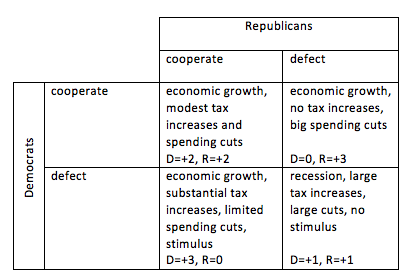
If we presume that the parties hold the ideological commitments that they claim they do, then the situation on Dec. 31 was either a Prisoner’s Dilemma or a Chicken Game. To simplify, let’s assume there were just two players, the Democrats and the Republicans, and they faced one choice. To “defect” was to refuse a deal and head over the cliff. To “cooperate” was to agree to split the difference midway between the parties’ preferences. If the game was a Prisoner’s Dilemma, it looked like this:

The dominant outcome (the one that would result when both parties maximized their own goals) was the bottom-right: recession. My preference was the bottom-left, but Republicans weren’t going to allow that in a one-round game. The top-left is better than the bottom-right, but the parties could not get there without each doing something that violated its own principles. That’s why it was hard.

One interpretation of the outcome is that the president simply caved, cooperating when the Republicans defected, and the result was the top-right corner. But even tough liberal critics don’t really think that. They think that Obama got something, just not as much as he could have won if he had opted for the bottom-right now and bargained again in January. For instance, Paul Krugman: “what Obama appears to have done is trade away part of the revenue from high-income taxpayers in return for some of the spending items he wanted.” From a conservative perspective, the bill certainly felt like a win for the president: taxes went up and no cuts were made. Charles Krauthammer called the deal a “complete rout for Democrats” and “complete surrender” for the GOP. In the Senate, only one liberal (Tom Harkin) voted against the agreement. I think the outcome counts as a compromise (i.e., cooperation by both sides, in game-theoretical terms). The only question is whether the president misplayed because the game is not final. It will continue, and perhaps he would have won more in 2013 if he had defected in 2012.

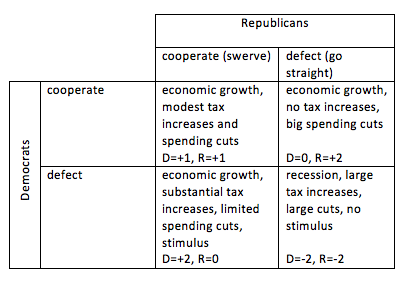
Prisoner’s Dilemmas are called “dilemmas” because it is very hard to get out of the bottom-right corner. Perhaps Biden and Reid McConnell got us out of there, helped by the fact that the game would recur–opponents are more likely to cooperate when they know they have to play again. Another theory is that it wasn’t actually a Prisoner’s Dilemma. If you change the rank-ordering of the cells, you can turn a Prisoner’s Dilemma into a Chicken Game, which looks like this:

Unlike a Prisoner’s Dilemma, a Chicken Game has two stable outcomes: top-left and bottom-right. Either player may believe that the other will swerve and therefore drive straight ahead. If they both do that, they will crash. On the other hand, both may blink. Then they will reach the top-left cell, which is where I think we find ourselves.

If this was a Chicken Game, then liberal critics have a point. The best way to win a Chicken Game is to commit in such a way that you cannot take it back; then the other side must swerve. If you throw your steering wheel out the window, the other driver has to get out of the way. Thus Obama should have pre-committed to veto anything that didn’t meet his original position. On the other hand, both players in a Chicken game can pre-commit more or less simultaneously, and that is when they ram into each other. The Republicans had acted on several occasions as if they were throwing their steering wheels out of the window. That makes the president’s swerve somewhat understandable.

Only one thing really puzzles me. It would have served the Republicans’ interests to have gone over the cliff, let that reality sink in, and then voted for tax cuts. In that scenario, they would have accepted the same outcome that we got to yesterday but after a somewhat longer delay. The game would have looked like a two-step affair. In the first step, Republicans could have gone home to their right-wing districts saying that they had defied the president’s call for tax increases and the recession was his fault. In the second round, they would have cooperated with Obama on tax cuts to save the economy, looking good back home. Instead, they allowed the two stages essentially to merge into one, and as a result it appears they supported a tax increase. That seems to me a bad play.

the spatial logic of cities

Michael E. Smith writes, “The spatial division of cities into districts or neighborhoods is one of the few universals of urban life from the earliest cities to the present. Neighborhoods are even found in some large village settlements, and they seem to appear quickly in ‘spontaneous’ informal settlements (shantytowns).”

I found this article via a note in Robert Sampson’s Great American City: Chicago and the Enduring Neighborhood Effect. Sampson shows that neighborhoods have durable characters and reputations that deeply influence the prospects of their residents. A neighborhood’s character may remain even if its entire population changes–for instance, African Americans replacing Italian Americans. Although people make choices about where to live, our choices are much more influenced than we believe by the logic of the city. Given vouchers to move to higher-income neighborhoods, for example, residents overwhelmingly move to particular neighborhoods linked to their current locations.

Sampson’s study focuses on a brutally unequal and racially segregated city, but the same patterns have been found in Stockholm. The most dangerous neighborhood of Stockholm are safer than Chicago’s safest neighborhoods, but in both cities, neighborhoods differ and are related in the same ways.

Peter Ackroyd’s London: The Biography is far less systematic and persuasive than Sampson’s book, but Ackroyd also cites intriguing evidence that particular spots in London have retained the same character since Roman times. A given street corner near Holborn may be mildly scruffy and transitional now, and archaeological evidence suggests it had the same function 2,000 years ago. I think a pattern was established by the high Middle Ages that the dominant areas were north of the Thames, the commercial center lay to the east, the government center to the west, and the socioeconomic gradient generally rose as one moved westward through London. That logic has withstood everything from a Great Fire to the Blitz and the Docklands restoration.

Clearly, there is no one pattern to the spatial organization of cities. In many American towns, the poor districts are central, and the suburbs are affluent. The reverse is basically true in Paris. But there may still be some general principles. The affluent want to live apart from the manufacturing center. It needs to lie near transportation hubs. The political/military core occupies the most strategically valuable land, whether a hilltop, an access point, or simply the center of town. The rich want to live within easy access of the political core.

The implication is that we must consider the spatial organization of cities as well as the bundle of goods, rights, and services that individuals receive, if we want to help improve lives.

libertarians, violence, and unions

Whenever unions are in the news–as recently, in Michigan–the concept of “union violence” draws enormous attention. Google News finds 137,000 recent mentions of that phrase, mostly under headlines like “When Thuggery is OK,” and “Union Violence in the Age of Obama.”

I am not going to be able to shed any light on the empirical questions: how much violence is committed by unions–or against them? Nor do I want to address the question of motivations: Why do conservative and libertarian commentators give so much attention to allegations of union violence? But I think a philosophical argument is being made against unions as intrinsically coercive organizations. If that argument is mistaken–as I believe it is–we should be able to rebut it, and doing so is valuable.

(The following discussion draws on an article of mine entitled “The Libertarian Critique of Labor Unions,” Philosophy & Public Policy Quarterly, vol. 21, no. 4 [Fall 2001]. I cannot find it online, so this is a PDF of the preprint.)

In 1959, the great libertarian Friedrich Hayek asserted that unions “are the one institution where government has signally failed in its first task, that of preventing coercion of men by other men–and by coercion I do not mean primarily the coercion of employers but the coercion of workers by their fellow workers.” This is the argument that circulates among libertarians, although it is by no means a consensus libertarian position.

To spell it out more fully, we might say: Except when a few firms monopolize the available jobs (a situation called “monopsony”), individuals are free to contract with employers on terms they mutually accept. This is what the Republicans of Abe Lincoln’s day called “free labor.” If a group of workers decide to contract jointly, that is their right. But if any workers or prospective workers do not want to join this group (which we’ll call a union), they must be free to remain independent–otherwise, they will suffer from majority tyranny. If the union chooses to strike, it may not block any dissenters from working.

To be sure, majority tyranny is also a serious drawback of democratic states, which have armies, police, and jails behind them. But that is not a fair debating point against libertarians, who spend most of their time worrying about coercive states. If, following Hayek, they also criticize unions, they are being consistent. Even if a union is very popular, their concern is for the individual who does not endorse its positions.

This is the argument that deserves rebuttal, and it is a philosophical rather than an empirical position. In other words, we cannot rebut it by asserting that coercion by unions is rare, or that violence against unions is more common. I think those claims are true, but the libertarian is–appropriately–concerned about principles. By analogy, we have found that the number of eligible citizens who were blocked from voting by photo ID laws was almost undetectably small in 2012. But that doesn’t make it OK to block any eligible citizens from voting.

How should one rebut the libertarian argument? I would suggest several paths:

1. Libertarians should tolerate the legal forms of pressure used by unions. It is illegal for a union forcibly to block individuals from working or to threaten force or physical violence. The state must (and does) enforce laws against such violence. What a union can do is to establish a picket line and yell at individuals who cross it. Some people might call such verbal abuse “violence.” But libertarians should be the last to do so. Whether in the context of campus speech codes, protests at abortion clinics, the pornography industry, or a strike, libertarians should insist on a strict distinction between physical violence, threats, and coercion (on one hand), and verbal expressions (on the other). A picket line is an expression of both free speech and assembly, and to label such speech “violence” is to threaten the civil liberties of the union members.

2. Unions enhance rather than restrict individual rights. Within a union, members have legally enforceable rights to express their views, to advocate, to form caucuses and associations, and to vote. These are individual rights that are meaningless without the union. They are closer to what Benjamin Constant called the liberty of the ancients rather than the liberty of the moderns. They are rights to “deliberate, in a public space …, to vote laws, pronounce decisions, examine the accounts, actions, and management of officials, to compel them to appear before the whole people, to accuse them, to condemn or acquit them.”

3. Unions promote political pluralism and countervailing force. We can debate whether a libertarian utopia is feasible and desirable, but we don’t live in one. We live under a powerful and pervasive state that not only influences corporations and markets, but is constantly used by them. So the employer with whom an individual laborer contracts is not a free individual; it is a corporation that has likely been regulated, subsidized, and protected by the state. One could imagine stripping the state of most of its powers, but that is not happening. As long as the state remains influential, liberty is best served by pluralism: by setting many different interests in peaceful conflict. Killing unions, the main countervailing force to industry, will reduce pluralism–and thus liberty.

Of course, states and companies are not the only powers that threaten liberty. Still arguing within the classical liberal tradition, Mill and Tocqueville emphasized that public opinion, conformity, and cultural assumptions are powerful and problematic influences. Unions counter the prevailing ethos of our post-industrial corporate culture. In my article, I quote labor lawyer Thomas Geoghegan on union meetings: “paunchy, middle-aged men, slugging down cans of beer, come to hold hands, touch each other, and sing ‘Solidarity Forever.’ O.K., that hardly ever happens, but most people in this business, somewhere, at some point, see it once, and it is the damnedest un-American thing you will ever see.” I don’t expect libertarians to like the “un-American” ethos of unions, and Tom Geoghegan was joking about that. What libertarians should like is the mind-opening alternative that unions create.

Individual liberties are important, but they are not the only principles we should honor. I want the right to contract my own labor. But it is not the only good, for me or for anyone else. Dignity, social bonds and solidarities, and welfare and security are also fundamental human needs. Unions–when properly accountable to their own members and policed by the state–enhance those goods even if they constrain individual rights to contract. (This last point, of course, is not compatible with libertarianism or classical liberalism but marks a point of disagreement about fundamental principles.)

political reform on a base of civic renewal

I have not seen any news reports yet, but today the Sierra Club, Greenpeace, the Communications Workers of America, and the NAACP had planned to announce a common agenda on democratic reform.

This is a welcome development, because they contribute grassroots constituencies, but they are likely to focus exclusively on formal political reforms, such as the filibuster, campaign finance, and the voting process. I could not agree more that these reforms are needed–I began my career working full-time for Common Cause and have written a whole book about campaign reform and related measures. But I think civic renewal is essential to political reform, and the two must be pursued together. That is true because …

  1. A broad base of active citizens is no longer available to demand beneficial political reform. When John Gardner announced Common Cause in 1970, 100,000 people immediately joined and began funding the new organization. They had habits of reading newspapers, joining and leading associations, and trusting the government enough to try to reform it. That base is now much smaller and more fragmented.
  2. Many of the proposed reforms would require active, skillful, committed, and organized citizens. For instance, disclosing campaign finance data will do no good unless independent citizens are ready to use it for constructive purposes.
  3. Even reformed governments cannot solve our most serious problems alone. Solutions require active and organized citizens. For example, in his magisterial new book, Robert Sampson finds that neighborhoods with more civic engagement have dramatically better educational outcomes, even though they are part of the same school system. Sampson, Great American City: Chicago and the Enduring Neighborhood Effect (Chicago: University of Chicago Press, 2012)
  4. As James Madison argued, the people are capable of selecting representatives who will deliberate about the common good—but only if the people themselves have some experience deliberating and governing. Otherwise, they will not know what good government looks like. Madison cited “good roads, domestic commerce, a free press, and particularly a circulation of newspapers through the entire body of the people” as means of enlightening the public. To those means, we should explicitly add experiences in governing voluntary associations and local communities.

The traditional structure of American civil society has eroded badly, as marked by serious declines in the proportion of people who attend meetings, work with neighbors on common problems, belong to voluntary associations, participate in the governance of religious congregations, follow the news, trust other people, and trust institutions.

But a new civil society is being invented. It is composed of groups that organize local deliberations; community development corporations and land trusts that govern public assets; broad-based community organizing groups; the national and community service programs (insofar as they allow their volunteers to influence their agendas); innovative civic education programs, from kindergarten through graduate school; universities that serve as community anchors; citizen-generated news sources; municipal governments that employ collaborative governance or participatory budgeting; watershed councils, restorative justice, and many other streams of civic practice.

This work needs to be in closer dialogue with advocacy for political reform. That is a goal of the Campaign for Stronger Democracy, a particularly important node in the overall network for democratic reform. The Sierra Club, Greenpeace, CWA, and NAACP are bolstering one wing of the reform movement. It is important, however, to retain the overall balance.