Category Archives: Uncategorized

my father’s books are going to James Madison’s desk at Montpelier

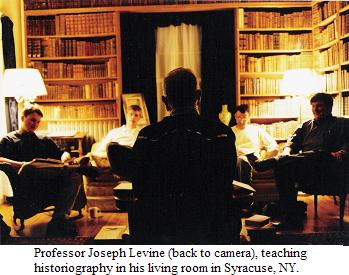
(Syracuse, NY) My father, Joseph M. Levine, collected more than 20,000 books as a working library of a professional historian. Many were published before 1800. I am a sort of trustee for this collection, happily responsible for its long-term future.
James Madison, the fourth president of the United States, collected a library of books that informed his thoughts about the Constitution. In his case, the next generation meant his ne’er-do-well son-in-law, John Payne Todd, whose gambling debts cost the family all their property, including the books.

Now the Madison home at Montpelier has been restored to look as it did in James Madison’s day. But Montpelier needs appropriate books to display beside the president’s desk. By mutual arrangement, ten feet of my father’s collection are going there on permanent loan. I am in Syracuse to pick out books that might have belonged in Madison’s personal collection ca. 1820.

This, for example, is the same edition of Montaigne on which James Madison took notes when he was a student. Those notes were the very first substantive writings Madison produced in his life.

CAM00067My father was a Jewish boy from Brooklyn, New York; a Dodgers fan; an FDR liberal. James Madison was a slave-holding Tidewater planter. My Dad studied English intellectual history and was something of an Anglophile. James Madison led the US in a war against Great Britain, yet he was very far from an immigrant New Yorker. How do all these pieces fit together?

The answer is a certain version of liberalism. Dad grew up in a liberal family and neighborhood, but an additional formative experience was studying at Cornell during the McCarthy period. Cornell was stocked with great thinkers, including refugees from totalitarianism and veterans of struggles at home. During Dad’s undergraduate years, Vladimir Nabokov, Frances Perkins, Edwin Arthur Burtt, Buckminster Fuller, Clinton Rossiter, and Richard Neustadt all served on the faculty. They pursued rich cultural ideas, developed the inner life, and fought for social reform. Cornell broadened and liberated minds. The Constitution and the fundamental principles of the American Republic stood with the university and against its enemies.

Dad became an historian to join this community of free inquiry, and also to understand the origins of the modern liberal world. He began his graduate studies interested in the founding period of the US Republic, but he soon moved backwards to explore its origins in Tudor and Stuart England. That period became his lifelong interest and caused him to spend many years in England and to ship literally tons of books and other artifacts back from there.

English history is morally complex, as is the legacy of James Madison. England was a monarchy and a colonial power. But England was also the birthplace of individual rights, representative government, and rule-of-law–at least as those institutions have come to the US. It not only gave us our liberal traditions but also our more radical currents. From the Agitators and Levellers of 1647 to the Commonwealthmen and Whigs of 1750 to the Chartists of 1838, English thinkers developed the idea that political liberty and equality should come first, with cultural equality and economic reform to follow. As the MP Thomas Rainsborough argued in the mid-1600s:

For really I think that the poorest hee that is in England hath a life to live, as the greatest hee; and therefore truly, Sr, I think itt clear, that every Man that is to live under a Government ought first by his own Consent to put himself under that Government; and I do think that the poorest man in England is not at all bound in a strict sense to that Government that he hath not had a voice to put Himself under.

Madison would certainly have qualified that populism in many ways. The poorest in Virginia were slaves, and Madison wanted to send them back to Africa rather than admit them as equals to the commonwealth. Federalist 10 presents Madison’s objections to “a pure democracy, by which I mean a society consisting of a small number of citizens, who assemble and administer the government in person.” He feared that “a common passion or interest will, in almost every case, be felt by a majority of the whole ….” But Madison constructed a political order that–when we honor its design–preserves individual liberties, defends minorities, promotes the “mild voice of reason,” and creates an important place for the “republican principle” of political equality.

It seems perfectly fitting that my father’s books should sit by the desk of the man who introduced the Bill of Rights and served as the second Rector of the University of Virginia.

[PS: I shouldn’t have written “desk,” as I believe the books are destined for a small room outside Madison’s study that he used as a library.]

citizens, stakeholders, publics, interest groups?

Last semester, as part of Tufts’ Water Diplomacy program, we discussed with MIT professor Larry Susskind a paper in which he advocated for “involving stakeholders before [important] decisions are made.”* In the ensuing discussion, I wrote down the following nouns that were used to describe the individuals who might participate in making these decisions, along with experts and policymakers: “the population,” “the public,” “publics,” “stakeholders,” “groups,” “interests,” “citizens,” “representatives,” “negotiators,” “people” and “everybody” (as in, “You have to get everybody at the table.”) These words may have overlapping referents, but they are not synonyms. They imply different strategies and different core values. To pick up a few:

Stakeholders may include organizations and agencies as well as individuals. They are defined by having an identifiable “stake” in the matter. It is possible to define stakes very broadly so that, for instance, we all have a stake in the sustainability of the globe. (Then everyone is a stakeholder.) But defining people in terms of their “stakes” attaches each person to some particular priority. You are a farmer, an environmentalist, or a government official. That encourages negotiation but not deliberation–if deliberation implies an openness to changing one’s values and priorities.

Citizens must be individual people, although in practice, actual participants in deliberations and negotiations are often representatives of organized citizen groups. The word “citizen” has varied resonances. It can mean a legal member of some defined political community (distinguishing them from aliens). It can mean a person who is not an official, for sometimes we hear about “citizens meeting policymakers,” as if the latter were not also citizens. It can mean individuals who are accountable only to themselves or to their consciences. In that case, it encourages high-minded deliberation rather than negotiation.

The public can mean the great mass of people minus representatives of a relevant in-group, such as the government, the university, or the legal profession. That usage makes the public a relative concept: I am in the public with relation to the US government but outside the public when Tufts University engages its local communities. Sometimes people use a plural form of the word to talk about “issue publics” or “mobilized publics.” Then I think the word means large communities that promote discussion.

Interest groups are usually defined as sectors of the population that can be well represented by formal organizations with mission statements and explicit objectives. Their objectives need not be self-interested; for instance, environmentalists and human rights activists can represent interest groups. The key point is that they can be counted on to pursue a particular objective, and therefore, as long as an organization successfully promotes that objective, it represents them. Interest groups may be organized democratically so that their members have a say in the organizations’ strategies, but that seems optional and it has pros and cons. (It favors voice over exit as a way of determining strategy.)

A community (in this context) seems to be a group of people who may be highly diverse in terms of identities, goals, and interests, but they interact with one another either directly or through intermediaries. So Somerville, MA, is a community to the extent that its very diverse residents interact on matters of common concern. It may also be a community in an aspirational sense: since its residents live in the same city, they should interact.

An interest group is different from a community because membership in an interest group requires support for the interest. A good member of a community seems to owe the other members some concern and loyalty but is not obliged to agree with them. You can belong to a community and seek to change its prevailing goals and values. In contrast, if you disagree with the core goals of an interest group, you do not belong to it at all.

*Susskind, “Water and democracy: new roles for civil society in water governance,” International Journal of Water Resources Development, 2013
Vol. 29, No. 4, 666–677

what is privilege?

What do we mean when we say “privilege,” in a political or social context?

Here are some valid everyday uses of the word: “It is a real privilege to be here tonight.” “Playing football is a privilege, not a right.” “I feel privileged and grateful to be enrolled at this college.”

A privilege seems to be some kind of benefit or desirable standing that not everyone has. Some privileges are perfectly appropriate. They create meaningful and worthy categories, such as membership in a given organization or the right to practice a particular profession. According to Elinor Ostrom’s hugely valuable research on how people manage common pool resources (such as fisheries and forests), one of the general principles is the need for clear boundaries between insiders and outsiders. The insiders have the privilege to, for example, fish in a common pond. If everyone has that right, all the fish will be taken.

The problem is unjust privilege. Teaching Tolerance says, for example:

white skin privilege is a transparent preference for whiteness that saturates our society. White skin privilege serves several functions. First, it provides white people with “perks” that we do not earn and that people of color do not enjoy. Second, it creates real advantages for us. White people are immune to a lot of challenges. Finally, white privilege shapes the world in which we live — the way that we navigate and interact with one another and with the world.

Several empirical claims are implicit here: (1) certain advantages accompany whiteness in the US; (2) these advantages persist even when no one deliberately endorses them; and (3) whites tend not to acknowledge their privileges.

Built into those claims are moral premises: (1) It is OK to make distinctions, but not on the basis of race; (2) earned advantages are justifiable but unearned ones are not; (3) it is better to be conscious of privilege.

I happen to share these six propositions–on the whole–but they are controversial. From the left, Bill Mullen writes in Socialist Worker that the concept of white skin privilege divides working-class coalitions, makes racial identity look fixed and inevitable, conceals the underlying cause of racism, and blocks the only path that he believes in, which is economic revolution. A left critic might also reject the assumption that earned privileges are acceptable because they come from talent or hard work. Although there’s a big debate about what this statement implies, John Rawls insists that “no one deserves his place in the distribution of natural endowments” (Theory of Justice, 17).

From the opposite end of the spectrum, David Horowitz asserts that white skin privilege is a radical leftist myth, and “black skin privilege” is the real problem today because official policies that acknowledge race favor people of color.

Meanwhile, people who endorse the use of the phrase tend to talk about other forms of privilege as well. Race is said to “intersect” with gender, sexual orientation, citizenship status, and social class to create webs of privilege.

We will not soon conclude these debates; but some conceptual clarity may help. I think “privilege” is being used to mean unjust advantage, and that raises the question of what constitutes justice. Distributive justice is a whole topic unto itself. Allowing skin color to predict social outcomes is unjust, but preventing that does not fully satisfy justice. Getting what you earn (and only that) would be one definition of justice–not mine. Getting all that you need to meet your potential would be another definition–but I don’t think it’s possible, since human potential is unlimited. Having an equal share of the society’s rights and goods would also not be my definition, for a variety of reasons, including the fact that I don’t mind if other people have much more than I do (for I have plenty). Assuring everyone a reasonable minimum sounds good, but that it is compatible with profound and invidious inequality above the line.

Despite the difficulty, I’d argue that one must first develop a theory of justice before one can identify “privilege” in the negative sense of that word.

what happens if EU members overturn their democracies?

I’ve had several moving conversations recently with democratic reformers from southeastern Europe. They are near despair about their respective countries. Instead of quoting their confidential assessments, I’ll cite this summary by Tamas Dezso Czigler of LSE:

I have previously written a great deal about Hungary; the latest development is that the government has changed the election rules once more, and introduced the anti-democratic pre-registration of voters, which further heavily distorts the election system. The government also continues to fire judges, even though the act which made this available was annulled by the Constitutional Court. In Romania, the problems are similar and obvious – the government simply does not respect democratic institutions like the Constitutional Court or the President.

Both Hungary and Slovakia have seen the possibly racially motivated murders of Roma in recent years (including children). In addition, Slovakia has introduced a heavily anti-democratic language act, which bans Hungarians from speaking Hungarian in government offices, even if the client and the officer both belong to the Hungarian minority. … There are also fears as to whether Croatia will be able to stay stable, since it has had an even darker history compared to the others. And we hear news about extreme corruption in Bulgaria every day.

Czigler does not happen to mention the strongly anti-Semitic rhetoric in Hungary and Romania. That isn’t the primary issue; I think Jewish residents will be safe against outright violence, and they are few. He is right to highlight the murders of Roma. However, given the historical role of anti-Semitism in this region, it is distressing that explicitly anti-Semitic parties can capture large shares of the vote. This is a sign of deeply anti-democratic and illiberal tendencies.

I would be the first to recognize that US states have also passed “anti-democratic pre-registration” provisions and laws targeting language minorities. But the question is not whose democracy is better. The question is what to do about anti-democratic threats in Europe, given the fragility of the continental system and the importance (to the whole world) of making it work.

Thus I wonder:

A nation must be a democracy to get into the EU. Once it’s in, what happens if it backtracks so that it would no longer meet the specific political criteria for membership? And what happens if a member drops all pretense of democracy and goes the way of Belarus?

EU members face judicial review at the European level. But the governments in Romania and Hungary are contemptuous of their own nations’ courts. What happens if EU members simply ignore the European Court of Human Rights?

I am told that some Hungarian Jewish families have fled to Austria. If true, it implies that there are already refugees of one EU nation in another one. How would the EU handle larger flows of political refugees?

The anti-democratic parties are mostly far-right and nationalistic. That may make coordination somewhat difficult, because a Greek nationalist doesn’t intrinsically care about Hungarian nationalism, for instance. In the 1930s, the attempt to build a Fascist International “was marred by serious conflicts between the participants.” Yet the far right of the various EU member states have common enemies and can do a lot of mischief together. Will they unite?

At least in Romania and Bulgaria, an underlying cause appears to be corruption, meaning the political power of economic oligarchs. Can European economic policy constrain them?

Will the EU ultimately make its weakest members more democratic and liberal, or will those states make the EU as a whole more authoritarian and illiberal?

How do members with deep civic traditions but poor current systems of government (Italy, Belgium) fit into the picture?

when east and west were one

(Washington, DC) I am highly skeptical of distinctions between “eastern” and “western” thought, considering the enormous diversity within both domains, the thousands of years of interaction between the two, and the arbitrariness of any border. (Why, for example, should a body of water less than 2,000 feet across be considered to divide two continents, Europe from Asia?)

But if you are committed to the distinction, it’s worth taking a look at the Milinda Pandha.  This is a dialogue written originally in Sanskrit or Pali before the year 200 CE. It describes a dialogue between a Greek king of India named Milinda (who is probably Menander I) and a Buddhist sage named Nagasena.

Menander I is well attested in Greek and Indian texts and archaeological evidence as a Greek king who converted to, and patronized, Buddhism. Here he is on a silver coin that reads “King Menander the Just” in Greek on one side and “Great King Menander, follower of the Dharma” in the Kharosthi script of South Asia on the other.

Nagasena is not known outside of this dialogue, wherein he is described as the son of a Brahmin who, having quickly exhausted the Vedic scriptures, studied Buddhism under a Greek monk named Dhammarakkhita (“Protected by the Dharma”).

Compared to a Platonic dialogue, the Milinda Pandha includes more fantastical details. The gods, for example, are directly involved. But it paints appealing portraits of the human characters. Menander goes around stumping sages with metaphysical paradoxes until he meets Nagasena, who bests him on a couple of those exchanges. Then the King simply asks questions about Buddhist doctrine and Nagasena answers with illustrative similes. The King replies after each one, “Very good, Nagasena!”

I can read the text only through the 19th century English translation of T. W. Rhys Davids. As far as I can tell, the perspective of the original document is orthodox Theravada Buddhism. Thus I am glimpsing Menander I through layers of interpretation, Asian and English; and it is hard to imagine how this European-born king of ancient India might actually have thought. But he and Nagasena seem to share the same social and cultural horizon, and the differences between them stem only from their respective roles as monarch and sage:

The king said: ‘Reverend Sir, will you discuss with me again?’

‘If your Majesty will discuss as a scholar (pandit), well; but if you will discuss as a king, no.’

‘How is it then that scholars discuss?’

‘When scholars talk a matter over one with another then is there a winding up, an unravelling; one or other is convicted of error, and he then acknowledges his mistake; distinctions are drawn, and contra-distinctions; and yet thereby they are not angered. Thus do scholars, O king, discuss.’

‘And how do kings discuss?’

‘When a king, your Majesty, discusses a matter, and he advances a point, if any one differ from him on that point, he is apt to fine him, saying: “Inflict such and such a punishment upon that fellow!” Thus, your Majesty, do kings discuss.

‘Very well. It is as a scholar, not as a king, that I will discuss. Let your reverence talk unrestrainedly, as you would with a brother, or a novice, or a lay disciple, or even with a servant. Be not afraid!’