Category Archives: Uncategorized

a concise and general argument for civic education reform

(Logan Airport) This article is newly out and publicly available:

Peter Levine, “Teaching the Deeper Aspects of Civic Education,” The Standard (National Association of State Boards of Education), March 24, 2014, pp. 37-39.

It is my best effort at a 3-page argument for policymakers and advocates, describing what we should want young people to learn, what obstacles stand in the way of satisfactory outcomes, and what policy changes would help.

Detroit and the temptation of ruin

In Detroit, they call it “Ruin Porn”: images of a 35-acre abandoned automotive plant, the 18-story abandoned railway station (modeled, in turn, on ancient Roman baths), and other vast and decayed structures.

I can certainly understand why citizens of Detroit would object to the aestheticization of poverty and abandonment–to their city’s being used to produce marketable images of tragic grandeur. But the story of Detroit is tragic, in the Aristotelian sense. Recall the plot: the city rises from a few thousand residents to 1.8 million when hubristic men like Henry Ford invent forms of mass production that transform work itself. Black people migrate there from the South, face violent hostility, but manage to obtain political and cultural power. The city builds cars, weapons, and pop music that conquer the world. It becomes a model of modernity, vividly depicted by Diego Rivera on the walls of its world-class museum. And then Detroit collapses to 700,000 people who live amid the empty shells of its industrial past, while the nation looks away.

There is nothing new about treating a tragic fall as sublime. “Round the decay / Of that colossal wreck, boundless and bare / The lone and level sands stretch far away.” Or: “It was at Rome, on the 15th of October, 1764, as I sat musing amidst the ruins of the Capitol, while the barefoot friars were singing vespers in the Temple of Jupiter, that the idea of writing the decline and fall of the city first started to my mind.”

In fact, because the Detroit Institute of Arts is an encyclopedic collection, one can find on its walls many images of ruin. For example, Jacob Isaaksz van Ruisdael paints the Jewish cemetery of 17th-century Amsterdam falling to pieces in a wild storm, as a momento mori. I don’t know why he picks Jewish graves, but perhaps because their dead are dead for good (in his view), not subject to resurrection.

van Ruisdeal, “The Jewish Cemetery” (ca. 1654)

The American Frederic Church imagines the coast of Syria as a kind of museum or theme park of ruins: Roman, Gothic, and Islamic piled almost on top of each other.

Frederic Edwin Church. “Syria by the Sea” (1873)

Anselm Kiefer paints a vast three dimensional canvass, parts of it literally burnt by the artist. He means to represent a particular brick factory in India (one that manufactures its own walls and sells the same walls, brick-by-brick, to consumers) and also the ovens of Auschwitz–which was another kind of Jewish cemetery.
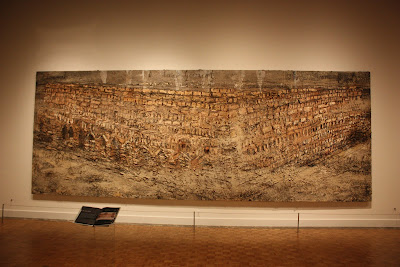
Anselm Kiefer, “Das Gewiert” (1997)

The DIA even includes a whole Gothic side chapel moved to Detroit from a chateau in Lorraine–reconstructed there from a real Old World ruin. When you stand inside it, with its streaked and burnished stone and stained glass all around you, you are in a late-medieval building, inside a much larger structure patterned on the ruins of ancient Rome, near the center of a modern American city that is partly falling into ruin.

The DIA itself is hardly ruinous. On a Friday night, it is packed with visitors of all ages and backgrounds who stroll through its magnificent galleries, listen to live jazz, or play chess. But the collection, whose market value might reach $1 billion, will likely be sold to make a small dent in the bankrupt city’s pension obligations. In the best case, the purchasers will be a consortium of foundations whose wealth derived from Detroit and which have pledged to give the art back once they buy it. It’s a strange twist that some of the objects they may buy and return to the city from which their endowments came will be “ruin porn” of other times and places.

the big lessons of Obamacare

For what it’s worth, I support Obamacare as a health reform strategy. To the best of my limited understanding, it makes sense as an approach to broadening insurance coverage and controlling costs. Whether or not I am right, the law will have a long-term impact on public views of government and politics. For instance, as I recently told NPR’s Tamara Keith and the Washington Post’s Dana Milbank, young people will draw powerful and lasting lessons from their perception of this initiative. In turn, that may affect their political orientation for the next 50 years.

I can see public opinion of Obamacare crystallizing in three different ways:

1. It is a fiasco that proves the government can’t be trusted. Just when we were learning that the feds can collect private information from anyone in the world (even the Chancellor of the Federal Republic of Germany, our ally), we watched the Obamacare website fail to capture data that people wanted to give it. That crisis has passed, but the whole reform could be seen–rightly or wrongly–as an emblematic failure of government.

People would ask whether more government is better, and their answer would be: No.

2. It is a demonstration of Clinton/Obama-era technocratic liberalism. The government pulls together some experts, mostly employed in universities and industries, and develops a clever set of tweaks to the existing insurance market. By offering individuals new choices in carefully designed market exchanges (while sparingly employing money and regulations), the government nudges employees and employers to act better. The key relationships are all private and transactional: I go onto a website, make choices for myself and my family, and get economic benefits for us. If that approach is seen to work, it strengthens the case for a certain kind of technocracy in which behavioral economics is the reigning discipline.

People would ask whether smarter government is better, and their answer would be: Yes.

3. It is an illustration that we the people can address problems together, using a combination of laws and the state, business and markets, and voluntary collective action. To be sure, that is not the way that Obamacare is being presented, either by its supporters or by its detractors. To its enemies, it is state-centered socialism. To its most prominent friends, it is the government helping individuals. And indeed, it was designed in a basically individualistic way. But the act has provisions that strengthen community health clinics that are governed by public boards. Lawrence Jacobs argues that the $11 billion in new funds for them is a huge investment. This investment could boost civil society and develop new leaders. Meanwhile, Health Access California has been outstandingly successful at signing people up for Obamacare by combining community organizing, education, research, and advocacy. A significant reason for the success of Obamacare, if it succeeds at all, will be this huge collaborative effort in California’s nonprofit sector.

If these aspects of the law were (a) publicized and (b) strengthened in the years to come, people might ask a different question: Can we address social problems together? And the answer would be: Yes.

my upcoming talks

Detroit, March 21: lunchtime plenary at the Center for the Study of Citizenship’s 2014 Conference, Wayne State University

Florida, March 28, lunchtime plenary at the “Democracy in America: Participation and Social Justice” conference at Stetson University, 

Chicago, April 5th 2014, panel on “best practices in civic engagement across two- and four- year colleges,” Midwest Political Science Association Annual Meeting

Charlottesville, VA, April 9: The Promise of Civic Renewal in America, the Rotunda, University of Virginia.

Champaign, IL, April 17: keynote speech at the city’s STAR (Service Together Achieves results) Expo/Awards Program.

Nashville, May 3: the Southeastern Chapter of the American Board of Trial Advocates (ABOTA)

Mexico City, May 28-30 (private seminar for professors)

Dallas, June 9, League of Women Voters National Conference

a free idea for a novel

Someone should fictionalize this:

As Warden, and afterwards Master, of the Royal Mint, [Sir Isaac] Newton estimated that 20 percent of the coins taken in during The Great Recoinage of 1696 were counterfeit. Counterfeiting was high treason, punishable by the felon’s being hanged, drawn and quartered. Despite this, convicting the most flagrant criminals could be extremely difficult. However, Newton proved to be equal to the task. Disguised as a habitué of bars and taverns, he gathered much of that evidence himself. … Newton had himself made a justice of the peace in all the home counties—there is a draft of a letter regarding this matter stuck into Newton’s personal first edition of his Philosophiæ Naturalis Principia Mathematica which he must have been amending at the time. Then he conducted more than 100 cross-examinations of witnesses, informers, and suspects between June 1698 and Christmas 1699. Newton successfully prosecuted 28 coiners..

One of Newton’s cases as the King’s attorney was against William Chaloner.  Chaloner’s schemes included setting up phony conspiracies of Catholics and then turning in the hapless conspirators whom he had entrapped. Chaloner made himself rich enough to posture as a gentleman. Petitioning Parliament, Chaloner accused the Mint of providing tools to counterfeiters (a charge also made by others). He proposed that he be allowed to inspect the Mint’s processes in order to improve them. He petitioned Parliament to adopt his plans for a coinage that could not be counterfeited, while at the same time striking false coins. Newton put Chaloner on trial for counterfeiting and had him sent to Newgate Prison in September 1697. But Chaloner had friends in high places, who helped him secure an acquittal and his release. Newton put him on trial a second time with conclusive evidence. Chaloner was convicted of high treason and hanged, drawn and quartered on 23 March 1699 at Tyburn gallows.