Category Archives: Uncategorized

thoughts on the College Scorecard

collegecost

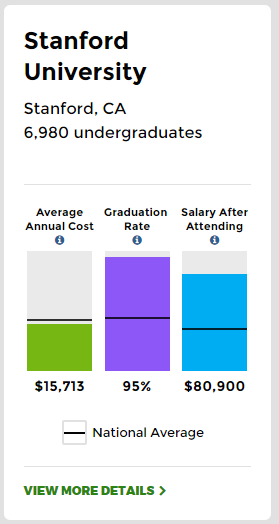
The College Scorecard began as a promise/threat to rate US colleges and universities, but for now, it offers some digestible nuggets of information on more than 3,500 institutions. The results for Stanford are shown to the right, as an example.

I like some things about this. Mainly, it tells a prospective applicant’s family not to be put off by the sticker price. Tuition plus room & board at Stanford costs $64,477, but the average student pays much less than that, graduates quickly, and earns a lot of money. That makes it a good deal (in strictly economic terms) for most people who can get in. In contrast, Cambridge College costs an average of $23,792 and yields an average salary of $36,500 for those who graduate–who represent two percent of those who enroll.

I have three main concerns. First, the average cost overstates the relevant price for a lot of students. Stanford completely waives the parental tuition contribution for families with incomes up to $125,000 a year and waives the whole cost for most families earning below $65,000 (which is about 60% of US households). The average cost is $15k because a lot of Stanford undergrads come from families in the very top tier of the income distribution. If you have a median family income, Stanford will probably be free.

Second, this kind of presentation can mislead about the business model. It can suggest that the real price of a Stanford education is $64k, but thanks to alumni gifts, the university subsidizes attendance for needy students (who, in this case, may be upper-middle-class). I think the following is closer to the truth: there are a lot of highly academically proficient students whose families can easily pay $64k and want to go to Stanford. Their kitchen counters cost more than a year’s tuition. So Stanford charges that much and uses the income to help subsidize all the operations of a research institution. It uses a sliding scale, however, so that all of its students aren’t rich. I don’t necessarily think this is wrong: it depends on how much public good comes from the research. But the numbers give a somewhat misleading impression of the financial model.

Third, the measure of “salary after attending” is very problematic if we see education as a public good. The lowest-paid majors for recent college graduates are “early childhood education ($39,000); human services and community organization ($41,000); studio arts, social work, teacher education, and visual and performing arts ($42,000); theology and religious vocations, and elementary education ($43,000); drama and theater arts and family and community service ($45,000).” A college that produces a lot of preschool teachers, clergypeople, and community organizers is going to score a lot lower on the measure of “salary after attending” than Stanford does. The average salary for recent Hampshire College graduates is $30,800, much less than half as much as Stanford’s figure, but it would be misleading to infer that Stanford offers more value than Hampshire.
unions, communities, and economic mobility

A new paper by Richard Freeman, Eunice Han, David Madland, and Brendan Duke, Bargaining for the American Dream: What Unions do for Mobility is getting a lot of attention. A key finding is that a parent’s union membership boosts the economic prospects of the children as they grow up and form their own households. The effects are large and especially pronounced for working-class union families.

That result deserves headlines, but I will focus on another significant finding, because it relates to civic engagement. Freeman and colleagues find that labor union membership boosts the economic mobility of all children in the community. They control for a range of relevant factors that might explain away this positive effect (for instance, the makeup of local industry and the progressivity of the tax code.) They find that labor unions have positive effects for non-members.

That finding contributes to a larger literature about the positive economic outcomes of various kinds of civic associations:

  • Freeman and colleagues build on the influential research by Chetty, Hendren, Kline, and Saez (2014). Chetty and colleagues found that the odds of moving up the socio-economic ranks are very strongly linked to the community where you grow up, and the main features of the community that matter are: having less residential segregation, less income inequality, better primary schools (measured by income-adjusted test scores and dropout rates), more family stability, and higher social capital. Their main measure of social capital is an index of “voter turnout rates, the fraction of people who return their census forms, and various measures of participation in community organizations.”
  • In our own work, we also found strong economic benefits from what we called “social cohesion” at the community level. We defined that as the degree to which residents socialize, communicate, and collaborate with one another. Separately, we looked at the number of nonprofit organization in a community. Both social cohesion and nonprofit density were strong predictors of economic success for communities, even after we adjusted for many other factors like those considered by Chetty et al and Freeman et al. Just as an example of our findings, “An employed individual in 2008 was twice as likely to become unemployed if he or she lived in a community with few nonprofit organizations (the bottom five percent in nonprofit density) rather than one with in the top five percent for nonprofit density, even if the two communities were otherwise similar.”

A union could be considered an example of social capital. (It is an organization of members.) However, Freeman and colleagues controlled for social capital and still found a strong effect for unions. Their method distinguished union membership from civic participation, and the result was a distinct advantage for unions. That raises two questions: 1) Why would civic participation in general have anything to do with economic outcomes at the community level? And 2) Is the case of unions special? For both questions, I would like to focus on the benefits to non-members, because belonging to a union, a church, or an NAACP chapter can have direct and easily explained value for the individuals who join.

Social cohesion, social capital, and nonprofit density (which are overlapping but not identical constructs) could have economic benefits because: active and organized citizens obtain better governance and better laws; they gain skills and values from participation that they also use to help others in their communities; the associations they form reduce community-level problems, such as crime; these associations spread information and raise knowledge; or these associations build norms of trust and collaboration that enable people to contribute to the economy. There is literature to support each of these mechanisms, but no way to be sure whether they contribute to the patterns we see here.

Unions could fit into any of these stories. For instance, unions seek legislation and they may teach members how to collaborate and trust one another. Unions could also be seen as a special case because they have collective bargaining power. Also, people typically join a union because the workplace is unionized, not because they go out looking for a union to join. A knitting club seems very different: highly voluntary, trust-driven, but lacking in explicit economic power. So there could be an economic explanation applicable to unions alone, e.g., by bargaining for higher wages in their own industry, they send positive ripples through the local job market.

Still, I wouldn’t differentiate too starkly between unions and other associations. It is always a bit misleading to see membership as pure individual choice. People join knitting clubs and soccer leagues because someone else has organized these groups (which is hard and skillful work) and has recruited members. So organizing and outreach are always fundamental.

In short, I would posit that all associations–including but not limited to unions–use a set of similar means to improve economic welfare and mobility in their communities. Some of their means run through the state–they obtain better governance–and some of them result from voluntary action apart from the state. Unions do have some special features that allow them to grow to large scale when conditions are favorable and that give them bargaining power. Although their special features are important, unions are also part of a larger story about organized civic life in the US.

See also The Legitimacy of Labor Unions (2001), and my posts on Why the Garden Club Couldn’t Save Youngstown; civic engagement and jobs; and unemployment and civic engagement: the video.

the Latinos Civic Health Index

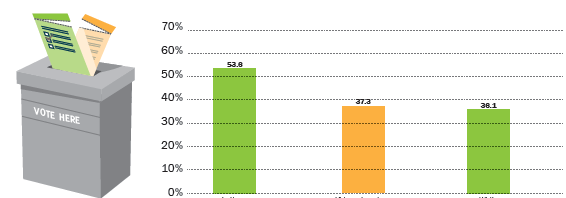
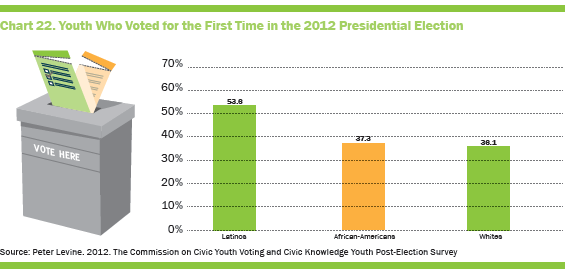
The National Conference on Citizenship (NCoC) released the Latinos Civic Health Index today. My colleague Kei Kawashima-Ginsberg is a co-author and the Tisch College of Citizenship and Public Service at Tufts collaborated with NCoC. Overall, the report points to challenges: Latinos are less engaged than non-Latinos in a wide range of civic and political activities. But there are signs everywhere that rates of engagement are rising. For instance, Latinos’ voter turnout is lower, but their turnout rates are improving. As a result, of all young Latinos who voted in 2012, an outright majority were voting for the first time. Meanwhile, their population share is growing. It seems apt, then, to describe the Latino population as a waking giant. The report provides much more detail, including information on non-political forms of engagement and data on differences among the major subgroups of Latinos.

latinos

when a university is committed to democracy

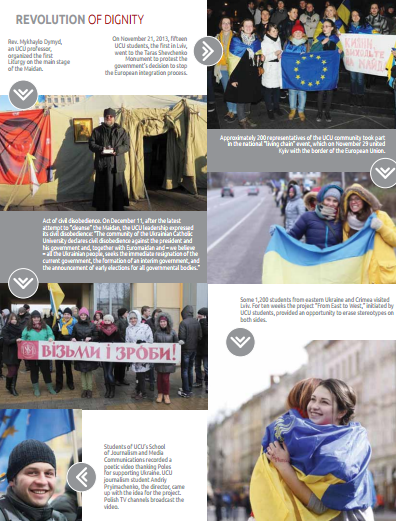
This is a page from the 2013-14 Rector’s Report of the Ukrainian Catholic University in Lviv, an institution that I visited this summer. (Click the image to open the PDF.) The page is headed “A Revolution of Dignity,” and it describes various political–even revolutionary–activities by the university or its members. The next page shows profiles of activists from the university, including a lecturer who was shot to death. It is an interesting combination of American-style glossy PR and strongly worded political commitment.

UkrainianCatholic

I would not hope for a comparable stance from an American university. For one thing, this brochure comes from a country with a war on its own territory and ongoing political crises. We shouldn’t wish for that level of strife here, even if it elicited more political commitment from higher education.

Besides, one can critically assess the position that the university has taken. I’m on the same side, but this position is debatable. Universities contribute to the public discussion by being fair and open to a range of perspectives and by demanding standards of evidence and reason from all participants. When a university commits itself strongly to a cause, it can undermine its ability to be an open forum for debate. It also acquires strange bedfellows–people on the same general side of the political issue who may be quite unsavory.

On the other hand, neutrality is impossible and is the wrong objective. Universities exist to promote free thought and substantive dialog and inquiry, which are incompatible with censorship, oppression, violence, and rampant corruption. Scholars also need intellectual freedom and public support in order to do their work. So universities are closely tied to social justice. They must leave space for a debate about what defines social justice, but they should not pretend that it is other people’s business.

US universities tend to respond to political threats and crises by staying clear of them, at least as official institutions. The Ukrainian Catholic University demonstrates what it looks like when an institution leaps into the fray. The Rector writes in his introductory message “we declared civil disobedience against the government and the president,” which is not what you’d expect in an annual report from a US college or university. He adds:

It’s difficult to summarize the last year, for most of the processes have only begun and are now continuing. We are still experiencing the ‘Revolution of Dignity.’ We are still fighting an external aggressor and internal problems. … From the first days of the revolution we clearly understood what we were fighting for. We were not distracted from running the university for a second. But we also supported our students. …  On December 11 we declared civil disobedience against the government and the president, who used violence against his own people. ….

We should work for victory and for reconciliation. Our weapons are truth and peace. We should already be thinking about what will happen after the war, how to heal physical and spiritual wounds, how to strengthen the country. In addition to the external enemy, Ukrainians need to conquer internal enemies: corruption, anger, hatred. I expect that the spiritual and educational life of the university will help our students handle these challenges.

upcoming talks

These are public talks I am giving in the next two months. All welcome!

Sept. 23: Philanthropy for Active Civic Engagement (PACE) Webinar, “America’s Civic Renewal Movement,” with me and Eric Liu (Citizen University), Kelly Born (Hewlett Foundation) and Joan Blades (Living Room Conversations project). (Register here.)

Sept. 24, Hamline University (St. Paul, MN), Commitment to Community Keynote Address

October 5, University of Texas San Antonio’s Center for Civic Engagement. At its first Civic Engagement Summit, I will talk about “The Promise of Civic Renewal in America.”

Oct. 14, University of Connecticut: the Myles Martel Lecture in Leadership and Public Opinion

Nov. 4, Educational Testing Service office in Washington, DC, “R&D Forum” on civic learning