Category Archives: Uncategorized

the Ohio marijuana initiative and the corruption of our republic

Ohioans vote tomorrow on the Marijuana Legalization Initiative, Issue 3. It is like a stew composed of horrible aspects of our current politics–not legalizing pot, which is fine with me, but allowing rich people to buy public policy, governments to enable rent-seeking and oligopolies, political professionals to manipulate voters, and special interests to extract private benefits in return for enabling popular reforms to pass.

Issue 3 would legalize marijuana but restrict large-scale cultivation to the ten individuals who bankrolled the referendum. The outcomes for the people of Ohio may be better if Issue 3 passes than under the status quo, because ten may be a good number of licensed producers. Zero legal distributors is too few. Prohibiting marijuana creates an illegal industry that causes huge damage. Also, I am enough of a libertarian to believe that if consenting adults want to do something like smoke pot, the presumption should favor their liberty to do so as long as they follow laws protecting others. On the other hand, if anyone can grow and market marijuana, prices will fall and usage will rise, which will have serious consequences for public health. Licensing ten growers may inflate prices and allow the government to regulate the industry effectively–a good balance.

But the voters are not asked to approve ten licenses that go to the highest bidders. They are presented with the opportunity to give state-mandated monopolies to ten wealthy rent-seekers. It’s like the days when kings gave favored courtiers the royal privilege to manufacture specific items in return for gifts and favors. Only it is worse than that, because it enlists the voters in creating these monopolies. In On Revolution, Hannah Arendt noted that corruption was traditionally a sin of rulers, but with democracy, the people can for the first time be corrupted. Issue 3 is blatant yet typical effort to do that.

To their credit, Ohioans have also proposed Issue 2, which specifically prohibits any state amendment that “grants or creates a monopoly, oligopoly, or cartel, specifies or determines a tax rate, or confers a commercial interest, commercial right, or commercial license that is not available to other similarly situated persons.” If both initiatives pass, interesting litigation will ensue. But even if Issue 2 passes, this is really no way to govern.

See also: bottom-up struggles against corruption: a frontier of democracy and the Supreme Court reflects the “degeneracy of the times”.
the changing nature of risk and its relevance to political economy

(Washington, DC) Inspired by the work of the late Ulrich Beck, let’s say that capital and risk are two different issues. Whether you face low or high risk, you may have anywhere from zero to vast amounts of capital.

The more capital you have, the more power you can wield over other people. But the more risk you face, the more vulnerable you are to other people and to nature and fate. Governments and citizen groups can try to make the distributions of capital and of risk more consistent with justice, although the nature of justice is perennially controversial.

I think that companies and big investors have gotten better at handling risk, most individuals are more exposed to risk, and governments are worse at mitigating it.

In (say) 1932, capital was unequally distributed: Daddy Warbucks had a lot more cash than Little Orphan Annie. Risks were also unequally distributed: you were a lot more likely to get black lung disease if you were a miner than a stockbroker. But governments had a toolkit for analyzing, predicting, and remedying both sorts of inequalities. They could use tax and health statistics to see how capital and risk were distributed and could intervene by taxing and spending, by regulating big accumulations of capital (mainly banks and large corporations), and by implementing health and safety regulations. Labor unions also helped to socialize or mitigate risk. Meanwhile, corporations had limited tools to predict the risks that they faced individually, from strikes to earthquakes. And they had lots of sunk capital, such as the vast factories of Detroit. So they shared in the risks faced by their workers and were probably better off when governments mitigated risks for all.

Fast forward to 2012. Risks remain very unequal. With smaller unions and other strong membership associations and with generally less effective regulations, risks tend to be individualized. We also have a strong cultural presumption that risk belongs to the individual. A teenager who gets in trouble is supposed to pay the full price for his mistake.

Entities that have a lot of capital can navigate this environment. A company like Google in 2015 has much less sunk capital than a company like GM in 1932. Google can move investments anywhere in the world. It can fire an employer employee who is not performing or whose skills have become obsolete. The private sector also has sophisticated tools to forecast at least short-term risks and exotic financial instruments to hedge against risk. Overall, a company or an investor with lots of capital and sophistication is better off in a high-risk/high-opportunity economy than in a more predictable environment. To an increasing extent, money can simply purchase protection against risk.

But risk has shifted from capital to labor. Whereas the private sector can use a whole panoply of tools to predict adverse events and to externalize or limit their risks, individual workers have little recourse, and governments do not seem to be able to plan for even the most obvious risks, such as climate change. They choose systematically foolish responses to risks, such as dramatically overreacting to terrorism while ignoring the threat of financial meltdowns. Their unwillingness and incompetence are not inevitable laws of nature. They have been made weaker on purpose. Nevertheless, even a well-intentioned government would now have a long way to go before it possessed an adequate toolkit for understanding and mitigating risk.

more young people voted in ’72 than ’12

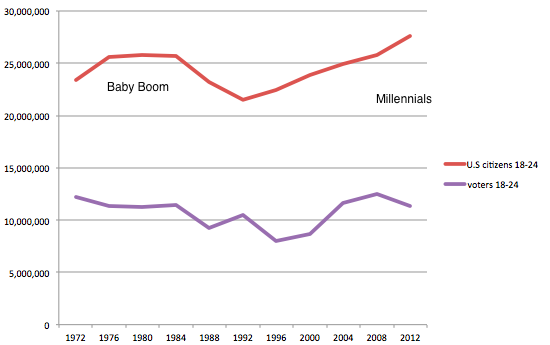
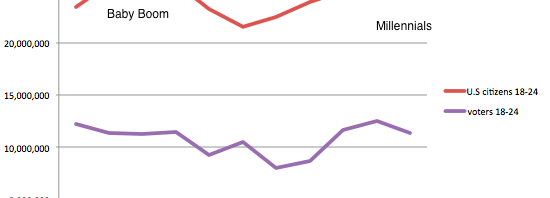
(Washington, DC) This graph shows two trends: the number of US citizens between the ages of 18 and 29, and the number of 18-29s who voted.
voting trend

The number of young voters fell from 122 million 1972 to 114 million in 2012, despite an increase of about four million in the number of eligible citizens under 30. That means that young voters had considerably less clout in 2012 than in 1972. They cast 24% of all votes in 1972 but 19% in 2012.

On the other hand, the comparison would look better if one set 1976 against 2008, because the latter was a stronger year for youth turnout. In 2008, the size of the youth population also surpassed the previous highs of the 1970s, producing record numbers of youth and of young voters. But the youth share was still smaller in 2008 (at 16%) then in had been in the 1970s, because of rapid growth in older generations. And then 2012 saw a fall in turnout.

does the falling homicide clearance rate in big cities promotes violence?

At Tufts on Wednesday, Danielle Allen made the following argument: the war on drugs lowers the chance that the police will solve any given murder by flooding a city with drug-related homicides. Once the homicide closure rate falls, there is a low chance that anyone who commits a murder will be caught. Under those circumstances, if you think someone might shoot you, you “shoot first,” as Allen said.

Right on cue, the New York Times reports from Baltimore: “as more people are being killed here, fewer killers are being caught. The homicide ‘clearance rate,’ the percentage of killings solved by the police, was 45.5 percent last year; today it is 32.8 percent, the police said. Nationally, the rate was 64 percent in 2013, the most recent year for which the Justice Department has statistics.”

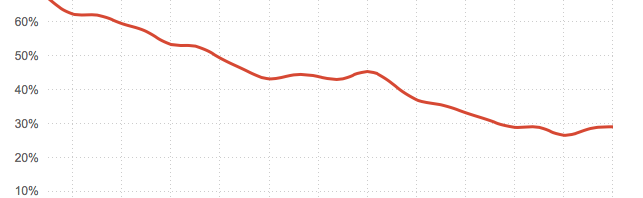
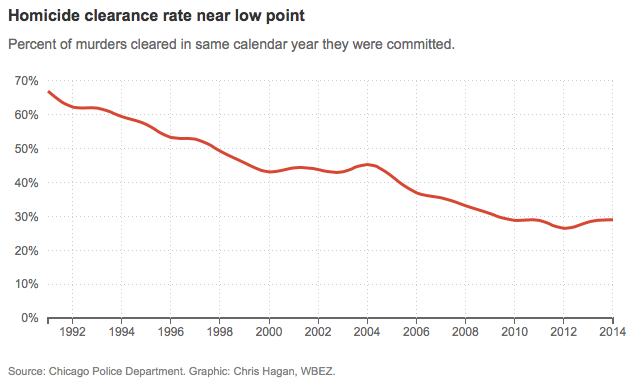
I also found this trend line for Chicago:

Homicide-Clearance-Rate-Chicago-2

These are big declines. In 1992, if you committed homicide in Chicago, the odds were you were going to be prosecuted. In 2012-14, the odds were you would get away with it. That could plausibly change violence rates. If the police can’t protect you against murder, you may feel you have to do it yourself.

Two caveats, however. First, clearance rates are imperfect statistics, subject to being gamed by police departments. Second, even while homicide clearance rates were falling in Chicago, so were homicide rates. So that is not really evidence of a vicious cycle of declining clearance rate leading to growth in violence.

But despite those two caveats, there certainly seems to be a vicious cycle in the last few years in Baltimore and perhaps other big cities, and that is a really serious concern.

does service boost employment?

(Cross-posted from the CIRCLE site) Yesterday, Wendy Spencer, CEO of the Corporation of National and Community Service (CNCS), announced $923,000 in research grants to increase the nation’s understanding and knowledge about the importance of volunteering, national service, and civic engagement in America.

CIRCLE was awarded one of the grants: $143,296 to explore whether including AmeriCorps service on resumes increases the employment prospects of AmeriCorps alumni.

Previous research suggests that participation in civic engagement activities, such as membership in AmeriCorps State and National programs, can have positive labor market outcomes for young people and that hiring managers see volunteering as relevant when making employment decisions. A study by CIRCLE director Kei Kawashima-Ginsberg, University of Wisconsin Professor Chaeyoon Lim, and me found that rates of civic engagement were strong predicators of employment growth after a recession. A CIRCLE study by Andrea Finlay and Constance Flanagan found that service experiences were linked to academic success for young adults.

However, it is not known whether being able to list AmeriCorps service on a resume increases prospects of employment. CIRCLE will conduct a randomized experiment to investigate this question. We will create fictitious resumes for applicants and will vary the service experiences and how they are described to see which forms of service and which ways of presenting it are most attractive to hiring managers.

CIRCLE director Kawashima-Ginsberg said, “High-quality service is beneficial for the people who serve as well as the communities they serve in. Hiring managers should treat challenging service as valuable preparation for the workforce. We will find out whether they do.”