Category Archives: Uncategorized

come work with us

(Washington, DC) Tisch College is advertising two positions:

A Program Administrator for the National Study of Learning, Voting, and Engagement, who will manage essential responsibilities associated with NSLVE including recruiting campuses to join the study, distributing data to campuses in the form of reports, and working to develop resources for all campuses to access through the website. The Program Administrator will also be responsible for supporting communications including but not limited to managing the process for the newsletter, updating the website, and collaborating with the team on other publications.

A Coordinator for our Voting Initiative: This individual will coordinate efforts to increase voter participation among Tufts students in the 2016 presidential election through initiatives supported by faculty and staff at all Tufts campuses. Responsibilities will include: working with student groups to sponsor forums on campaign issues of interest; implementing a plan for comprehensive voter registration opportunities; administering a fund for student-driven initiatives (etc.)

is hope an intellectual virtue (or a virtue at all)?

Ta-Nehisi Coates wrote recently that the “black political tradition is essentially hopeful,” yet the historical record gives many indications that injustice is tenacious and unlikely to yield. That means that a historian or a political analyst deeply cognizant of history should not be committed to hope:

A writer wedded to “hope” is ultimately divorced from “truth.” Two creeds can’t occupy the same place at the same time. If your writing must be hopeful, then there’s only room for the kind of evidence which verifies your premise. The practice of history can’t help there. Thus writers who commit themselves to only writing hopeful things, are committing themselves to the ahistorical, to the mythical, to the hagiography of humanity itself. I can’t write that way—because I can’t study that way. I have to be open to things falling apart. Indeed, much of our history is the story of things just not working out.

Coates is critical of “only writing hopeful things” and of assuming that “your writing must be hopeful.” He is not saying: abandon all hope, you who enter into historical thought. But he is distinguishing the cultivation of hope from the pursuit of truth. If hope emerges from truth, that is a matter of sheer chance and not to be counted on.

I have argued, more generally, that truth, justice toward others, and inner psychological wellbeing are distinct goods.* It would be wonderful if they could fit together neatly, and even better if each caused the others. That would be the case in a universe constructed by an omnipotent and just creator, which is why the Bible says things like “the truth will make you free.” But I see no particular reason to believe that truth will make you happy or just, that justice will make you happy or truthful, or that happiness will make you truthful or just. In many situations, knowing the full truth just causes sorrow and paralysis; committing fully to justice requires sorrow and untruth. In my view, all three goals are estimable, but they conflict, and that is one reason it is so hard to live well. This position is consistent with Coates’ admiration for both the truth-telling historian and the hope-instilling tradition of Black politics in the US.

In the previous paragraph, I wrote about happiness in contrast to justice and truth, dropping the word “hope.” For some, hope is a form or close relative of happiness. But one can debate whether hope is a good at all. Neither the classical Greeks nor the ancient Indian thinkers thought that it was. Hannah Arendt observed that “Greek antiquity ignored [faith and hope] altogether, discounting the keeping of faith as a very uncommon and not too important virtue and counting hope among the evils of illusion in Pandora’s box” (The Human Condition, p. 247.).

Indeed, a Stoic or a Buddhist can endorse a strong argument against hope. First, hope is a thought about the future, but wisdom lies in fully experiencing the present, which alone is real. Like nostalgia and regret, hope is a source of irrational disquiet.

Second, hope is about matters beyond our control. For instance, it makes no sense for me to “hope” that I will answer a question honestly. If I am an honest person, I will just answer it honestly. To hope about our own actions is to renounce responsibility. By the same token, we ought to spend no energy hoping that others will be honest–or otherwise ethical–because that is beyond our control. They will do what they will do, and we should respond in the best possible way.

Third, we should not make hope the precondition of acting right, for that is moral weakness. We must do right regardless of the odds of things turning out well.

Most pre-Christian thinkers of the Mediterranean and Northern India ignored or opposed hope. Christians then turned hope into one of the three greatest virtues. That made sense because of their theistic commitments. Indeed, hope is closely connected to faith and charity because it is faith in the Creator’s charity or grace that (alone) substantiates hope in a world of evident suffering.

Arendt was a non-Christian author who thought that the Christian concept of hope had been a positive contribution, related to her own core virtue of amor mundi–love of the world. Notwithstanding the Stoic and Buddhist arguments against hope, and notwithstanding the real tensions between hope and truth that Coates explores–hope could be a virtue. It could be a virtue if it is a resource that human beings need in order to act well. Then instilling hope increases the odds of good action, just as giving people courage does.

In both Stoicism and at least some classical Indian thought, quietism is a common theme. The wise person accepts what is–in which case, hope is irrelevant and distracting. But activists must think about more than the present. They must form plans, which requires estimating the probability of success. When the probability approaches zero, it is time to form a new plan. That means that hope is a rational precondition of action.

And possibly hope is an intrinsic virtue. By Act IV, Scene 1 of King Lear, Edgar has already suffered much, having been cast out of his family and society and onto the wild heath. He convinces himself that he can still be happy because he can still have hope (“esperance”):

Yet better thus, and known to be contemn’d,
Than still contemn’d and flatter’d. To be worst,
The lowest and most dejected thing of fortune,
Stands still in esperance, lives not in fear.
The lamentable change is from the best;
The worst returns to laughter. Welcome then,
Thou unsubstantial air that I embrace!
The wretch that thou hast blown unto the worst
Owes nothing to thy blasts. 2255

Immediately following these lines–in a perfect illustration of tragic irony–Edgar’s father stumbles into view. We have watched his eyes being deliberately thumb-wrenched out of their sockets, and now we see him “Enter …, led by an Old Man.” Edgar cries:

But who comes here?
My father, poorly led? World, world, O world!
But that thy strange mutations make us hate thee,
Life would not yield to age.

It was not true that Edgar had seen the worst or that the subsequent changes would be for the better. Things were about to get much worse. And things ultimately get worse for all of us. Yet it was better for Edgar to have those moments on the heath than not to have had them. It was to his credit that he could forgive and “embrace” life. He chose to describe his state as hope, and that seems praiseworthy. Hope wasn’t an accurate prediction of the future but rather a choice and a disposition.

To return to the beginning: I agree with Coates that history is not hope-instilling and that the rigorous empirical historian should not go looking for hope in the record of the past. At the same time, a human being who manages to be hopeful seems to be praiseworthy and a gift to others. The historian is a human being, and like all of us, must navigate these two inconsistent values.

*See also: on hope as an intellectual virtue (with the opposite thesis from today’s post); unhappiness and injustice are different problems; why we wish that goodness brought happiness, and why that is not so; three truths and a question about happiness; and all that matters is equanimity, community, and truth.

citizens at work: how small groups address large-scale problems

(Orlando) I am on my way home from a meeting of the Florida Partnership for Civic Learning. I’d like to argue that it exemplifies citizens’ work. To be sure, it has a specific mission: improving civic education in Florida’s k-12 schools. And it enlists a specific kind of person: professionals in k12 schools, ed schools, and state agencies, all of whom participate in the effort as part of their jobs. It thus differs in significant ways from a group of miners forming a union or volunteers fixing a neighborhood park. (I can spot k12 teachers and ed-school professors from 500 yards away, due to some ineffable mix of demographics, fashion/accessories, and ways of navigating the physical world). Still, the essential features of this group would apply to different issues and different people.

Using the terms I summarize in this 10-minute video, groups of effective citizens seriously ask the question, “What should we do?” That question implies a deep consideration of values, of facts and constraints, and of strategies. The group not only discusses (deliberates), but also takes collective action (collaborates) and learns from the results of its own actions. Finally, it is attentive to relationships both within the group and with outsiders. It specifically promotes civic relationships, which imply certain values–such as mutual respect and accountability–without relying on personal friendships or financial ties. Because the fundamental question is “What we should do (about some large question)?” the group is satisfied neither with just doing something by itself that has limited effects nor with wishing or hoping that someone else acts. It finds leverage over larger systems.

Without going into details about the Florida Partnership or its current work, I would argue that it embodies all the key words in the previous paragraph. The question for the Partnership is “What should we do to improve civic learning for all Florida students?” The main value-questions include: “What is important for a citizen to learn and know?”, “What rights/obligations do schools have to educate citizens?” and “What constitutes just outcomes for the population of students across the state?” Participants discuss extensive factual information: 7th grade civics test scores for every student in the state, detailed survey data on students’ values and behaviors, and information on the effectiveness of various programs. At this particular meeting, we looked at regression models that predicted test scores, elaborate maps of schools that surpassed expectations, toplines from surveys, and qualitative reports from some of those schools. Participants spent time building relationships among themselves and with other actors. Finally, the group considered a whole range of strategies, from working with elementary reading organizations to changing course requirements in state colleges.

Nothing is perfect, but I think we did a good job of avoiding these classic pitfalls:

  1. Turning everything into a communications problem, a problem of “getting the word out.” In an era of constant marketing and propaganda, it seems to come as second nature to focus on “messaging.” But rarely is the main problem that lots of people believe the wrong things. And even when they do, communicating is challenging in a very crowded media environment. Smart groups communicate as they need to but don’t overemphasize its importance.
  2. Imagining phantom agents. It’s a constant temptation to imagine–or hope–that someone else will solve a problem. Someone else’s actions may indeed be essential. For instance, it may take the state legislature to improve civics. But then the question becomes: How can we influence the legislature? The “we” has to be concrete and real: an actual list of individuals who know what to do next. We are the ones we have been waiting for.
  3. Oscillating between the trivial and the utopian. I have often observed groups jump back and forth between the ends of a spectrum of practicality. At one moment, they will convince themselves that a given problem cannot be solved without changing the whole political/economic system. At another moment, they will talk about making one presentation at someone else’s small-scale meeting. To make a substantial difference, you have to find space between those extremes.
  4. Operating at only one level of power. According to the train of thinking inaugurated by Steven Lukes and John Gaventa in the 1970s, power operates at several levels. There is explicit power: the power to do something (such as require a statewide civics test or grade an individual kid). There is the power to set agendas. There is power over other people’s preferences and values. And there is power to affect who uses the other forms of power. Truly effective citizen groups think at all these levels.
  5. Losing the moral questions in data. We have civics test scores for every 7th grader in Florida, and my colleagues have analyzed those data in several illuminating ways (geospatially, demographically, even qualitatively). But it is fundamentally a moral question what to measure on a 7th grade civics test. It is also a moral question whether the state should test students, and what consequences should follow from success or failure on a test. Finally, given a distribution of real test scores, it is a moral question what to do next. Should you devote all your resources to serving the lowest-scorers? Raise the median? Reward the high-scorers? In an age of positivism, we tend to be better at analyzing the data than at reasoning about what the data imply morally. But good groups hold philosophically diverse and productive explicit discussions of the moral issues.
  6. Losing sight of either the short-term or the long-term. Really effective citizen groups achieve short-term victories with an eye to building momentum and winning longer-term victories later. The two mistakes to avoid are looking only for easy “wins” that don’t create momentum or working directly on long-term problems without having enough people or money to sustain the effort.

new chapter on generational trends in US politics

(Orlando, FL) I was asked to write a chapter about the US for an international book about “youth disaffection with politics.” I looked at 40-year trends in more than 20 survey questions, ranging from trust in government to support for government programs to turnout. I really did not find evidence of “youth disaffection” in the US. All Americans are pretty alienated, but it isn’t a generational pattern. Most of the trends I looked at aren’t generational at all–they rise and fall with recent news and events.

My chapter is mainly an argument against thinking of alienation from politics and government in generational terms, at least for the US. I even venture that a generational framework is generally problematic. It distracts attention from the most important phenomenon, which is the stubborn replication of the same inequalities from decade to decade. I am for studying and supporting youth, but not because today’s youth are different in some fundamental way from their predecessors. Rather, institutions should finally treat a new generation better so that we begin to see some meaningful differences.

See “Youth Disaffection with Politics: The US Case,” in Pedro Pérez Herrero (ed.) Desaffección política y gobernabilidad: el reto politíco (Madrid: Instituto Universitario de Investigación en Estudios Latinamericanos, 2015), pp. 45-60. See also the Millennials and politics and Letter to a Young Political Reformer.

nonprofit outreach boosts turnout

Yesterday, I wrote that higher education has limited capacity to improve economic mobility in the US, and our greatest contribution is to help understand and promote the policies that would increase justice. Right on cue, my colleagues at CIRCLE announced a new report they helped Nonprofit Vote to write. It shows that nonprofits are effective when they conduct nonpartisan voter registration and get-out-the-vote efforts for the people who come to them seeking services.

Nonprofit Vote calls this strategy “reverse door knocking,” because instead of canvassing highly disadvantaged people, you talk to them about voting when they knock on your organization’s door.

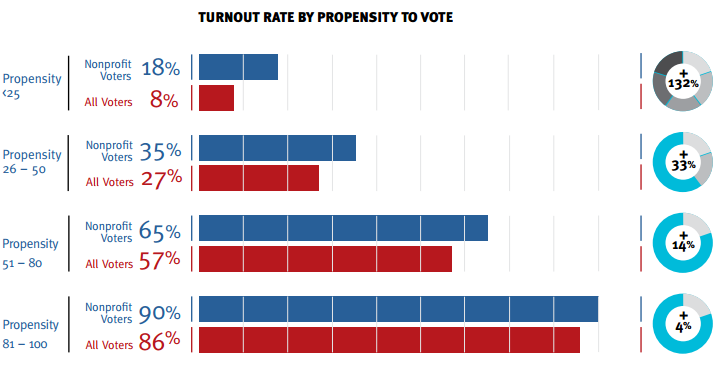
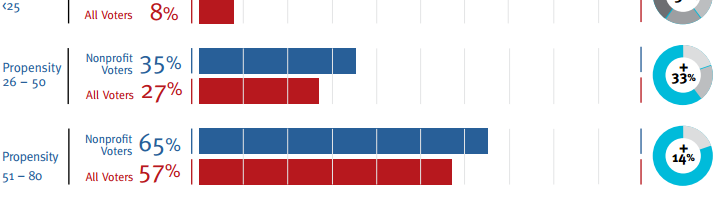
CIRCLE helped to document the positive impact in several different ways. Here is one. The graph shows the turnout (based on actual voting records) of people who were registered at participating nonprofits versus those who were registered in other ways. The categories are different levels of propensity to vote, as calculated by the firm Catalist, which usually advises campaigns on whom to target. If you’re a low-propensity registered voter who was registered through one of the participating nonprofits, you had an 18% chance of actually voting in 2014, ten points higher than if you were a registered voter with the same propensity but you didn’t receive outreach from a nonprofit.

nonprofit

The analysis also shows strong effects on young people.