Category Archives: Uncategorized

the US frequently bans visitors on the basis of speech and opinions

I think the British Parliament made the right decision when it voted not to ban Donald Trump from entering the UK. During the debate, MPs had the opportunity to call him–and I quote–“poisonous,” “a buffoon,” “crazy,” “wrong,” “stupid,” and a “wazzock.” (The Urban Dictionary suggests, as an example of that last term, “You great useless spawny-eyed parrot-faced wazzock.”)

It’s almost never smart to respond to odious speech by keeping it out. It’s almost always better to respond with confident, reasonable, yet forceful speech on the opposite side.

That said, the British are certainly not the only ones to consider banning people on the basis of speech. Indeed, they have a long, if not spotless, record of accepting radicals and subversives of all stripes; Karl Marx is buried in Highgate Cemetery. And we–meaning the executive branch of our federal government–have a long tradition of barring people because of their speech. E.g.,

  • Gabriel Garcia Marquez: denied tourist visas on multiple occasions for having contributed to (but not belonged to) the Communist Party
  • Michel Foucault, denied a visa to attend a conference on “Knowledge, Power, History: Interdisciplinary Approaches to the Works of Michel Foucault.”
  • Pablo Neruda, 1971 Nobel Laureate in literature, denied a visa but admitted after an appeal by Arthur Miller.
  • Palestinian poet Mahmoud Darwish, unable to attend the PEN conference in New York City in 1985.
  • Andrew Feldman, a Canadian professor, denied entry in 2007, when “a border agent discovered he’d written an academic paper about taking LSD in the Seventies.”
  • Hortensia Bussi De Allende, widow of the former President of Chile, who had been murdered in a CIA-supported coup.
  • Tariq Ramadan: Swiss scholar, banned from 2004–2010 on various grounds, including  for having “endorsed terrorism.”
  • The former Cat Stevens (Yusuf Islam): denied entry from 2004-6.
  • German author Ilija Trojanov: denied entry while boarding a scheduled flight for unexplained reasons; known for his criticism of the NSA.

I omit from this list two heads of state who were banned for reasons that arguably involved action as well as speech. Former Austrian President Kurt Waldheim was barred for his Nazi affiliation in WWII. Before taking his current office as Indian PM, Nerendra Modi was denied a diplomatic visa and his existing visa was revoked for having (per the US government) “directly carried out … particularly severe violations of religious freedom.”

US policy has oscillated. The 1952 McCarren Walter Act aimed to bar anyone whose presence could be “prejudicial to the public interest,” a 1978 amendment reversed that law, and the Patriot Act excludes aliens who “endorse or espouse terrorist activity” (i.e., for speech alone). Despite these vacillations, barring people from entering the US on the basis of their speech has been rather common. If it was an unwise proposal to ban Donald Trump from the UK, we ought to reconsider our own policies.
four tendencies in liberalism

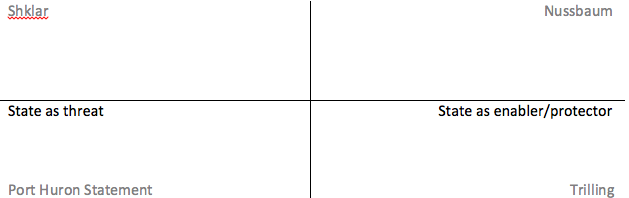
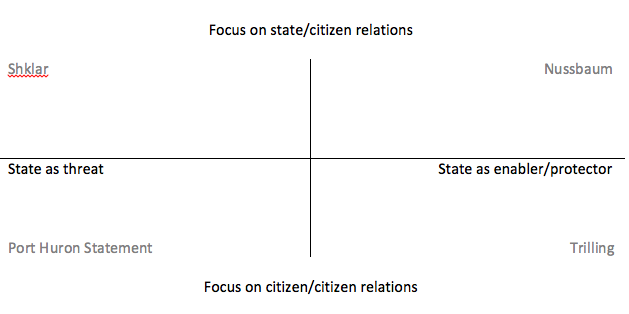
This simple typology might be helpful for distinguishing tendencies within liberal political thought. The x-axis measures attitudes toward the state, ranging from fear to enthusiasm. The y-axis measures the degree to which the state is central to politics. If you are primarily concerned with the state, you belong at the top, and if you focus on horizontal relations among people, you’re at the bottom.

Screen Shot 2016-01-20 at 8.10.05 AM

Judith Shklar exemplifies the top-left quadrant. She is explicit that the question for liberals is how the state treats citizens, and the driving concern is the state’s potential for cruelty and oppression:

Given the inevitability of that inequality of military, police, and persuasive power which is called government, there is evidently always much to be afraid of. And one may, thus, be less inclined to celebrate the blessings of liberty than to consider the dangers of tyranny and war that threaten it. For this liberalism the basic units of political life are not discursive and reflecting persons, nor friends and enemies, nor patriotic soldier-citizens, nor energetic litigants, but the weak and the powerful. And the freedom it wishes to secure is freedom from the abuse of power and intimidation of the defenseless that this difference invites.[1]

Martha Nussbaum exemplifies the top-right. She is also fundamentally concerned with the government, but she emphasizes its potential to enhance human capabilities:

In the end it is government, meaning the society’s basic political structure, that bears the ultimate responsibilities for securing capabilities. [Government] must actively support people’s capabilities, not just fail to set up obstacles. … Fundamental rights are only words unless and until they are made real by government action.[2]

Despite the manifest disagreements between these two authors, both view politics mainly as a set of relationships between the state and citizens.

Down at the bottom right is someone like Lionel Trilling, who thinks that liberalism is about relations among citizens—“discursive and reflecting persons,” in Shklar’s phrase. In a liberal culture, fellow members of a community develop close, responsive relations with one another so that they can enrich their inner lives and develop mutual understanding before they seek to influence the state, their culture, or their community. In passing in The Liberal Imagination, Trilling endorses laws and institutions that enhance freedom and happiness (that puts him on the right side of the spectrum), yet he wishes to “recall liberalism to its first essential imagination of variousness and possibility, which implies the awareness of complexity and difficulty.”[3] For Trilling, sensitive literary criticism is a characteristic liberal act because it involves the recovery of another individual’s thought.

The bottom-left belongs to people who see great importance and positive potential in human beings when they relate appropriately to each other, and who fear the state as a threat to authenticity and creativity. This is at least a thread in the Port Huron Statement, which inaugurated the New Left in America:

Men have unrealized potential for self-cultivation, self-direction, self-understanding, and creativity. It is this potential that we regard as crucial and to which we appeal, not to the human potentiality for violence, unreason, and submission to authority. …  Human relationships should involve fraternity and honesty. Human interdependence is contemporary fact; human brotherhood must be willed however, as a condition of future survival and as the most appropriate form of social relations. Personal links between man and man are needed, especially to go beyond the partial and fragmentary bonds of function that bind men only as worker to worker, employer to employee, teacher to student, American to Russian. … Loneliness, estrangement, isolation describe the vast distance between man and man today. These dominant tendencies cannot be overcome by better personnel management, nor by improved gadgets, but only when a love of man overcomes the idolatrous worship of things by man.

[1] Cf. Judith Shklar, The Liberalism of Fear, reprinted in Nancy L. Rosenblum (ed.), Liberalism and the Moral Life (Cambridge, MA: Harvard University Press, 1989), p. 27.

[2] Martha Nussbaum, Creating Capabilities: The Human Development Approach, pp. 64-5.

[3] Trilling, The Liberal Imagination: Essays on Literature and Society (New York: New York Review of Books, 2008), Preface (1949), p. xxi

the pantomime of the Democratic primary, or the choices that actually confront the next president

The first question in Sunday’s Democratic primary debate was: “President Obama came to office determined to swing for the fences on health care reform. Voters want to know how you would define your presidency? How would you think big? So complete this sentence: in my first 100 days in office, my top three priorities will be — fill in the blank.”

All three candidates answered as they had been encouraged to, by describing grand changes in society that would require legislation to accomplish. None mentioned that conservatives have almost a 100% chance of controlling the House, the judiciary, and most states.

I wouldn’t criticize their approach to answering the question. If they had stuck to politically realistic answers, they would have allowed the other party to narrow the scope of discussion and debate. Also, it was illuminating to understand the differences that emerged when the candidates discussed legislation. For instance, are the Affordable Care Act and Dodd-Frank hard-won and fragile victories to be protected with strongly affirmative rhetoric (Clinton), or mere promissory notes demanding to be redeemed with better laws (Sanders)? Are almost all political dysfunctions traceable to campaign money (Sanders), or could skillful leadership within the current system improve things (Clinton)? Finally, it would have been defeatist for these candidates to offer realistic plans for their first 100 days. That would have undercut progressives’ efforts to win down-ballot races and would have converted a prediction into a self-fulfilling prophesy. In other words, it would have been bad leadership.

And yet, as someone deciding which candidate to choose, I am interested in what each candidate would actually do in office (as well as the more pressing question: Who has a better chance of beating the Republican nominee?). At least in the first two years, they would be able to do virtually none of the things they proposed in the debate. Any of them would veto assaults on the Affordable Care Act and negotiate a budget deal that retains most of the status quo. But some choices would confront them:

What unilateral foreign policy decisions to make. This is the area where Congress has–perhaps unfortunately–the least scope, although the national security apparatus has a great deal of say, and it’s not clear that the president really does decide. Dovish progressives have a hard choice in ’16, because Clinton has a hawkish record and Sanders has no experience managing the military and security agencies.

What legislation to propose to Congress first. Three options to send to the Hill are: 1) Widely popular but small-bore bills that can pass and establish a record of accomplishment. 2) Wedge issues: bills designed to catch the House Republicans between their constituents’ opinions and their party orthodoxy. Or 3) grand visions of alternative health or justice systems. These would fail but could possibly alter the terms of public debate. It’s a hard choice.

What executive orders to issue. Note that President Obama seems intent on using that authority to its full in his final year, and he may not leave a lot of attractive options for his successor.

Whom to nominate for a wide range of offices. Within many domains of policy, a Democrat has genuine choices. For instance, she or he could nominate an education reformer enamored of metrics, accountability, and competition (continuing the status quo) or switch to someone who prefers to give teachers autonomy and resources. There is plenty of room within the legislative framework of the Elementary and Secondary Education Act to push in either direction. In the economic agencies, there is a choice between mollifying Wall Street and the markets or regulating them aggressively.

In making appointments, the president also gets to choose leaders with a range of personal profiles. Any Democratic president will look for racial and gender diversity, but how to weigh ideological, religious, generational, and regional diversity? Should most cabinet secretaries have extensive experience as CEOs of large bureaucracies so that they can run things smoothly, or should they be thinkers and advocates?

I enjoy the debate about long-term directions for progressive politics and the nation, but we should probably ask the candidates how they will resolve the decisions that they will actually face.

if you’ve voted, it’s been noted

(Washington) In Hacking the Electorate: How Campaigns Perceive Voters, Eitan Hersh shows that candidates and campaigns obtain their knowledge of us, the citizenry, by analyzing voter files. They don’t know the truth about us; they know what the voter files say about us.

That means that getting on the voting rolls is a source of power. Once you’re on, the political class becomes interested in you. They measure and model and predict your preferences and behaviors. Your vote may not make a marginal difference in the electoral outcome. After all, most elections are lopsided victories. But even if you are part of a large majority or a small minority, the candidates will pay attention to you if you’re in the voter files, and they won’t even see you if you aren’t.

This is an argument for registering and voting that may not be easy to convey, but it has the advantage of being right.

Don’t campaigns learn what the whole population thinks from polls? The answer is: sometimes. Polls are mainly conducted for high profile races. It’s a pop-culture myth (see “The Good Wife”) that ordinary candidates do any significant polling. Besides, we are in the midst of a data revolution in which companies, governments, and politicians are shifting away from random samples to datasets that track all of the relevant behavior–every purchase on Amazon, every Web search, or every vote. These datasets are far more powerful than surveys for predicting and influencing people. In particular, voting files are powerful because: (1) public policy requires the collection of more data on voters than is strictly necessary to run an election, (2) voter files can be merged with commercial records, and (3) analysis of such data is becoming both more sophisticated and more user-friendly. (I take all of this from Hersh.)

Don’t campaigns learn about the public by talking to people? They used to rely on skillful, experienced neighborhood-level volunteers to provide information about the electorate. That whole infrastructure has been hollowed out by money and technology. Of course, there are still volunteers. But they come forward to work on particular campaigns. Few have deep and accumulated knowledge of local voters. The best way to harvest what they learn during a campaign is to require them to upload their observations about specific citizens to the voter files. Meanwhile, the candidates spend their time talking to donors. The voter file is how the campaign learns who you are–which means that you should make sure you’re on it by voting.

inequality as viewed from Silicon Valley

Gregory Ferenstein has interviewed Silicon Valley moguls about inequality. He summarizes the results thus:

They believe that a relatively small slice of geniuses advance humanity more than the combined efforts of everyone else, and that economic growth is better at improving the overall quality of life than burdensome redistribution schemes.

And many believe that the best long-term solution to inequality may be a guaranteed basic minimum income, which minimizes regulation on innovation but ensures that the masses are well-off.

Many of his interviewies identify as liberals, but that is probably because of social issues. They are certainly pro-market and see economic growth as the solution to almost all social problems. That assumption aligns them with libertarian conservatives, albeit with a subtle and important difference.

A certain kind of laissez-faire conservative believes that inequality would not be a big problem in a free market because almost all people have significant market value. Anyone can make money who works hard and exercises thrift. Poverty exists because of disincentives to work or because of market distortions. A moderate version of this position adds that universal public education and some regulation is necessary to allow everyone to attain adequate market value. A proponent might also acknowledge that markets yield inequality but argue that that doesn’t matter as long as most workers can attain a reasonable level of welfare. They should be able to do that if labor markets clear, and the ones who can’t (e.g., the sick and old) can be taken care of by small government programs or philanthropy.

The Silicon Valley moguls have a different view of the world. They do not think that most people have much market value. One wrote in Ferenstein’s survey, “Very few are contributing enormous amounts to the greater good, be it by starting important companies or leading important causes.” Another defends MOOCs not because they educate most students well but because they can find the diamonds in the rough who have the potential to produce substantial value. “Most said that the top 10 percent of talent would naturally earn more than 50 percent of the nation’s wealth” if an economy were unregulated.

I think Silicon Valley people make a core distinction between commodities and innovations or “disruptive” technologies. In this framework, a commodity is something that anyone can consume or produce if she can pay the market price. Wheat, for example, is a commodity. You can buy it by the pound. You can also produce it at the market rate. If you don’t have land, water, and seed, you can buy those. If you don’t know how to farm, you can hire a farmer. In contrast, you cannot make a Rembrandt or a MacBook Air. Rembrandt is dead and Apple has patented its design.

This distinction is crucial because profit margins for commodities are low in a competitive economy, and the real money comes from innovations. I think Silicon Valley people sometimes confuse price and value and conclude that social benefits also come from innovation, not from the provision of ordinary commodities. (Some in the Obama Administration hold a similar view, assuming that it is more important for the federal government to be able to fund social innovations than to maintain standard services.)

On this view of the world, the top priority is to support and liberate the few who are in a position to innovate. All the others play a limited role and have limited economic significance. If they are poor, no harm comes from giving them transfer payments so that they can purchase commodities. It’s not necessary to give them incentives to work hard and be thrifty, and it’s benign to make sure they can consume.

In contrast, a classic (Victorian or neoliberal) free-marketer believes that everyone can and should contribute importantly to the common good by working, and transfer payments harm the recipients by reducing their incentives to work. That argument is lost on Silicon Valley entrepreneurs, who don’t think most people’s work is all that valuable, anyway.

I think this fundamental difference cuts through the various pro-market movements that are ascendant today and is worth watching.

(Notes: I recognize that markets aren’t natural but are created by public policy. I recognize that merit–or the capacity to produce value–is constructed, not innate, and that different people would be seen to have merit if we designed society differently. Finally, I recognize a third category apart from commodities and innovations: rents. You can’t actually make as much wheat as you want, because God only made so much land, and you can’t make a MacBook Air, because the government limits your ability to imitate Apple by awarding patents to the company. So both landowners and tech. companies can collect rents. These three points are among many important complications, but I don’t think they challenge my interpretation of the worldview of Silicon Valley neoliberals.)