Category Archives: Uncategorized

the Danish Parliament’s paternoster

Earlier this month, my family and I took the free and excellent tour of the Danish Parliament in Copenhagen. There were many serious insights to be gleaned about parliamentary government, unicameral legislatures, multiple-party systems, and the cultural norms that prevail in Scandinavia, such as egalitarian informality.

But I write not to share insights; I write to relate an anecdote. Although the embedded sideways video is not mine, it shows part of the same tour that we took. The machine in the background is a “paternoster”–like an elevator except that the doors remain always open and a sequence of boxes passes by continuously. You have to jump on and off. Characteristically for Denmark, this contraption is considered too dangerous for tourists and reporters, but MPs and their staff can ride it. As the guide notes, this makes it a good refuge from journalists (who otherwise are allowed everywhere in the parliament building, at will).

The guide–or one of his colleagues–once explained to some Danish 7th-graders that the paternoster goes up, over, and down. That means that if you ride it up on the left, soon you will be coming back down on the right, still standing comfortably upright. The oldest Member of Parliament at the time, who was also a minister in the government, heard this explanation as he rode up. A few seconds later, down he came on the left–standing on his head.

It is fairly hard to imagine this happening in the US Capitol.


public support for civics

PDKThe annual Phi Delta Kappa survey of public attitudes toward education is out.

Adults are asked whether preparing students to be good citizens is important and how well schools are doing it. Eighty-two percent say it’s extremely or very important, and 33% say schools are doing it extremely or very well. As a priority, it ranks somewhat below developing work habits and providing factual information, it ties with critical thinking, and it comes ahead of working in groups.

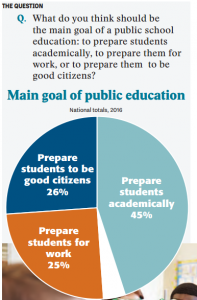
In a different question, respondents are asked to pick the single main goal of education. About a quarter choose preparing students to be good citizens, which is on par with preparing students for work but behind preparing students academically.

The advantage of a forced choice is that most people will favor a whole set of good outcomes if allowed to pick them all. However, there’s something a little artificial about the results of a forced choice. My job is to study and advocate for civic education, so I’d pick the “citizenship” choice. I nevertheless believe that preparing students academically and for work are essential goals, and are complementary with civics. So it’s not the case that 26% of Americans think only citizenship matters, or that 74% think it doesn’t matter at all.

Still, the forced-choice reveals that education for citizenship is the top priority for quite a few Americans. That’s valuable to know, because the major reforms that have passed through education like earthquakes’ seismic waves since 1980 have hardly mentioned civics at all. The PDK survey doesn’t prove that Americans put the civic mission of schools above all else, but it does suggest a lot of support, which ought to be reflected in policies.

Further, the forced choice reveals differences within the public. It appears that the civic mission is most important to young and older citizens; parents and other adults in the traditional child-rearing years are more concerned about academics.

There’s also a partisan and ideological split: “Fifty percent of conservatives emphasize academics vs. 43% of moderates and 40% of liberals. Liberals instead are more likely (33%) than moderates (24%) and conservatives (22%) to say schools should focus on building citizenship. Republicans are less apt than others to value a role for citizenship instruction in public schools.” The partisan divide creates challenges for proponents of civic education. In my opinion, citizenship should be a core value for conservatives, and it’s important to make that case.

The PDK poll doesn’t ask people what they mean by “good citizens.” We know from other studies that answers would vary. Some think of good behavior–obedience in the kindergarten classroom or staying out of trouble as a teenager. Others think of patriotism and support for the regime; still others, of activism and debate. Note that support for citizenship education is strongest among liberals and young people, and I doubt that most of them favor simple obedience.

One thing we can conclude is that good citizenship shouldn’t be an afterthought for policymakers, for 82% of adults think it’s at least very important, and 26% think it’s the main goal of schools.

the Nordic model

We are just back from a vacation in parts of Iceland, Denmark, and Sweden. Although I’ve been in the region before, I am very far from expert on Nordic politics and economics. But it’s worth understanding the Nordic model–even if it looks a little rickety today and may depend on factors that couldn’t transfer to the US–because basic measures of human well-being are extraordinarily high in the five Scandinavian nations. For instance, Norway has the highest human development level in the world. I think the Nordic model represents a fusion of two contrasting impulses, a combination that is perhaps obscured in talk about social democracy or democratic socialism.

The (conservative) Heritage Foundation’s Index of Economic Freedom makes the point. From Heritage’s perspective, Denmark is an odd mix, although its overall rank is high. Heritage considers Denmark very bad at “limited government,” because one aspect of the Nordic model is high taxation and spending. On the other hand, Heritage ranks Denmark very high on measures like business freedom, investment freedom, and property rights (as well as freedom from corruption, which everyone values).

I think the Nordic model boils down to competitive entrepreneurship in the global marketplace plus strongly egalitarian social policies for everyone in the home country. Scandinavians are out and about, learning foreign languages (95% of Swedes speak English), and studying and working overseas. Goods as well as human beings flow across their borders. Denmark’s international trade is 102% of GDP. I’m not certain how that number can be greater than 100%, but the ratio is obviously much higher there than in the US, where trade is 27% of GDP. You see imports everywhere in Scandinavian stores, as well as export-oriented businesses.

Competitiveness brings material benefits: high-quality goods and services selected from around the world. It provides opportunities for ambitious and talented people to create new things. An index of innovation ranks Sweden first in the world, and Finland and Denmark are also in the top 10. Competition also identifies and rewards excellence. The result is a lively, flexible, future-oriented society. Scandinavians are proud of their nations’ marquee industries and are notably patriotic without being bellicose.

At the same time, competitiveness hurts people–the people who cannot or don’t happen to win, who were doing fine before all the market “disruptions,” who value traditions, or who don’t even want to fight for success in market economies. Competition can also erode civic virtues and responsibilities, including concern for public institutions and shared resources.

That’s why the other side of the Nordic model is so important. At home, everyone has very extensive and unconditional economic rights, which cost a lot of money. The public sector budget is 55% of GDP in Denmark. The state also demands people’s time and attention. Sweden, Denmark, Iceland, and Denmark all rank in the top seven for voter turnout, they have among the highest rates of associational membership in the world, and their governments are rated as the least corrupt.

All of this is hard to build and maintain, and I have not mentioned the drawbacks and frailties of the model. My point is really an ideological one. There are genuine virtues to systems that we might call “neoliberal,” systems that involve property rights, competition, and globalization. Strongly democratic societies that protect everyone’s welfare also have virtues. And although these goals can trade off in some respects, it’s possible to pick elements from the neoliberal menu and others from the socialist menu without contradiction.

the different logics of class and race

It’s common to list racism, classism, sexism, homophobia, and xenophobia together. These are all important and bad phenomena, but they have different logics, and I’m not sure it’s helpful to put them in a single category. Here I explore the differences by focusing on racism and classism.

Older meanings of racism were, I think, always attitudinal. To be a racist was to have negative attitudes toward a racial group, even if those attitudes were unconscious. We now speak of structural racism, which can exist even in the absence of racist attitudes. I sort of wish that we just called that problem “racial injustice,” because the “-ism” suffix connotes an attitude or mindset. But I can accept the linguistic evolution, and I certainly believe that both interpersonal racism and structural racial injustice persist and are destructive.

Classism can be made analogous to the older meaning of racism. You’re a classist if you hold someone in lower regard because of the status of her job, her working-class accent, her neighborhood of birth, or her parents’ social role. Classism of that kind is evident and harmful.

Structural classism would then mean some kind of advantage enjoyed by people due to their class. But this is where the analogy breaks down. Classes are differences in status, power, and advantage. If a society has classes at all, then it gives people different advantages. Put a different way: if a society differentiates among social roles, then it has classes, and that’s structural classism.

Racism is never justifiable, and it’s possible to envision a society that has racial diversity yet no racism. Indeed, I hope that’s where we are headed. In contrast, it’s impossible to imagine a society with classes that doesn’t have “structural classism,” if that means different levels of status, power, or money for different social roles. In theory, we could pay everyone the same salaries, but I’m not sure that would work in practice, and even if it did, it wouldn’t eliminate differences in the quality of work or the status of professions.

Further, classes may be justifiable or even good. Some argue that a classless society is the ideal. We haven’t seen one, however: communist societies produced powerful, detached social strata–the nomenklatura, etc. John Rawls argued that it’s right to pay heart surgeons more than carpenters if (and only if) that is necessary to serve the interests of cardiac patients–who would want highly skilled doctors. Rawls was not perfectly egalitarian, but he was more egalitarian than many Americans, who would make principled and sincere arguments in favor of different pay and status for jobs of different difficulty and complexity.

To say that structural racism exists is to make a critique. To say that classes exist raises the question of whether they are good or bad, and that is worthy of discussion.

One can see the analogy break down in educational settings. A university, for example, ought to be free of both interpersonal and structural racism. It should strive to be a place where your race doesn’t affect how well anyone else treats you or how you flourish. A university cannot, however, be free of class if it exists to provide the education that people need to enter certain desirable professions. If a university prepares people to be teachers, doctors, accountants, and poets, then it is producing a certain class. They could theoretically be paid the same as domestic workers and laborers; they would nevertheless form an advantaged group. A university can strive to reduce interpersonal classism, in the form of prejudice against first-generation students and its own blue-collar employees. But as long as it has blue-collar employees at all, it has classes; and as long as it promises good jobs for its graduates, it generates the class structure. Again, this may be necessary, justifiable, or even good–but it’s no use pretending that an advanced educational institution could be class-free.

Ending racism is theoretically possible and compatible with everyone’s legitimate best interests. You have no right to any advantage conferred by your race, and the very existence of such differences is caustic for all. In contrast, ending class differences might be just, if it’s possible, but it is not compatible with everyone’s interests. We like to talk about “social mobility,” because then we can focus on happy upward trajectories from poor to rich. But for everyone who moves up, someone else must go down. For instance, if the children of domestic workers have a decent chance of growing up to be doctors, then the children of doctors must have a good chance of cleaning houses for a living. Again, we could reduce the disparities in after-tax income and political power, but there will still be winners and losers as long as some people diagnose patients while others clean homes for a living.

Finally, the causation seems to be different. Presumably, interpersonal racism was an original cause (although maybe not the only original cause) of structural racism. We wouldn’t have had slavery, Jim Crow, or redlining if most white people had held most black people in high regard. But today the causal link may be weakened, for structural racism can persist even in the absence of interpersonal racism. For instance, assume that white college grads come to feel benignly and respectfully toward all other races. Still, if each college grad succeeds in getting his own children into a desirable college, those colleges will enroll mostly white students. As long as the distribution of goods in a society is racially unjust, you don’t need interpersonal racism to replicate the inequality; you just need unequal resources plus self-interest.

Meanwhile, interpersonal classism is mainly a consequence of objective differences in income, status, and power. It’s not that middle-class people are prejudiced against working-class people and give them bad jobs. It’s rather that people with bad jobs get treated worse. That pattern can turn into class prejudice, as when a person who has a working-class accent but plenty of money gets treated rudely at a snooty restaurant. But classism of that sort is not the main problem. The main problem is the real distribution of status, wealth, and power in the society. To change that is not a matter of improving attitudes but of redesigning institutions.