Category Archives: Uncategorized

no justice, no peace? (on the relationship between these concepts)

As a political philosopher, I’m trained to think about justice versus injustice. Both terms are controversial. It would be hard to find two people (even two who might be labeled “social justice warriors”) who define “justice” exactly alike. We each put together our own recipes using various combinations and flavors of liberty, equality, happiness, solidarity, sustainability, rights, voice, agency, status, security, and other values that conflict in practice. Injustice is equally complicated, and it may not mean the mere absence or negation of justice. But although the polarity of justice/injustice does not generate consensus, it structures many of our debates.

There’s another polarity that plays an analogous role for people who have been strongly influenced by Gandhi or the Civil Rights Movement: for instance, people who work in Peace and Conflict Studies.  This is the polarity of violence versus peace.

Again, both terms are complicated. Just as it won’t really work to define “justice” as equality (Equality of what? For whom? Equality and nothing else?), so it doesn’t work to define violence as physical assault, or peace as the absence of violence. Like justice, peace can provide the framework for a discussion in which various definitions are proposed and defended.

The following schematic diagram depicts these polarities as two different axes. It implies that it’s conceptually possible to have an unjust situation of peace or a just case of violence. Consider, for example, the imprisonment of a former dictator. He is arrested at gunpoint and forced into a cell (violence) but that’s a manifestation of justice. This case belongs in the bottom-left quadrant. On the other hand, situations of political quiescence involve living in injustice without any conflict: the top-right.

Some would argue that (true) justice is (true) peace; and injustice equals violence. Then the schematic is wrong; there is just one continuum whose ends should be labeled “Peace/Justice” and “Violence/Injustice.”

Or it could be that peace is a component of justice but not the only component. Perhaps you can’t have perfect justice with violence, but you can have a violent situation that’s more just than a peaceful situation would be, if the former scores higher on liberty, equality, or some other value.

My general instinct is to resist smooshing values together, because then we fool ourselves into ignoring tradeoffs. For instance, I don’t like to load lots of values into the definition of “democracy.” I prefer to define it as a system for making binding decisions in a group that affords everyone roughly equal influence. Then we can ask whether democracy requires or implies other values, such as social equality or freedom of speech, or whether it conflicts with these values. The same logic would encourage distinguishing between peace and justice as two different goods.

I have not made up my mind on this question, but here’s a text with which to think about it. Dr. King visited Joan Baez and other anti-war protesters in prison in Santa Rita, CA, on Jan. 14, 1968. Addressing a crowd outside the prison, he said (in my transcription from the audio):

There can be no justice without peace and there can be no peace without justice. People ask me from time to time, ‘Aren’t you getting out of your field? Aren’t you supposed to be working in civil rights?’ They go on to say, ‘The two issues are not to be mixed.’ And my own answer is that I have been working too long and too hard now against segregated public accommodations to end up at this stage of my life segregating my moral concerns. For I believe absolutely that justice is indivisible and injustice anywhere is a threat to justice everywhere. And I want to make it very clear that I’m going to continue with all of my might, with all of my energy, and with all of my action to oppose that abominable, evil, unjust war in Vietnam.

The first sentence might mean that peace and justice are always causally connected: one is necessary for the other. But then it becomes clear that King’s struggle for Civil Rights is about “justice,” and his opposition to the war is about “peace,” and he wants to connect these two concerns because they are both “moral.” That implies that justice and peace are two distinct components of a larger category: what is moral or right. Finally, King defines the specific war in Vietnam as unjust, leaving open the possibility that a different war (e.g., the US Civil War?) might be just. In that case, peace in Vietnam is a necessity of justice but not because it will bring about peace; only because the war is an injustice.

At another level, of course, King insists on peace as a strategy for justice. Active nonviolence is an ethical and effective method in a wide range of circumstances, with a better record of success than violent insurrection has. But analytically, we could still distinguish between peaceful and just means and between peaceful and just ends and then ask when any of these four go together.

See also:  the kind of sacrifice required in nonviolencesocial justice should not be a cliché; and we are for social justice, but what is it?

assessment criteria for participation in a seminar

Thinking that I should be explicit about how I define good participation in a seminar that I’m teaching, I circulated these eight criteria:

  • Being responsive to other students. (Responsiveness needn’t always be immediate, verbal, or occur within the class discussion itself.)
  • Building on others’ contributions, and sometimes making links among different people’s contributions or between what they have said and the text.
  • Demonstrating genuine respect for the others, where respect does not require agreement. (In fact, sometimes respect requires explicit disagreement because you take the other person’s ideas seriously.)
  • Focusing on the topic and the texts, which does not preclude drawing unexpected connections beyond them.
  • Taking risks, trying out ideas that you don’t necessarily endorse, and asking questions that might be perceived as naive or uninformed.
  • Seeking truth or clarity or insight (instead of other objectives).
  • Exercising freedom of speech along with a degree of tact and concern for the other people.
  • Demonstrating responsibility for the other students’ learning in what you say (and occasionally by a decision not to speak).

Students also privately wrote how they will assess themselves. Their assessments will be for their reflection alone–I won’t ever see them.

See also: responsiveness as a virtuewhat makes conversation go well (a network model); and network dynamics in conversation.

my fall philosophy class on the question: How should I live?

This introductory course will emphasize one of the great philosophical questions: “How should I live?” The readings will specifically consider whether truthfulness, happiness, and justice are important aspects of a good life, and how each should be defined. …

Moral Mapping Exercise: With colleagues, I have been developing a method for moral introspection that involves making and revising a network diagram (or map) of your moral ideas and the connections among them. I will ask you to make a private map early on and to revise it regularly. I will ask you to bring a copy to class that you are comfortable sharing: it should omit any ideas that you prefer to keep private. At the end, I will collect your final map and a 2-page reflection on it. Instructions are here.

Syllabus: Subject to Change

Continue reading

the Obama Foundation Fellowship

The Obama Foundation is recruiting their first cohort of Fellows. This inaugural class will have a special opportunity to shape the program for the future. The fellowship takes the form of four face-to-face gatherings over two years, plus a lot of opportunities for professional development. The Foundation is looking for a “diverse set of community-minded rising stars – organizers, inventors, artists, entrepreneurs, journalists, and more – who are altering the civic engagement landscape. By engaging their fellow citizens to work together in new and meaningful ways, Obama Foundation Fellows will model how any individual can become an active citizen in their community.” More here.
anxieties about American exceptionalism

In our century, a major fault line in US politics has been the question of “American exceptionalism,” meaning the unique excellence or mission of the USA–“the notion that America is freer and more democratic than any other nation, and for that reason, a model, vindicator, and at times the chief defender of ordered liberty and self-government in the world” (Stanley Kurtz).

As I observed in 2010, “Newt Gingrich, Sarah Palin, Mike Huckabee, Mitt Romney, and Rick Santorum agree: the president and his allies in Washington deny ‘American exceptionalism’ in a way that is unprecedented (Huckabee), ‘truly alarming’ (Gingrich), or ‘misguided and bankrupt’ (Romney).”

This was ironic, since Barack Obama had come to national attention with a riveting speech at the 2004 Democratic convention in defense of nothing other than … American exceptionalism. “Tonight,” Senator Obama had said, “we gather to affirm the greatness of our nation.” Throughout his presidency, he often spoke on the same theme. In 2014, he said, “I believe in American exceptionalism with every fiber of my being.” And yet accusing him of failing to understand–or of actively undermining–America’s unique excellence became a competitive sport on the right.

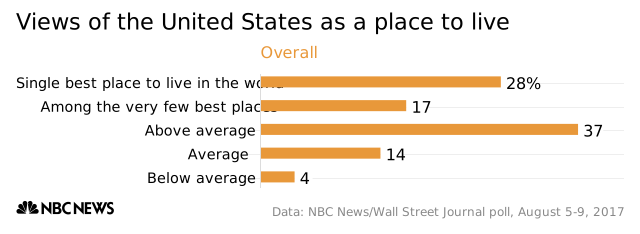
But there is an important group that doesn’t really believe in American exceptionalism: the American public. Here is a result from this week’s Wall Street Journal/NBC poll:

It looks as if most Americans think the US is above average as a place to live (I agree, by the way), but that just over a quarter think it’s the single best place in the world. Asked to rate the “national character,” the median respondent gives us a score of 5 out of 10, down from 6 out of 10 in 1998. This survey question makes no explicit mention of other countries, and it’s possible that people would rate every other nation’s character lower than ours–but that seems unlikely for the people who rate us 5 or lower.

The claim that America is “is freer and more democratic than any other nation” is empirical. It begs for comparative statistics. Freedom House rates the US 89 on freedom, a good score but 11 points below Sweden’s perfect 100. Maybe they’re wrong, but ranking the US number one in the world certainly requires evidence. It’s not a test of patriotism but a hypothesis about the world.

One might focus instead on prosperity and economic dynamism. But the enormous comparative advantages that we held as result of the Second World War have faded away, and we now represent just 4% of the population of a competitive world in which lots of nations, small and large, inevitably score economic successes.

This gap between a rhetoric of unique superiority and the facts seems to cause profound anxiety. In 2016, Trump positioned himself as the candidate who believed that the US should be better than every other nation but had lost that status due to feckless politicians. He often asserts that we are worse off today than anyone else–for example, that our tax rates are uniquely high, as if we were the socialist exception in a neoliberal world. Clinton took the view that we were “already great.”

Both positions could be seen as responses to anxiety. Valid criticisms of the American past (slavery and segregation, especially) have perhaps fueled this anxiety by suggesting that we were never exceptionally great to start with. That’s a raw point for people who think that our exceptionalism is threatened.

Three issues to think about:

  • To what extent is the US actually “exceptional”–not in the sense of better, but different? We are unusual (but not actually unique) in our degree of racial diversity. We have the oldest constitution in the world. We have no way to call an early election to end a failing administration. We have never had a socialist government, but our left has a robust alternative tradition of pluralist populism. We are the birthplace of the Civil Rights Movement and its philosophy of politics. We fought a civil war over the question of slavery in which 750,000 died. We tend to think of ourselves as a commercial republic instead of, for example, a social democracy, a social market economy, or a consensus model. We may once have had a high degree of economic mobility, but now we do not. We once had a very strong voluntary sector, but it, too, is now probably weaker than those in other nations. We are a Petri dish for new religions, some messianic in nature; and we are more religious than other advanced economies. These are just examples of ways that we are, or once were, unusual.
  • Underlying most claims of exceptionalism are normative positions: assertions that some aspects of our society are not just unusual, but valuable. What values that are plausibly associated with the US are worthy of praise? Should we be proud because we have a tradition of laissez-faire economic policies? Or because of the New Deal and its legacies?
  • What attitude should an American citizen hold toward the US Republic? Favoritism over other countries? An even-handed and detached stance toward the US as just one of many countries? For myself, I would say: a special, focused responsibility for awakening the better angels of our nature.

See also: the new history warsAmerican exceptionalismBritish exceptionalism: how the UK is different from Europeshould we teach patriotism?; and a palindrome (a poem on America).