Category Archives: Uncategorized

Sinclair and Bezos: media ownership and media bias

These two stories ran on the same page of the print New York Times on April 2: “Sinclair Videos Renew Debate Over Media Ownership” and “To Trump, It’s the ‘Amazon Washington Post.’ To Its Editor, That’s Baloney.”

Both articles are about possible bias in powerful, for-profit media companies. Donald Trump has opinions on each case. He thinks that Sinclair (which owns 193 local TV stations) is a “far superior” media company that is being smeared by liberals. But he suggests that the “Fake News Washington Post [is] being used as a lobbyist weapon against Congress to keep Politicians from looking into Amazon no-tax monopoly.”

I start with the opposite assumptions: Sinclair is a creepy would-be monopolist, while the Washington Post holds power accountable. I’m no fan of Amazon, but I assume that Jeff Bezos’ investments in the Post strengthen democracy by enabling the newspaper to do more investigative reporting. I see two threats to the First Amendment: Sinclair’s goal of owning more than 200 local TV stations, and a president–who sits atop a regulatory state–threatening the owner of a newspaper.

But imagine that you admired Trump rather than despising him (as I do). You might then reverse the polarity. The biggest threat might seem to be the billionaire with the national newspaper. You might be a little cynical when the Post‘s executive editor, Martin Baron, says, “There isn’t anybody here who is paid by Amazon … Not one penny.” Technically true, but Bezos, who makes his money from Amazon, bought the Post for $250 million, and, “Buoyed by [these] new resources, it has added more than 200 newsroom employees.”

I want to control corporate influence on politics, but when people point out that newspapers also influence politics, and they are corporations (or owned by corporations), I cry “First Amendment!” When Rupert Murdoch builds Fox News, I see a billionaire colonizing the public sphere, but when Bezos expands the Post, I am grateful to him.

It’s important to be principled, not arbitrary or reflexively partisan, in making such judgments.

The economics are complex. You can make money selling news that you don’t agree with, or lose money by selling views you like. (Generations of owners of The New Republic will testify to that.) There is evidence of media effects: news companies change public opinion. But consumers also choose which news to buy and thereby affect the production of news.

The sociology is complex. Sinclair Broadcast Group is a publicly traded company that maximizes returns for its shareholders. It is also an organization with a CEO and other leaders who have leverage over the shareholders. And it employs reporters, who can be understood as members of a profession that is committed to the public good. It would be naive to ignore the corporate structure, but cynical to ignore the professionals. An anonymous anchor interviewed by Maxwell Strachan said,

most of the people who are commenting on this have never even watched our local newscast. … They see that we’re a Sinclair station. They assume what they want to assume about it. But we produce good news here. Sinclair does not tell us what to cover, who to talk to, or what to say in terms of local coverage. Our local news, it doesn’t have bias. If people are looking for it, they won’t find it. So don’t call me a zombie. I do damn good work on a daily basis and anybody in my community would tell you that.

Whether he is right or not, his point that many critics have never watched a Sinclair Station’s local newscast applies to me.

Finally, the politics is complex. I have no doubt that Donald Trump is a terrible leader, but I choose to consume news that mostly reinforces that view, and I rarely delve deeply into the other side. We should make judgments and take a stand. Forming a judgment is not a form of bias. But we must recognize our fallibility.

Ultimately, you can’t render appropriate judgments without taking a closer look at both the products of these companies (Are their stories any good?) and the detailed ways in which they work. I presume that the Post has a strong firewall between its business operations and its newsroom, but that is an empirical assumption that can be tested. I find this kind of language in Sinclair’s employee handbook disturbing: Sinclair “may monitor, intercept, and review, without further notice, every employee’s activities using Company’s electronic resources and communications systems.” But I don’t know whether anything similar applies at the Post.

All of this plays out in a marketplace. We’d like journalists to have market power over their employers. But for newspaper reporters, the market is terrible:

According to a new Knight Foundation report, “In the decade since the last recession hit, newspapers have shed 26,300 newsroom employees — 46.1 percent of total employment. … In contrast, local TV news employment is up 4.9 percent in that same time frame, and most TV newsrooms are at their highest level of staffing ever.” Many stations are hiring former newspaper reporters and editors.

Despite the rising number of employees in broadcast journalism and the generally tight labor market, Sinclair has leverage over its employees, perhaps because there are just a few TV stations in any community. The anonymous Sinclair anchor says,

These jobs? they’re very hard to come by. And if I quit, I owe the company 40 percent of my salary, plus a percentage of the [redacted] years remaining on my contract, plus any bonuses that they’ve paid to me and any reimbursements that they’ve paid to me. And they’re going to take me to court for it. And in the time that I’m in court, I’m not employable.

See also: media literacy and the social discovery of realitydon’t confuse bias and judgment.

new research on youth and nonviolence

While the student anti-gun student movement attracts national attention, two new publications have arrived in my inbox that address youth engagement in nonviolent social movements. Both depict youth as peacemakers rather than victims or perpetrators of violence, but both require significant caveats.

Taylor et al. provide a useful literature review with mixed findings. In some studies, exposure to political violence and abuse during childhood predicts more empathy and more civic engagement–even in some of the worst situations in the world. That suggests that youth can be peacemakers rather than victims of violence. In other studies, the relationships are negative.

Using a longitudinal dataset from Northern Ireland, the authors find (if I understand their complex statistics correctly) that kids who have seen more sectarian violence and discrimination by age 10 are more empathetic and more engaged in their communities, but that prolonged exposure to such violence reduces engagement. Empathy and engagement are positively correlated, but engagement falls for everyone during the teen years.

Dahlum finds that “Campaigns with a high degree of involvement by students and educated protesters are more likely to be nonviolent” and “Campaigns with a high degree of involvement by students and educated protesters are more likely to succeed”–but the latter is only true because students and educated protesters are more likely to opt for nonviolent strategies, which are more successful than violence. (See Why Civil Resistance Works.)

A casual look at Dahlum’s article, which is entitled “Students in the Streets,” might suggest that this is a study of youth. She is actually focused on people of all ages who have a lot of education. That is basically a proxy for social advantage. For example, she mentions a movement in Bangladesh that was led by “students, doctors, lawyers, [and] intellectuals,” among others. That is not a description of an age group but of a social class.

Dahlum combines students with graduates (of any age). If we view them separately, students have these characteristics:

  1. They tilt toward the young. Even in very poor countries, many (and often most) 7-year-olds are students. But nowhere are most 75-year-olds in school. Not only are students experiencing childhood, adolescence, or young adulthood as developmental stages, but they represent the newest generation in any society. (See this post on age versus generational effects.)
  2. They tilt toward the upper socio-economic tiers, because education is an expense and a path to income and power. This tilt varies by country and by age. Seven-year-olds in Sweden are students regardless of their social class. But at age 20, only the elite in many countries are still in school.
  3. Being a student is an occupation, a way of life. It may facilitate social activism because schools and colleges concentrate large groups of peers in places where they can be mobilized (or mobilize themselves); because they often are better protected against retaliation than many workers are; and because institutions devoted to learning are good places to spread news and ideas. (See also: why do students sometimes lead social change?)

Therefore, students often play disproportionately important roles in social movements. But that is only partly a matter of age and generation. Social class and occupation are also relevant.

Sources: Dahlum, S. 2018. Students in the Streets: Education and Nonviolent Protest, Comparative Political Studies, April 2, 2018 (online); Taylor, L., Merrilees, C. E., Baird, R., Goeke-Morey, M. C., Shirlow, P., & Cummings, M. (2018). Impact of Political Conflict on Trajectories of Adolescent Prosocial Behavior: Implications for Civic Engagement. Developmental Psychology (online).

the emperor’s new wall

Donald Trump says that his border wall is being built; yesterday, he even tweeted pictures of it. Today he added, “We started building our wall, I’m so proud of it. We started. We have $1.6 billion. You saw the pictures yesterday. I said what a thing of beauty.”

The budget he signed into law provides $341 million “to replace approximately 40 miles of existing primary pedestrian and vehicle border fencing along the southwest border using previously deployed and operationally effective designs, such as currently deployed steel bollard designs, that prioritize agent safety; and to add gates to existing barriers.”

But the President can have what he wants: a tweet about his own success. Almost 100,000 people clicked to like it. They could feel the #MAGA. Meanwhile, we don’t have to pay for a wall. It has no environmental impacts. Pronghorn antelope may still roam back and forth at will. I assume our neighbors in Mexico realize the wall is not actually taking physical form in the universe that we inhabit as corporeal creatures.

So everyone wins. Could this be the model for solving other problems in the Trump years?

the 2018 Youth Electoral Significance Index (YESI)

From CIRCLE today:

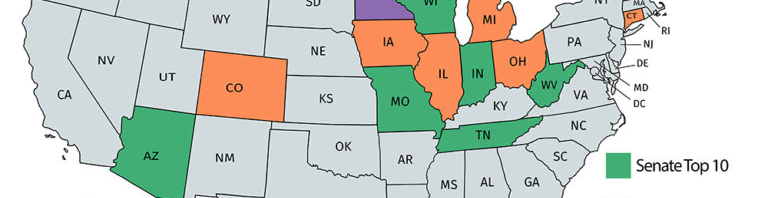
CIRCLE’s updated Youth Electoral Significance Index (YESI) is a valuable tool for any individual, campaign, organization, or institution that seeks to increase youth political engagement. Earlier this month, we highlighted the top 10 congressional districts where young people might have an especially high electoral influence. Today we are releasing the top 10 senate and gubernatorial races where young people have the potential to do the same. The YESI can help stakeholders identify places where additional efforts and resources to turn out the youth vote could be decisive. It can also be a tool for equity and broadening engagement, if efforts focus on reaching those not yet engaged in the top-ranked locations.

Please click to Explore the Interactive Index  or Read the Full Report and Methodology

should Democrats play constitutional hardball in 2019-20?

In How Democracies Die, Steven Levitsky and Daniel Ziblatt use comparative evidence to argue that democracies rely on two “soft guardrails”: constitutional forbearance and mutual toleration.* Forbearance means that political actors refrain from using all the powers that the written text of the constitution affords them. Regimes rarely survive once politicians routinely honor the letter but not the spirit of the rules. Toleration means explicitly acknowledging that the other side has a legitimate place in politics, a right to its views, and a right to govern if it wins elections.

We are perilously close to losing both constraints. This won’t be the first time in our history, but then again, our history has involved major breakdowns, like a Civil War that killed 620,000 Americans.

If Republicans beat expectations in 2018 and 2020, both parties’ behavior is predictable. Republicans will remain behind Trump because their base likes him and because the whole party will be winning under his banner. Democrats will resist as aggressively as possible, but with built-in limitations.

The choices for both sides will become much harder if the Democrats do well in 2018 and then 2020, capturing at least one house of Congress and then maybe the whole federal government. The Republicans’ choices will then be:

  1. The GOP stays Trumpian. This is what their base wants. Their losses will have been concentrated in swing districts and among independent-minded incumbents who tangled with the Trump base. The remaining party will be all-in for Trump. Since this scenario assumes that they lost ground in elections, they will be even more hostile to the political system, the media, and the Democrats, now seen as clearly rigging the system against real Republicans.
  2. Or the GOP turns into a principled conservative party that is skeptical of ambitious government, resistant to both taxation and public debt, and committed to constitutional restraint, including a restrained presidency. It presents that package as attractive to younger and more diverse voters and grows less demographically distinct from the Democrats.

Meanwhile …

  1. The Democrats play what Mark Tushnet calls Constitutional Hardball. Because they lost a Supreme Court seat when the Republicans wouldn’t even consider Merrick Garland, they return the favor and refuse Trump any new appointments. They launch aggressive investigations against Trump, his family, and his cabinet, focusing on potential financial crimes. They lay the predicate for impeachments and then prosecutions. They shut down the government over budget disputes, reckoning that Trump will send undisciplined tweets that will make him look at fault. If a Democratic presidential candidate wins in 2020, they drive through political reforms that advantage them in subsequent elections. In short, they decide not to be rolled, and also that their substantive policy goals require strong action.
  2. Or the Democrats try to restore mid-20th century norms of constitutional forbearance and partisan toleration. That doesn’t mean that they seat Trump’s Supreme Court nominees or refrain from investigations, but they try to follow the traditional procedures. For example, they bring Trump’s nominees up for votes but vote nay, and they make their investigations as focused and as bipartisan as possible. Democrats look to peel off independent-minded Republicans who are uncomfortable with Trump’s style and go out of their way to honor these colleagues.

Game theory is tailor-made for situations in which two players can make independent choices and the result is a single outcome. Here is a guess about how these choices would play out.

Democrats play “Constitutional Hardball” Democrats try to restore cooperative norms
Republicans stay Trumpian Democrats probably win on policy–increasingly so as the demographic trends favor them. Republicans retain 35% of the population that is overwhelmingly white and Christian and increasingly angry. The GOP still dominates some states and regions. Right-wingers give Democrats rationales for using increasingly hardball tactics. Political violence grows. Democrats are corrupted by the lack of legitimate checks. Democrats get rolled on policy. Possibly they expand their electoral power as a result of demographic trends plus a reputation for being responsible (if their forbearance is widely understood as such). Possibly they just look weak, and lose.
Republicans shift to principled conservatism Perhaps the Democrats prevail on policy and grow stronger due to demographics. Or perhaps they further erode confidence in government and thus strengthen principled conservatism, which wins elections and policy battles. The republic is safe. Democrats make incremental progress on policy, but Republicans offer a conservative alternative that sometimes prevails.

This is pretty close to a Prisoner’s Dilemma (PD), with the best option for all being the bottom-right, yet both sides have strong reasons to choose the other course. It’s a little more complicated than a pure PD because it plays out over time. The options and payoffs depend on the precise circumstances of the moment–say, in 2019 with a Democratic House and a narrowly Republican Senate, or in 2021 with (hypothetically) a newly inaugurated Democratic president. But versions of the choices arise at each stage, from congressional primaries today to legislative strategies in 2021.

*See pp. 7-8. However, my comments are based on hearing the authors speak, not having read their whole book yet.