Category Archives: Uncategorized

demystifying graduate education in the USA

On Sunday, I met with about 65 students at An-Najah National University in Nablus, the West Bank. For about two hours (until our time ran out), they asked me questions about how to pursue graduate education in North America or Europe. Our conversation helped me see that our system must seem mysterious and may be misleading. Here are some points that I found myself making which might be worth sharing with others. …

Generally, you should apply to a graduate program and seek financial aid, which can mean free tuition plus a stipend for a teaching or research assistantship. You should aim not to pay for a graduate degree in the social sciences, humanities, or natural sciences. An admission offer without a financial package is probably not desirable.

You could apply for scholarships in your field that can be used at any institution, but those are extremely competitive. You are much more likely to get support from the university where you enroll, and you should apply for admission even if you know that you couldn’t afford the tuition. You should expect a conversation/negotiation about financial aid.

If you aspire to a PhD, you should apply to a PhD program and receive an MA along the way. In general, you should not seek an MA in your field before applying for a PhD.

You should view MA programs with some skepticism unless they offer substantial financial aid. Professional masters degrees, such as MBAs and MPHs, may make more sense economically, since they can make you more competitive for desirable jobs. But even those require a careful cost/benefit analysis.

Yes, you can wait until after you have graduated with a BA to apply for graduate school. In fact, many programs prefer candidates who have several years of work experience. (This may be less true in the liberal arts than in fields like public policy and law.)

A lengthy graduate program is not worth the years of your life unless you think that you would enjoy those years. But graduate school can be a good experience if the topic interests you, the financial package is manageable, and you would like to live in the community where the university is located. If you pursue a graduate degree just for the outcome, the program should be brief and/or clearly profitable, which may be the case for an MD or a PhD in engineering.

Speaking of “where the university is located,” the USA is a big and diverse country. For anyone, pursuing graduate school will be a different experience if that means living in New York City versus a small Southern college town. For a Palestinian, the difference may be even more important (which is not to say that NYC would obviously be better).

To differentiate yourself from other applicants with equally good grades and scores, you need some depth of knowledge and experience on a particular topic. Your experience may be academic (for instance, a research project), or applied, or both. If you’re at an early stage and you don’t have this kind of depth, a first step is to find a mentor in your own university or community. By the way, you will need references, and mentors can provide letters.

Your application essay should reflect your personality and the admissions criteria of the specific program to which you are applying. That said, if you need a generic template for an essay, consider addressing these three questions: 1) What have you done so far in this field? 2) What do you want to learn in graduate school? 3) What do you want to do with what you’ve learned?

If you want to collaborate remotely with an American academic, don’t email and say you want to do research. Send an email that demonstrates specific understanding of the recipient’s own research and propose new research that would contribute to that person’s agenda.

We also talked a bit about visas and the climate for Palestinians in the USA, but I have focused this blog post on admissions and financial aid because I feel better informed about those issues, and my thoughts might apply to people from other countries.
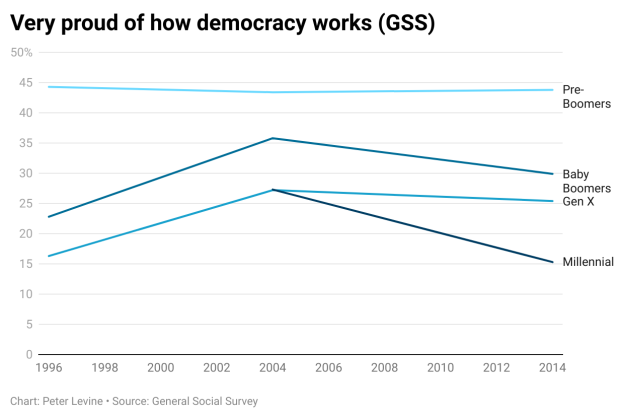
Americans’ pride in democracy, by generation

As a trustee of the Charles F. Kettering Foundation, I’m proud of our new partnership with Gallup called the Democracy for All Project, which released the first results of a national survey yesterday. That study shows broad support for democratic values and cultural diversity.

The survey finds that commitment to democracy rises with age and is lowest among adults under 30:

I show the percentages who agree that democracy is the best form of government. Among youth, another 35% are neutral and 12% disagree. The lower level of support among younger people is an important issue. I also recommend CIRCLE’s April 2025 report on that topic.

Here I’ll add a historical dimension. Although I haven’t found precisely the same question on surveys going back decades, the General Social Survey (GSS) did ask a relevant item in each decade from the 1990s through the 2010s. In a battery about which aspects of the country made people proud, one question asked about pride in democracy.

As shown in the line graph above this post, each generation has been somewhat less proud than its predecessors, but Boomers and Gen-Xers showed increasing pride as they grew older from 1996-2004 and were prouder in 2014 than they had been two decades earlier. On the other hand, Millennials lost a lot of pride in democracy between 2004 and 2014.

I am not sure how I would have answered that question at those times. I am committed to democracy but not necessarily “proud” of the way it functions in the USA. Nevertheless, the GSS trends show that today’s differences by age are fairly typical, and people change their views as they go through life and as history plays out.

This background might discourage us from assuming that something has recently gone wrong with civic education in K-12 schools or that the current media environment is uniquely toxic. Both civic education and media deserve attention, but not because of a unique generational gap in the present.

(The GSS data are here.)

The City, by Cavafy

Constantine Cavafy wrote “The City” in 1894. This poem doesn’t speak for me or articulate feelings that I happen to hold. But it is a famous work that is difficult to render in other languages, particularly because the original is densely rhymed. I gave it a try:

You said: I will get out of here, I will leave.
Some other place will be better than here.
Here everything I write comes back as a jeer,
And here my heart feels buried like a corpse.
Can my mind still bear what withers and warps?
Wherever I look, where I turn my eye,
I see black ruins from my life gone by.
Here, where time has dragged on without reprieve.


You will find no new places, no other coasts.
This city will follow you. You will return
To the same streets and quarters in turn.
In the same neighborhood, you will grow old.
You will turn white in this very household.
You will always arrive back at this station.
Stop hoping for any other destination.
There is no ship for you, there is no road.
Just as you ruined your life in this abode,
So you have ruined all the world’s outposts.

Last summer, I read a most of Lawrence Durrell’s Justine, which is an homage to Cavafy and his city (Alexandria) and concludes with Durrell’s loose translation of this poem. However, I quit before the end because I didn’t like the characters and found the novel’s evocation of Alexandria fervent yet vague. I thought this remark by a character (not the narrator) rang too true: “Justine and her city are alike in that they both have a strong flavour without having any real character” (p. 125).

See also: “Complaint,” by Hannah Arendt, which begins “Oh, the days they pass by uselessly …”; and Istanbul melancholy. (Pamuk loves Cavafy’s “The City.”)

The Lost Art of Organizing Civic Groups

I have a piece in the current edition of the American Bar Association’s Human Rights Magazine (with free access), entitled “The Lost Art of Organizing Civic Groups” (Nov. 5, 2025).

The main points:

  • Democracy relies on participation in autonomous civic groups, but engagement has declined due to the erosion of unions, grassroots political organizations, and participatory religious communities. 
  • Many Americans lack the organizational skills needed to sustain civic groups, especially in today’s fast-paced, informal culture, but there are tools and legal guidance that can support new organizers. 
  • Lawyers and community leaders must help rebuild the infrastructure of civic life to preserve democratic values.

I thought the last point was worth making to an audience of lawyers, because they have useful training to help groups with documents and policies. Some groups may need official legal advice.

At the same time, many of the most important documents are less formal and do not require a lawyer. The Civic Helpdesk on this website can draft many documents for you.

moving to the center is a metaphor, and maybe not a good one

There is a huge debate underway about whether Democrats should move toward the center of the political spectrum or to the left. As usual, many people who want the party to land at their preferred point on the spectrum also argue that this would be the best electoral strategy, although those are separate issues.

Some observers note that shifting one’s ideological placement is a poor tactic because, as G. Eliot Morris told Paul Krugman, “voters have very poor understanding of what candidates actually stand for at the issue-position level. They also have a very poor understanding of what these ideological labels: moderate, progressive, really even mean.” He also says, “the vast majority of the American public is not consuming the type of information that you would need to know, first off, what issue positions politicians hold and second, what the ideological labeling, the orientation of those, what those issue positions are.”

For some progressive commentators, this kind of evidence counts against moving to the center. A centrist platform won’t help win elections if voters are unaware of candidates’ positions. But the same evidence would also argue against moving to the left. If we assume that people don’t know enough to evaluate policies, and a candidate can equally well propose anything–well, that is a cynical theory and a depressing one if it’s true.

I take a different view. I observe that voters are heterogeneous. They care about various issues, believe various kinds of information that they derive from various sources, identify with various social groups, feel various ways about each major institution (experiencing emotions that range from trust and respect via obliviousness to contempt or fear), vote–or don’t vote–for various reasons, and consider various combinations of policies, personal characteristics, demographic markers, and perceived performance when they assess candidates.

One interpretation is that people are naive or “innocent” about ideology (Kinder & Kalmoe 2017). They have, as Morris says, “a very poor understanding” of the ideological spectrum. I would counter that the ideological spectrum is just one way of organizing beliefs, and probably a poor one. We shouldn’t allow the seating arrangements of the French National Assembly in 1793 (when the Jacobins sat to the left and gave that word its political significance) to mesmerize us. People who organize their political thoughts in other ways may have insights.

Consider John, a major character in Farah Stockman’s nonfiction book American Made: What Happens to People When Work Disappears. John is a union activist who comes from a long family tradition of militant unionism, originally in Kentucky. He knows a great deal about trade policy. Some of his most important sources of news are union publications. There is a Confederate flag in his basement, which has meanings that he may not want to acknowledge but that also stands, in his own mind, for Appalachian workers against elites. Most deeply, he divides the world between workers and managers. He hates talk of “white privilege” because he feels oppressed as a worker. He wants the union to fight the company, and he voted for Trump in 2016. His wife is more favorable to management. On that basis, he describes her as a “liberal.” He is surprised when a Republican politician doesn’t seem to favor US workers over managers, as he would expect.

I disagree with John in many respects, including the way we use words like “liberal.” Still, I could learn a lot from him about trade policy and industrial issues. He is not “innocent” of ideology. (If that flag is anything, it isn’t innocent.) Not is he ignorant or uncaring. He just organizes his beliefs about the world very differently from me because of his accumulated experiences.

If most voters agreed with John, then candidates would be wise to favor both unions and tariffs and to oppose race-conscious policies. But that is not my point. John represents one sliver of a very heterogeneous electorate. A policy recipe that would appeal to him would not work for many others.

I should acknowledge that I know what people mean when they distinguish progressive politicians from centrists. This distinction conveys information to me. If all I know is that politician A is to the left of B, then I will be biased in favor of A. But the information I can glean from these labels is limited, reflecting just one way of organizing the political debate. It is a signal with a whole lot of noise. I would much rather know more than which candidate is considered further left according to a certain elite discourse.

Policy positions do matter, and no one should treat the electorate as ignorant. But it is literally impossible to move to the center–or to the left–if there is no common spectrum.

If you are a candidate, you should generally adopt the policies that you believe are best and advocate for them. If a specific policy is unpopular among swing voters in your constituency, you might need to compromise on it, because you can’t accomplish anything if you lose the election.

You should consider the pros and cons of proposals that elites and specialists would classify as belonging to the left, and the center, and the right. The ideological label of a policy does not tell you whether it is smart.

However, you shouldn’t adopt a miscellaneous list of policies. You should present your ideas coherently. You need a narrative or core theme. But each candidate’s thematic coherence may look distinctive.

You should demonstrate respect for the electorate by endorsing and defending specific positions. But you should also realize that your policy platform is just one factor. At least as important are your biography and record, your rhetorical style, and your modes and methods of campaigning.


Sources: Donald R. Kinder and Nathan P. Kalmoe, Neither Liberal nor Conservative: Ideological Innocence in the American Public (University of Chicago Press, 2017); Farah Stockman, American Made: What Happens to People When Work Disappears (Random House, 2021). The classic source for the idea that American voters do not understand ideology is Phillip E. Converse, “The nature of belief systems in mass publics (1964)” reprinted in Critical Review 18.1-3 (2006): 1-74. Converse does acknowledge that if people’s opinions are “idiosyncratic,” then we will find “little aggregative patterning of belief combinations,” because people may “put belief elements together in a great variety of ways” (p. 44). For him, this would be evidence of ignorance, but I would observe heterogeneity instead.

My own work on this topic includes: “People Are Not Points in Space: Network Models of Beliefs and Discussions.” Critical Review 36.1-2 (2024): 119-145; and “Mapping ideologies as networks of ideas.” Journal of Political Ideologies 29.3 (2024): 464-491.