Category Archives: Uncategorized

Center on Democracy and Organizing Summer Institute 2019

I’m posting the following announcement with my enthusiastic recommendation. The Principal Investigators of the Center for Democracy and Organizing are the extraordinarily talented and engaged scholars Lisa Garcia Bedolla, Hahrie Han, and Taeku Lee. More information here.

The Center on Democracy and Organizing (CDO) seeks applications from advanced Ph.D. students and early career researchers and organizers for participation in a summer training institute in 2019 focused on the study of democracy and organizing. The institute will be held from July 31 to August 2 at the University of California, Berkeley. This summer institute will bring together faculty and practitioners interested in developing the capacity to do engaged research in partnership. This dynamic and interactive institute will give participants—10 researchers and 10 practitioners—the chance to learn to work together on research projects that help practitioners advance their strategic goals.

The institute will focus on articulating the benefits of building research partnerships between  academics

and organizers, developing the capacities needed among both academics and organizers to work together, and creating the opportunity for researcher-organizer pairs to work directly on a project of interest. The institute seeks to reframe how graduate students and early career scholars understand their role as researchers, focus on the ways engaging with practitioners can deepen and improve their theorizing about the socio-political world, and also help practitioners and scholars develop a common language in order to engage as equal partners in the research process.

Researchers and practitioners with similar interests and goals will either be paired by CDO, or can apply as a pair.

This institute is funded thanks to grants from the Ford Foundation and Open Society Foundations. Travel (U.S. domestic economy-class round-trip airfare), food, and lodging will be covered for accepted applicants. In addition, participants will be eligible to apply for seed funding of up to $5,000 from CDO to carry out research projects conceived and developed through the institute.

who must be included in which meetings, committees, and movements?

At a recent meeting, we discussed people who should be encouraged to join the effort we were working on. We quickly listed demographic categories that we should pay attention to: race and ethnicity, gender and sexuality, age, class, ideology, partisanship, and religion.

I think these categories are important for outreach and recruitment–but importantly different.

Race, gender, and sexual orientation

Race, gender, and sexual orientation matter because we live in a society that is deeply unequal on those dimensions. Unless you seriously strive for equal representation, you are likely to end up with a panel or committee full of straight white men–and the more influential and prestigious the group is, the more that will be the outcome. Failing to address it preserves inequality.

A demographically homogeneous group may also lose the wisdom that comes from a wider range of perspectives and experiences, but to me, that is not an essential argument. Sometimes, adding racial or sexual/gender diversity won’t actually add relevantly different perspectives on the issue under discussion, but inclusion is still important for addressing inequality in the society as a whole. There is often also a pragmatic imperative for improving racial and gender representation. Without such diversity, a group looks illegitimate and can’t win the support it needs to move forward.

I would equate religion with race/ethnicity insofar as it’s an identity that provokes discrimination by others. As a set of beliefs about the world, a religion is more like an ideology, which I will address below.

Social class

Our society is also unequal by class, but this is different. Class is a name for social inequality. It doesn’t make sense to imagine a society with different classes that are equal to each other. If you have equality, you don’t have classes at all. However, it is not clear that a classless society can be accomplished. State communist societies produced the nomenklatura, a powerful new class or (as Trotsky thought) a caste composed of party officials and their families. According to Robert Michels, social democratic parties and unions quickly created “oligarchies” of professional organizers, notwithstanding their sincere commitments to equality. By virtue of being a union official instead of a unionized line worker, you are now part of a different class.

If you organize a meeting of people who hold a certain range of positions in society–a meeting of union leaders, or teachers, or leaders of nonprofit organizations, or college students, or miners–it will have a class “bias.” Yet surely there is value in such meetings. It wouldn’t be reasonable to argue, for example, that teachers should never organize except along with students, parents, and others. But if teachers organize, that is a middle class movement.

Therefore, it is a bit disingenuous to imagine that you can be “inclusive and diverse” with respect to class. But you can strive (1) to be inclusive of people who have various class origins and cultural markers of class, such as accents; and (2) to organize meetings and movements that engage grassroots participants, not merely leaders and experts. But (2) is hard. After, who will organize, pay for, and advertise the big meeting that is open to the public as a whole? Surely some kind of specialized subgroup will be responsible. Michels thought oligarchy was an “iron law,” and even if it’s less rigid than that, there is still a powerful tendency for people who hold certain social positions to run things. That’s what it means to have those positions.

Age

Age is different, too. We should be concerned about including younger people because we should be worried about future leadership and must create opportunities to learn and to develop power. But age equality is not like racial or gender equality. There are actual differences among people of different ages. For instance, senior managerial positions cannot be equally distributed between the young and old. It takes time to develop the experience, expertise, and connections that institutions need.

The House Democrats who will lead important committees if the party wins in November  will include Elijah Cummings, age 67, Bennie Thompson, 70, Maxine Waters, 80, Nita Lowey, 81, and Eddie Bernice Johnson, 82. These are women or men of color who have waited a long time for gavels. To be sure, the party caucus could replace them with younger leaders who were also diverse, but these people’s claims to leadership rest on seniority, and that deserves consideration. I wouldn’t oppose replacing them with younger chairs, but I would insist that age is different from, say, race. It can be legitimate to consider seniority or experience.

Ideology, partisanship, and theology

It’s worth bearing in mind that our goal is to develop the right views so that we can do what is right. The right views are not equally consistent with all ideologies, party platforms, or applications of theology.

In pursuing the right views, we must be humble. It is very likely that each of us is wrong and that others are more right. So we must be open and interested in alternative views.

I am typically a mainstream liberal, center-left. I especially benefit from being an outlier in meetings that are dominated by libertarians/neoliberals or by radical proponents of identity politics. I don’t fully align with either position but always learn from them–usually more than I learn from hanging around other people with whom I easily agree.

Learning provides a rationale for philosophical diversity–but with important caveats. First, some alternative views are more worthy than others. I seek out libertarians but not Trump-supporters to learn from. That is a judgment, and it could be wrong, but it’s my best judgment at this moment. I don’t believe that I have anything whatsoever to learn from Donald Trump himself, yet more than 60 million Americans really like him. Demographic representativeness would argue for including Trump-supporters, but my judgment about how to learn does not.

Furthermore, the value of ideological diversity depends on the purpose of a meeting or event. If I am trying to advance an agenda, I want a majority of participants to share my considered views of the topic. I may value some minority views to keep us sharp, but I’d like the majority to agree with me. I can achieve that goal either by recruiting like-minded participants or by persuading other attendees to agree. I would never treat racial or gender/sexual diversity in a similar way, trying to stack the room with people who were like me. On the other hand, if my goal is to learn, I may prefer to be one of a few participants in a meeting dominated by people who oppose my views, so that I can get a full dose of their perspective.

Conclusion

In sum, race/ethnicity and gender/sexuality make powerful claims for equal representation. Class and age are more complicated; it can be disingenuous to imagine that a meeting can be egalitarian on those dimensions. And ideological diversity is not a good in itself, but intellectual humility and striving to learn are genuine goods that sometimes provide reasons to be ideologically inclusive.

The complication is that race and ethnicity, gender, age, religion, ideology and partisanship correlate in the population. Say you want a meeting of influential people who are in a position to allocate resources, but you also demand racial diversity in your meetings. The most influential people are likely to be predominantly white. Or say you’re a libertarian who is genuinely committed to racial equality (as some are). You’re entitled to form a committee of libertarians, but it’s your problem if they all turn out to be white men.

I think these points of conflict among different kinds of diversity generate some of the hardest issues, both ethically and pragmatically.

See also: what is privilege?the rise of an expert class and its implications for democracyto what extent can colleges promote upward mobility?defining equity and equalitytwo approaches to social capital: Bourdieu vs. the American literature; and a college class on equalitywhen social advantage persists for millennia.
closing remarks at the Bridge Alliance summit

(Posted by request: my remarks at the close of the 2018 Bridge Alliance Members Summit, a convening of “more than 90 respected established organizations committed to revitalizing democratic practice in America,” Washington, DC, Oct 17.)

I’ve been asked to offer some reflections on the day’s discussion.

My first reflection is gratitude to the Bridge Alliance, its whole staff, and to all the Alliance members for all the work you do every day.

My second reflection is anxiety. I admit that in meetings like this, I am filled with anxious questions:

  • Are we big enough? Are enough people and resources here? Do we have enough people with us?
  • Are we diverse enough? The answer to that is clearly no. That is a problem that belongs to the whole network, not to the Bridge Alliance alone.
  • Are we experienced, knowledgeable, talented, and smart enough?
  • Are we unified enough? Today, I was privileged to participate in one small-group discussion in which the axis of disagreement was institutionalist versus insurrectionist: should we try to defend beleaguered institutions such as journalism, science, and the US Constitution, or seek to replace them because they were never good enough? I also participated in a good discussion about ideology: should we aim to be maximally inclusive or neutral, or rather develop a distinctively pro-democratic stance that some may support more than others do? These kinds of disagreements seem to threaten our unity.

What we know about social movements may be helpful. I have in mind two kinds of movements. One is the coalition or network that works for “healthy self-government”–in other words, the organizations that are in this room. As a group of groups, we could gain more of the “fizz” of a movement. Meanwhile, we see actual movements around us: #MeToo, #BlackLivesMatter, #NeverTrump, and the Tea Party. They could operate in ways that have more collateral benefits–and do less collateral harm–to democracy.

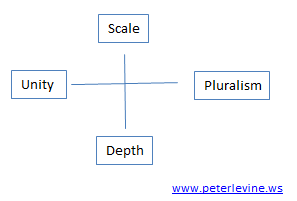
My reading of the social movement literature suggests that social movements succeed when they have four qualities:

Size: Movements need many members, organizations, and resources. Erica Chenoweth says that no nonviolent resistance campaigns in her large database have failed if they have “achieved the active and sustained participation of just 3.5% of the population—and lots of them [have] succeeded with far less than that. … In the U.S. today, this means almost 11 million people.” If 11 million people came together for a reform, it would probably happen.

Depth: Participation must develop the members’ commitments, skills, knowledge, and tactics. No group begins smart enough to win; they must learn. In Stride Toward Freedom, Martin Luther King writes, “Human beings with all their faults and strengths constitute the mechanism of a social movement. They must make mistakes and learn from them, make more mistakes and learn anew. They must taste defeat as well as success, and discover how to live with each. Time and action are the teachers.”

Unity: Social movements always present themselves as unified, because that is a source of strength. Hence the hashtags, armbands of a single color, protest songs, and mass demonstrations.

Plurality: Social movements need diverse perspectives, skills, and assets. They need both insiders and outsiders, both romantics and pragmatists. They should be demographically diverse, too, although that doesn’t always mean reflecting the demographics of the whole country. The Big Six leaders of the American Civil Rights Movement were all Black men. It wasn’t great that they were all men, but it was good they were all Black. The movement needed African American leadership and was rooted in the Black community. Still, their diversity of backgrounds, stances, and skills was essential. Randolph was a union leader, King a pastor and theologian, Lewis a youth leader, and so on.

Unfortunately, size conflicts with depth, and unity conflicts with plurality. It is very hard to have a large movement that also affects most of its members deeply, or a diverse movement that also achieves unity.

These four qualities spell SPUD, and we need more of it (even if it sounds like a lot of carbohydrates).

In interviews that Eric Liu and I conducted for “America’s Civic Renewal Movement: The View from Organizational Leaders,” Scott Reed of the faith-based PICO network said that his organization “invests lots and lots of time to connect with people and develop relations.” But “scale is what we are trying to figure out … because we are nowhere near where we want.” In short, PICO has U and D and some P, but no S. Meanwhile, Anna Galland of MoveOn acknowledged that her online organization has “tremendous scale and little depth.” MoveOn’s goal, she says, is to “move from a list of 8 million to horizontal connectivity.” MoveOn has S and U but no P or D.

SPUD is in short supply in the US as a whole. But I would suggest two reasons for hope.

First, the Bridge Alliance is not just the people in this room: organizational leaders. It encompasses all the grassroots participants in your many organizations. It is appropriate to gather organizational leaders periodically. But that strategy also has limitations–for instance, it is much harder to achieve true diversity of age and socioeconomic status when you convene the leaders of 501(c)3 organization. If we can convene our many members, we can come much closer to achieving SPUD.

Second, SPUD increases the chance of victory. It pays off. Movements that draw a diverse 3.5% of the population and build their talent and unity almost always win. Therefore, it is in the interest of the powerful movements that we see around us to cultivate SPUD. The more SPUD-ly they are, the more they are likely to win–and the more they will create diverse, empowered, deliberative groups of Americans. That should have deep collateral benefits for our republic. Because many of us are experts on group dynamics, civic education, discussion, etc., we have a lot to offer to our fellow Americans who are invested in social movements with specific agendas.

I hope this makes you less anxious than I am. We have good reasons to be optimistic.

See also: we need SPUD (scale, pluralism, unity, depth)Why Civil Resistance Worksthe power of the NRA in an age of civic desertsso, you want to strengthen democracy?; and a sketch of a theory of social movements.

curiosities from Wikipedia (an occasional series)

From the entry on Norfolk Island, pop. 1,748, which lies 877 miles from mainland Australia:

This common heritage has led to a limited number of surnames among the islanders – a limit constraining enough that the island’s telephone directory also includes nicknames for many subscribers, such as Cane Toad, Dar Bizziebee, Lettuce Leaf, Goof, Paw Paw, Diddles, Rubber Duck, Carrots, and Tarzan.

From the entry on the Scots Language:

The results from a 1996 trial before the Census, by the General Register Office for Scotland, suggested that there were around 1.5 million speakers of Scots, with 30% of Scots responding “Yes” to the question “Can you speak the Scots language?”, but only 17% responding “Aye” to the question “Can you speak Scots?”.

From the entry on Isaac Newton:

As Warden, and afterwards Master, of the Royal Mint, [Sir Isaac] Newton estimated that 20 percent of the coins taken in during the Great Recoinage of 1696 were counterfeit. … Convicting even the most flagrant criminals could be extremely difficult. However, Newton proved equal to the task. Disguised as a habitué of bars and taverns, he gathered much of that evidence himself. … Newton had himself made a justice of the peace in all the home counties. … Then he conducted more than 100 cross-examinations of witnesses, informers, and suspects between June 1698 and Christmas 1699. Newton successfully prosecuted 28 coiners.

See also: strange livesthe European country that spoke Esperanto; and Anson Burlingame and the duel that never happened.

new CIRCLE youth survey: high youth engagement in the 2018 election

From today’s CIRCLE release:

The 2018 midterms have the potential to be historic for youth political participation, with young people receiving campaign outreach, paying attention, and intending to vote at unusually high levels (34% “extremely likely” to vote) that come close to the levels of engagement seen in the 2016 presidential election. Young people who report being actively engaged with the post-Parkland movement for gun violence prevention are even more likely (50%) to say that they’re extremely likely to vote. Our poll reveals strong support overall for Democratic candidates in Congressional elections (45% plan to vote for Democrats, versus 26% for Republicans), but large disparities among different demographic groups of young people, with Black and Latino youth much more likely to support Democratic candidates, young white men actually favoring Republicans, and unaffiliated white youth spreading their support across various parties and ideologies. We also find that, for all the focus on young people’s engagement with political content online, family remains the most important way for youth to learn about the election and the most influential in their engagement and participation.

Much more is here, and this is just the first in a series of analytical posts drawn from a new survey of 2,087 people aged 18 to 24 in the United States, with representative over-samples of Black and Latino youth, and of 18 to 21-year-olds.