Category Archives: Uncategorized

avoiding a sharp distinction between the state and the private sphere

Several political theories and ideologies are invested in distinguishing the state from the private sector (which may encompass the market, families and civil society):

  • For libertarians, the state bears the badge of original sin because it alone claims a legitimate right to coerce violently. That doesn’t mean that we should abolish the state, which plays an essential role in protecting rights, but government requires special controls and constraints because it could not exist without its ultimate power to kill.
  • For strong popular democrats and European-style social democrats, the state alone reflects the people’s will, so it is free from the corrupt influences of money that infect the market and that often spill over into nonprofits. That doesn’t mean abolishing markets, but states should hold the commanding heights and be shielded as much as possible from market influence.
  • For many American constitutional lawyers, the state must be distinguished from voluntary associations because the state alone should be constrained by the First Amendment and committed to neutrality about matters like religion. In contrast, the First Amendment gives voluntary associations the right not to be neutral in their own domains. A university, for instance, may discriminate pervasively in favor of high-quality expression and against poor speech and writing. No one has a First Amendment right to tenure. This constitutional argument fits with certain versions of philosophical liberalism, such as John Rawls’ and Ronald Dworkin’s.

Here is my objection. I don’t think that people experience actual institutions differently depending on whether they belong to the state or the private sector. Phenomenologically, the political and the civil are not sharply distinct.

I had that realization a year or so ago when I was with classical liberals/libertarians in the conference hotel of Michigan State University. I wondered idly whether that was a public or private space. It was not easy to tell, given the complex relationships between a state, its university, and the university’s hotel. But I realized that I had no reason to care. The distinction would make no difference to how I was treated.

I had the same thought again recently in New Haven, the city where I first became politically active three decades ago. We were discussing Ian Shapiro’s fine recent book, Politics Without Domination. I agree with much in it, but not with this distinction on p. 31:

Political institutions are centrally concerned with power. This differentiates them from civil institutions, which, though invariably suffused with power dynamics, are ultimately geared to the pursuit of other goals. … Governments should stay out [of the affairs of civil institutions] unless people’s basic interests are at stake, and even when they are, it is best to seek the least intrusive available means to protect them. But political institutions are different because politics is about power through and through.

Compare a classroom in Shapiro’s university, Yale, with a street nearby in New Haven, and think of the various people who populate these spaces: students, workers, shoppers, professors, salespeople, bosses and administrators in various roles. To students, I think Yale will feel the most like a government, with its centralized authority and formidable power to judge, exclude and punish. New Haven will generally feel more permissive and informal.

If they are activists, students may find themselves working voluntarily with New Haven municipal employees on common goals, like making the city more beautiful or safer. The city employees and the students wear different hats, but they all have complex lives and multiple attachments. A city official is also a parent; a student is also a shopper. The official normally has very limited scope to compel but may have tax dollars to allocate. Those dollars work just the same as the money that students might generate from a fundraiser. Students, other citizens, and workers all contribute to making the city with their bodies, their voices, their purchases, and their choices to stay or to exit.

If we start with a fundamental distinction between the state (with its monopoly on the legitimate use of force) and voluntary civil associations (with their non-political purposes), then we will strive to disentangle hybrid cases–a Yale police officer who carries a gun as a sworn peace officer but gets her paycheck from a private institution; a lab that is funded by the NIH but employs Yale students; a university disciplinary hearing the enforces Title IX; a campus/community event that is funded by the city and philanthropy.

I think such hybridity is not the exception but the norm, because all institutions are composed of people who have multiple identities and objectives. The state is not made up of human beings “centrally concerned with power” but is composed of teachers, accountants, counselors, office managers–just as Yale is. A government or state is not one thing, a leviathan that derives all its powers from its ultimate ability to compel. It is rather a bunch of schools, parks, military units, prisons, welfare offices, scientific labs, deliberative fora, authoritarian fiefdoms, secret agencies, purchasing offices, etc., etc. It is pervasively related to various “private” entities that have similar functions. In New Haven, the Alders have what passes for state sovereignty, but all of them are also mainly other things: business owners, activists, teachers, and one Yale undergrad. When they define and address problems, they probably don’t sharply distinguish their roles.

As Shapiro argues (p. 21), Foucault went too far in seeing every space as equally suffused with domination. A prison is different from a classroom or a clinic. But Shapiro draws the distinction too sharply. A classroom may be no easier to escape than a prison, even if it’s in a private school. Yale may dominate much more thoroughly than New Haven does, and Yale may dominate because of its function as a gatekeeper to a corporate sector that determines what the US government does.

I would propose this alternative view. People are involved with “politics” at all scales, in all sectors, and in a vast variety of forms. “Politics” does mean domination and exclusion, but also deliberation, problem-solving, and co-creation. These are the two sides of the coin, as powerfully illustrated by the Book of Nehemiah.

The venues of politics constantly influence each other, and often those agencies that are officially arms of the state are not the most influential or the most likely to dominate.

We are all subject to domination, prone to dominate others, and capable of improving our shared condition. Our degree of power and vulnerability varies with our social position; to be a just person requires attention to those differences. But there is room for everyone to combat domination, everywhere. And how we manage that task in smaller settings may affect what happens at larger scales. The Tocquevillian argument for the importance of civic culture is that citizens who learn to deliberate, cooperate, and respect each other in associations may be more likely to choose national leaders who do the same.

Elinor Ostrom concluded her presidential address to the American Political Science Association (1996) with a call for a different approach to civic education:

All too many of our textbooks focus exclusively on leaders and, worse, only national-level leaders. Students completing an introductory course on American government, or political science more generally, will not learn that they play an essential role in sustaining democracy. Citizen participation is presented as contacting leaders, organizing interest group and parties, and voting. That citizens need additional skills and knowledge to resolve the social dilemmas they face is left unaddressed. Their moral decisions are not discussed. … It is ordinary persons and citizens who craft and sustain the workability of the institutions of everyday life. We owe an obligation to the next generation to carry forward the best of our knowledge about how individuals solve the multiplicity of social dilemmas- large and small-that they face.

See also polycentricity: the case for a (very) mixed economy; from classical liberalism to a civic perspective; against state-centric political theory; is our constitutional order doomed?the Citizens United decision and the inadequate sociology of the US Constitution; and free speech at a university.


integrating the northeast’s transit systems

I’m on Amtrak, en route from Boston to New Haven. I’ve also been in Newark, Delaware, the Philadelphia airport, and other points along the Northeast Corridor this week. This means navigating portions of a fragmented public transportation network that is composed of long-distance train lines, commuter rail lines, subways, public buses, and even some ferries. It extends from southern Maine well into Virginia, serving a population of 50 million or more.

From NortheastRailMap.com, which offers a large version (of rail only)

In a way, this network is already connected. Google Maps does a fairly decent job of telling you how to get from an address in one city to an address in a different city by public transportation. Since all these transit systems take US currency, your cash or credit card enables you to move from one mode of transit to another. But because the systems don’t coordinate themselves, the whole network is less efficient, useful, and enticing than it could be.

Imagine that the various transportation networks (municipal, regional, long-distance) kept their autonomy–for political reasons and because a behemoth agency might perform worse–but they coordinated closely through a compact. It could have these features:

  1. One ticket (perhaps either a mobile phone app or a plastic card for those without smartphones) would get you from any point to any other point in this network.
  2. Prices would reflect the needs and capacities of the various components. Traveling one mile might be cheaper within one city than another. But there would be opportunities to set prices to increase ridership for everyone’s benefit. For instance, right now, Amtrak is much more expensive than commuter rail for the same itinerary. This is necessary because of Amtrak’s financing. But Amtrak trains are much faster for longer distances, so it would be better for more people to take them. If the whole system subsidized Amtrak, I think more people would ride, and net revenues would rise.
  3. The network could be enhanced where there is demand for more connectivity. For instance, right now there is only one gap in the commuter rail network that otherwise connects Richmond, VA to New London, CT. It’s 2o miles in Delaware. Whether a lot of people would travel those 20 miles by rail is an empirical question–maybe they wouldn’t. But the integrated system could test such questions and fill in the most significant gaps, wherever they are.
  4. The whole system could also invest in “intermodal” connections, places where people change from one kind of transit to another. Transfers would become a little smoother if a single ticket covered your whole journey, but there is still much need for better stations and other facilities. The Intermodal Surface Transportation Efficiency Act of 1991 invested in such upgrades, but I can’t believe it solved the problem.
  5. The whole system could advertise, not only with generic messages about public transit, but also by delivering tailored ads to remind you that you can get from, say, my house in Cambridge, MA to a friend’s house in Washington, DC by a combination of Amtrak and subway rides.

I’m certainly for subsidizing public transportation, but it’s significant that other OECD countries actually charge transit customers more, spend proportionally less government money, and provide much better service for many more people. Once public transportation becomes a welfare good, it may be subsidized, but it is degraded. A unified northeastern system should receive federal and state support, but the ideal is a more attractive business model that encourages the riders to pay more for investments. The goal would be to get a lot more people more efficiently from A to B with a lot less carbon.

British exceptionalism 2: the unique nature of the aristocracy

(Newark, DE) In 2010, I wrote a post entitled “British exceptionalism: how the UK is different from Europe.” It still draws traffic these days, probably because people want to understand Brexit and the roots of anti-“European” sentiment in a country that most Americans consider a part of Europe. My theme was the dramatically different level of economic development in Britain vs. continental Europe ca. 1930. I doubt that such differences explain Brexit, but I remain interested in ways that the UK has diverged from its continental neighbors.

Here’s another way. William D. Rubenstien observes, “In 1789…, it is generally estimated that there were about 250,000 members of the French nobility, but only about 300 members of the British aristocracy!” In France and (I believe) in every continental country, the aristocracy was a substantial caste, delimited by naming conventions and granted hereditary privileges under the law. The French nobility voted away their own privileges during the heady night of August 4, 1789, but until then, they had been exempt from regular taxes while permitted to tax peasants, allowed to wear swords and hunt, guaranteed a separate justice system, and in many other ways, set apart. These privileges applied to whole extended families and were by no means limited to the individuals who held the aristocratic fiefs and titles, from baron up to duke.

In contrast, since the Middle Ages, the English (and then the British) aristocracy consisted of the “peers” who held specific titles, of which there were only a few hundred. These titles were possessions that could be granted, inherited, or confiscated, although not sold. One person held each title at a time (or one couple, if you consider married peers to share in a title). Peers had very limited privileges, such as the right to sit in the House of Lords and be tried there. The rest of their extended families were not aristocrats.

Britain also had (and to some extent still has) a gentry, composed of ladies and gentlemen. Traditionally, they were defined as people who made their living from rents on land, clerical or military offices, or professional fees for lawyering or doctoring–not from labor or “trade.” As economic power shifted to merchants and manufacturers, they increasingly entered the gentry–no longer having to buy land or professionally educate their sons to count as gentlemen.

More like a class than a caste, the gentry has been defined by its social role and power. That makes the borders fuzzy. It creates some opportunities for mobility, and also a stronger ideological assumption that upward mobility (as opposed to equality) is the hallmark of a just society. I’d speculate that this is one reason “neoliberalism” has more of a hold in the UK (especially England) than it does on the Continent.

See also: British exceptionalism: how the UK is different from Europe; two approaches to social capital: Bourdieu vs. the American literaturewhen social advantage persists for millenniasorting out human welfare, equity and mobility; and why some forms of advantage are more stubborn than others.

James Madison in favor of majority rule

The James Madison who contributed to the Federalist Papers is famous for a system of checks and balances meant to limit the power of the majority, because the many might turn against the few and the common good. This was before the United States came into being and before Madison had experience in electoral politics and national office. By 1834, the federal system had operated for 45 years and Madison had held several offices in it, including president. After that experience, he shifted in a majoritarian direction, at least according to this unsent letter. (H/t Ian Shapiro, Politics Against Domination, p. 62).

Madison first says (we don’t know to whom),

You justly take alarm at the new doctrine that a majority Govt. is of all Govts. the most oppressive. The doctrine strikes at the root of Republicanism, and if pursued into its consequences, must terminate in absolute monarchy, with a standing military force; such alone being impartial between its subjects, and alone capable of overpowering majorities as well as minorities.

Madison reviews the arguments that majority rule will become more dangerous as a jurisdiction grows in extent and as it encompasses greater economic diversity, because then huge factions will be able to dominate small and scattered minorities. He counters that differences of interest and identify emerge at all scales, “even in corporations [that] have the greatest apparent simplicity & identity of pursuits & interests.”

Acceding to the majority is generally a better choice than trying to dominate them; and the problem is least serious at a continental scale. The states, for example, are more likely to suffer from conflicts between majorities and minorities than the federal government is, and things were worse in the states before they came under federal sovereignty:

whatever may have been the just complaints of unequal laws, and sectional partialities, under the Majority Govt. of the U. S. it may be confidently observed that the abuses have been less frequent and less palpable than those which disfigured the administrations of the State Govts. whilst all the effective powers of sovereignty were separately exercised by them …

Madison’s argument in favor of majoritarianism is not that doing what the majority wants is automatically wisest and most just, but that it beats the alternatives:

Those who denounce majority Govts altogether because they may have an interest in abusing their power, denounce at the same time all Republican Govt. and must maintain that minority Govts. would feel less of the bias of interest, or the seductions of power.

He concludes with these theses:

[1] no Government of human device, & human administration can be perfect; [2] that which is the least imperfect is therefore the best Govt. [3] the abuses of all other Govts. have led to the preference of Republican Govt. is the best of all governments because the least imperfect. [4] the vital principle of Repub: Govt. is the lex majoris partis, the will of the majority; [5] if the will of a majority can not be trusted where there are diversified conflicting interests, it can be trusted no where because such interests exist every where ..

Madison wouldn’t call himself a “democrat,” because for him (in this letter and elsewhere) democracy means direct rule by the citizens “assembled in mass.” But he would–and did–call himself a “republican,” and for him the “vital principle” of republicanism is majority-rule.

See also: do we live in a republic or a democracy?; a Democratic Republican Federalist.

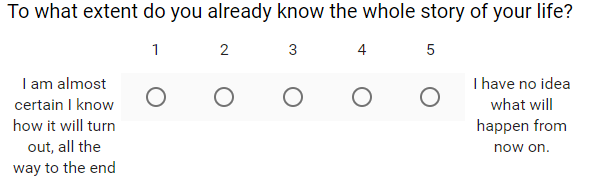
to what extent do you already know the story of your life?

If people were asked this question on a survey, I think the variations in responses would be significant and useful to know:

In general, people would give lower scores as they got older, but not always. The YouthBuild program (which we evaluated) serves disadvantaged adolescents and young adults. Before entering this 9-month program, participants predict that they will live to an average age of 40. Many believe that they already know the outlines of their lives. But upon completing the program, they think they will live to the age of 72: a 32-year increase (Hahn et al 2004). They now foresee decades of life that present unpredictable possibilities.

I agree with Kieran Setiya that “midlife” is best understood not as a span of years–say, ages 35-60–but as a subjective attitude to time that can occur at any age. Inspired by his book but departing a bit, I would measure midlife as a low score on the question shown above. By that definition, adolescents entering YouthBuild are already in midlife and even suffering from midlife crises. But for someone else, that state might never arise, or it might occur for the first time at age 90.

Is it good or bad to score high on this measure? That may depend on how well your life is going. If you expect to continue back-breaking labor for the rest of your life, still shackled to an uncaring partner, and suffering the regular deaths of loved-ones, you certainly would prefer not to be able to predict the rest of your life based on your story so far. But if you have retired in good health to a lovely seaside community, you may want nothing more than to run out the clock without seeing any unexpected changes to yourself or the people you care about. Priam had every reason to think that his life was a happy story until, as a very old man, he had to witness his hero son Hector being dragged dead around his besieged city.

I suspect we also vary in our subjective stances to change. For some people–almost regardless of their objective circumstances–predictability is comforting. But it is horrifying for others.

James Joyce published “The Dead” when he was 32. He had a long, dramatic, and hugely influential life ahead of him and surely couldn’t imagine that he’d become the Zurich-based author of Finnegans Wake by 1941. His protagonist, Gabriel, is also a “young man.” But I think “The Dead” is all about realizing that you know the whole course of your life. This is possible if you are a somewhat average bourgeois Dubliner, like Gabriel, or a budding international literary sensation, like James Joyce. Either way, to think you know your whole life-course is akin to being dead: you might as well just fast-forward to the end. That is the sense in which midlife is a depressing state rather than a comforting one.

I would predict that answers to this question would vary by age (but not in a lockstep correlation), by social circumstance (people with more opportunities will be less likely to think that they know their own futures) and by temperament.

Certain meditative experiences are intended to lower one’s score. For example, momento mori–meditating on death–is meant to remind you that you already know the important part of your story, how it ends. That is supposed to focus you on being pious. But Buddhism often reminds us that life is unpredictable, basically unstable, and that not being able to know the future should drive your attention to current experience. I vote for the latter although I am not very good at it.

Source: Hahn, A., Leavitt, T. D., Horvat, E. M., & Davis, J. E. (2004). Life after YouthBuild: 900 YouthBuild graduates react on their lives, dreams, and experiences. Somerville, MA: YouthBuild USA. See also Kieran Setiya on midlife: reviving philosophy as a way of life; nostalgia for now; rebirth without metaphysics.