Category Archives: Uncategorized

two models for analyzing policy

Here is a rather standard model for policy analysis, representing the content of a fairly typical public policy course or a textbook such as Eugene Bardach’s A Practical Guide for Policy Analysis (2000).
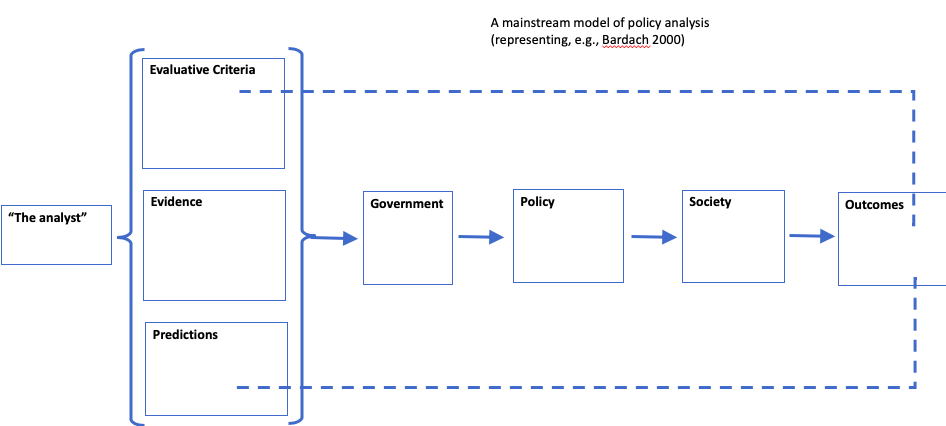
The analyst is a professional: a staffer, a consultant, or possibly an elected official. This person assembles evidence, combines it with evaluative criteria (e.g., fairness or efficiency) and makes predictions. The result is advice, probably in the form of a memo or slide deck. Methods for reaching conclusions may include, among others, cost/benefit analysis or sensitivity analysis.

The recipient is an authority: a decision-maker within a government or perhaps someone whose role is like a government’s, e.g., a corporate executive who sets internal policies. Influenced by the analyst, the authority makes policy, which takes the form of taxes or fees, prohibitions and penalties, authorizations, subsidies and rewards, licenses, personnel deployments, etc.

In turn, the policy influences “society.” That is a complex amalgam, but a major component of society is a set of markets that can be affected by governmental policy. As a result of the society’s own dynamics, plus the government’s policy intervention, certain outcomes arise. The analyst had tried both to predict and assess those outcomes (hence the dotted lines), and did a good job if the outcomes turn out to be good.

In contrast, here is the model of Institutional Analysis and Development (IAD) developed by Elinor Ostrom and colleagues. I have explained it in more detail before.
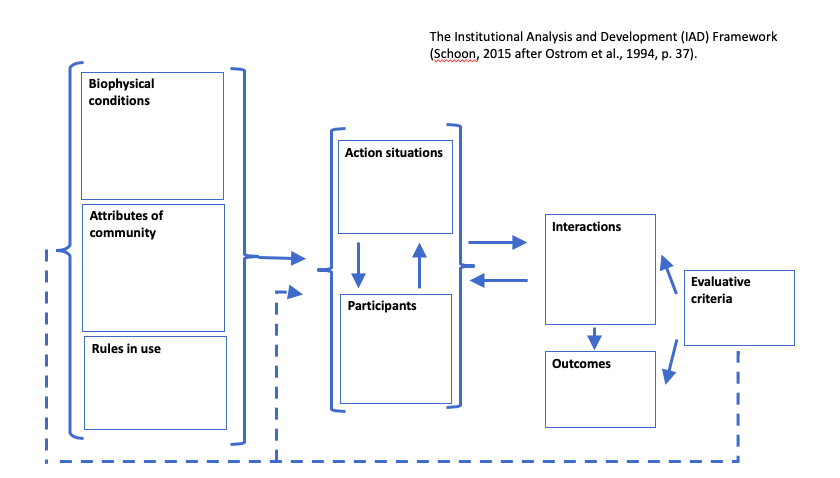
To some extent, these two models can be reconciled. For instance, the analyst in the first model collects evidence, some which may be about biophysical conditions (Which medicines work on which diseases?), attributes of community (How equal are people in the population?) and “rules-in-use” (What actual laws and/or norms are people observed to follow?). Evaluative criteria appear in both models.

But the models also differ in some important ways.

Where is the analyst in Ostrom’s model? Perhaps it is anyone who can observe and analyze the institution, including participants in it. In fact, analysts always work within institutions, with their own biophysical conditions, attributes of community, etc.

The first model treats “government” as the major actor, whereas the second sees institutions all over the place. According to Ostrom et al., a government is a set of institutions, but so is the analyst’s agency, the market they’re considering regulating, and even the discussions that generate the evaluative criteria. Whereas the first model is linear–from the analyst to the outcome–the second one is deeply recursive.

Here are some questions to ask about either model, or about any model for analyzing policy:

What is the value of analysis? Specifically, what is the value of relatively professional and trained, yet not hyper-specialized, analysis? What does an analyst know that immersed participants don’t know? What can someone with an MPP contribute?

How should we think about time? In the first model, the whole point is the future. As business school students learn, it’s rational to ignore sunk costs. The only questions are: What will happen if we act in a given way, and is it good? The second model is arguably static, a map of how an institution functions at time-T. But where did it come from? What would change it into an entirely different institution? And for both models: should the past matter?

Whose responsibility is it to decide? Perhaps a “decision-maker” inevitably decides, even if it’s in favor of the status quo. Then perhaps people who are decision-makers should learn to have a mental bias in favor of making decisions and taking responsibility for them. But do you or I have a moral responsibility to be decision-makers?

What is the place of markets in all of this? For Bardach (pp. 4-5) they seem to be the default social form, and governments intervene in them if and when they fail in various ways. Governments, in turn, are not markets: they regulate or affect markets. For Ostrom et al., all institutions involve distinct participants who interact to produce outcomes. Markets involve a certain range of interactions (bargaining, exchange, but also discussion, persuasion, collaboration, and exit). So do other institutions, including governments. There is no sharp difference between a market and a government (or a church, or a scientific discipline, or an online network). The differences are the details in the boxes above.

What is the role of the public, citizens, and public discussions? These are not mentioned in either diagram. For Bardach, citizens emerge as audiences and sometimes as sources of political constraint. The analyst should consider public opinion because it’s too hard to implement advice that is deeply unpopular in a democracy. Those are narrow roles for the public. In Ostrom, everyone is part of a complex, dynamic system. That means there are no sharp distinctions among policy-makers, analysts, and citizens. They all make policy in various ways. But should there be a special role for citizens, as such? And can policy promote that role?

See also a template for analyzing an institution; polycentricity: the case for a (very) mixed economy; syllabus of a public policy course; and avoiding a sharp distinction between the state and the private sphere

the 2020 election in the shadow of the Iraq War

Polls usually show that foreign policy is a low-priority issue in US political campaigns. This year is no exception: asked to choose one priority, just 13 percent of prospective voters recently selected foreign policy.

But I think the Iraq and Afghan wars influence Americans in deeper ways. These are not “foreign policy issues,” like how we should address Brexit or North Korea. They represent a wound that hasn’t been treated. The question on people’s minds is not, “What should we do about Iraq?” or even “What should have been done in 2001?” The question underneath people’s explicit thinking is: “What kind of people are in charge of our country?”

After all, the decision to invade Iraq and Afghanistan caused about 60,000 US casualties. (That includes those killed or wounded but not suicides or PTSD cases.)

It is very hard to know how many Iraqis and Afghans have died, because the data are not available and because it’s debatable how much causal responsibility the US holds for the deaths of various combatants and civilians. However, by 2007, 53% of Iraqis were saying that “a close friend or relative” had “been hurt or killed in the current violence.”

The running tab for the two wars is about $6 trillion, which is about 30% of the goods and services that all Americans produce in a year.

And for all this sacrifice and damage, we have lost–failing to attain any of the original objectives of the Bush Administration. Iran has the most power in Iraq; we are negotiating a ceasefire with the Taliban, whom we supposedly defeated in 2002.

For some Americans, none of this may be very salient. But for others, it reflects a deep betrayal by the global elites who sent our men and women into danger overseas. For still others, it is a classic case of American imperialism running amok. Considering the magnitude of the disaster, the debate has been relatively marginal or even submerged. But I think it’s always just below the surface.

Consider the record of these presidential candidates since 2008:

  • Hillary Clinton: votes for the war, apparently in large part because she, her husband, and other senior members of her own party favored it (not just because of the Bush Administration). She later calls her vote her mistake but still feels qualified to run for president in 2008 and 2016 and to serve as a hawkish Secretary of State in between. Thus she is partly responsible for managing the war after having helped to start it. When she comes before the voters, she loses both times.
  • Barack Obama: against the war from the outset, not in Washington when it starts, seems to want to wind it down; wins the presidency twice.
  • Jeb Bush: the presumed front-runner for the Republican nomination in 2016, but his brother launched the wars. Wins 4 delegates in the 2016 primary.
  • Donald Trump: actually fairly positive about the war when it started, but claims to have been against it, which is consistent with his general attitude that foreign interventions waste American lives and treasure. Beats all the establishment Republican primary candidates and Clinton. In office, battles the national security establishment and generally refrains from deploying US military assets overseas. His record conveys a willingness to spend money on the troops, a reluctance to put them in danger, and a contempt for the top brass. Now he’s in a good position for reelection.
  • Joe Biden: as chair of the Senate Foreign Relations Committee, he votes to authorize the war. Although he is the former vice president in a popular Democratic administration, he looks likely to lose the current primary.
  • Pete Buttigieg: he opposes the Iraq War yet serves in Afghanistan–sort of the opposite of the bipartisan elites who started the war without putting themselves in danger. Considering that he’s the 38-year-old mayor of the 4th-largest city in Indiana, he’s done pretty well in a presidential primary campaign.
  • Bernie Sanders: the only Democratic primary candidate who can provide clear evidence that he was opposed to the war and tried to stop it. This is credible not only because his House vote was recorded but because he has opposed almost all US interventions since the 1970s.

If you believe (as I tend to) that dominant US institutions deserved to be sustained and protected even after the debacle of these wars, then there should have been a much deeper house-cleaning. It’s true that Members of Congress who voted for the war faced a hard choice with limited knowledge and no foreknowledge of the 19 years ahead. Nevertheless, they chose wrong and should have been banished from public life unless they took full responsibility for their own decisions and used their power to prevent anything similar from happening again. You don’t shake off hundreds of thousands of deaths, a $6 trillion bill, and a catastrophic defeat and move on to other topics. National leadership is a privilege, not a right, and if you help cause a disaster, you lose the privilege.

Some Americans never had strong reasons to sustain dominant US institutions. They have now been joined by people for whom the past 19 years provide reasons for distrust–whether they believe that globalist elites have betrayed real Americans or that America is the global bully of the neoliberal era. Although I make no equivalence between Trump and Sanders–they are opposites in character, policy proposals, and commitment to democracy and rule of law–a national campaign between those two is surely a consequence of decisions made by 2003.

practical lessons from classic cases of civil disobedience

I have been teaching two classic examples of civil disobedience or satyagraha—Gandhi’s Salt March and the Montgomery Bus Boycott—to very smart and committed undergraduates. The readings are listed below. As I reflect on our discussions, I’m thinking about two lessons that may not be widely understood today.

First, the objective is not the same as the target. Your objective might be to dismantle white supremacy, but that is not a “target“ because you can’t directly affect it, especially if you are a group of Black citizens of Montgomery, AL in 1955. The bus company is a target because 75% of its riders are African Americans, and you can bankrupt it by boycotting it.

The bus company was not the worst offender against racial equity, even among local institutions. For example, the city’s chief law enforcement officer was a member of the White Citizens Council, which made the police a worse problem than the bus company. But the bus company was a better target because Black people had more leverage over it.

The pitfall is to choose the targets that you can affect even though affecting them doesn’t trouble the worst offenders. I think a lot of left activism in the US since 2000 has targeted city governments and universities, leaving Wall Street unaffected. That is because left activists know how to target cities and colleges, but not how to target Wall Street. On the other hand, you do need targets that you can actually affect. The Montgomery bus boycott and the British colonial police force in India were good examples. They were vulnerable to direct action, and targeting them caused problems for higher authorities.

Second, a social movement is not primarily a protest. In fact, I am not sure that any act of “protest” occurred during the whole Montgomery Bus Boycott, if that means a gathering in a public space to convey a message: a march or demonstration. The Great Salt March was (in fact) a march, but that was not what gave it power. Gandhi got many people arrested for making their own salt and thereby flooded British jails; the Montgomery Improvement Association boycotted a bus company. Both were accomplishments of organization more than expression, although both certainly conveyed meaning to their supporters, their targets, and third parties.

The Montgomery Bus Boycott, in particular, was a matter of getting thousands of Black workers to their jobs every day for many months without using the buses. A protest would have accomplished little. Building an alternative transportation system brought a company to its knees and conveyed a message of power.

Readings

  • Ramachandra Guha, Gandhi: The Years that Changed the World (2018), chapter 16 (“The March to the Sea”)
  • Bikhu Parekh, Gandhi, Chapter 4 (“Satyagraha”), pp. 51-62;
  • Gandhi, Satyagraha (Ahmedabad: Navajivan Publishing Co., 1951), excerpts; and Gandhi, Notes, May 22, 1924 – August 15, 1924, in The Collected Works of Mahatma Gandhi (Electronic Book), New Delhi, Publications Division Government of India, 1999, 98 volumes, vol. 28, pp. 307-310
  • Karuna Mantena, “Showdown for Nonviolence: The Theory and Practice of Nonviolent Politics,” in Shelby and Terry, pp. 78-110
  • Martha Nussbaum. “From Anger to Love: Self-Purification and Political Resistance,” in Shelby and Terry, pp. 114-135
  • Episode 1 of Eyes on the Prize, “Awakenings, 1954-1956”
  • Charles Payne, “Ella Baker and Models of Social Change“; and Ella Baker, “Developing Community Leadership“
  • Danielle McGuire, At The Dark End of the Street: Black Women, Rape, and Resistance–A New History of the Civil Rights Movement from Rosa Parks to the Rise of Black Power.
  • James L. Farmer Jr., Lay Bare the Heart: An Autobiography of the Civil Rights Movement (excerpts)David Garrow, Bearing the Cross: Martin Luther King, Jr., and the Southern Christian Leadership Conference (1986), pp. 105-205.
  • Taylor Branch, Parting the Waters: America in the King Years, 1954-63 , pp. 11-82
  • Martin Luther King, Stride Toward Freedom, chapters 3, 4, and 5.Charles Tilly, “Social Movements, 1768-2004“
  • Marshall Ganz, “Why David Sometimes Wins: Strategic Capacity in Social Movements,” in Jeff Goodwin and James M. Jasper, Rethinking Social Movements: Structure, Meaning, and Emotion (Lanham, MD: Rowman and Littlefield, 2004) pp.177-98.

The French Republic denounces the French State

“In tribute to the thousands of Jews of the Rhone who were tortured and executed, deported and exterminated in 1942, 1943, and 1944.

Let the locations of their martyrdom be engraved in our memory:

Fort Montluc, The School of Military Medicine, the Hotel Terminus, Rue Sainte Catherine, Rue Sainte-Helene, the Catelin cul-de-sac, Venessieux Camp, Neyron, Rillieux, Dorieux Bridge, Bron, Saint Genis Laval.

Let those who helped them, at risk to their lives, be thanked forever.

The French Republic, in tribute to the victims of racist and antisemitic persecution and crimes against humanity committed under the de facto authority called the “Government of the State of France” (1940-44). Let us never forget.

This is a pair of plaques on the wall of the former School Military Medicine in Lyon, headquarters of Lyon’s Gestapo chief, Klaus Barbie. The building was used for frequent torture and executions until it was destroyed by Allied bombers; the site is now a small Museum of the the Resistance and Deportation.

What should we make of the French Republic denouncing the Government of the State of France?

One view might be that individual human beings are always the only responsible parties. In 1940-4 in France, human beings denounced Jews, or killed them, or saved them, or did nothing. They also actively supported, complicitly upheld, resentfully accepted, subtly undermined, or bravely resisted the government of France as it was constituted before, during, and after WWII. They should be judged on whether they hurt or helped people and whether they strove to make their governments just.

That view denies all moral agency to groups and institutions, which would have some problematic implications. It would mean, for one thing, that responsibility never survives a change of generations. If an individual didn’t denounce Jews in 1941, that person has nothing to be concerned about. We are born with a clean slate.

Yet an individual can inherit the advantages of an institution, such as the French Republic (or the USA). Not only does a state have has a treasury from which it pays benefits–and which represents the accumulated balance of all its past debts and credits–but it also shapes and realizes citizens’ rights. Insofar as our rights are important components of our identity, a state helps to constitute us.

Another view is that France (again, like the USA) is a morally responsible entity to which its citizens are tied, like it or not. The past belongs to the living. Today’s French inherit the responsibility for Vichy as much as for the Third or Fourth Republic that bracketed it, because they inherit France.

But surely we bear more responsibility for democratic governments than for authoritarian governments that rule us in our name. In that sense, the sins of the French republics should perhaps weigh more on modern French people than those of Vichy. Yet we know that Vichy was pretty popular, and the Third Republic was rickety. Public support is a sliding scale, not an on/off switch. So is any government’s responsiveness to the public.

Also, the laws and policies that result from a democratic process depend on precisely how the democracy is organized. Americans would have different laws if we elected one unicameral legislature with 10,000 members as our sole branch of government. We are constituted in one way; we (the same people) could be constituted differently. The US has not been re-constituted since 1789, although some of the changes have been pretty basic. France was definitely reconstituted in 1940 and again in 1945-.

I am inclined to think that the French Republic is an institution that is distinct from Vichy, as proven by the armed conflict between the two. The Republic can describe Vichy as an “it.” The Republic speaks just as it pays bills or forbids you from walking on the grass: as a corporate body.

However, the Republic has particular corporate responsibilities for the crimes of Vichy, not because the two states are the same thing, but because the Republic inherited the debts and assets of Vichy, like a business that buys a bankrupt firm. One of the Republic’s many assets is the address at which Klaus Barbie tortured his victims, and France is obligated to memorialize that space in the right way.

Meanwhile, French citizens have a particular obligation to assess whether the Republic is saying the right things. Reading those plaques on the wall, a French person should not ask, “Do I say that?” The speaker is the state, not the citizen. Instead, the citizen should ask, “Do I endorse the Republic’s saying that?” If not, the citizen should speak to the Republic by expressing a public criticism, because it is, after all, the citizens’ state (res publica).

By the way, I think the first plaque is the statement, and the second attributes it to the Republic as its author. Although the second plaque has no punctuation, I think the last three words form an imperative sentence in the third-person-plural: “Let us never forget.” The Republic expresses its view and then refers to a “we.” The metaphysics is odd here, but I this may be a way of capturing the particular relationship between a people and their state. The state is telling its own people to do something as individuals: read and remember.

In turn, the people may–and should–judge the state, including this declaration that they can read on the public plaques. However, the French people cannot unanimously and directly decide this position about the Deportation, or any different stance. Rather, they can act as individuals through the mechanisms of government to make a corporate change.

(Written on the way home from Lyon. See also: against methodological individualism; why social scientists should pay attention to metaphysics; what constitutes coordination?; rebirth without metaphysics; is social science too anthropocentric?; how many foundings has the US had?); Social Ontology 2018: The 11th Biennial Collective Intentionality Conference; and system, organism, person, organization, institution: some definitions.

nature includes our inner lives

(posted in Montreal)

For natural philosophy everything perceived is in nature. We may not pick up and choose. For us the red glow of the sunset should be as much part of nature as are the molecules and electric waves by which men of science would explain the phenomenon.

Alfred North Whitehead, The Concept of Nature (1920), pp. 28-9

Here are three widely-held presumptions:

  1. All truth is scientific truth. Any claim that isn’t scientific is an opinion.
  2. Nature is everything that science investigates, including the human or social world.
  3. Science means a suite of methods that strive to represent nature without influence from the observer. A scientific truth is one that would obtain even if there were no scientist. This is an aspiration; any given scientific claim is actually subject to bias. But the goal is to remove subjectivity to understand nature.

Whitehead disputes these assumptions (as have many since him). I came across the quoted sentence in an article by Bruno Latour entitled, “Why Has Critique Run out of Steam? From Matters of Fact to Matters of Concern.”* Latour’s provocative article sent me to Whitehead’s original text, which elaborates his argument. A little later in The Concept of Nature, Whitehead writes:

What I am essentially protesting against is the bifurcation of nature into two systems of reality, which, in so far as they are real, are real in different senses. One reality would be the entities such as electrons which are the study of speculative physics. This would be the reality which is there for knowledge; although on this theory it is never known. For what is known is the other sort of reality, which is the byplay of the mind. Thus there would be two natures, one is the conjecture and the other is the dream.

Another way of phrasing this theory which I am arguing against is to bifurcate nature into two divisions, namely into the nature apprehended in awareness and the nature which is the cause of awareness. The nature which is the fact apprehended in awareness holds within it the greenness of the trees, the song of the birds, the warmth of the sun, the hardness of the chairs, and the feel of the velvet. The nature which is the cause of awareness is the conjectured system of molecules and electrons which so affects the mind as to produce the awareness of apparent nature. The meeting point of these two natures is the mind, the causal nature being influent and the apparent nature being effluent

I acknowledge that we have often made progress in understanding specific phenomena (in the social world as well as what we call “nature”) by employing techniques that isolate the object from the perceiving human subject. An astronomer wants to know how the universe works regardless of how people perceive it, uncovering truths that would apply even if there were no sentient observers at all. Many methods that we label scientific aim for that kind of understanding. Quantification and blind experiments are two rather different examples.

Meanwhile, we have learned about human beings’ subjectivity. We have studied people’s experiences, their causes, and how they differ. Sometimes we treat subjectivity as another phenomenon that we can study objectively. And sometimes we express or convey our own subjectivity in first-person terms.

The problem that Whitehead decries is the bifurcation. When the earth rotates so that the line of sight between a human observer and the sun becomes partially obscured, molecules and waves are involved in the process. But you, the human observer, also truly see something that you call a “red sunset.” It has formal qualities and significance, even symbolism, for you as a human observer. It is not true that only the molecules and waves are “nature,” hence that only they can be understood using science. Your reaction to the sun’s setting is also part of reality, even if you phrase it as idiosyncratically as Edith Wharton did:

Leaguered in fire
The wild black promontories of the coast extend
Their savage silhouettes;
The sun in universal carnage sets ...

-- Wharton, "An Autumn Sunset"

*Critical Inquiry, Vol. 30, No. 2 (Winter 2004), pp. 225-248. See also introspect to reenchant the inner life and is all truth scientific truth?