Author Archives: Peter

About Peter

Associate Dean for Faculty and the Lincoln Filene Professor of Citizenship and Public Affairs at Tufts University's Tisch College of Civic Life. Concerned about civic education, civic engagement, and democratic reform in the United States and elsewhere.

democracy in the digital age

New chapter: “Democracy in the Digital Age,” The Civic Media Reader, edited by Eric Gordon and Paul Mihailidis (Cambridge, MA: MIT Press, 2016), pp. 29-47

Abstract: Digital media change rapidly, but democracy presents perennial challenges. It is not in people’s individual interests to participate, yet we need them to participate ethically and wisely. It’s easier for more advantaged people to participate. And the ethical values that guide personal relationships tend to vanish in large-scale interactions. The digital era brings special versions of those challenges: choice has been massively disaggregated, sovereignty is ambiguous, states can collect intrusive information about people, and states no longer need much support from their own citizens. I argue that these underlying conditions make democracy difficult in the digital age.

The Moment is Now National Convening

Registration is now open for Everyday Democracy’s The Moment is Now: National Convening, December 8-10, 2016 in Baltimore, Maryland. People will come together from across the country to think of dynamic ways to solve community problems and build racial equity.

Related to the conference is a video competition for young leaders (18-30). The deadline is October 17th, and the winners will receive a small grant and full all–expenses-paid scholarship to the convening.

it’s hard to talk about tough issues if no organization represents you

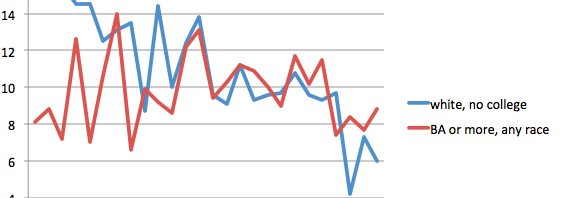
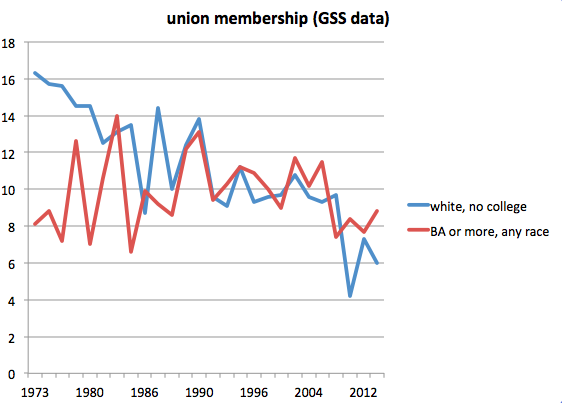
I’m back from a great meeting in Chicago in which one theme was the need to have honest, productive conversations between people who might support Donald Trump and members or supporters of movements like Black Lives Matter. I’d note a major obstacle: the fact that working-class white people–the demographic core of Trump’s support–don’t have organizations that answer to them. As an illustration, consider that just 6 percent of adult Whites without college educations now belong to unions. That’s below the rate for college graduates, many of whom have other organizations behind them.

union

A lack of organization blocks or distorts difficult discussions, for these reasons:

  1. It’s literally hard to convene people who aren’t organized. Absent organizations, conversations tend to be online or draw highly atypical individuals who show up of their own accord.
  2. People who have no organizations behind them usually feel powerless. If that’s how they feel, they are unlikely to want to participate in difficult conversations. Especially when the topic is their own ostensible privilege, they are likely to resist talking. To be clear: I believe that everyone who is White in the US gains privilege from that. But if I felt politically powerless, I would not be in a mood to have that conversation, especially with people who were better organized than I was.
  3. People without organizations end up being represented by famous individuals–celebrities–who claim to speak for them and who claim mandates on the basis of their popularity. Celebrities have no incentives to address social problems; they gain their fame from their purely critical stance. And they owe no actual accountability to their fans, since no one (not even a passionate fan) expects a celebrity to deliver anything concrete. Donald Trump is unusual in that he has moved from a literal celebrity to a presidential nominee; but he still acts like a celebrity, and presumably he will return to being a pure mouthpiece once the election is over. Meanwhile, back at the grassroots level, a person who feels represented by celebrities is unlikely to talk productively with fellow citizens who disagree.
  4. People without organizations cannot negotiate. For instance, imagine that an individual Trump voter becomes convinced of the case for reparations, or at for least for race-conscious policies aimed at equity. That person cannot literally support such remedies, because he has no means to enact them. All he can do is assent to their theoretical merit. That also means that he can’t get anything tangible out of a deal. He’s just being asked to concede a point.

In 1959, A. Philip Randolph helped found and led the Negro American Labor Council as a voice for civil rights within the labor movement. As he pressed and negotiated with his fellow labor leaders on matters of civil rights, he was giving their millions of White rank-and-file members the opportunity to discuss segregation and racism productively. Crucially, not only were the Sleeping Car Porters organized; so were the predominantly White autoworkers, steelworkers, and mineworkers. Randolph also had–and used–substantial leverage over a Democratic Party that was still dependent on working-class voters, White and Black.

I’m certainly not implying that everything went smoothly in those days and reached satisfactory conclusions, but Randolph at least had a strategy that made sense. In an era of niche celebrities, candidate- and donor-driven political parties, and weak civic institutions, that strategy looks much harder.

Counterargument: The Fraternal Order of Police is an organization. Its members, although diverse demographically and ideologically, need to be at the table for any discussion of racial justice. But the FOP has endorsed Trump; and in many local contexts, its spokespeople seem particularly unwilling to deliberate and negotiate. Hence being organized is not a path to productive conversations. … To which I’d respond: Privilege yields to political power. Only effective political action will bring a group like this to the table. But the police can come to the table because they are organized, and that creates a strategic opening that is absent when people with similar views aren’t organized. It also enables pressure to come from within. For instance, the association that represents 2,500 Black police officers in Philadelphia has called Trump an “outrageous bigot” even as the Philly FoP has endorsed him.

See also: why the white working class must organize.

the Pew climate change survey and the state of science

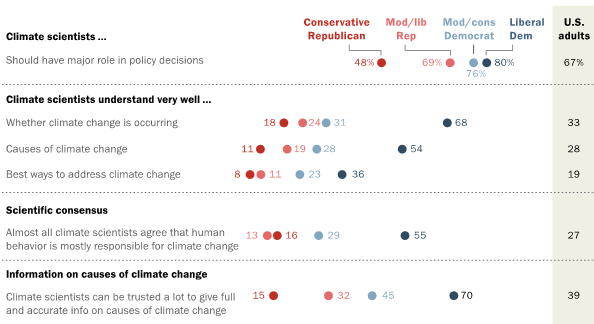
According to Pew’s new survey, only about one third of Americans care “a great deal” about climate change. That might be a matter of values: some citizens may set a higher priority on liberty or growth than on environmental protection, or they may not trust the government plus scientists to protect the climate.

But the public is also divided on a key matter of fact. In reality, there is near-universal scientific consensus that humans cause global warming, but only 27% of Americans perceive that consensus, including just over half of liberal Democrats.

If I thought that scientists were divided on the basic question of whether humans cause climate change, I would be much less confident that the problem is worth combating.climate

Two fairly obvious but crucial lessons:

  1. Giving an impression that a topic is contested is a great way to sew doubts about it. Once just a few people who claim expertise criticize the mainstream scholarly view, the issue looks debatable. Then everyone has permission to be skeptical.
  2. Scientists must take more responsibility for how their work is communicated, debated, received, and used by the public. There’s not much point to specific studies of climate change if a large majority of the public remains unconvinced about the basic problem. If the traditional division of labor–scientists conduct research; reporters cover it–ever worked, it doesn’t work now. Scientists and their institutions (including universities) must develop better ways of engaging in public life.

See also Five Strategies to Revive Civic Communication; science, democracy, and civic life.

it’s 1989 all over again: HRC and Bush 41

If Hillary Clinton is elected in November, the parallels with the start of the George H.W. Bush Administration will be striking. That does not imply that Clinton’ presidency must follow the trajectory of his: history rarely echoes, and her luck as well as her personal qualities may prove different. But she will begin where he did.

Bush the Elder ran for president in 1980 as the favorite of his party. He had the longest resume, stood near the ideological center of the traditional GOP, had close ties with powerful leaders in business, government, and foreign capitals, and was the son of a US Senator. He lost to the insurgent Ronald Reagan, who represented “change.” Bush served loyally in the Reagan Administration and then ran to succeed his boss and uphold a legacy that he had not originally endorsed.

Hillary Rodham Clinton ran in 2008 as the favorite of her party, with a long resume, relationships comparable to Bush Senior’s, and the support of party regulars. She was the spouse of a former president and had helped him to define the ideological center of the New Democrats. She was defeated by an insurgent who represented “change,” but she then served loyally in his administration and is running to preserve his legacy.

Both candidates were distrusted by the ideological base of their party. Bush 41 had to beat Pat Buchanan in 1988. Buchanan turned out to represent a powerful strand in the future of the GOP. Bush promised “No new taxes” to satisfy his base. Clinton had to beat Bernie Sanders in 2016. The demographics of Sanders’ support suggest that he represents a major strand in the future of the Democratic Party. Clinton has made policy concessions to satisfy Sanders voters (and Black Lives Matter).

Mike Dukakis is a fine public servant and an exemplary person, but he ran a notably weak campaign against George H.W. Bush in 1988. Donald Trump cannot hold a candle to Gov. Dukakis as a human being, but Trump is also running a poor campaign.

Although both George H.W. Bush and HRC are capable, detail-oriented policymakers who are said to be impressive in private, neither has the kind of eloquence that leaves a mark on the language or memory. Bush Senior is known for “Read my lips” and “Message: I care.” I don’t think Hillary Clinton is yet associated with any particular phrases.

Bush 41 faced a Democratic Congress with formidable opposition tacticians, such as Senate Majority Leader George Mitchell. HRC is likely to face at least a Republican House in 2017, and probably a Republican Senate after 2018. In the face of congressional opposition, Bush achieved no changes in domestic policy other than a grand compromise on the budget that lost him the support of the Republican base. Clinton will have to negotiate budgets with the Republican House. Bush left a much bigger mark on foreign policy. Clinton has also demonstrated that she is willing to use executive power overseas. Both confront a war in and around Iraq

When Bush the Elder took office, an economic recovery was 7 years and three months old and had only 18 months left to run. When our next president takes the oath of office, the current recovery will be seven-and-a half years old and probably can’t last much longer. Both also inherit a party apparatus that is pretty tired after almost a decade in control of the executive branch.

Again, none of this implies or predicts that Clinton (assuming that she is elected) will follow the path of Bush Senior. New realities will confront her, and she has some freedom to act differently. But the parallels are a bit sobering and deserve some thought.