Author Archives: Peter

About Peter

Associate Dean for Faculty and the Lincoln Filene Professor of Citizenship and Public Affairs at Tufts University's Tisch College of Civic Life. Concerned about civic education, civic engagement, and democratic reform in the United States and elsewhere.

John Stuart Mill, Stoic

I sometimes envy my fellow academics in the humanities who regularly renew their acquaintance with fundamental works that have slipped pretty deep into the well of my own memory because my job is to conduct and administer empirical research about current politics. For just that reason, I am thoroughly enjoying reencountering some major works as I teach first-year undergraduates this semester.

For instance, I now see Mill’s Utilitarianism in an entirely new way thanks to re-reading it with students after our extensive discussions of authors like Epicurus, Buddha, and Emerson. It seems much less an explanation of the utilitarian principle of justice (maximize everyone’s happiness) than I had remembered, and more an exploration of how an individual should pursue happiness. It thus belongs to a genre that Mill knew very well, the tradition of therapeutic philosophy inaugurated by the Hellenistic schools and revived by Montaigne.

In the text of Utiliarianism, Mill refers several times to Epicureanism and Stoicism. For instance: “I do not, indeed, consider the Epicureans to have been by any means faultless in drawing out their scheme of consequences from the utilitarian principle. To do this in any sufficient manner, many Stoic, as well as Christian elements require to be included.” This passage suggests that Mill is interested in constructing the kind of “eclectic” view (drawing from multiple Hellenistic schools) that was popular from the time of Cicero and continued in early Christianity. Continue reading →

CIRCLE breaks down the youth vote

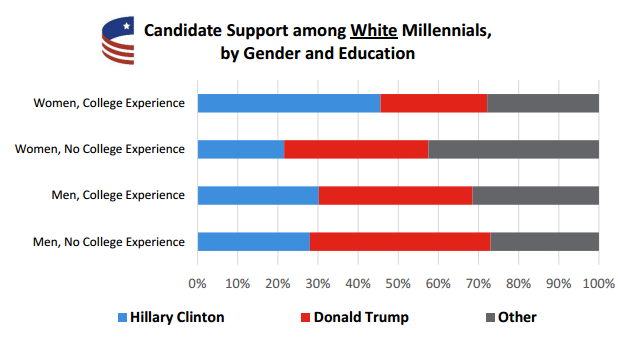
When CIRCLE’s Millennial survey was conducted (9/21-10/3), Clinton was beating Trump by 21 points (49% vs. 28%). Clinton may do better when the actual votes are cast, because there seems to be a trend in her favor among youth. That said, the CIRCLE poll allows detailed comparisons between young Americans who were favoring the two candidates at a moment when Trump was drawing one in four.

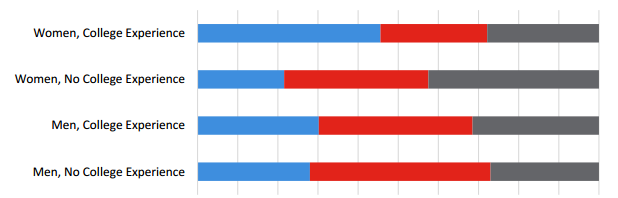
Young Trump and Clinton voters were starkly different people, and today CIRCLE has published an analysis that compares them by demographics and by opinions. For example, this graph shows Trump winning a plurality of non-college-educated men under 30 even as he was losing college-educated young women by almost 2-to-1.

circletrump

A couple of other illustrative findings from the report, which deserves to be read in full:

  • 85% of young Trump voters are dissatisfied with the way things are going for the country, and they are far more likely than Clinton supporters to believe that the country’s best days are behind us.
  • Trump supporters are less experienced with various types of political engagement, and more likely than Clinton supporters to say that they would “never, under any circumstances” do things like volunteer for a campaign or attend a political rally, suggesting that Trump supporters are overall less likely to be politically engaged.

the floating “that”: a linguistic innovation?

(Orlando) “You’ve got to eat those vegetables and do that exercise every day.” “We’re concentrating on those metrics, that whole assessment piece.”

Maybe it’s just me, but I’m noticing this speech pattern lately. People use “that” to intensify a noun. I think they’re mimicking a situation in which you have already talked about an important topic–and perhaps achieved agreement on it–and now you use “that” to refer back to the previous discussion. But in this new linguistic phenomenon, there’s no previous discussion to refer back to. “That” simply stresses the following noun.

No value-judgment implied. People are endlessly inventive; language constantly changes. I just find this new speech pattern interesting. (I wouldn’t use it in written text, however.)

social class does predict Trump support

Some say that Trump has captured the support of working-class Whites who are economically stressed or anxious. Others reply that Trump voters are relatively upscale but motivated by racial resentment alone. The former premise suggests that Democrats must do more to empower the working class, including Whites. The latter suggests that White nationalism is our fundamental problem today. Although I see truth in both positions, I’ve argued for addressing the economic and political vulnerability of the White working class. I present that as a strategy for countering Trumpism, but it’s a misguided strategy for that purpose if Trump voters are relatively affluent.

The raw story is that White people with lower incomes are Trump’s strongest backers.
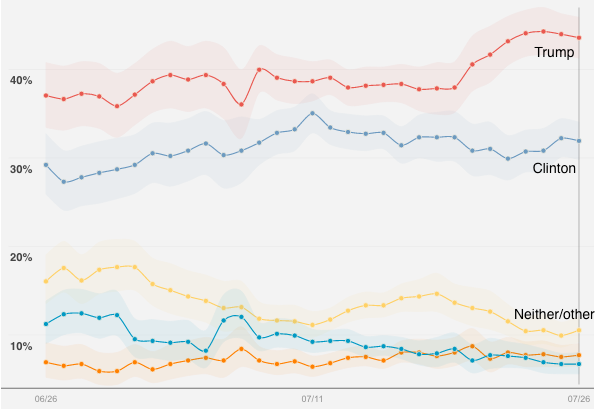
Presidential Candidate Preference for Whites with Family Income <75K (Reuters)

Presidential Candidate Preference for Whites with Family Income <$75K (Reuters)

But it’s not just about income and race. Education levels, age, and gender are also strongly related to voters’ preferences in this election, as I illustrate with data from YouGov:
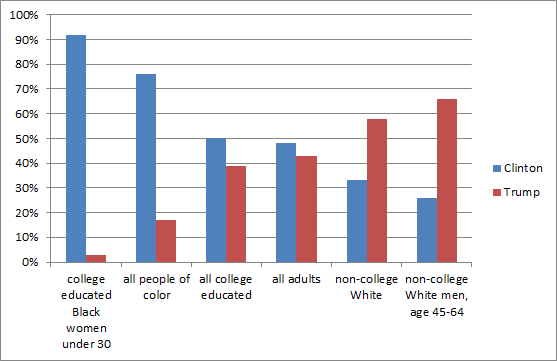
yougov

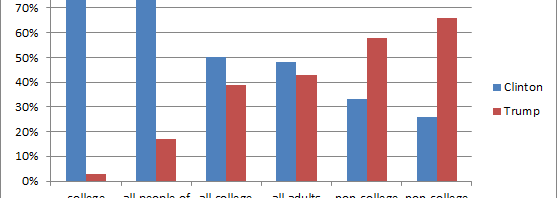
The question is what to make of those middle-aged White men without college degrees, who are preferring Trump over Clinton by more than two-to-one in the YouGov polls (and by 59%-25% in Reuters). Is it economic anxiety, racial identity, or what?

One of the most widely cited pieces of evidence against the economic-anxiety explanation is Jonathan Rothwell’s paper, “Explaining nationalist political views: The case of Donald Trump.” Rothwell, who works for Gallup, conducted a regression analysis of almost 100,000 Gallup survey responses collected over the year that ended in July (i.e., mostly during the primary season). I have no quarrel with the paper, but I would note that it does not debunk a class analysis of the Trump vote.

Rothwell finds that holding a favorable view of Trump correlates with higher, not lower, income. Nate Silver is also widely cited for his finding that Trump voters during the primary season had higher median incomes than Clinton and Sanders voters (but the same as Cruz voters and lower than Kasich voters).

However, Rothwell also looks at whether household income remains a significant predictor of Trump support once you consider the fact that Trump voters are disproportionately White, male, and older. Using one measure of income, it remains a significant predictor; with a different measure, it ceases to predict Trump support.

At the same time, Rothwell’s model shows that you are more likely, to a statistically significant degree, to favor Trump if you: (1) hold a blue-collar job; (2) did not attend college; and (3) live in a community with high White mortality rates. Those relationships appear in the whole sample but are especially strong when the model is restricted to non-Hispanic Whites. Further, “more subtle measures at the commuting zone level provide evidence that social well-being, measured by longevity and intergenerational mobility, is significantly lower among in the communities of Trump supporters.”

If social class means income, then class is not a strong predictor of Trump support in Rothwell’s model. At least during the primary season, Trump voters were actually wealthier than the mean American voter. But if class means social status, and status involves occupation and education, then Trump voters tend to be downscale Whites in downscale White areas.

Rothwell’s paper uses a binary outcome of Trump support versus non-Trump support. The non-supporters include Republicans who were still favoring Cruz, Rubio, and others, plus Democrats for Sanders. That makes the analysis a bit dated now that we’re down to Clinton v. Trump. Reuters data suggests that Trump widened his lead among working class White men once he won the nomination.
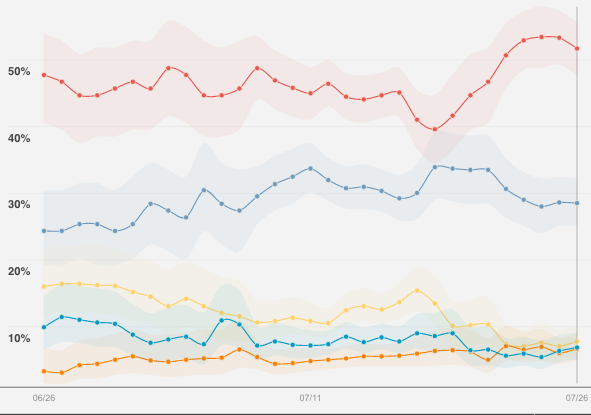
Presidential Candidate Preference, White Men Without College Degrees (Reuters)

Presidential Candidate Preference, White Men Without College Degrees (Reuters)

Meanwhile, Clinton is now doing very well among the top 1 percent of the income distribution.

In sum, the relationship between working class status (measured by education) and Trump support seems strikingly strong for the White population. This doesn’t mean that class is the only issue. Race/ethnicity and gender are obviously very significant. But it means that there is some truth to the class analysis.

See also why the white working class must organize and it’s hard to talk about tough issues if no organization represents you.

America: The Owner’s Manual

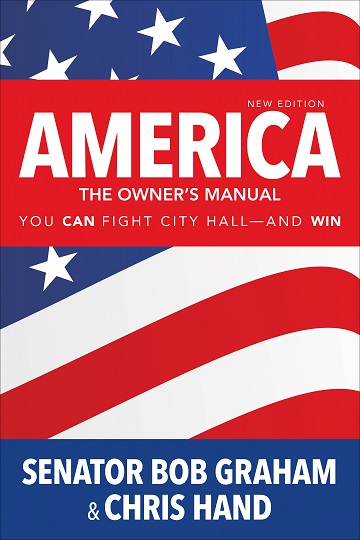
atom-cover-highresI’m delighted to see that the new edition of America: The Owner’s Manual is out. Senator Bob Graham, a truly dedicated leader for civic engagement, has written it with Chris Hand. They take the research, structure, and impact of the book with the utmost seriousness and have worked hard to revise it for a new edition. As I say in my blurb, “America, the Owner’s Manual is the only book that comprehensively explains how to be effective in American politics and civic life, and it does so brilliantly. It’s consistently practical, realistic, accessible, and inspiring. It’s perfect for anyone who wants to improve the world.” It works very well as a textbook, but you can also use it on your own or with a voluntary group.

Buy it here. Follow it on Twitter, @USAownersmanual; on Facebook, USAownersmanual; or use hashtag #ATOMbook.