Author Archives: Peter

About Peter

Associate Dean for Faculty and the Lincoln Filene Professor of Citizenship and Public Affairs at Tufts University's Tisch College of Civic Life. Concerned about civic education, civic engagement, and democratic reform in the United States and elsewhere.

why the global turn to authoritarian ethnonationalism?

It seems impossible to explain why Donald Trump won the 2016 election. For one thing, he lost the popular vote. Besides, a single election is an “n” of one with numerous contingent circumstances, in this case including the FBI’s last-minute intervention, Hillary Clinton’s gender, and the behavior of cable news. We often think of a cause as something that would yield a different result if it were changed. In this case, changing any of a dozen or more factors might have put Clinton in the White House.

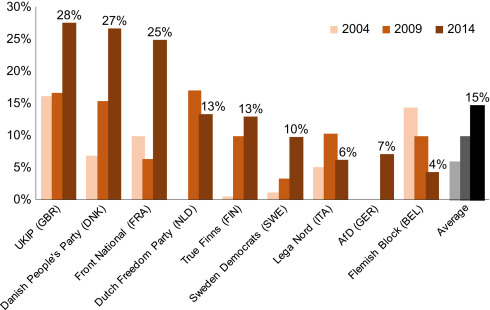
More valuable is to consider why authoritarian, illiberal nationalists either dominate or (like Trump) have narrowly missed winning majorities in many countries: at least in Austria, China, Hungary, India, Israel, the Philippines, Poland, Russia, South Africa, Turkey, and the United States–with England and France also looking at risk. Across the 34 OECD countries, true right-wing parties still capture only about 8 percent of total popular support, but that’s steadily up from five percent in the 1970s. This graph from Funke, Moritz & Schularick shows the recent shift in nine major European nations.

Vote Share for the Far Right Since 2004
At the global level, the “n” is much greater than one, and we can rule out certain explanations for the trends. For instance, in other counties, an authoritarian leader hasn’t replaced a person of color or defeated a female opponent.

I cannot estimate the relative impact of the following factors, but they seem plausible to me across the whole range of cases:

Oligarchy: Many of the authoritarian leaders are billionaires or closely associated with billionaires. Their supporters are personally wealthy individuals rather than multinational public companies, which are more comfortable with predictable centrists like Hillary Clinton. A billionaire can know political leaders personally, can trade wealth for influence, and can profit from disruptions in the larger economy. Several of the key billionaires are media personalities. I think some of them develop authoritarian expectations by being the barons of large private enterprises, within which their word is law. Billionaires have almost tripled their share of global GDP since 1996, and their inflation-adjusted total assets have risen by 7.5% annually over those two decades. They represent a global force that was absent in 1996.

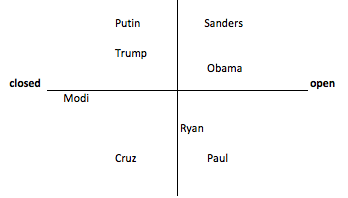
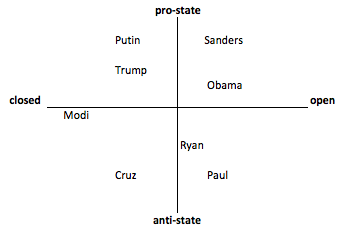
A gap in the ideological landscape: For this purpose, let’s categorize ideologies along two dimensions. They are either pro-state or anti-state/pro-market. And they either favor a narrowly defined ethnocultural group or they support diversity and globalism. I’ll call the latter spectrum closed versus open.

Since the 1950s, the dominant parties and movements in the wealthy democracies were all fairly open, at least in principle; the debate was about how much the state should intervene. We often thought of the US ideological spectrum as one-dimensional, from pro-state to pro-market, with everyone giving lip-service to openness. Some conservatives claimed to be pro-market and nationalist, but it’s not clear that that was a coherent position. The whole structure ignored the possibility of a pro-state, explicitly closed position. Like entrepreneurs who have discovered a market niche, authoritarian nationalists have filled the corner previously occupied by fascism. To be sure, Trump may govern like a market libertarian if he turns things over to Paul Ryan and contents himself with symbolic nationalism, but that’s not what he promised to do.
You would think that nationalist authoritarians wouldn’t cooperate much across international borders, because they are xenophobic. But there was a short-lived Fascist International in the 1930s, and we definitely see some coordination today.

Al Qaeda/ISIS: Before explaining why I think these terrorist organizations share causal responsibility for the global turn to authoritarianism, I want to stipulate that we are morally responsible for how we have responded to them. We did not have to invade Iraq, pass the Patriot Act, or turn Guantanamo into a prison. Those stupid and harmful acts are our responsibility as American citizens. Still, it seems both naive and misleading to omit the intentional acts of Al Qaeda and ISIS from our causal theory. They sought to provoke antidemocratic reactions, and they succeeded. An admired friend of mine recently summarized her qualitative research with Muslim teenagers in suburban New Jersey over the past decade, explaining that they have moved from a comfortable feeling of being Americans to a sense of vulnerability and alienation. This is an injustice that is up to remedy. But it struck me as a mistake not even to mention Al Qaeda as a major cause of the change. Osama bin Laden got what he wanted when he sent those planes into the Trade Towers. Although the US leadership of 2001 (including H. Clinton) proved monumentally stupid, Al Qaeda found a vulnerability that would have been hard to defend.

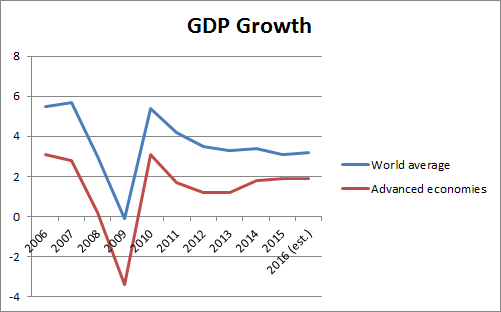
The 2007-8 financial crisis: Funke, Moritz & Schularick show pretty compellingly that voters shift to the far right after financial crises. This has been a pattern across many nations for at least a century. The 2007-8 collapse was an especially terrible one. It hit the advanced economies particularly hard, thus giving their voters a sense that they were losing comparative advantage as well as absolute wealth. It was followed by fiscal austerity that punished ordinary people, while no elites were held accountable for the trillions of dollars of waste and disruption. My sense is that Barack Obama got a pass from a majority of Americans because he wasn’t responsible at the time of the crisis, and he has been seen as laboring to repair the damage. But Hillary Clinton was part of the governing elite that was on duty when the fateful decisions were made.
Cultural backlash: Pippa Norris proposes that cultural liberalization (marriage equality, improving sexual equality, growing racial diversity, etc.). have produced a backlash rooted in the White working class of OECD countries. She clearly favors the trend of cultural liberalization and abhors the backlash, but a different take is Nancy Fraser‘s: people are rightly rejecting a form of “progressive neoliberalism” that unites “new social movements (feminism, anti-racism, multiculturalism, and LGBTQ rights)” with the cultural agendas of “high-end ‘symbolic’ and service-based business sectors (Wall Street, Silicon Valley, and Hollywood).” That is the coalition that delivers diversity in schools and workplaces along with “the weakening of unions, the decline of real wages, the increasing precarity of work, and the rise of the two–earner family in place of the defunct family wage.”

A hollowing out of democracy: People have died or placed themselves in terrible danger in the name of democracy and liberal values, whether on Omaha Beach or the Edmund Pettus Bridge. But an inspiring vision of democracy means more than the right to choose among professional politicians every few years. Even a call for equality isn’t inspiring enough, because how much should each of us care whether our share of power is as great as everyone else’s? Democracy must mean working together to create a better world.

Instead, the US rightwing has abandoned the sometimes inspiring pro-democratic rhetoric of Ronald Reagan to claim that we are not a democracy at all, but a republic. Similar rhetorical shifts away from democracy are evident in other countries as well. Meanwhile, the technocratic center presents democracy as a system of regular elections along with transparent information. Even defenders of the EU admit that it demonstrates a severe “democracy deficit.” Democratically governed associations, such as unions and congregationalist churches, are in decline. And several strands of the left are reflexively critical of any pro-democratic project that emerges in the US or elsewhere in the wealthy global North. People seem increasingly sophisticated about democracy’s drawbacks (misinformation, majority tyranny, cultural bias, etc.) and decreasingly inspired by its promise. That leaves the field open for explicitly illiberal and antidemocratic movements.

winter break

As friends know, I’ve been blogging almost daily here since Jan. 8, 2003 (with 3,313 posts so far). I usually try to rotate among political analysis, social theory, and some cultural commentary. While I expected Clinton to win the 2016 election, I looked forward to reducing the frequency of my topical political posts. Barack Obama is a leader for whom I feel unique regard and emotional commitment. I thought that once his eight years were over, I’d try to go a bit deeper into theory, while the US political system entered a period of–as I expected then–stalemate. Instead, on Nov. 8, we experienced the civic nightmare of a Trump victory. For the first time in nearly 14 years of blogging, I have focused essentially on one question every day: how to respond? Although this remains a comparatively low-traffic site, it saw enormous growth compared to any time in its history. Particularly popular posts (by my standards) have been:

We are about to take a family vacation, and I am also feeling the need for a mental break–not to retreat from political engagement (much as I would like to be able to consider that option), but to regroup and consider how to be most useful. Thus I am signing off until Jan. 2. Happy holidays!

the verdict on the Massachusetts Citizens Initiative Review

Last summer, working with Healthy Democracy and the office of State Rep. Jonathan Hecht, we at the Tisch College of Civic Life organized the first Citizens Initiative Review in Massachusetts. A representative group of citizens deliberated intensively about a pending ballot initiative to legalize marijuana and co-wrote an informative statement about the initiative’s pros and cons that we helped to disseminate to voters. Watching them at work was a powerful antidote to the atmosphere of civic despair so prevalent in 2016.

Now a research team led by Penn State’s John Gastil has published an evaluation. These are some key findings (verbatim from this site):

The 2016 Massachusetts CIR panel achieved a high quality of deliberation, which enabled panelists to understand and consider key arguments for and against Question 4 (marijuana legalization ballot measure).

  • The 2016 Massachusetts CIR maintained either the same or a higher level of deliberation obtained in previous years and in other locations. The review provided participants with high quality information provided by strong teams of advocates and experts and created a respectful and open atmosphere for panelists to engage in deliberation.
  • The vast majority of participants reported learning enough about the measure, and most reported little difficulty processing information, arguments, and underlying values related to Question 4.
  • CIR panelists and neutral observers largely agreed in their assessment that the CIR was both analytically rigorous and conducted in a democratic fashion.

The 2016 Massachusetts CIR produced a clear and reliable Citizens’ Statement.

  • Claims made in the 2016 Citizens’ Statement generally were accurate and verifiable, though some elements reflected unchallenged expert testimony of indeterminate accuracy.
  • The 2016 Massachusetts Citizens’ Statement was clearly written in broadly accessible language, but the Statement could have been stronger with better direction in relation to the ordering of claims and the inclusion of values.

Voters rated the 2016 Massachusetts CIR Statement as useful and informative.

  • Nearly two-thirds of voters (65%) rated the Statement as “easy to read.”
  • The vast majority of voters rated the Statement as either “very informative” (42%) or “somewhat informative” (52%).
  • In deciding how to vote on Question 4, a third (32%) said the Statement was “very helpful,” and another 45% said it was “somewhat helpful.”

Voters shown the 2016 Massachusetts CIR Statement on Question 4 increased their issue knowledge and were eager to share its findings

  • Massachusetts voters were randomly divided into two groups—one reading just official information about Question 4 and the other reading those same materials, along with the CIR Statement. The CIR exposure group improved its knowledge scores on three of the four factual claims tested by becoming both more accurate in its beliefs and more confident in the correct knowledge those voters held.
  • Knowledge gains were found across three different voter groups, including those opposed to Question 4, those in favor, and those undecided on the measure.
  • A majority of voters (57-75%) said they would “probably” or “definitely” share these four pieces of information. This finding held true across all three voter groups (those opposed to, in favor of, or neutral on Question 4), though those in favor or opposed to the measure were somewhat more eager to share the information that aligned with their views.

When asked whether they would continue to believe findings in the CIR Statement even after being refuted by an alternative source, voters were divided. When the hypothetical refutation came from pro and con campaigns, roughly twice as many voters continued to trust the CIR versus those inclined to doubt it. When the refutation came from an “independent expert,” a plurality were more inclined to trust the expert.

save the date for Frontiers of Democracy: June 22-24, 2017 in Boston

Frontiers of Democracy is an annual conference hosted by the Jonathan M. Tisch College of Civic Life at Tufts University with partners.

In 2017, the frontiers of democracy are threatened around the world. Leaders and movements that have popular support–yet are charged with being undemocratic, xenophobic, and illiberal–are influential or dominant in the Philippines, Russia, Turkey, Hungary, South Africa, France, Britain, and the United States, among other countries. Meanwhile, many peoples continue to face deep and sustained repression. Social movements and networks are confronting this global turn to authoritarianism. Please join us for a discussion of what we must do to defend and expand the frontiers of democracy.

You can enter your information here (shortlink: http://tinyurl.com/zp2qlpz) to let us know that you are interested in attending and to ensure that you receive additional information about the agenda and registering for Frontiers. (This is not a registration link.)

As always, the format of Frontiers is highly interactive; most of the concurrent sessions are “learning exchanges” rather than presentations or panels. We welcome proposals for learning exchanges for 2017. Please use this form to submit ideas (shortlink: http://tinyurl.com/jfdurwv).

Frontiers is a public conference that follows immediately after the Summer Institute of Civic Studies, a 2-week seminar for scholars, practitioners, and advanced graduate students. The Summer Institute requires an application, and admissions decisions are usually made in May. Prospective applicants should sign up on the Summer Institute’s webpage (shortlink: http://tinyurl.com/hgm64rb) to receive more information.

the bright side of one-party government: accountability

Here’s an excerpt of Sarah Kliff’s interview with Debbie Mills, a Trump voter:

Are you surprised how much Republicans are talking about repeal [of Obamacare]?

No.

Did you expect — do you think they’ll do it, or do you think it’ll be too hard?

I’m hoping that they don’t, ’cause, I mean, what would they do then? Would this go away?

Yes, possibly.

The insurance?

It will go, if they repeal it. I mean, that’s what they promised to do in so many elections.

Right … so … I don’t know. … [snip]

Our interview began to make her a bit nervous.

You’re scaring me now on the insurance part … I’m afraid now that the insurance is going to go away and we’re going to be up a creek.

How could this happen? Why would vulnerable people vote against their own essential interests when they are aware of the stakes and have no altruistic or principled objections to the policy that’s at risk?

Kliff proposes that it was reasonable to doubt that Obamacare really would be repealed, since many political experts also predicted that it would become untouchable, like Social Security. Even to this day, there is a chance that Republicans will leave it alone. But, if we assume that Debbie Mills should have voted for Clinton over Trump to preserve Obamacare, then here are two familiar explanations for her choice:

  1. Trust. Nobody really knows that political leaders will do in the future. Nobody even knows what any given policy will accomplish. We all rely on information, interpretation, predictions, and promises from sources that we trust. I think many Trump voters did not trust Trump to do anything specific that he said, but they did trust his general competence and alignment with their interests. Meanwhile, they distrusted Clinton’s motivations. I believe they were wrong in these judgments, but the difference is not my superior rationality. Rather, we made different assessments of trustworthiness.
  2. Salience: Joseph Schumpeter observed in 1942 that “the typical citizen drops down to a lower level of mental performance as soon as he enters the political field. He argues and analyzes in a way which he would readily recognize as infantile within the sphere of his real interests. He becomes a primitive again. His thinking becomes associative and affective.” This was true, Schumpeter said, of “educated people and of people who are successfully active in non-political walks of life.” The reason was basically that each vote hardly counted, so it was irrational to spend a lot of time sorting through the “masses of information” that were already available in 1942–not to mention the vast masses today–to make careful judgments. In the absence of “immediate responsibility, ignorance will persist.” And voting, although a responsibility, is too small to compel much attention. Schumpeter originated this way of thinking about politics, but much subsequent psychological research has reinforced it.

I would add a third explanation, and this one is significant because it is likely to change.

  1. Divided government. For 28 of the past 36 years, the elected branches of the federal government have been divided between Democrats and Republicans. Even during the remaining eight years (two each under Clinton and Obama and four under G.W. Bush), Senate filibusters, opposing state governments, and courts have checked the majority’s power. This is one reason that net government spending–federal plus state plus local–rose by nearly 50% under a conservative-sounding president (Bush) and leveled off under under a liberal-sounding president (Obama). As long as the ideology of our most prominent leader is largely unrelated to the actual policies in place, voters get poor feedback from their choices at the ballot box. That makes them unlikely to learn.

I am not saying that it’s a Good Thing that we now face unified Republican government in most of the country. Mills will probably lose her health insurance, which could shorten or wreck her life. Many others will pay a severe price as well. It’s relatively easy for me to see the bright side, since I am not nearly as vulnerable.

But there is a bright side. If you believe in electoral democracy at all, you must acknowledge that voters will make mistakes severe enough to cost lives. The argument for electoral democracy is that voters will learn from such mistakes. But we have frustrated such learning for more than a generation. The political system has performed very poorly at times–killing half a million Iraqis, incarcerating 2 million Americans, allowing our industrial cities to whither wither away–but few citizens have had to rethink their prior assumptions about which ideology is better for them. The signal has been lost in the noise.

The signal is now about to be heard pretty clearly. Democrats and other progressives should amplify it by constantly drawing connections between the reigning ideology and its outcomes, and by refusing to mitigate the short-term damage. Then Trump’s 2016 victory will be Pyrrhic.