Author Archives: Peter

About Peter

Associate Dean for Faculty and the Lincoln Filene Professor of Citizenship and Public Affairs at Tufts University's Tisch College of Civic Life. Concerned about civic education, civic engagement, and democratic reform in the United States and elsewhere.

deeper learning, civic learning

Newly published from Harvard Education Press is Rethinking Readiness: Deeper Learning for College, Work, and Life, edited by Rafael Heller, Rebecca E. Wolfe, and Adria Steinberg. It is an important overview of current efforts to make education “deeper,” meaning that students learn from guided but direct experience how to think critically and collaboratively about multidimensional problems. The Hewlett Foundation has been a leader in this work, and its Deeper Learning webpage is a useful introduction.

My colleague Kei Kawashima-Ginsberg and I contribute the chapter on civic education. We argue that the deeper learning movement can revitalize civic education–and that civic education is an important opportunity for deeper learning. Subsections examine changes in the context of civics (such as political polarization and the rise of online citizenship), trends in civic education, and the relevance of the whole curriculum and school climate–not just civics courses–to youth civic development.

Suggested citation: Peter Levine and Kei Kawashima-Ginsberg, “Preparing for Civic Life.” In Rafael Heller, Rebecca E.,Wolfe & Adria Steinberg (eds)., Rethinking Readiness: Deeper Learning for College, Work, and Life (Cambridge: Harvard Education Press, 2017), pp. 59-79

why do students sometimes lead social change?

(Cincinnati) At several critical points during the past century, college students have been at the vanguard of social change. Their agendas have not always been desirable; fascism, for example, had a student wing. But student activism is an important phenomenon. I think four frames of reference are most common for explaining it:

Age effects: Traditionally, most college students have been young. During young adulthood, individuals become aware of the social world but are still forming their identities and opinions. That gives them a certain critical detachment that is favorable to radical activism. They are also not overly burdened by experiences of political failure. Using that framework, we would expect younger adults consistently to be more active.

Generational effects: People who come of age during the same historical moment may form a shared and lasting identity as members of a given generation. The classic example (analyzed by Karl Mannheim in his seminal article) is the experience of being drafted into WWI. With this framework in mind, we might presume, for example, that German college students became highly active after 1965 because they shared the experience of growing up in prosperous homes with suppressed memories of the Nazi past. People born around the same time in contexts as different as Germany, Japan, and the Soviet Union might even share a common generational identity (e.g., as children of The Sixties) if some of their formative experiences were similar.

Historical effects: Major events can affect people differently depending on their social circumstances. For instance, when a war breaks out, only the young single men may be drafted. A budget crisis can cause the government to cut funds for higher education; then college students see their fees go up. With this framework in mind, we would expect college students to become activated soon after major events affect them specifically.

Class effects: College students come disproportionately from middle-class or wealthy homes. Thanks to college, they are destined for positions in the top half of the income distribution. We might then interpret college student activism as “bourgeois” activism and ask why the bourgeoisie is, or is not, activated at a given moment.

I would like to add a fifth type of explanation, derived from some thoughts in Offe (1985). College students may face specific material circumstances that encourage–or discourage–them from being politically active. These circumstances are variables that will influence students’ levels and forms of engagement even of we hold age, generation, class, and historical moment constant. In other words, these are consequences of how college is organized socially.

Offe argued that certain demographic groups predominated in the New Social Movements of the 1970s and 1980s, such as Second Wave feminism and environmentalism. Two especially active groups were “housewives” (his word) and college students. He proposed that both groups were exposed to explicit discipline that provoked them to criticize social norms. Married women faced explicit coercion from their husbands; students, from their universities and parents. Yet both enjoyed a degree of flexibility about how to employ their time. That meant that they were able to protest if they wanted to.

I think we can elaborate on these explanations. Typically, college students who attend large institutions along with many other full-time students experience the following material circumstances:

  • A great deal of fluid social interaction, not limited to a nuclear family or work unit. That means that students can easily find and select into activist groups.
  • A concentrated population of other youth, which attracts political actors looking for support. Politicians speak on campuses; they don’t go around to fast food franchises hoping to talk to all the service workers.
  • Some useful non-cash assets for social-movement participation, such as flexible time, access to information and ideas, and connections to well-positioned adults.
  • A significant level of protection for free speech, especially as compared to workers in for-profit enterprises (and often in state bureaucracies).
  • Institutions designed for political discourse and communication, such as student newspapers and governments.
  • Some encouragement, via the curriculum, to think critically.
  • Some ability to choose courses of study and career pathways, which they can use as leverage over parents and universities. For instance, a student may be able to threaten to go into social work instead of accounting and then negotiate with tuition-paying parents. Threatening to drop out may also offer leverage.

If these factors matter, then we would expect the level of college student activism to vary when they change. For instance, if students lose their ability to choose courses of study because the job market is bad, they will have less leverage. If their freedom of speech is reduced, that will either suppress activism or serve as a form of explicit discipline that prompts them to revolt.

See also basic theories of civic development; the New Social Movements of the seventies, eighties, and today and to what extent can colleges promote upward mobility.  Reference: Offe, Claus, “New Social Movements: Challenging the Boundaries of Institutional Politics,” Social Research, vol. 52, no. 1 (Winter 1985), pp. 817-68.

the New Social Movements of the seventies, eighties, and today

(Oxford, OH) By the 1980s, a large literature distinguished the “New Social Movements” from older strands of politics. Jürgen Habermas chose to list the following New Social Movements then active in Germany: “the anti-nuclear and environmental movements,” “the peace movement”; “the citizens’ action movement”; the “alternative” movement that included urban squatters and new rural communities; movements of “minorities (the elderly, homosexuals, disabled people, etc)”; support groups and youth sects; “religious fundamentalism”; the “tax protest movement”; “school protests” by parent associations; “resistance to modernist reforms”; and “the women’s movement” (1981, p. 34).

Some of these might be classified with the left, and others (notably, tax protests and religious fundamentalism), with the right. In retrospect, it is debatable whether they formed a meaningful category or could be distinguished sharply from the “Old” social movements, such as labor unionism and civil rights in the USA.

My view is that these movements did represent a new stage of politics in the wealthy democracies. That stage has passed, however, as new problems have come to the fore and as the social movements of ca. 1968-1985 have become institutionalized in the nonprofit sector, thus losing their emancipatory role. These changes mean that it’s important to compare our time with the 1970s and early 1980s and to envision productive combinations of the Old and New Social Movement forms.

Continue reading →

the European country that spoke Esperanto

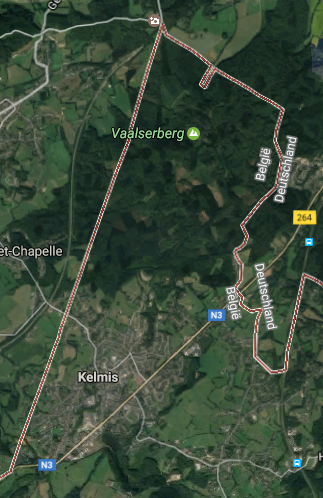
Did you know that there used to be a quasi-autonomous European jurisdiction with a land area of 3.5 km and a population as large as 3,500 that used Esperanto as its official language?

Moresnet (Esperanto: Amikejo, or “friendship place”) lay among Belgium, Prussia/Germany and the Netherlands in roughly the location shown on this Google Map. It was established in 1816 and absorbed into Belgium in 1920. I exaggerate by calling it a “country,” but it was an international condominium with sovereignty shared by Prussia (later, Germany) and Belgium, official neutrality, its own tricolor flag, and a high degree of self-rule. In 1918, a project began to make it Esperanto-speaking; many residents learned the language, and the World Congress of Esperanto named it the capital of the global Esperanto community.

I learned this after reading about Alexander Dubcek, the face of Socialism with a Human Face and a Czechoslovak leader during both the Prague Spring and the Velvet Revolution. Dubcek was conceived in Chicago but born in what’s now Slovakia. He and his family moved to what’s now Kyrgyzstan at age 3. There he and his family lived in an experimental co-op called Interhelpo, where first Esperanto and then Ido (Esperanto for “offspring,” meaning a kind of Esperanto 2.0) was spoken as the main language. In 1943, Stalin liquidated Interhelpo and shot many of its crunchy residents, but by then Dubcek was back in Czechoslovakia, flighting the Nazis. He survived to be a thorn in the side of totalitarian communism, but not–as far as I know–a dedicated Esperantist.

Any dreams of uniting Moresnet and Interhelpo into a confederation of Esperanto states proved (shall we say) utopian.

three views of the Democratic Party when democracy is at risk

View #1: The same two parties have alternated power since 1854 and will continue to do so for the foreseeable future. Today, the most serious threat to small-d democratic norms and institutions comes from the Trump Administration, and the Democratic opposition is an essential counterweight. A Democratic House in 2018 could begin serious investigations; a Democratic president in 2010 2020 would end the Trump era. You may or may not agree with the platform of the Party, but it’s a big tent, and you have your choice of intraparty factions to back, from Sen. Manchin to Sen. Warren. Moreover, any Democrat would endorse positions on some issues that are preferable to those of the Trump Administration. The Party is accountable to communities most threatened by Trump: for instance, half the voting delegates at the Democratic National Convention were people of color. That fact pushes the Party to defend basic rights for all. The Democratic Party is a bulwark of democracy; it must win the elections of 2018 and 2020.

View #2: At the root of our problems is partisanship. Most of us (including me) use partisan labels as heuristics for assessing policies, candidates, news sources, and opinions. As a result, we are prone to misunderstanding the situation and demonizing half of our fellow Americans. “Partisanship is a helluva drug.” What we need is less reliance on party labels and more cross-partisan or non-partisan dialogue. Maybe it would be better if more Democrats won elections, but that is up to the Party apparatus and should not be our focus as concerned citizens.

View #3: The party duopoly stands in the way of progress, for reasons specific to our moment. Once industrial unions declined and working-class whites migrated to the GOP, we were left with two parties controlled by economic elites. Main Street business interests and extractive industries like coal and oil control the GOP, drawing votes from working-class whites who are not likely to see their interests served. Highly educated coastal elites control the Democratic Party, with votes from people of color who have no better choice. The result is hard-wired neoliberalism, with modest distinctions between the parties on civil rights and environmental regulation. Democracy (in the sense of government that responds to mass economic needs) requires a major reorientation of the whole duopoly. Trump actually enables that in a way that Hillary Clinton could not, in part because of his potential to blow up his own party.

For those keeping score, these three views are most consistent with the first, sixth, and second boxes in my flowchart (below). They can be posed as stark alternatives, demanding a debate. But it’s possible that they all contain truths and that we need people working on all three.