Author Archives: Peter

About Peter

Associate Dean for Faculty and the Lincoln Filene Professor of Citizenship and Public Affairs at Tufts University's Tisch College of Civic Life. Concerned about civic education, civic engagement, and democratic reform in the United States and elsewhere.

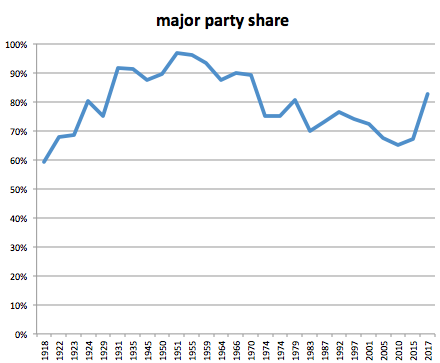
does the UK election show a return to two-party rule?

A May 2016 article in the Financial Times was headlined, “British politics has broken out of the two-party system.” The lead explains:

Politics has fragmented. London’s choice of Sadiq Khan as mayor grabbed the headlines — and rightly so. But the local and regional elections across the UK carried a broader message. British politics has broken out of the familiar framework of the two-party system. As in much of the rest of Europe the old rules are being discarded.

Provisionally, it seems the 2017 election results tell the opposite story. Here’s a hypothesis about what happened in Britain last week:

  1. Elections based on single-member districts tend to produce two-party systems, because votes for parties other than the top two are seen as “wasted.” The exceptions occur when regional parties are able to win majorities in their home areas.
  2. Given two parties, over time, people tend to split their votes about 50/50. If one party has a big advantage, that’s a disequilibrium; soon some demographic or identify groups migrate to the other party to even it out. Voters use party labels as heuristics and are not mainly affected by the specific policies or personalities on offer in a given campaign. That each party will get 50% of the vote is a pretty good guess.
  3. Britain avoided a two-party system for parts of the 20th century, but the 2017 election saw the duopoly return. That’s why, despite May’s poor performance and Corbyn’s arguably radical views, each got closer to 50% of the vote than their predecessors had for decades.

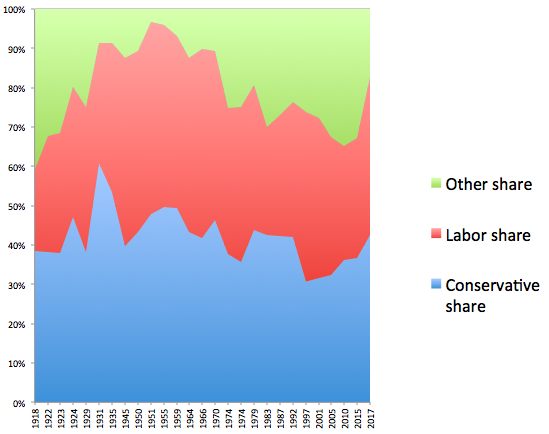
This second graph breaks it down by party:

Sources: The Guardian for the 2017 vote tallies so far. The UK Electoral Commission for historic data. Analysis is my own.

starting the 9th annual Summer Institute of Civic Studies

The 9th annual Summer Institute of Civic Studies begins this morning and continues for two weeks, with 6½ hours of seminar discussion daily.  This year’s participants hold degrees in religion and literature, social policy, social welfare, international relations, political theory, philosophy, management, education, public administration, communications, geography, and sociology. They come from Liberia, the Philippines, Latvia,  Colombia, Nigeria, China, and the US. And they come from graduate programs, faculty positions, or staff roles at Brandeis, Harvard, North Carolina Agricultural and Technical University, Penn State, Sheffield, Syracuse, University of Colorado, University of Ottawa, University of the Philippines-Los Banos, University of South Florida, Vanderbilt, the UN mission in Liberia, the US Embassy in Brazil, the Chicago Community Trusts, and the private sector.

One of our inspirations is this “Framing Statement” by Harry Boyte, Stephen Elkin, Jane Mansbridge, Elinor Ostrom, Karol Soltan, Rogers Smith, and me.  At one point in the Statement, the “civic ideal” is defined (in part) as “Public spiritedness, or the commitment to the public good, the res publica (to make explicit the republican roots of this idea in the Western tradition), a certain form of patriotism, a loyalty directed toward political communities.”

I like to present the ideal of public spiritedness in this way. If you look around a university, you will see lots of people asking the following questions:

  • What is going on? For instance, who is in poverty? How is the global climate changing?
  • What causes these patterns and what would change them? For example, would a global carbon tax reduce emissions?
  • How should things be? (What is justice?)
  • What should be done–for example, by the government?

But if you’re public-spirited, your question is different. As a public-spirited citizen, you ask:

  • “What should we do?”

A “Copernican turn” is a terrible cliché and sounds arrogant. But it works as a metaphor for what the authors on our syllabus have tried to accomplish. Copernicus kept all the planets and other heavenly models from the old system; he just moved the sun to the center. Civic Studies retains all the components (governments, markets, etc.) of standard social science and political theory, but it moves the citizen to the center. It’s an effort to theorize rigorously from the perspective of “we.”

on teaching the US Constitution

Today at a Social Science Education Consortium meeting, Walter Parker is presenting his fine paper with Sheila Valencia and Jane Lo entitled “Going for Depth in Civic Education: A Design Experiment,” and I am replying.

Parker and colleagues have completely redesigned the AP American Government class–often a rapid march through miscellaneous material–so that it employs nothing but elaborate simulations (a model Congress, a mock Supreme Court, etc.) and focuses on a few central concepts instead of a long list.

The results have been positive: students perform just as well on the AP test while developing much more civic skills and interests. I love the move to interactive projects and the willingness to distinguish central from peripheral concepts. I also agree with Parker and his colleagues that if the course is AP American Government, then the core concepts are “federalism and constitutional reasoning.” Working with those concepts in interactive settings will teach you what you need to know to score high on the test.

The question is whether these should be the core concepts if we have one chance to teach civics to high school seniors. I can think of three major reasons that they should be:

  1. Americans should understand federalism and separation of powers as major aspects of our constitutional system, because the constitution determines our politics.
  2. Americans will be more effective if they understand these concepts. For instance, if you understand federalism, you won’t contact your Member of Congress to report a broken streetlight on a state or city road.
  3. Americans should honor the basic values of constitutional government, which include obeying the rules that constrain us and recognizing the value of limitations on the power and discretion of each person and office.

Here are my reasons to doubt, or at least to complicate, these arguments.

First, the US Constitution is not very well designed for our era. I am not primarily talking about its undemocratic aspects, such as the highly unequal significance of a vote in different states. That is a planned feature, not a bug. Instead, I am talking about the bugs.

For example, if the president and Congress belong to different parties, no coherent policy is possible, and all the incentives favor each side sabotaging the other. Juan Linz found that the US was the only presidential republic that hadn’t already collapsed into a dictatorship. The reason may have been lucky circumstances (vast ideological diversity within each party) that allowed US presidents to form working majorities regardless of which party controlled Congress. Those days are gone.

Likewise, the Constitution fails to acknowledge such crucial components of our modern polity as parties, general purpose corporations, lobbies, media companies, administrative agencies, security agencies, and nonprofits. Our jury-rigged system copes by treating parties, companies, and nonprofits as First Amendment “associations,” media companies as “the press,” and federal agencies as arms of the president. This doesn’t work very well. Therefore, learning the official theory of the Constitution does not help a citizen to understand how things actually work; and learning how things work does not reinforce trust in the official theory. (See yesterday’s post on the small negative correlation between political knowledge and trust in government.)

Second, learning the official rules doesn’t help you navigate the system all that well. A very common assignment (or assessment question) asks students to choose which branch or level of government to contact about various topics of concern. But that’s not how things really work. Your Member of Congress might be the best person to ask about a significant road repair if you know her; she can call a city official and get it fixed. Your Representative is not worth contacting about a federal issue if she she has taken a hostile position on it or if the issue is off the table. Effectively navigating the system involves answering such questions as: What is being decided, by whom? Whose interests align with yours? Whom do you know? Whom do you know who knows someone else who knows an actual decision-maker? What does the press care about? Is there an organization that might take an interest in your issue? I fear that by teaching the official theory, we actually give the wrong impression of how a bill becomes a law. (A question for Walter is whether simulations of governmental processes primarily teach the official rules, or skills like persuasion, or both.)

Third, I am not sure that the values implied in a curriculum about separation of powers are the most important ones for students to learn. We do want people to honor the best principles that underlie a constitution like ours, such as rule of law and limits on powers. Our president never acknowledges that he should be limited in these ways, which is one of the reasons that I consider him anti-conservative. Citizens who understand the importance of limits may be less likely to assess politicians in unreasonable ways–expecting them to accomplish things that they are prevented from doing.

However, these principles may not be the paramount ones for everyday citizens (as opposed to presidents of the United States). Citizens should also honor such principles as personal responsibility for the world, openness to alternative views, concern for facts, and fairness. I am worried that by emphasizing constitutional values that mainly pertain to office-holders, we encourage students to think like states, when they should above all think like citizens.

See also: is our constitutional order doomed?; the Citizens United decision and the inadequate sociology of the US Constitution; liberals, conservatives, and love of the Constitution; constitutional piety.

how political knowledge related to opinions in 2016

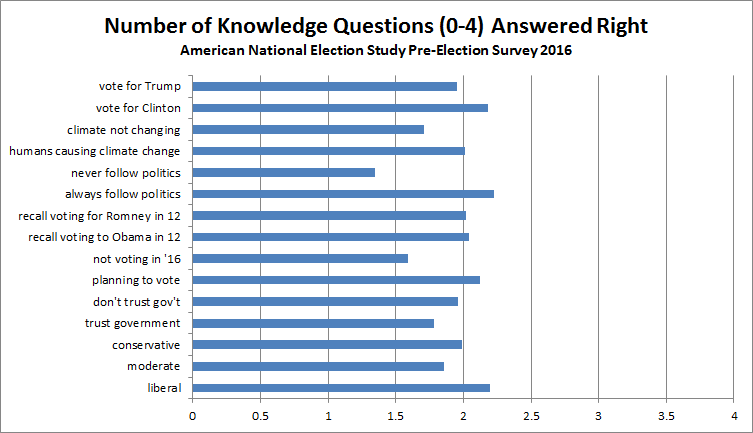
Last fall, the American National Election Study asked a representative sample of Americans four factual-knowledge questions about government: which party controlled the House and the Senate, how long a Senator’s term lasts, and which federal program costs the most. The mean respondent got just under two (1.94) of the four items right.

I thought some comparisons would be interesting. As shown in the chart below, Clinton voters scored a bit higher than Trump voters–but not by a mile. Political knowledge of this type correlated somewhat with understanding climate change, and a lot with following political news and planning to vote. Obama and Romney voters had indistinguishable levels of political knowledge. Liberals performed a bit better than conservatives, and both knew more than moderates. Knowing more about government correlated with trusting it a bit less.

Mindlessness: A Sonnet

I’m striving to be a little less present.
You need the attention of our group.
Your anxious eyes, urgent words convey a gripe;
They sketch a threat you’re sure is prescient.

But I’m counting syllables in my head,
Selecting words for a private longing,
Rehearsing anxieties—more than learning.
The staccato of your speech makes it hard

For me to keep my restless inward eye
Focused steadily on my lost past, my fears,
Or to freeze this mood in lasting phrases.
You, they, and we interrupt the flimsy I.

It’s a discipline to suggest attention
While indulging fully my own tension.

(Posted on the DC->Boston shuttle)