About 800,000 people are “DREAMers”–enrolled in Deferred Action for Childhood Arrivals (DACA). They are subject to deportation unless Congress reverses Donald Trump’s executive order rescinding DACA. Their cases represent 800,000 potential tragedies. When so many people are faced with such brutal and deliberate hardship, it can seem bloodless to consider subtle theoretical questions–especially when one isn’t personally threatened.
But politics is often a matter of life and death, and it’s important to debate abstract issues of justice as long as one also retains empathy and commitment. A refusal to address contrary arguments can come across as fear that those arguments may actually be right. Here are some thoughts on three issues that have come up in the debates so far.
Does amnesty violate the rule of law?
Attorney General Jeff Sessions invoked the rule of law when he announced that DACA would be rescinded:
No greater good can be done for the overall health and well-being of our Republic, than preserving and strengthening the impartial rule of law. Societies where the rule of law is treasured are societies that tend to flourish and succeed.
Societies where the rule of law is subject to political whims and personal biases tend to become societies afflicted by corruption, poverty, and human suffering.
To have a lawful system of immigration that serves the national interest, we cannot admit everyone who would like to come here. That is an open border policy and the American people have rightly rejected it.
Therefore, the nation must set and enforce a limit on how many immigrants we admit each year and that means all can not be accepted.
This does not mean they are bad people or that our nation disrespects or demeans them in any way. It means we are properly enforcing our laws as Congress has passed them.
It is with these principles and duties in mind, and in light of imminent litigation, that we reviewed the Obama Administration’s DACA policy.
Here Sessions echoes prevalent talking points on the anti-immigration side. The idea is that it’s illegal to bring a child here without authorization; and for the government to ignore illegality is to erode the rule of law, which is a buttress of the republic. Sessions cites the fact that President Obama enacted DACA by unilateral executive order as additional evidence that the policy is arbitrary.
I endorse the rule of law as an aspect of justice. But I think Tyler Cowan offers the right response to Sessions’ argument:
What is striking about immigration, and immigration policy, is the very simple but oft neglected fact that it concerns human bodies. Any exercise of immigration law thus requires some violence, either explicit or implicit, against those bodies. It will mean the rounding up and forcible restraint of bodies, the widespread use of prisons and other coercive holding chambers, and tearful scenes of airport separation. Those methods will be applied to individuals who do not enjoy the full protections of the U.S. Constitution, who are vulnerable to mistreatment during the process, and who do not always have full fluency in the English language or a full understanding of their legal rights. … A somewhat lax enforcement of immigration restrictions is in fact the friend of the future of the rule of law, not the enemy.
If you have faith in the government to execute laws impartially and efficiently, you could conclude that rule-of-law arguments support deporting people who are present in the United States against the law. (You might think that even if you also see stronger reasons to support DACA). On the other hand, if you doubt that our actual government can deport hundreds of thousands of people without demonstrating partiality, without committing arbitrary violence, and without violating legal rights, then the way to preserve rule of law is to offer amnesty. This is a point where insights from classical liberalism and Public Choice theory are pertinent.
In Origins of Totalitarianism, Hannah Arendt defines citizenship as “the right to have rights.” Without DACA, DREAMers are people inside the United States who have no right to have rights. That status threatens the rule of law for all. Removing them is not only cruel but also impossible to accomplish without permitting the state to act lawlessly against a large category of people. In principle, a wise state could follow its own laws as it made decisions about people who lacked rights. A real state will surely not do that.
Is migration an intrinsic human right?
Arendt argues that everyone must be a citizen somewhere; statelessness is a profound human rights violation. But that doesn’t mean that everyone has a right to be a citizen anywhere.
If you believe that every human being has a right to reside anywhere, then the DREAMers should obviously not be deported. Neither should anyone else, nor should anyone be stopped at any border.
For my own part, I don’t believe it. There are many countries where I would like to be able to live and work, but I think I have a moral (as well as a legal) obligation to follow the immigration laws of those countries. They have a right to keep me out unless I am a refugee in immanent danger. My reason for being highly sympathetic to migrants to the USA, regardless of their legal status, is that I regard US relations with many of their home countries as unjust. I don’t see their decision to move to the US as simply “free,” because the economic and political conditions in their home countries were beyond their own control and are sometimes the result of US foreign policy. When, however, highly educated citizens of wealthy nations sneak into the US illegally, I am unsympathetic.
Most Americans do not share this worldview. Quite the contrary: they believe that we are generous with foreign aid and brave in defending democracy abroad. This premise is factually incorrect, but skepticism about immigration follows logically enough from it.
Is there a basis for distinguishing the DREAMers from other undocumented residents?
Perhaps we are debating DACA separately right now because of sheer political necessity. There is no immediate opportunity to accomplish a reform that would cover people other than the DREAMers. The DREAMers won precarious rights through DACA that Congress is actually considering enacting by statute. That would be half a loaf, but it’s better than none.
If the reason to separate DREAMers from other undocumented immigrants is nothing but political necessity, it’s important to say so publicly and clearly. Otherwise, we might inadvertently justify denying rights to other people, including the DREAMers’ parents. We might allow that distinction to harden.
It’s clear that the DREAMers have won more public support than other immigrant groups. One explanation could be their own skillful, innovative, and courageous organizing. I suspect two other reasons as well. First, people who’ve lived in the US since their childhood are especially likely to suffer if they are suddenly deported; and suffering is to be avoided. That is a utilitarian rationale for offering a unique policy to DREAMers. But clearly, DREAMers are not the only people who suffer from deportation (or the threat of it), and some may suffer more.
A different argument involves intention. Since the DREAMers did not choose to immigrate, they should not be held responsible for their parents’ choices. I’m sure that this argument is widely held, but it is problematic. It assumes that adults’ choices to migrate were free (in a morally relevant sense), and it justifies imposing very dire penalties on individuals because they were adults when they migrated.
Both arguments have some plausibility, but neither really justifies a bright line between the DREAMers and other undocumented residents. If it’s a matter of justifiable expediency to single out the DREAMers, we should constantly say so.

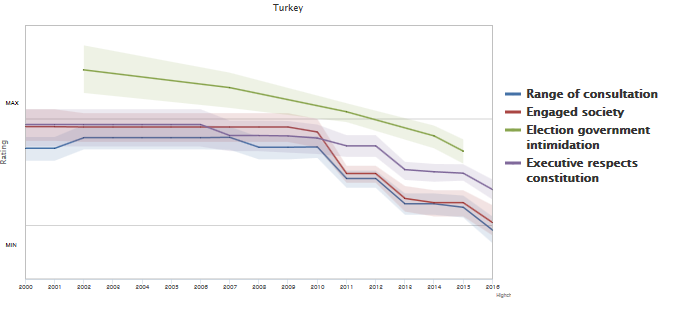 The pattern is less pronounced but similar in Poland since 2011.