Author Archives: Peter

About Peter

Associate Dean for Faculty and the Lincoln Filene Professor of Citizenship and Public Affairs at Tufts University's Tisch College of Civic Life. Concerned about civic education, civic engagement, and democratic reform in the United States and elsewhere.

powering youth civic engagement with data

(Providence, RI) Two of our marquee data projects have made the news this week. In The New York Times (March 3), Farah Stockman writes:

Efforts to bolster student turnout have been aided by a new national study that analyzes voting behavior on campuses across the country.

For the first time, schools can get detailed data on how many of their students cast a ballot, either locally or absentee, thanks to the National Study of Learning, Voting, and Engagement, put out by researchers at Tufts University.

The study aims to assess how well schools are doing at preparing students to be active citizens in a democracy, said Nancy Thomas, director of the Institute for Democracy & Higher Education at Tufts University, who oversees the study.

The study, which matches enrollment records with voting records, began in 2013 with a modest expectation of getting a few hundred colleges to participate. Today, it includes voting data from more than nine million students on 1,100 campuses in all 50 states. Identifying information has been removed from the data to protect students’ privacy.

The data has unearthed a series of fascinating insights about the 2016 elections: Social science majors had higher turnout than math and science majors (53 percent versus 44 percent). Female students had higher turnout than males (52 percent versus 44 percent). Asian students turned out at a far lower rate than their peers (31 percent versus 53 percent for white students, 50 percent for black students and 46 percent for Hispanic students).

“This initiative will hopefully motivate educators to teach students across disciplines why they should not take democracy for granted,” Dr. Thomas said.

And Josh Kurtz writes in Scientific American (March 5):

Millennial voters are poised to drive the U.S. debate on climate change—and they could have an oversized impact on 10 competitive congressional elections this year, two new studies suggest. …

The second study, also released late last week by the Center for Information & Research on Civic Learning and Engagement at Tufts University, showed the 10 congressional districts where millennial voters could potentially make the greatest difference in November. Eight of the 10 districts are in the Midwest or Plains states. …

“Millennial voters have generally favored Democrats in midterms, and that trend continues,” the Pew report says. “But, comparing early preferences this year with surveys conducted in previous midterm years, Millennial registered voters support the Democrat by a wider margin than in the past.”

That’s where the Tufts study comes in.

The Center for Information & Research on Civic Learning and Engagement created a Youth Electoral Significance Index, using demographics, historical voting patterns and projected competitiveness to produce a ranking of the congressional districts where young people (ages 18-29) have the highest potential for impact on the 2018 elections.

The study identified 10 swing districts with large populations of young people, including college campuses.
 

what if there were no public or no private schools?

The Atlantic’s Julie Halpert asks us to imagine two scenarios. In one, “every child would have to attend private school, and in the other, every child would have to attend public school. Which scenario would be more likely to improve or worsen kids’ educational outcomes—and, by extension, the health of American society?”

She quotes me a few times with doubts about an all-private system:

Levine’s prediction for an all-private-school world? “You’ll have this very intensely competitive market in which every child would be assessed,” he said, “and if your child has behavioral issues, they won’t get as good a deal in the market.” … An all-private-school world, then, would foster a system that thrives on selectivity. As Levine emphasized, private schools can’t just scale up like companies can because small size is often a selling point in K-12 education; the best schools are those that don’t accept large numbers of students.

I am not a doctrinaire opponent of choice or market mechanisms in education. Denmark is rightly admired as a model social welfare system, yet 15.6% of Danish kids attend private schools fully funded by vouchers. In many European cities, all the schools are what we would call “charters”: basically self-governing entities, regulated by the state, that get public money in proportion to their enrollments. (Rural areas tend to offer less choice, simply because the low population density favors local mandatory-enrollment schools).

By the way, the Danish Union of Teachers represents 97% of primary and secondary teachers. A competitive market with high union density may offer a good combination of choice plus job security.

Meanwhile, it’s not so clear that offering only public schools really gets rid of market competition. The American “common school” model–one school system for all the children in each political jurisdiction–reflects a fierce market for housing. Americans of means choose their residence in order to determine their kids’ schools. It would arguably be better to separate the market for schools from the market for houses, rather than combining them and kidding ourselves that we have ever had a “public” school system.

But I was asked whether I’d like to see a system without public schools at all–Milton Friedman’s model of vouchers for an all-private system. I offered several ways in which education differs from other markets.

One difference is that education is meant to produce public goods, such as a unified body of informed citizens, not just private goods, such as each graduate’s value in the labor market. I agree with this normative position, but the empirical evidence is complicated. There is evidence that Catholic high schools in the United States–which are private–have done a better job than public schools of generating public goods.

Another difference is that educators typically do not want to increase the size of their own enterprise. For teachers, it’s better to have 18 rather than 8o students. For principals, it may be preferable to have 20 rather than 200 teachers. Families may also prefer smaller and more selective schools. The usual incentives to “scale up” don’t apply.

A third difference is that kids, not just schools, have unequal market value. Coca-Cola doesn’t care who you are if you have enough money for a bottle of Coke. Detroit Country Day School (the institution that Halpert uses as an example) definitely does care who you are if you want to enroll. The other kids contribute profoundly to each student’s experience and trajectory.

In fact, I have sometimes wondered whether a university that had sufficient status–thanks to its history and branding–could offer no education at all, and its students would still fare well thanks to their cultural capital, the network ties they form among their peers, and the market signal conveyed by enrolling them. The admissions office and the dormitories could do the whole job of conveying social advantage. It would not be irrational to prefer (and to pay tuition for) such an institution rather than an open-access university that added more value in the classroom.

In the long run, it might be a mistake to blatantly offer no pedagogy or curriculum whatsoever. That might erode an institution’s brand. However, I’m confident that many highly selective schools and colleges do a subtly worse job of instruction than many low-status institutions that enroll less advantaged kids. The former still win in the market for students because they have already attracted other privileged students.

Charging higher tuition can even make a school more desirable by ensuring that most of its students have high social positions. (A school may then get even more value by admitting a few non-privileged kids for “diversity,” charging them less than the sticker price).

These are not reasons to reject choice and market mechanisms altogether, but they do suggest that facile analogies between ordinary consumer markets and education are likely to mislead.

new CIRCLE report on Millennials’ ideology

CIRCLE has released a new report entitled “Millennials’ Diverse Political Views: A Typology of the Rising Generation.” From the summary:

Millennials are already the largest group of potential voters and are destined to dominate American politics in decades to come. As a demographically and economically diverse generation, they naturally hold a wide range of opinions. In the 2016 election, for example, voters under the age of 30 split their support: 55% percent for Hillary Clinton, 37% for Donald Trump, and 8% for other candidates.

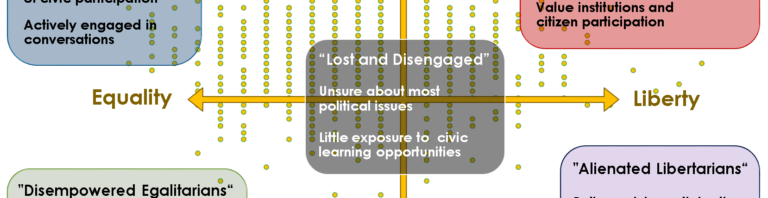
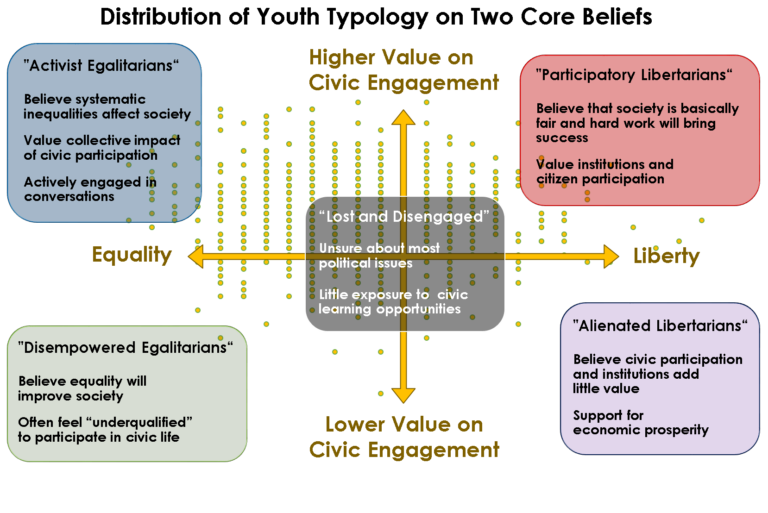
We use recent data to identify clusters of Americans between the ages of 18 and 34 into five groups:

  • Activist Egalitarians (39% of Millennials)
  • Participatory Libertarians (29%)
  • Disempowered Egalitarians (8%)
  • Alienated Libertarians (5%)
  • The Lost and Disengaged (18%)

The two egalitarian groups are concerned about social, political, and economic inequality, and they tend to support government action to combat it. The two libertarian groups are concerned about individual freedom and are more skeptical of government. These orientations characterize some, but not all, core characteristics of young people’s beliefs about the size and responsibilities of government, and whether inequality is seen as a major barrier to progress.

Within both the libertarian and the egalitarian sides, there are disagreements about civic engagement. Millennials of all political stripes differ on whether it is useful for people like them to engage with fellow members of their community or with institutions—or both—to change society. Meanwhile, the Lost and Disengaged do not seem sure where they fall, are disconnected from news media, and largely disengaged from civic life.

The largest group, Activist Egalitarians fit an influential stereotype of Millennials. However, they number less than two-fifths (39%) of all Millennials, and are themselves not monolithic. Less than a third (28%) see themselves as liberal or extremely liberal, and 14% see themselves as conservative or extremely conservative. More than half (54%) of Hillary Clinton’s Millennial voters came from this group, but they have mixed feelings about the Democratic Party.

Demographic and Social Differences

There are important demographic and social differences between the groups, particularly related to education and income.

Participatory Libertarians are almost three times as likely to have a college degree as the Lost and Disengaged.

Among the two Egalitarian groups, the Activists are almost twice as likely to have completed college as the Disempowered, more than half of whom have no college experience at all. That a lack of civic efficacy and confidence correlates with these disparities only exacerbates political and social inequalities.

Those who do not believe in the power of people’s collective work in communities and society vary not only on their Egalitarian-Libertarian polarity, but also on why they may not believe that people can make a difference:

Disempowered Egalitarians acutely feel social inequities but may be hopeless that anything could change.

Alienated Libertarians appear to worry about individual prosperity first and foremost and believe that everyone should look out of themselves rather than work with institutions or with each other.

It is encouraging that a majority of young people of diverse ideologies believe that they should work with others to benefit society and communities, and that civic institutions can play a positive role if they are kept accountable. Still, a troublingly sizable minority are unconvinced that they and their fellow citizens can effect change, and/or feel unqualified to contribute to civic life. Engaging these young people will be challenging, but it is not impossible. We must implement multi-pronged, short- and long-term strategies for engagement that support all young people as they develop their civic and political identity. And we must ensure that Millennials have the resources and opportunities to express their identities with a loud and clear voice, and to turn that voice into effective action.

my exchange with Beth Rubin about policy for civics

Paul G. Fitchett and Kevin W. Meuwissen have published Social Studies in the New Education Policy Era: Conversations on Purposes, Perspectives, and Practices. This edited volume is devoted to exchanges between pairs of scholars. My assigned debating partner is Prof. Beth Rubin from Rutgers, whose work I admire and who has influenced me a lot. There isn’t a whole lot of room between Beth and me, but we manage to disagree mildly in ways that might be illuminating.

I begin by arguing that the policies adopted so far by states and districts for civic education matter, but not as much as how such policies are implemented. Support for things like professional development makes policies either work or fail. I also note that the policy debate reflects disagreements about what should be taught. Given such disagreements, no one can expect to get the curriculum that she or he prefers enacted into law in all 50 states. I propose a division of labor: public schools should teach relatively uncontroversial, relatively basic civics, and community-based groups should add more politically charged content that reflects their diverse perspectives.

Beth understandably worries that the mainstream curriculum mandated by governments will, in fact, be biased. She argues that governments should make schools good places for learning, leaving civics curricula mostly unconstrained by policy. That would imply skepticism about policies like standards and tests, because they centralize decisions about the curriculum. I counter by offering a state policy agenda that includes standards, professional development, reforms of school discipline, and tests–if they are well done. This package is fairly minimalist, intended to create a baseline for all kids while leaving space for diversity. Beth ends the exchange with some concerns about whether the “baseline of knowledge” that I want to see in state standards can really be good for all of our kids.

The rest of the book is entirely devoted to similar debates, and it looks good throughout.