judicial activism when the legislative branch is broken

The recent Supreme Court decisions would matter much less if Congress regularly passed legislation that reflected popular opinion. Instead, for half a century, Congress has hardly ever enacted ambitious legislation, even when the majority party has endorsed it. In that context, an activist court poses a particular threat to democracy.

In West Virginia v EPA, the court focused on the problem of vague delegation. The Constitution vests all legislative authority in Congress, yet the EPA asserted a right to regulate power plants based on vague statutory language. In my 2000 book, The Future of Democracy, I argued that it was undemocratic to give administrative agencies broad discretion. I was actually aligned with the central argument in West Virginia v EPA: Congress should make consequential decisions. However, I had not yet realized how badly the legislative branch was broken. In the succeeding two decades, Congress has only passed a few meaningful laws: the catastrophic domestic and international reactions to 9/11, the amendments to the Elementary and Secondary Education Act that were hyped as “No Child Left Behind” (and then substantially abandoned), and the tweaks on private insurance markets called “Obamacare.”

It is Congress’s job to regulate power plants. The public would support somewhat stronger environmental regulations, as would the party that currently controls the White House and both the House and Senate. Nevertheless, no one expects a new environmental bill to pass. At best, Congress could focus on that task but neglect its other goals. We face a Hobson’s choice: executive branch overreach or paralysis in the face of climate crisis.

The abortion decision is different: the court took away a constitutional right, applying an extremely problematic method for interpreting the Constitution. The court assigned power to the states, many of which will adopt policies that reflect their respective publics’ opinion. The problem with the abortion decision is not so much that democratic processes will fail at the state level (that varies by state), but that a human right has been rescinded.

Yet even here, it is worth noting that very few other countries protect a right to abortion in their constitutions or through decisions of their constitutional courts. Many more countries have enacted regular laws that permit abortions in various circumstances–broadly reflecting popular opinion. If we had a functioning Congress, then our national policy would depend on the congressional majority, and it might vary. Since I believe in a constitutional right to abortion, I would not accept such variation. Still, over time, there would usually be a national statutory right to abortion. (The current court might strike down a federal law on 10th Amendment grounds, but for now, that is speculation.)

Just 24 percent of experienced Hill staff agree that “Congress currently functions as a democratic legislature should.” Why not?

An obvious explanation for the current stalemate is the distribution of votes. The Democrats have just 48 members in the Senate, including two wildcards, plus two friendly Independents. However, neither party has accomplished very much–even with considerably larger majorities–at any time since the 1970s.

A proximate cause is the filibuster. That is certainly the immediate reason why a bill to protect abortion rights will fail in the Senate. However, it’s worth looking more deeply. After all, the Senate choses its own formal rules and creates its own culture. Why do senators vote for the filibuster even when it is so widely abused?

I used to believe the reason was money. An excellent example would be Joe Manchin’s financial ties to fossil fuels. However, it’s important not to overgeneralize from prominent anecdotes. The evidence that campaign finance affects legislative outcomes is not very compelling. To the extent that money talks, its impact would be weakest on high-salience issues, yet most of those issues are stuck. I’d add other explanations.

First, Newt Gingrich intentionally reduced legislative capacity, i.e., the expert staff support that enables legislators to develop bills. He did that less to reduce the size of the government than to centralize power in the Speaker’s office. Only five percent of Hill staffers surveyed by the Congressional Management Foundation and the Partnership for Public Service believe that Congress has adequate capacity today–a problem that is being discussed by the Select Committee on the Modernization of Congress.

Second, national cable news and social media encourage members of Congress to act like celebrities and pundits but do not reward legislative work. Professional reporters employed by city newspapers used to cover lawmaking regularly, focusing on their own delegations and issues of interest to their communities. Most of those reporting jobs are gone, and rank-and-file members of Congress receive much less overall scrutiny. At the same time, national cable networks fill hours with elected talking heads who opine on hot-button issues.

What about polarization? All Democrats fall to the left of all Republicans on standard, unidimensional measures of ideology. The disappearance of Dixiecrats and liberal northern Republicans has made it harder for a president to assemble a governing majority from components of the two parties. However, polarization should only create paralysis during times when the parties split control. When one party holds both houses plus the presidency, one would expect polarization to facilitate the passage of legislation.

I think partisan polarization is a somewhat misleading diagnosis. Even as candidates and voters identify with parties as labels, the parties have become extraordinarily weak institutions, with very little capacity to develop and implement coherent plans. Politicians are independent entrepreneurs with unique constellations of donors and local interest groups. Due to gerrymandering, they are much more concerned about fending off primary challengers than beating the other party in the general election. Working on a bill requires compromise and complexity that can backfire in a primary campaign.

Besides, both of the parties are cross-pressured. In this week’s New York Times/Siena poll, Democrats perform better among highly-educated whites than among people of color. No wonder the Democratic congressional caucus is “agonizing” over tax increases, which would hit a core Democratic constituency. The state with the second-lowest household income, West Virginia, seems out of reach for any kind of progressive Democrat. (Yes, West Virginia is 92.5% White, but that should not be the end of the discussion about why West Virginians vote conservatively in the 21st century.) Meanwhile, Republicans encompass low-education whites and many Latinos who wouldn’t benefit from tax cuts, plus business owners, who would.

A major ideology, such as Great Society liberalism or Reaganite neoliberalism, can orient elites toward a common end even when their grassroots constituencies are heterogeneous, but all ideologies are in rough condition today.

For me, it always comes down to civil society: how individuals join or form groups that can influence the state (or solve problems directly). Today, there are many dynamic and creative groups, and social movement participation may be at an all-time high. Thus, civil society is not in decline in a straightforward way. However, it is possible that groups are poorly configured to push legislation all the way through Congress. Ryan Grimm’s controversial piece in The Intercept about “meltdowns” in progressive organizing groups may or may not be fair and complete–I cannot tell. For me, the main takeaway is that major liberal membership organizations failed legislatively during the first year of the Biden Administration. Whether this is due to “meltdowns” or other factors, it is a problem. It is hard to think of examples in the past several decades in which membership groups have been more successful in the legislative arena.

One might still imagine that the current Congress will pass some significant legislation. But it is worth remembering how low our expectations have become. There is hardly any chance that Congress will address more than one urgent national problem by 2024. When the Supreme Court assigns responsibility to Congress, it is asking a dysfunctional entity to act.

See also: legislative capacity is not zero-sum; are Americans ‘innocent of ideology’?; a different explanation of dispiriting political news coverage and debate; and the social class inversion as a threat to democracy
how we use Kant today

Michael Rosen’s wonderful book The Shadow of God: Kant, Hegel, and the Passage from Heaven to History explores the seriously theological aspects of German idealist philosophy. Rosen’s core insight is that philosophers from Kant to Hegel (as well as Marx) tried to solve the problem of arbitrariness by identifying free individuals with something abstract and rational–morality, the state, or history–which could take the place of a traditional Abrahamic God; but these were impersonal constructs that were unable to forgive or love us. “Two powerful drives–the desire to see the world as personal and human and the desire for human beings to be subject only to relationships that are rational and transparent–are in fundamental conflict” (p. 216). The German idealists chose the latter. They thus traded the “alienation of arbitrariness” for the “alienation of impersonality” and bequeathed to us a lonely world in which we became vulnerable to totalitarianism.

Although Rosen covers much more ground, here I want to mention his interpretation of Kant and explore what it suggests about moral philosophy today.

Kant is mainstay of undergraduate ethics courses, and we usually present him as offering a plausible–but also controversial–procedure for addressing moral questions, such as whether it is ever permissible to lie. We ask students to compare and contrast Kantian ethics to other theories, notably utilitarianism.

According to Rosen, Kant presumed that people already knew what was right to do. Kant was a “moral unanimist.” He agreed with–and was deeply influenced by–Rousseau’s claim that “the heart of man is always right about everything that does not relate personally to him” (p. 126). When we act and think wrong, it is because we are biased (Kant says, “seduced”) by self-interest. We don’t need a procedure to help us choose among options when we are sincerely confused or ambivalent. We need a reminder to be moral, in which case the right answer will be obvious. And we want to understand how human morality relates to freedom in a deterministic universe and how people can be free when the deity is omnipotent and omniscient. These are meta-ethical questions rather than ethical ones. Rosen cites previous commentators–H.R. Paton, plus others who are unfamiliar to me–who anticipate his approach to interpreting Kant.

Very few people are “moral unanimists” today. To varying degrees, we are aware of four kinds of plurality:

  1. Personalities vary, and it’s hard to adjudicate when individuals are drawn to different values, at least among basically decent ones.
  2. Cultures and eras have characteristic values or perspectives on ethics.
  3. A given person may feel compelled by real obligations that are in mutual tension (cf. p. 312).
  4. Human beings as a species may be hard-wired by evolution to value things that other species would not.

Even people who are convinced that there should be one right way for all creatures to answer all moral questions will generally concede that unanimity does not prevail. Few share Rousseau’s faith that all uncorrupted human beings agree about moral matters. Even if a single moral position is correct, it is pretty obvious that well-motivated people do not all see things that way.

At a time when people are deeply aware of–and often anxious about–moral disagreements of various types, it’s tempting to turn back to Kant for actual answers to our moral quandaries. Some find his theory persuasive and prefer it over utilitarianism or other available views. Others would relativize it in various ways, seeing Kantianism as: 1) a personality type, perhaps reflecting a tilt toward Jonathan Haidt’s “moral foundations” of fairness and freedom, 2) a cultural inheritance, probably Protestant, bourgeois, and European, 3) a view that favors certain goods–especially freedom–and ignores others, or 4) a fancy way of describing instincts that evolved in human beings as social animals.

Despite these and other disagreements about how to read Kant, most are convinced that he proposes views about contested moral issues. Rosen suggests, instead, that a deep historical gap separates Kant from all of us. Kant is not interested in deciding what is right, because he assumes that is an obvious matter. For our part, we are so unsure what is right that we search Kant’s abstract principles and his rather unconvincing examples for actual moral guidance. This may say more about our circumstances than it does about Kant’s thought.

I find Rosen’s interpretation of Kant’s texts persuasive. At the same time, I continue to be interested in the contrast between Kantian and utilitarian applied ethics. For instance, the influential Effective Altruism movement is worth paying attention to. If nothing else, it challenges some prevalent hypocrisies and inconsistencies. Yet I can’t accept it because it seems to view the donor as the sole moral agent and the recipients as essentially passive. I find modern Kantian ethics–and some passages by Kant himself–useful for articulating the intuition that all people should be accorded the dignity of self-determination and that human beings should relate to each other as moral equals with rights, not as means to any end. Rosen acknowledges a “connection” between Kant’s philosophy and modern theories of rights (p. 257), notwithstanding the historical gap discussed earlier.

It could be that Kant would be a bit mystified by the debates about effective altruism and other issues in applied ethics and surprised to see his arguments deployed on one side of these controversies. Yet these are worthy debates, and Kant is more than just a famous name that we can cite as a token of respectability when we want to emphasize abstract duties and rights. In this case, intellectual history and practical ethics come somewhat apart. Kant may have been thinking about theodicy (how can God be good if there is evil in the world?), but we can find ethical advice in his principles and examples.

See also: qualms about Effective Altruism; why ambitious ethical theories don’t serve applied ethics; structured moral pluralism (a proposal); why ambitious ethical theories don’t serve applied ethics; etc,.

reflections on German/US learning exchanges

Tisch College has been proud to collaborate with the Arbeitskreis deutscher Bildungsstätten e.V. (“network of German educational institutions” or AdB) on a Transatlantic Exchange of Civic Educators (TECE). This project has allowed 24 people who educate for democracy and civic life in Germany or the USA to interact intensively online and to visit the two countries together. I personally learned a great deal about contrasting policies and institutional cultures and common challenges, especially the teaching of “hard histories.”

Americans have a lot to learn from Germany’s extensive system for adult education, which involves governmentally funded but substantially independent centers and institutes all across the country, staffed by professionals who have studied adult education. These institutions explicitly promote democracy. On the other hand, the US expects our colleges and universities to provide more public outreach and education, and we have strong social movements that offer a lot of learning opportunities–albeit generally without any state funds.

AdB has now published a detailed and valuable report from the project that is available online, in English. Among other components, it includes an essay by TECE fellows Navina Engelage, April Grayson, Gabrielle Lamplugh, Elena Neu, Teresa Pfaffinger and Sarah M. Surak on history “as an entry point to dialogue and civic education,” and an essay by fellows Laura Tavares, Christina Wiley, Emma Humphries, Sarah Wagner and Christian Johann on the context of political polarization in both countries.

college students’ civic knowledge “appalling” … in 1943

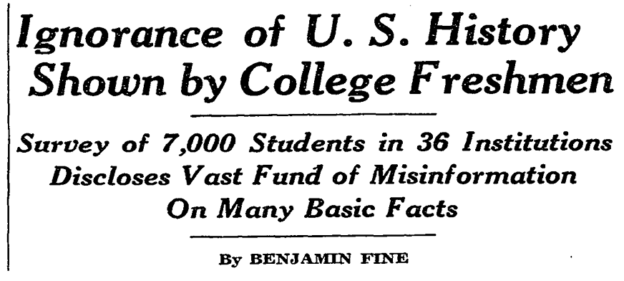
Thanks to a Twitter thread by historian Meredith Henne Baker, I read an article from The New York Times entitled “Ignorance of U.S. History Shown by College Freshmen.” In that piece, Benjamin Fine reported the results of 7,000 surveys completed at a substantial set of participating institutions, from Boston University to Yeshiva College.

The results look pretty awful. “A large majority” could not answer questions about Lincoln, Jefferson, Jackson, or Lincoln. Twenty-five percent did not know that Lincoln was president during the Civil War. Students’ geographical knowledge was also deemed poor: “Most of our students do not have the faintest notion of what this country looks like.” Asked about the Bill of Rights, many respondents named rights that are not in that document, including FDR’s four freedoms and women’s suffrage.

None of this sounds like news. We have surely heard it all before. See, for example, “Failing Grades on Civics Exam Called a ‘Crisis’” (New York Times, May 4, 2014).

The interesting point about Fine’s article is its date: April 4, 1943. He uses a lot more words than his 2014 successor, and he combines commentary with reporting in a looser or breezier style. Otherwise, these articles almost rhyme.

I might have expected the results to look better in 1943. College freshmen were a more elite subgroup of the young-adult population then, the curriculum was narrower (giving American history potentially a larger share), and the US was fighting a highly patriotic all-out war. But overall, the statistics looked no better in those days, and maybe worse than today.

When arguing for better civics and historical education, we should avoid the language of decline or current crisis. In reality, levels of civic and historical knowledge–as measured by such instruments–appear remarkably flat despite dramatic changes in education and society. These surveys and their specific questions are subject to debate; people know important things not reported in these articles. Still, it is worth seriously investigating why basic political and historical knowledge seem so persistently poor.

One implication is that quick and easy solutions are unlikely to work. Requirements for courses and tests have come and gone over the past 80 years, with sometimes statistically significant results but no fundamental change.

Another implication is that political reforms must accompany changes in education. Just to name one example, Gimpel, Lay & Schuknecht (2003) found that young people learned and knew more about politics if they grew up in competitive electoral districts rather than “safe” seats. Thus gerrymandering reform would help civic education. That is just an example of how civic knowledge has a demand side as well as a supply side. The more adults are invited to play consequential political roles, the more youth will seek and receive civic education. However, to empower citizens is usually a struggle, because it usually comes at the expense of current power-holders.

A third implication is that we would need bolder policy reforms to improve civic education substantially. Adding or removing a test may matter, but it is a pretty modest intervention. If knowledge of the political system and its history are truly important, we will need more than a course or test.

We have never really tried a sustained and coherent effort to set targets, enact requirements, educate educators, produce materials, assess students, evaluate programs, and improve all the inputs. Educating for American Democracy offers a roadmap for such an effort, and it would be unprecedented.

bootstrapping value commitments

On the third day of the 2022 version of ICER (the Institute for Civically Engaged Research), I am thinking about the normative commitments of engaged scholars–their theories of justice or social ethics.

All research requires and reflects normative commitments. Even a highly positivistic study addresses specific topics and questions for a reason, whether or not that reason is acknowledged. We should be accountable for these normative commitments, willing to defend them in public, respond to criticisms of them, and modify them when the criticisms seem valid.

I don’t believe we have a right to “outsource” that process to other people. For instance, it’s not acceptable to say that the community you study has certain values and that you simply report them without influencing them. Whether you are right to study this particular community in this way is a question about you, and you are responsible for answering it to the best of your ability.

On the other hand, we can acknowledge our frailties and limitations as individuals. We have cognitive and moral limitations–in fact, we are foolish and selfish. It can therefore be wise to consider questions of justice in the company of others and to make oneself open to their views.

That raises the question: Which others? In the projects I briefly described yesterday, the community is the border region of metropolitan San Diego/Tijuana. Making oneself part of that community, and accountable to it, directs one’s normative reasoning in particular ways. That choice is debatable: some people would say that employees of California’s state university system should make themselves accountable to that state, whose southern border runs between San Diego and Tijuana.

Reflection on justice is a bootstrapping process. We begin in communities; we refine our sense of which communities we belong to; we explore what is right with other members of those communities; and then we reflect on whether we want to remain fully engaged with those communities or redefine our memberships again.

This process reminds me of a Reformation debate. In contrast to the Catholic view that the church mediates between the individual soul and the divine, Protestants said that each sinner stands alone before the Maker. Why then should people belong to churches at all? The canonical Protestant answer is that we are individually accountable yet we should also be humble. We need other people to help us see, or remember, what is right.

Perhaps this Protestant heritage biases my thinking (even though I am not of that faith). Although the moral individualism inherent in what I have written here is not accurately described as “Western”–it contradicts Western Catholicism–it does have a specific European heritage. Still, this combination of individual accountability with humility seems about right to me. And perhaps it roughly resembles the combination of dharma and sangha and other hybrids of truth and community from around the world.