introducing Habermas

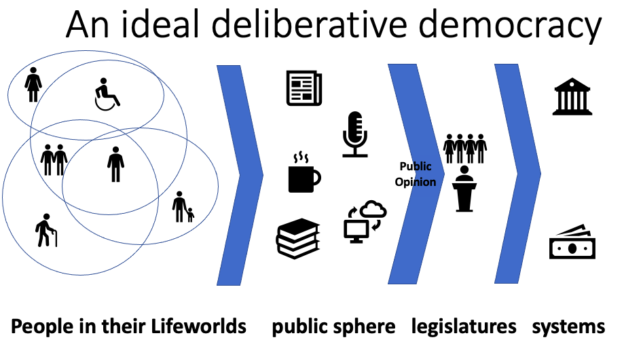
This is a 29-minute video lecture* in which I introduce the core ideas of the great German philosopher and sociologist Jurgen Habermas. I made it for our current Introduction to Civic Studies course, but it’s available for anyone to use. It also summarizes the beginning of chapter 4 of my recent book, What Should We Do? A Theory of Civic Life. In the book, I proceed to raise numerous critiques of Habermas, all of which have some validity, although I continue to find his framework useful.

*New version posted on 9/29, with better audio.

an existential threat?

John Mearsheimer made the case against Ukraine on a well-attended panel discussion at the American Political Science Association. I don’t agree with those who disapprove of giving him a platform. If he’s wrong, his views should be aired so they can be rebutted, and I think that’s what happened when my Tufts colleague Oxana Shevel and other co-panelists debated him at APSA. If he has any actual insights, we should listen and use them.

I would emphasize a point that probably arose already in the panel discussion (some of which I had to miss). Mearsheimer said repeatedly that Russia faces an “existential threat” in Ukraine and is responding rationally and predictably. When he completed this phrase, it turned out not to mean a threat to Russia’s sovereignty, autonomy, or security within its borders. Mearsheimer meant a threat to Russia’s status as a great power.

I do not doubt that Putin and other Russian nationalists view a successful and European-oriented Ukraine as diminishing Russian global power. But this is the problem: Russia is not actually a great power.

In 2019, before the pandemic and the current full-scale war, Russia ranked right below Canada (population: 38 million) in GDP, and well below each of four European countries (Germany, the UK, France, and Italy). Its medium-term economic prospects were much worse than theirs because Russia is so dependent on fossil fuels. In population, Russia lies right between Bangladesh and Mexico (which has almost as big an economy), but its population has shrunk since 1992.

To be sure, Russia has a large military. In 2019, it ranked fourth in the world in military spending and sixth in the number of military personnel (at least on paper). But it arguably could not afford this expense. The Russian military cost 4.3% of its GDP, versus 3.7% in the USA, which nevertheless spent 11 times as much. That year, the proportion of the population that was enlisted in the military was four times as high in Russia as in the USA (an economic burden). And Russia was probably getting bad value for its military spending because of endemic corruption.

Russia has a vast supply of nuclear weapons, sufficient to end civilization. Nuclear weapons guarantee its security against a foreign invasion, and certainly pose a risk to other countries. Perhaps they are an asset in a conflict like the current one, because the US would be more likely to supply Ukraine with aircraft and long-distance guided missiles absent the nuclear threat. On the other hand, nuclear weapons are difficult to use to support conventional political aims.

It is a dilemma if Russia lacks the underlying basis for being a superpower yet views any events that diminish its great-power status as existential threats. However, the proposed solution of allowing Russia to act like a superpower is not only unjust; it is also unrealistic. Sooner or later, Russia must navigate the difficult road that Britain and France began to travel after 1945, reluctantly and incompletely acknowledging that they could no longer have empires. The USA should also make that transition, but in our case, the imperative is justice rather than necessity, since we actually retain the capacity to project global power.

See also: Russia in the larger history of decolonization; when states are blind

applying Beyond Adversary Democracy to solve problems

Jane Mansbridge published Beyond Adversary Democracy in 1983. This book has been cited thousands of times and has deeply influenced political theory, certainly including my own work. At the recent annual meeting of the American Political Science association, Mansbridge won the Benjamin E. Lippincott Award for a “work of exceptional quality by a living political theorist that is still considered significant after a time span of at least 15 years since the original date of publication.” Beyond Adversary Democracy was the book in question, although Mansbridge would also deserve the Lippincott for Why We Lost the ERA (1986). She gave a beautiful and interesting lecture on the future of political theory.

During her speech, Mansbridge recalled that she had been inspired to write Beyond Adversary Democracy to help the radically democratic organizations of the 1970s–the many co-ops and communes that sprang up in that era–to address the challenges of self-governance that seemed, sooner or later, to wreck most of them. Someone asked whether any group had ever used her book to solve such problems. She said: never!

Perhaps no one has developed, tested, improved, re-tested, refined, and disseminated a practical toolkit based on the theory of the book. Such a product would be useful not only for radically democratic organizations but for any group that employs democratic decision-making for some purposes and at some times. For instance: a department in a university.

The first draft of such a tool would be an experiment, requiring testing and improvement. The draft might start like this:

A friendly person who is independent of the organization should conduct an anonymous survey (derived from Jenny Mansbridge’s own instrument) to identify points of widespread agreement as well as conflicts of deeply felt interest within the group. “Interests” mean not only self-interested goals and needs (like raising one’s pay) but also ideals, such as committing the organization to a certain strategy.

The person who conducts the survey should then provide a public list of any issues that are not conflictual within the group. Members should not devote time to discussing these issues. Instead, they should delegate them to one person or a small team. The people who are put in charge of each non-conflictual issue should be required to report back periodically and to keep records, and they should be open to advice and complaints, but they should decide what to do without the whole group’s involvement. Rotating such responsibilities can be smart, but it can also be wise to give these tasks repeatedly to people who enjoy them and are good at them.

The survey should also generate a public list of issues that are contentious. The whole group should discuss these issues with a trusted moderator who can stay fairly neutral. An important purpose of such discussion is to help everyone better understand the contours of the disagreement by allowing individuals to voice their divergent values and needs. Some time should be spent looking for creative solutions that could satisfy most people. However, the group should be prepared to resolve such issues by voting anonymously after a finite amount of time spent on deliberation. Although majority rule cannot satisfy everyone, it is better than trying fruitlessly to reach consensus when interests actually diverge.

Once a vote is taken, the fact that a minority has lost should be explicitly acknowledged, and the group should formally thank them and resolve to try to make it up to them in some way later on. Then the group should shift to an issue that has been identified as non-controversial. They should explicitly mark this transition. “Well, that was a tough discussion, but now let’s talk about office furniture. Does everyone agree that Al can take care of that? Thanks so much, Al. Everyone, please contact Al if you have any special concerns.”

The survey should be designed to reveal whether differences of interest fall along identity lines. For example, women might be tend to differ from others on matters related to maternity. Or people of color might have specific concerns in a predominantly White organization. When that is the case, it is important for the people who hold leadership positions to represent both or all of the relevant identity groups. It may be both fair and necessary to reward them for serving on committees, since this burden can fall disproportionately on disadvantaged members of an organization.

On the other hand, when there are no differences of interest, or when differences do not fall along identity lines, then it is much less important for the decision-makers to be demographically representative. It becomes correspondingly more important to give tasks to willing volunteers, to individuals who have experience for the task at hand, or to people whose turn it is do more for the group.

These are principles or maxims, but they could be turned into flowcharts with diagnostic questions and suggestions. For instance: “Does this disagreement seem to divide your group by race, or gender, or job title, or some other identifiable characteristic? If so, what is the characteristic? Does the committee include people on both sides of that difference? How should we reward individuals who join the committee to make it more representative?” (etc.)

This kind of application by no means exhausts the value of Beyond Adversary Democracy, which is mainly a rich contribution to theory. For instance, the book can influence how we read Aristotle or Rousseau. However, applying insightful theories can improve the world; and the experience of applying them can further enrich theory.

Added later: a flowchart for collective decision-making in democratic small groups. See also: the New Social Movements of the seventies, eighties, and today; friendship and politics; needed: pragmatists for utopian experiments
cities in an era of migration

(Montreal) I’ve had opportunities to visit several cities since July and have enjoyed watching migrants in those spaces.

In Cordoba, Spain, the cathedral was once one of the world’s great mosques. I watched many Muslim visitors, especially young Francophone Arabs. I wondered how they interpreted this space, with its Islamic heritage and its boldly Catholic symbolism. (In a terrible act of vandalism, Charles V dropped a cathedral right in the middle of its coolly harmonious aisles.) Meanwhile, Grenada now has a mosque for the first time since the renaissance, serving its substantial and growing Moroccan population.

Forty-five percent of Augsburg’s population consists of migrants. I heard second-hand about an African migrant’s strong critique of structural racism, which reinforces what I have learned on other recent visits to Germany. (I was in Weimar last November.) However, superficially, Augsburg appears to be a lively and diverse city in which people from many part of the world–including, now, thousands of displaced Ukrainians–interact quite productively. It’s also nice that Augsburg doesn’t seem to draw many tourists, despite being very attractive and interesting. That means that the diverse population seems committed to the place. For instance, they are rapidly learning German.

Iceland’s national citizen population is about 366,000, and each year before the pandemic it was receiving about 2.3 million visitors (counting the ones who stayed at least one night). Meanwhile, citizens of the Schengen zone can easily get Icelandic work permits. As a result, Reykjavik has turned into one of those global transit zones, where a sample of the world’s wealthier countries–plus a few refugees–parades through public spaces, being greeted and served by people who are almost as diverse as the visitors. Although Dubai is Iceland’s opposite in many other respects (from climate to politics), it is another example of this category.

Now I’m in Montreal, which I always enjoy as a bilingual city that is also a magnet for migrants from the whole world. I love the “bonjour hi” greeting, which invites one to respond in French or English. (As someone whose French is not bad, but is generally much worse than the locals’ English, I’m not sure what is expected of me.) I also enjoy watching the trilingualism of many recent immigrants. The men who served me my “shawarma poutine magique mix” communicated amongst themselves in Arabic, and with their customers in rapid-fire English and French. The actual dish combined tater tots, shawarma meat, hot sauce, cheese, and fresh parsley in an apt melange.

why don’t colleges allocate more resources to access?

You would think that when a college or university gets a financial windfall, it would spend as much of its new funds as possible to make itself more accessible. It could cut tuition prices, increase financial aid, and/or expand the number of students. But George Bulman finds that none of these things happen.*

Bulman investigates the results when institutions see highly varied returns on their investments, from a 19% increase in an endowment in a single year to a 19% loss. Even in a given year, different comparable institutions can see disparate returns. Bulman finds that when their investments do well, colleges and universities spend more money on their programs, become more selective, allow their tuitions to rise, but allocate no additional money to financial aid, and actually admit and fund fewer students of color. The overall decrease in racial diversity is statistically significant.

Bulman doesn’t really speculate about the reasons. One could model institutions as decision-makers that are trying to maximize their own selectivity and rankings and use windfall money for that purpose. That model fits the data, but I would offer a different explanation that reflects my informal observations better.

I think that a host of groups within any given institution have needs. They make arguments for spending money on everything from student housing to research administration. Often these arguments have merit and an idealistic ring. For instance, students at several universities that I know are advocating more campus housing to relieve rent pressure on nearby neighborhoods that are subject to gentrification. They get this idea from their genuine engagement with those neighborhoods. They don’t want housing for themselves in a narrow way.

However, as a result of many such claims, all available revenues are quickly used up. The new expenditures tend to make the institution look more impressive, increasing applications and allowing the admissions office to become more selective. In essence, it’s a problem of actual internal constituencies trumping the interests of an abstract constituency: potential students.

What should we think when we read this kind of announcement?

Princeton University will enhance its groundbreaking financial aid program, providing even more generous support to undergraduates and their families as it works to attract talented students from all backgrounds.Most families earning up to $100,000 a year will pay nothing, and many families with income above $100,000 will receive additional aid, including those at higher income levels with multiple children in college.

To put this in context, I would note that Princeton’s endowment of $4.5 million per student should generate an average payout of about $225,000 per student per year. Princeton could double or triple its student body and offer full scholarships to all the additional students. Instead, it spends its funds on a range of activities, many of them meritorious, and many of which increase its luster, thereby allowing it to reject 94.4% of its applicants—all the while soliciting its alumni to support financial aid. Again, I would interpret Princeton’s priorities not as an intentional choice to buy selectivity, but as a result of many internal constituencies making valid claims on resources.

(Tufts’ endowment is about $200k per student, which should generate about $10k per student in an average year: a different story.)

See G. Bulman, “The Effect of College and University Endowments on Financial Aid, Admissions, and Student Composition,” NBER Working Paper 30404 http://www.nber.org/papers/w30404. See also Four perspectives on student debt forgiveness;  the weirdness of the higher ed marketplace; etc.