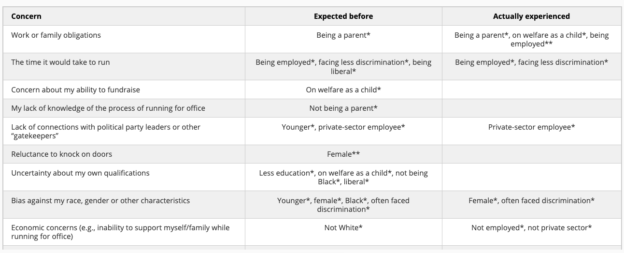
Challenges Reported by Candidates for Local Office

Newly published: Peter Levine & David Abromowitz, “Challenges Reported by Candidates for Local Office,” State and Local Government Review (2022). Available behind a paywall: https://doi.org/10.1177/0160323X221130449 or in page proofs as open access here.

Abstract:

A survey of 711 candidates for local offices in the United States, conducted in December 2021, reveals that many were concerned before they began their campaigns about the impact of politics on their work and family, the time demands of campaigning, their ability to raise funds, and their knowledge of the process, among other obstacles. Many candidates who had anticipated each concern found it less onerous than they had expected. Those who were parents, those with full-time jobs, and those who had experienced poverty as children were especially likely to have difficulty meeting work and family obligations while campaigning. Being liberal, being young, having less education, and experiencing poverty in childhood were all associated with concerns about being qualified to run. The study offers additional details about which backgrounds and experiences are associated with specific challenges in local campaigns. The results may inform efforts to recruit and support underrepresented candidates.

Table 6 (“Predictors of Concerns”) summarizes some key findings. It is based on statistical models that account for other factors.

Our paper is an example of Civically Engaged Research (CER) in political science: “an approach to inquiry that involves political scientists collaborating in a mutually beneficial way with people and groups beyond the academy to co-produce, share, and apply knowledge related to power or politics, contributing to self-governance.”* David Abromowitz is a leader of the the New Power Project, which is “uniquely focused on recruiting and empowering values-driven individuals who have grown up in marginalized or underserved communities” to run for office. David approached me with the idea of conducting a survey of current candidates, drawing the sample from BallotReady. We designed the survey instrument together. I crunched the numbers, addressing David’s queries as well as my own. Our article illustrates that civically or community-engaged research is not always qualitative or hands-on. Although we statistically analyzed an anonymous survey, our collaboration was essential, and the results should help the New Power Project while contributing to the scholarly literature.

*Rasmussen, A., Levine, P., Lieberman, R., Sinclair-Chapman, V., & Smith, R. (2021). Preface. PS: Political Science & Politics, 54(4), 707-710. doi:10.1017/S1049096521000755. See also: civically engaged research in political science; engaged theory and the construction of community; how to keep political science in touch with politicsmethods for engaged research.

the Iran crisis and literature on nonviolent uprisings

I wish I could follow the uprisings in Iran more closely and insightfully, but my background knowledge is limited and news coverage in English is scanty. I must admit that the regime’s victory over mass nonviolent protests in 2011-2012 made me pessimistic, especially since that turned out to be the first in a series of victories by repressive regimes. The global success rate for nonviolent social movements has fallen from near 70% in the 1990s to under 30% in the past decade, probably because authoritarian governments have improved their tactics.

That said, pessimism can be self-fulfilling. Turning trend-lines into predictions squelches agency and hope. Successful revolutionaries are not determinists. Walter Benjamin wrote in 1940, “The awareness that they are about to make the continuum of history explode is characteristic of the revolutionary classes at the moment of their action.” One never knows when masses of people will find inspiration in selected moments from the past and disrupt the patterns of recent history.

The literature on social movements and popular uprisings may offer some insights. That literature suggests that we should focus on certain recent developments in Iran.

The protests appear widespread, highly decentralized, and attractive to a diverse range of Iranians, including students, merchants, oil workers, and ethnic minority groups. In the literature, both the size and the pluralism of protests are related to their odds of success. (The “s” and “p” in my SPUD framework stand for those two factors.)

The movement appears capable of coordinating across a large country even though Iran has shut down the Internet and the protesters do not follow a few charismatic (and hence vulnerable) national leaders.

There are preliminary reports of some soldiers and police joining protests. Although “security force defection” has not occurred yet at substantial scale in Iran, it is a recognized phenomenon in popular uprisings. Chenoweth and Stephan (2011) found that nonviolent movements have been 46 times more likely to succeed when some members of the security forces defect. Anisin (2020) identifies “the size of the oppositional campaign (100,000+ participants)” as a common precondition of security force defection. One recent example was in neighboring Armenia in 2018.

There are also some preliminary reports of possible fissures within the regime, with (for instance) a “Hardline Chief Justice Call[ing] For ‘Dialogue With People’.” The supreme leader, Ayatollah Ali Khamenei, is said to be “gravely ill,” and his office may represent a power vacuum.

I believe that whether to use violence is a matter of judgment that depends on the circumstances, yet movements generally benefit by imposing restraints on their own behavior. Unrestrained tactics tend to escalate in ways that can damage or split a movement. Refraining from physical violence against human targets–or refusing to use live ammunition–can be bright lines that prevent such escalation. So far, the Iranian protesters seem to be using nonviolence as a self-imposed restraint.

By the way, a movement can be nonviolent despite scattered exceptions. Indeed, a mass movement that is predominantly nonviolent can benefit from the pressure imposed by parallel military movements. In the current case in Iran, several armed insurgencies are underway that may prove synergistic with the civilian protests.

Women play a disproportionate role in the Iranian protest movement. Women have certain strategic assets for social movements. For one thing, their activism can present “an apolitical appearance” that allows them to “engage in more political forms of resistance” without seeming to threaten the state’s monopoly on violence, as my colleague Anjuli Fahlberg notes in her study of Rio (Fahlberg 2018).

So far, we are seeing a familiar cycle: violent state repression instigates broader and more intense popular protest, which create dilemmas for the security forces and may initiate a downward spiral for the regime. That was the pattern in Paris in 1789 and also in Tehran in 1979, when every time the Shah’s regime killed protesters, the vast funeral processions turned into new expressions of popular will. Of course, it was also the pattern in Syria in 2011, with an ultimately tragic outcome.

Overall, I would be looking–and hoping–for scale and diversity, security force defections, self-imposed limitations, and acts of repression that stimulate even broader resistance. Success is far from inevitable but remains possible.

Citations: W. Benjamin, Theses on the Philosophy of History (1940), trans. by Harry Zohn, xv; Erica Chenoweth and Maria Stephan, Why Civil Resistance Works: The Strategic Logic of Nonviolent Conflict (New York: Columbia University Press, 2011; Alexei Anisin (2020) Unravelling the complex nature of security force defection, Global Change, Peace & Security, 32:2, 135-155; Fahlberg, A. N. (2018). Rethinking Favela Governance: Nonviolent Politics in Rio de Janeiro’s Gang Territories. Politics & Society46(4), 95–110. See also: people power in Iran (2009); why autocrats are winning (right now); Why Civil Resistance Works; the case for (and against) nonviolence; pay attention to movements, not just activists and events; etc.

call for proposals for Civic Studies papers and panels at APSA 2023

The American Political Science Association’s annual meeting will be in Los Angeles from August 31-Sept 3, 2023. The overall conference theme is “Rights and Responsibilities in an Age of Mis- and Disinformation.” (But most papers do not address the annual theme.)

The Civic Studies Related Group invites proposals for panels, round tables, and individual papers that make a significant contribution to the civic studies field; articulate a civic studies perspective on some important issue; or contribute to theoretical, empirical, or practical debates in civic studies. We especially encourage proposals that emphasize actual or potential civic responses to current social and political crises, their origins, and possible consequences.

Recent civic studies sessions have included a panel on how COVID-19 affected civil society and an authors’ roundtable on the books Four Threats: The Recurring Crises of American Democracy by Robert C. Lieberman and Suzanne Mettler and The Upswing: How America Came Together a Century Ago and How We Can Do It Again by Robert D. Putnam and Shaylyn Romney Garrett.

Civic studies is a field defined by diversity yet connected by participants’ commitments to promoting interdisciplinary research, theory, and practice in support of civic renewal: the strengthening of civic (i.e., citizen-powered and citizen-empowering) politics, initiatives, institutions, and culture. Its concern is not with citizenship understood as legal membership in a particular polity, but with guiding civic ideals and a practical ethos embraced by individuals loyal to, empowered by, and invested in the communities they form and re-form together. Its goal is to promote these ideals through improved institutional designs, enhanced public deliberation, new and improved forms of public work among citizens, or clearer and more imaginative political theory.

The civic studies framework adopted in 2007 cites two ideals for the emerging discipline: “public spiritedness” (or “commitment to the public good”) and “the idea of the citizen as a creative agent.” Civic studies is an intellectual community that takes these two ideals seriously. Although new, it draws from several important strands of ongoing research and theory, including the work of Elinor and Vincent Ostrom and the Bloomington School, of Juergen Habermas and critical social theory, Brent Flyvbjerg and social science as phronesis, and more diffuse traditions such as philosophical pragmatism, Gandhian nonviolence, the African American Freedom Struggle. It supports work on deliberative democracy, on public work, on civic engagement and community organizing, among others.

To propose a session, click here. You do not have to be a political scientist, but you would have to attend APSA 2023 in person. APSA members can also join the Civic Studies group (free) at this link.

conversation with Danielle Allen about civic education

I really enjoyed a conversation with Danielle Allen last week, which was organized by Facing History & Ourselves and very nicely moderated by Facing History’s Elizabeth Carroll. You can watch the video here. (You’ll have to create a free account, which is a good thing to do, since Facing History is a wonderful organization.)

possible paths for the Ukraine war

  1. Russia regains momentum and expands its control of Ukrainian territory. Today, most non-Russian military experts discount this possibility, but war is unpredictable. Ukraine would certainly not give up, but it would experience rising external pressure to surrender some territory permanently.
  1. Russia holds a static defensive line, probably set back from the current front. (For instance, Russia would probably abandon Kherson and fall behind the Dnieper.) Ukraine would remain motivated to fight, but European support would become more questionable–and US support, too, if Republicans gain control of Congress or the White House. Putin would try to manage his domestic problems by maintaining a war footing and promising success in some undetermined future. The situation might stabilize, with Ukraine continuing to receive some foreign support and Russia managing to protect some of its 2022 gains. Sanctions would remain in place, but Europe would probably import some Russian energy, albeit less than it used in 2021. There might be considerable partisan warfare and perhaps some organized nonviolent resistance in Russian-occupied territory. The situation would be similar to 2014-22, but with new boundaries–and high costs for all.
  1. Ukraine continues to make breakthroughs. If Ukraine pushes deep into Zaporizhzhia Oblast, Russian forces in Melitopol, Kherson, and Crimea would be stranded on the wrong side of Ukrainian lines and in deep trouble. In that case:

a) Russia could experience a classic military defeat, as in 1905. Russia and Ukraine might or might not sign an armistice or a treaty, but in any event, the war would effectively end in Ukraine’s favor. Putin might survive by exercising repressive control, or he could be removed and replaced either by a better or a worse leader. The potential would certainly remain for Russia to start a new war later, but “rebuilding” an army that has turned out to be hollow would be a major undertaking.

b) Putin might try to avoid suffering a humiliating defeat at the hands of Ukraine by escalating the conflict to include NATO. That would allow him either to salvage a victory by frightening NATO into demanding concessions from Ukraine or at least save face by presenting the West as his foe. (In that case, he would loosely resemble the Japanese military junta in 1945, who used the atomic bombings to cancel their own pledge to fight to the death). To escalate, Putin could:

  1. Attack Ukraine with weapons of mass destruction (WMD);
  2. Attack a NATO country with conventional weapons or cyber; or
  3. Attack a NATO country with WMDs.
  1. At this point, NATO would have a choice about whether and how to respond, ranging from a diplomatic effort to isolate Russia, to a targeted conventional or cyber attack, to a massive military strike on Russia itself. The possible outcomes would range from Putin’s backing down to uncontrolled escalation to WWIII.

I’m certainly hoping for #3a, a straightforward Ukrainian victory. It seems plausible, if only because Putin appears to hope that new troops will turn the tide, and that false hope could keep him fighting until he has simply lost. Again, war is unpredictable, but today’s reports of Ukrainian advances in Kherson Oblast make a victory seem more likely and a Russian rebound (#1) quite improbable. A stalemate (#2) would be harsh and unjust, but it is not difficult to imagine.

Russian escalation (#3b) is very dangerous for the world. I think it would most likely play out as a Russian WMD attack on Ukrainian military targets that prompts a global reaction that is not devastating and that gives Putin an excuse to settle the war. But the other possible results of #3b are all much worse.