bias at the Times

Last Friday, Daniel Okrent, the “public editor” of The New York Times, asked a conservative and a lefty to address charges of bias at his newspaper (link). From the left, Todd Gitlin argued that The Times is biased against Kerry because it insists on treating Republicans and Democrats as if they were equally dishonest and corrupt. Gitlin thinks that the Bush Administration is far worse, and the apparent even-handedness of the coverage actually gives the incumbents a free pass and encourages bad behavior: “The Times‘s decorous approach to the news has often helped President Bush in three significant ways: by equating his gross deceptions with Mr. Kerry’s minor lapses; by omitting or burying news of administration activities and their consequences; and by missing the deep pattern of Mr. Bush’s prejudices and malfeasances.”

From the right, Bob Kohn argued that The Times is biased against Bush because its news coverage assumes the liberal answer to social issues. Kohn lists “same-sex marriage, abortion, stem-cell research, gun control, environmental regulation, capital punishment and faith-based initiatives” as topics on which news stories in The Times always assume the liberal perspective. For example, Okrent had earlier described the tone of news articles on same-sex marriage as “cheerleading.” But Republicans are strongly against same-sex marriage. Thus “the president’s views fly in the face of what are being presented as objective facts. No technique of bias is more powerful–more useful as a means of influence–than presenting a candidate’s unadulterated views through a prism of advocacy passed off as hard news.”

A blog is for sharing what its author thinks, so here are some of my responses:
  • As I argued in an earlier post, the Bush campaign has behaved worse than the Kerry campaign, but Kerry and Edwards could have avoided headlines of the “both-sides-twist-the-truth” variety if they had been scrupulously accurate.
  • However, the bigger problem is not spurious even-handedness. It’s a relentless focus on the behavior of candidates on the campaign trail. We have plenty of ways, nowadays, to find out what candidates are saying, how they look in the field, what strategies they’re using, who is funding them, and who’s currently ahead. These issues are of limited importance to citizens. It would be much more useful for a well-staffed and well-funded institution like The Times to give us information about issues and policies. What does the federal budget consist of? If one wanted to cut it, what could be cut? What is the empirical evidence about the effectiveness of gun control? What would likely happen if the minimum wage went up? In what ways does the federal government currently regulate industry to preserve the environment? Which of these ways are thought to work? What ideas have been proposed for addressing the loss of manufacturing jobs? If reporters concentrated on these questions, they would not have to be referees in the campaign scrum.
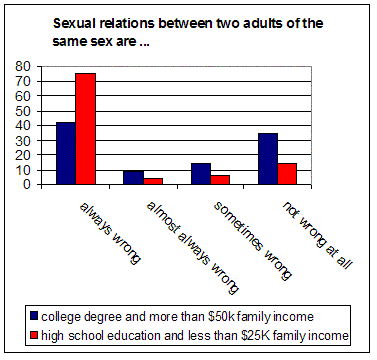
  • Bob Kohn is correct that The Times’ news coverage often presumes a positive attitude toward gay marriage, gun control, and environmental protection, and a negative attitude toward Christian fundamentalism. This “bias” (if you want to call it that) probably reflects the attitudes of the social class that reads The Times (see yesterday on social class and tolerance for homosexuality). Likewise, The Times’ news coverage assumes that GNP growth is intrinsically good; that the business of America is business; and that people should consume lots of expensive items, including foreign travel and electrical gadgets. Compared to the huge amount of space that The Times devotes to Wall Street, it hardly covers labor unions. Thus its “bias” is consistent with upper-income, urban, East-coast liberalism, and inconsistent both with religious conservatism and with radical leftism.
  • But I don’t think it’s helpful to shout “bias.” One could strive for even-handedness on every issue, but to what purpose? Who said that The New York Times should to represent the median voter’s opinion on every topic? I think a complaint about bad coverage should always be accompanied by a moral argument about the issue being covered. For example, assuming that The Times really is a “cheerleader” for same-sex marriage, the issue is not whether this represents “bias.” The issue is whether same-sex marriage is good or bad. Since I think it’s good, I have no problem with The Times’ coverage. If someone wants me to object to the coverage, he will have to argue that same-sex marriage is wrong.
  • social class and tolerance for gays

    I

    was wondering whether people who are more educated and wealthier are more tolerant

    of homosexuality. According to the General Social Survey, the answer is yes.

    I guess this result is intuitive, but I always like to check.

    Education and income each correlate with tolerance. I don’t have the time right

    now to figure out whether the real driver is education (which may increase both

    income and tolerance). There could be a third factor underlying the relationship,

    such as urbanicity, age, religious denomination, or region. But just to dramatize

    the basic situation, here is a graph that contrasts upper-middle-class people

    who have college degrees (in blue) and lower-income people with no more than

    high school (in red). The difference in attitudes toward gays is pretty stark.

    hope for reform of gerrymandering

    Many political scientists view partisan gerrymandering as the worst flaw in our political system today, worse than campaign finance abuses or poor and biased journalism. By drawing districts that are reliably Democratic or Republican, incumbent politicians have basically stripped voters of their choice. In approximately 385 congressional districts, a vote really doesn’t matter, because the lines have been drawn to preclude competition. Since challengers have virtually no chance, they tend to be weak and under-qualified. In these districts, parties and interest groups make little effort to mobilize voters, so turnout falls. Also, there is little discussion and debate within such districts, so people who live there don’t grasp the diversity of opinion in America. They regard the debate in Washington as mere mud-slinging and believe that every reasonable person agrees with the views that are prevalent in their own districts. Jim Gimpel, Celeste Lay, and Jason Schuknecht show, in Cultivating Democracy, that growing up in an uncompetitive district has a lasting negative effect on one’s civic engagement.

    Until recently, I assumed that this problem was basically intractable. Incumbent politicians like things as they are. There is a public interest in competitive districts, but each citizen has relatively little to gain from reform, so it is difficult to mobilize people for this cause. Even if citizens do get mad about gerrymandering, their votes don’t count in most districts. Finally, the courts seem basically tolerant of gerrymandering if the intentions are partisan rather than racial.

    But a recent conversation with the lawyer Tom Geogehegan made me more optimistic. It turns out that all the existing case law on gerrymandering pits one major political party against the other. The plaintiff says: You gerrymandered too much, or with unacceptable motives. The defendant says, No we didn’t. Neither party says: The current system for drawing districts violates the Constitution. If a public-interest group were to bring suit on broader constitutional grounds, it would be a novel and untested legal strategy–which means that there’s a chance it would succeed.

    By the way, there are several possible remedies for the existing system. One option is a nonpartisan electoral commission, as in Iowa. As a result of Iowa’s reform, that small state has more competitive congressional districts than California and New York combined. One might worry that a “non-partisan” commission would ultimately by hijacked by stealth partisan appointees. An alternative is a computer algorithm that would randomly group citizens in compact districts. In drawing districts, it is necessary to weigh competing values (compactness, “naturalness” of communities, tradition, racial justice, and competitiveness). A computer cannot resolve this balancing problem neutrally. However, it can dramatically reduce the odds of seriously bad results. It can deliver what John Rawls called “pure procedural justice,” which is an important basis for legitimacy.

    food for thought

    Here is a strange statistical result. My colleagues and I have been teaching

    high school students to investigate the causes of obesity in their communityas

    a form of civic education. This fall, they are going to conduct and tape interviews

    and create a radio show to publicize their results. To give them some data to

    work from,

    we surveyed all the students in the school’s health classes. The response rate

    was poor, because students had to bring in parental permission slips before they could complete

    the survey; and there was no penalty for failing to participate. Nevertheless, we

    received enough surveys to draw tentative statistical conclusions. Here is the

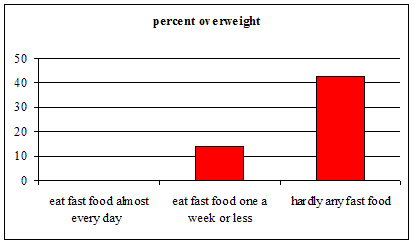
    one that surprises me. None of the 17 kids who said that they ate fast food

    every day are overweight (according to their self-reported combination of height and weight). However, 43% of those who said they eat "hardly

    any" fast food are considered clinically overweight.

    What’s going on? Maybe a lot of kids are mistaken or dishonest, but it’s strange

    that the relationship between fast food and body weight would be so linear and negative. The sample is too small for serious statistical analysis,

    but we noticed that immigrant kids are more likely to eat fast food, yet less

    likely to be overweight. So maybe immigrants eat good food at home but go out a lot

    to McDonalds.

    There are more possible explanations. For instance, the Washington Post’s “Kid’s Post” section reported last Wednesday that young people order less healthy food at restaurants like Outback Steakhouse and Red Lobster than they do at fast-food places. So maybe it’s good to go to McDonalds if it keeps you from ordering the “surf and turf” at a sit-down restaurant. But most of the kids we surveyed cannot afford regular visits to real restaurants.

    In any case, the students’ research task is a lot harder because of this result.

    The Bonanza! Group

    People who work to improve the quality of public culture deserve our attention and thanks. For example, Adrienne Schatz is one of the co-founders of the “Bonanza!” group. She explains that Bonanza! is:

    a network of Republican and Democrat friends who’ve put aside differences – at least in this realm – to create www.bonanzag.com, a very comprehensive, accessible, and truly nonpartisan election resource. We emphasize fact-checking, and have compiled dozens of easily navigable links to information on candidates, issues, registration, voters’ rights, poll monitoring volunteer opportunities, humor (if you haven’t seen the shenanigans at www.jibjab.com, you should …), etc.