Frontiers of Democracy 2023: Religious Pluralism and Robust Democracy in Multiracial Societies

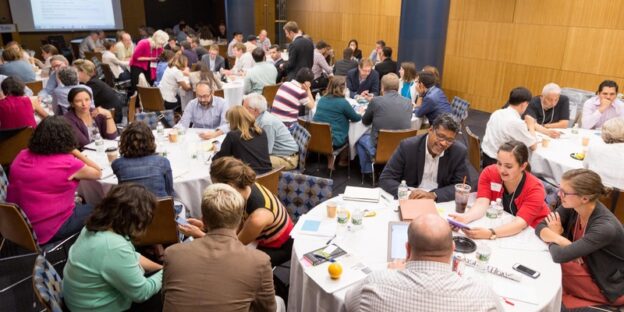
Frontiers of Democracy is an annual conference at Tufts University’s Tisch College of Civic Life that convenes practitioners and scholars for intensive discussions. In 2023, thanks to generous funding from the Arthur Vining Davis Foundations, the special theme of the conference is religious pluralism and its relationship to democracy in multiracial societies. 

The speakers in plenary sessions will include Cornell William Brooks, Brandon Thomas Crowley, Diana Eck, Aminta Kilawan-Narine, Eric Liu, Cristina Moon, Simran Jeet Singh, Michael Wear, and others. 

The religious pluralism theme is not exclusive, and we welcome sessions on other topics related to Tisch College’s “North Star”: building robust, inclusive democracy for an increasingly multiracial society. While we will consider proposals for presentations or panels of presentations, we actively seek proposals for other formats, such as moderated discussions, meetings devoted to strategy or design, trainings and workshops, case study discussions, debates, and other creative formats. 

Time and location: July 13 (5-7 pm) to July 15 (noon) on Tufts University’s Medford, MA campus near the Medford/Tufts Station on the Boston Green Line.

Cost: $240 for a standard ticket with discounts for current students. This includes hors d’oeuvres on July 13, breakfast and lunch on July 14, and breakfast and lunch on July 15. Other meals and lodgings are not provided.

Podcast on What Should We Do?

APSA’s Civic Engagement Section has a podcast, Civic Cafe, that’s organized and introduced by University of Virginia political scientist Carah Ong Whaley. Episode 2, “What Should We Do?”, is an interview of me by my friend David Campbell, the Packey J. Dee Professor of American Democracy at the University of Notre Dame. Dave’s most recent book (with Geoff Layman and John Green) is Secular Surge: A New Fault Line in American Politics, which received the Distinguished Book Award from the Society for the Scientific Study of Religion.

Here is a link to listen to the episode. (I think a video version is coming to YouTube, and I will include a link once that’s up.) Civic Cafe also provides links to relevant websites , namely: APSA Civic Engagement Section; Guided activities that build civic skills and capacity; Civic Studies at Tufts University; Common Cause; and Educating for American Democracy

Institute of Civic Studies and Learning for Democracy

(I will not be able to attend this whole event because of my teaching responsibilities at Tufts, but I will help with planning it and certainly endorse it.)

Call for Applications

We are happy to invite applications for the Institute of Civic Studies and Learning for Democracy (ICSLD) that will take place at James Madison University in Harrisonburg, Virginia (USA), from September 3–10, 2023. The ICSLD is organized by a team from University of Augsburg, Germany (Tetyana Hoggan-Kloubert), North Carolina State University (Chad Hoggan), and the Madison Center for Civic Engagement at James Madison University (David Kirkpatrick, Kara Dillard), with support from Tufts University (Peter Levine) and University of Maryland (Karol Soltan).

http://www.CivicReconstructionProject.org/ICSLD.html

Objectives and Topics

The Institute of Civic Studies and Learning for Democracy is an intensive, 8-day, seminar and residential retreat—bringing together an international group of practitioners, graduate students, and scholars from diverse professions and fields of study. Participants will be staying in the same hotel and participating in workshops, planning sessions, and social events all day and evening throughout the nine days. Costs for hotel and meals are covered by ICSLD.

The ICSLD deals with issues related to the development of civic society, the role of the individual/citizen in society, the role of education in promoting democracy, the role of institutions in the development of a civic society, and questions related to the ethical foundation of civic issues in a democratic society. These topics will be examined in international and comparative perspectives.

The ICSLD engages participants in challenging discussions such as:

  • What kinds of citizens do democracies need?
  • What do citizens need to know and be able to do in order to participate effectively in democratic society?
  • What practices and institutional structures promote effective adult civic learning?
  • What ought to be the relationships among empirical evidence, ethics, and strategy?
  • How can we learn from influential theorists and practitioners at important turning points in history?

The Institute of Civic Studies and Learning for Democracy is a continuation of the Summer Institute of Civic Studies, which was organized annually by Peter Levine, Karol Soltan, and Tetyana Hoggan-Kloubert from 2015-2019 (and at Tufts University 2009- 2018).

How to apply

All application materials must be submitted in English. The application must include the following:

  • A cover letter telling us why you want to participate in the ICSLD and how the seminar will help you promote civic capacities and engagement in the area in which you live (currently or in the future) (maximum 2 pages)
  • A curriculum vitae or resumé

All application materials should be sent as an email attachment in .DOC or .PDF format to tetyana.kloubert@uni-a.de. The total number of participants will be limited to 20. We will consider applications from any country. We are interested in applicants who have a long-term interest in developing the civic potential in their respective countries. Participants will be asked to attend two brief online meetings prior to the ICSLD and to prepare by reading provided texts in advance of the Institute.

The working language of the ICSLD will be English. Your mastery of the English language must be sufficient to read and understand complex texts from multiple disciplines, and to take part in lively discussions.

Deadline For best consideration apply by March 15. Decisions will be announced late April.

Expenditures Participants will be provided with lodging, meals, and full event access. Participants will be responsible for their own travel costs. We are seeking additional funding to contribute towards travel costs. If those funds become available, we will inform applicable participants.

Contact For more information about the Institute of Civic Studies and Learning for Democracy, please contact tetyana.kloubert@uni-a.de. We encourage you to share this message with your networks of people who might be interested in attending.

the sociology of the analytic/continental divide in philosophy

I agree with William Blattner that “the so-called Continental-analytic division within philosophy is not a philosophical distinction; it’s a sociological one. It is the product of historical accident.”

The Continental and analytic schools each encompass too much diversity and overlap too much to allow them to be distinguished on the basis of doctrines or methods. Rather, they are two social groupings whose behavior can be illuminated by thinking about group-dynamics, incentives, and structures that may apply in other such conflicts.

In other words, we can put aside the content of the philosophical discussion and view analytic and continental philosophers as analogous to other examples of rival groups that display similar behavior, such as the Jacobins and Girondins during the French Revolution (minus guillotines), Weimar Classicists vs. Jena Romantics around 1800, or perhaps mods and rockers in British youth culture around 1960.

Here are the features I would note. Professional philosophy is a community that controls who can belong, and memberships (college teaching jobs) are scarce and desired by a larger population than can be accommodated. The community is decentralized, without a single authority; decisions about membership are made by local clusters (departments). However, the prevailing culture is hierarchical and status-conscious, and participants value reputation highly–fame is more salient than money. A small proportion of members have reputations across the community, but most are not widely known.

Within the whole community, two larger groups formed in the later 1900s and persisted for many decades: the analytics and the Continentals. They never encompassed all philosophers. There were also smaller self-conscious groups (American pragmatists, Thomists, specialists in classical and Asian philosophy, Marxists) and many individuals who refused to identify with a group at all. But some philosophers were committed to the analytic-Continental distinction and invested effort in debating, shifting, and maintaining the boundaries of their own group and expanding its influence.

Individuals may hold principled reasons to identify with one of these groups or the other, or not to participate in the distinction at all. They also have incentives to align or not align and to publicize or obfuscate their own stances. Such incentives vary. Is there an opportunity to get a job in a department that is overwhelmingly analytic? Is that department looking to reinforce that tilt or to diversify? Some philosophers may want to avoid such careerist considerations, but natural selection will weed out many of the purists.

A situation like this encourages people to treat some individuals as shibboleths. Perhaps a controversial person is influential–although not universally admired–within Group A. Most people in Group B cannot believe that this person has any admirers at all. Not only do they make tolerance for the person a defining characteristic of Group A, but they attribute aspects of his beliefs and behaviors to everyone in Group A.

Perhaps Robespierre is an example, polarizing Jacobins and Girondins even though many Jacobins hated him, and even though it is hard to identify sharp conceptual differences between these groups’ ideologies.

I think Blattner is right to attribute this role to Heidegger in the analytic-Continental divide. Although many Continental philosophers dislike Heidegger on numerous grounds (not only his Nazi phase), most would acknowledge that he belongs in the curriculum, that he inspired valuable work by others, and that one should know his work. For many analytics, he is a willful obscurantist, and they tend to attribute various aspects of his writing (an extremely self-conscious style, lots of hard-to-define neologisms, close readings of Romantic lyric poetry, an idealist history of thought) to Continental philosophy in general.

I am not sure which specific author to mention as a shibboleth on the analytic side, but it would be someone who dismisses historical philosophy and insights from the humanities in favor of only the latest natural science and logic and who denies being influenced by his (sic) social, cultural, and class position. Maybe A.J. Ayer?

Philosophy is usually under external pressure–since Socrates–and it now faces declining enrollments and doubts about its economic value. (See “the ROI for philosophy“.) External pressure could unify the discipline, and maybe it is doing so to some extent. But it can also fuel the fires of internal division, as when royalist invasions of France provoked Jacobins and Girondins to turn on each other as traitors.

There have been many examples of fruitful interaction at the level of individuals or even between groups. But the analytic-Continental conflict persisted for so long that plenty of people carry lists of grudges. “Yale Riot Protests Tenure Denial” said the headline after Richard J. Bernstein was denied tenure at Yale–in 1965–and that episode lingered when I majored in the same department two decades later.

Affective polarization within the discipline is a Bad Thing, because it discourages learning, promotes stereotyping, and discriminates against heterodox approaches. But I don’t think it is unusual or inexplicable. In philosophy, the problem may already be improving. To the extent it persists, we should think about group-dynamics and instutional incentives more than actual philosophical differences.

apply to the Institute for Civically Engaged Research (ICER)

APSA’s Institute for Civically Engaged Research (ICER) is a four-day, residential institute that provides political scientists with training to conduct ethical and rigorous civically engaged research. Up to 20 scholars will be selected as ICER Fellows and invited to attend the 2023 Summer Institute. ICER Fellows will network with other like-minded political scientists, and together, learn best practices for conducting academically robust, mutually beneficial scholarship in collaboration with communities, organizations, and agencies outside of academia.

ICER is organized in partnership with Tufts University’s Jonathan M. Tisch College of Civic Life. The 2023 Institute will be held in person at Tufts University, outside of Boston, MA, from July 10-13.

The Institute will take place on campus at Tufts University from July 10-13. Approximately twenty fellows will meet each day for intensive discussions and workshops. Thanks to support from the Ivywood Foundation, participation in the Institute for Civically Engaged Research is free, housing on the Tufts campus or a stipend to partially offset the cost of a hotel stay will be provided, and scholarships are available to defray costs of meals and travel. Applicants are expected to seek financial support from their home institution, but admission to the Institute will not be affected by financial need.

To apply, please complete this form. Application deadline: March 31, 2023.

Note: The Institute will operate according to the recommendations and requirements of federal and local public health authorities. We plan for the Institute to be held in person at Tufts University but reserve the right to change these plans as the public health situation warrants.

Learn more here.