This is the video from a recent colloquium entitled “What Should Civic Education Become in the 21st Century?” at the Ohio State Center for Ethics and Human Values (CEHV). Law professor Angela Banks (Arizona State University) and I presented, and the moderator was Ohio State philosopher of education Winston Thompson. The blurb from CEHV says:
Democracies, in their essence, require the engaged participation of their citizens working towards articulating and pursuing shared goals. Arguably, these practices require a degree of skill and preparation such that the value of civic education cannot be overstated as a core component of a successful democracy. But how should societies understand the complexities of civic education in the current age? How should civic education respond to growing calls for justice as voiced through emergent social movements? Amidst rising patterns of immigration and globalized loyalties, can traditional approaches to civic education satisfy the needs of our democracy?
Angela Banks discussed how schools should address citizenship when rights to entry and residency and full legal citizenship are contested, and when many students do not have those rights. I presented a general framework for civic engagement that does not put the nation-state at the center. Winston Thompson, who had envisioned and organized this symposium, asked us good questions.
A city or town newspaper was nicely designed to keep people informed about their own elected representatives. Traditionally, it appeared on your doorstep, offering a mix of features that might encourage you to open it up. Election news would often appear above the fold on the main page. Elections in your own community would be emphasized. You didn’t have to be curious about politics to receive the most relevant political news.
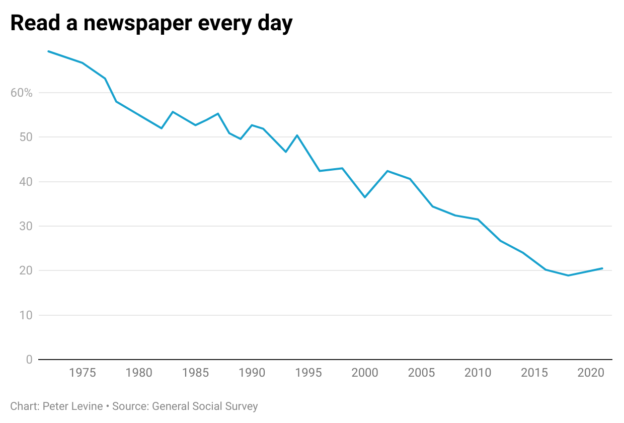
As the chart with this post shows, most Americans (69.3%) claimed they read a newspaper “every day” in 1972, but that proportion has been around 20% since 2016, mirroring a 50% decline in the number of paid journalists. People still consume news, but cable television is national, local television tends to skip politics, and online sources require you to seek them out. (They mainly reach those with prior interests.) Besides, very few people are paid to report factual information about local politics.
I wish I could test whether the decline in daily newspaper journalism and readership explains current low levels of political knowledge. Perhaps that can be shown, but I have not found a long-lasting survey that asks about both news consumption and political knowledge in consistent ways.
The American National Election Survey (ANES) did ask individuals how often they read the newspaper and whether they recalled the names of the congressional candidates in their district. That series lasted from 1984 to 2000. Each year, just about twice as many of the regular newspaper readers recalled the candidates’ names correctly. For instance, in 2000, 51.8% of the regular readers and 24.2% of non-readers got that knowledge question right.
I’d conjecture that if these survey questions had continued, the proportion of news readers would have fallen in the ANES, and with it, knowledge of people’s own local political candidates. But I can’t quite prove it.
I am color-blind. I have the common red/green type sometimes called Daltonism.
I do not mind. In fact, I don’t think I would accept a permanent “cure,” if there were one. I might like to experience the colors that most sighted people see, but I wouldn’t want to leave the world I know on a one-way journey. I love what I experience.
Miguel Fructuoso, Maria Sanchez and Miguel Angel Tornero are established Spanish artists. Although Fructuoso was born in 1971, he was recently diagnosed with Daltonism. I am curious about that story. Adults realized that I was color-blind when I was still a little kid. Fructuoso is a painter, and he has the same physical condition I do. I am not sure how he remained undiagnosed for half a century. It has been suggested, but not widely accepted, that the English landscape painter Constable was color-blind at a time before that condition was recognized.
In any case, Fructuoso’s realization “initiated an intense collaboration” with Sanchez and Tornero, who have co-produced works as “formal exercises” that help them to explore “empathy and exclusion, the rare and the common, individualism and the collectivity.”
They have created several such works for the Centro Jose Guerrero in Granada. Guerrero was born here in 1914, spent a considerable portion of his life as an abstract expressionist painter in New York City, and died in Barcelona in 1991. He was known for vivid color. That makes his eponymous museum a perfect location for an exhibition about color-blindness.
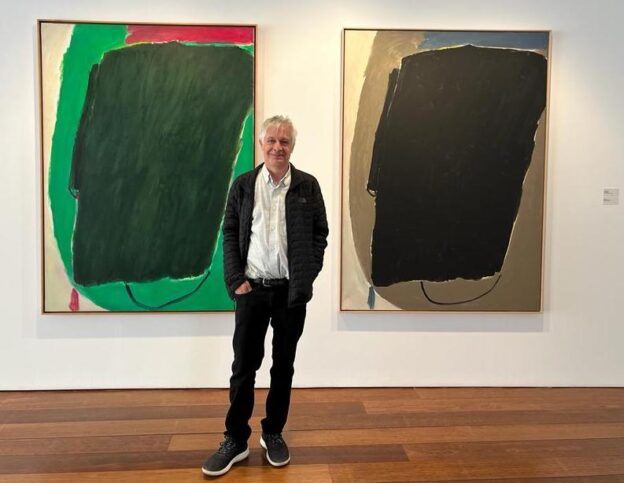
The photo (above) that illustrates this post shows a painting by Guerrero from ca. 1970 (I think), copied by the three contemporary artists, with color-blind “Bill” choosing the paints. Yes, the two images look very similar to me, except along the top band.
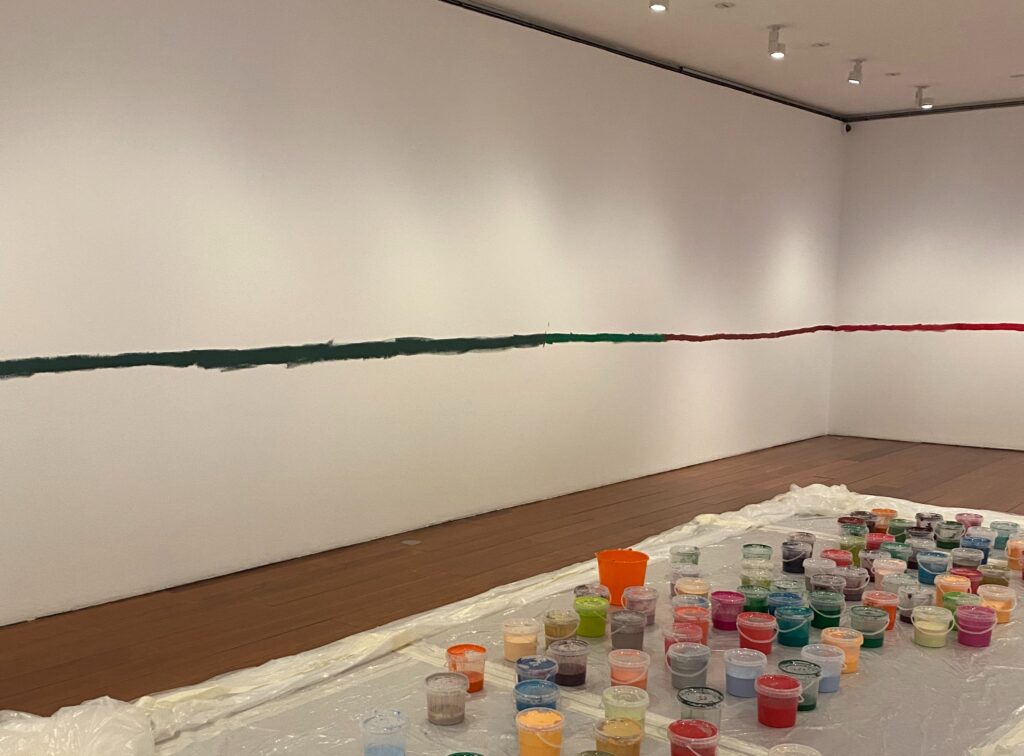
Below is the result when many people with red/green color-blindness were offered a large selection of paints and asked to paint a line of a single color around the room in the Centro Jose Guerrero. Yes, I perceive a green line going all the way around.
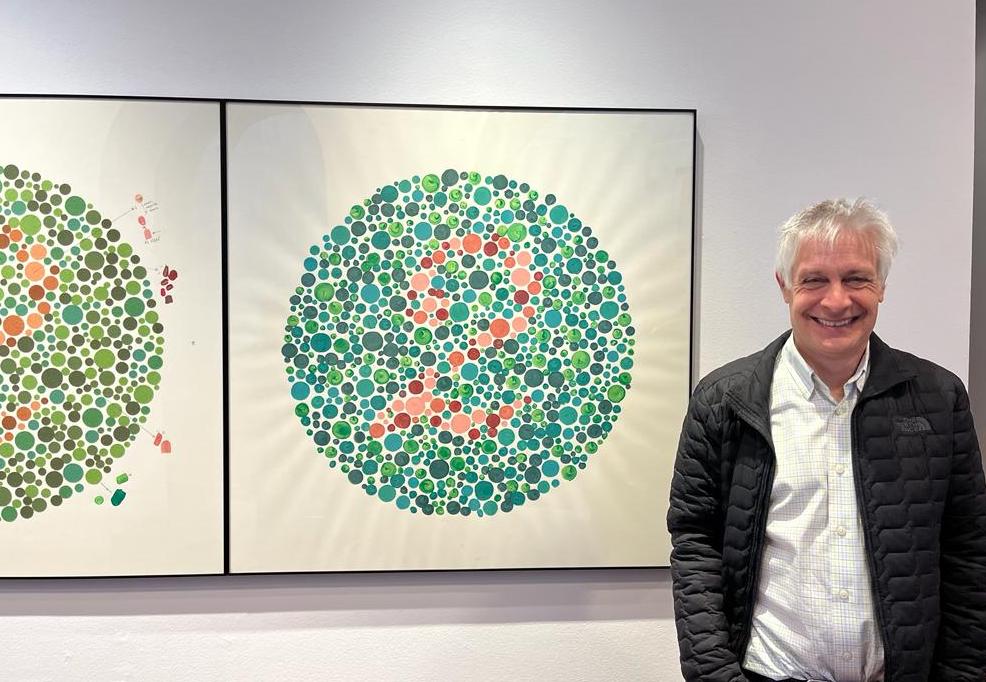
And here, the artists have reproduced the standard tests for color-blindness as gallery works in paint and print. (No, I cannot see any numbers, but I do like these images.)
Since I have not felt mistreated as a result of color-blindness, I was not deeply moved by the exhibition’s message of empathy and inclusion, although it’s certainly benign. And I suppose I am sympathetic to Fructuoso, although he has done very well in a conceptual/expressionist mode.
I find aesthetic questions about color-blindness interesting. For example, how might we compare the art that I see (and love) to what most of you see? Does it matter that I don’t see what was intended? And how should I feel, as a person with Daltonism, about monochrome art, expressionist art that is meant to look different from the real world, or impressionist works that reproduce nature’s colors for me even though both the paintings and their objects look different to you?
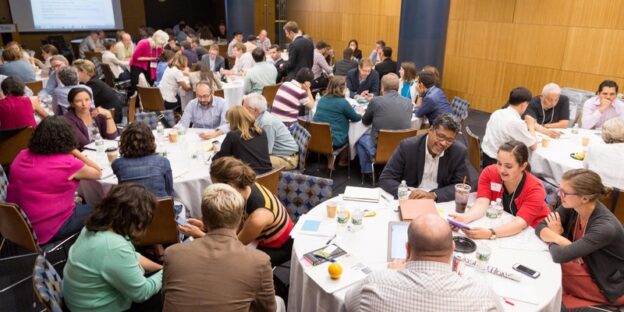
Proposals are welcome on any topic at the “frontiers of democracy”—for instance, political reform, organizing and social movements, dialogue and deliberation, journalism and media, civic education from K-12 to college or community settings, nonviolent resistance, collaborative governance, social entrepreneurship, democratic theory, online forums and tools, issues such as climate change or racial justice, engaged research methods, democracy in any region of the world, and more. Many formats are welcome with a preference for interactive designs over pure presentations.
The last face-to-face Frontiers conference before COVID-19 drew about 140 people, of whom 30% were nonprofit staff, 25% were scholars/researchers, 15% were educators, 5% were community-organizers, and the rest came from many fields, including the arts, philanthropy, business, and government. Most came from beyond the Boston area and a few from overseas.
Most proposals for 2023 are not expected to address the special theme: religious pluralism and robust democracy in multiracial societies. That theme will mainly be a topic for two of the plenary sessions, which will be panel discussions involving Cornell William Brooks, Brandon Thomas Crowley, Diana Eck, Andrew Hanauer, Aminta Kilawan-Narine, Eric Liu, Cristina Moon, Simran Jeet Singh, Michael Wear, and others to be named. Some conference participants may be interested in considering connections between religion and your proposed topic, but you do not have to mention religion in your proposal.
The submission form for a session requires a title and description for the conference agenda, some thoughts about your format and audience, and the contact information of confirmed collaborators.
This year’s conference will be in-person, not hybrid. However, session organizers may propose to include remote people in their own sessions.
Time and location: July 13 (5 – 7 PM) to July 15 (noon) on Tufts University’s Medford, MA campus near the Medford/Tufts Station on the Boston Green Line.
Cost: $240 for a standard ticket with discounts for current students. This includes hors d’oeuvres on July 13, breakfast and lunch on July 14, and breakfast and lunch on July 15. Other meals and lodgings are not provided.
This Democracy Works podcast from Penn State’s McCourtney Institute for Democracy is a conversation between me and Chris Beem about my 2022 book What Should Do? A Theory of Civic Life. I enjoyed our discussion!