philosophy of boredom

This article is in production and should appear soon: Levine P (2023) Boredom at the border of philosophy: conceptual and ethical issues. Frontiers of Sociology 8:1178053. doi: 10.3389/fsoc.2023.1178053.

(And yes, I anticipate and appreciate jokes about writing yet another boring article–this time, about boredom.)

Abstract:

Boredom is a topic in philosophy. Philosophers have offered close descriptions of the experience of boredom that should inform measurement and analysis of empirical results. Notable historical authors include Seneca, Martin Heidegger, and Theodor Adorno; current philosophers have also contributed to the literature. Philosophical accounts differ in significant ways, because each theory of boredom is embedded in a broader understanding of institutions, ethics, and social justice. Empirical research and interventions to combat boredom should be conscious of those frameworks. Philosophy can also inform responses to normative questions, such as whether and when boredom is bad and whether the solution to boredom should involve changing the institutions that are perceived as boring, the ways that these institutions present themselves, or individuals’ attitudes and choices.

An excerpt:

It is worth asking whether boredom is intrinsically undesirable or wrong, not merely linked to bad outcomes (or good ones, such as realizing that one’s current activity is meaningless). One reason to ask this question is existential: we should investigate how to live well as individuals. Are we obliged not to be bored? Another reason is more pragmatic. If being bored is wrong, we might look for effective ways to express that fact, which might influence people’s behaviors. For instance, children are often scolded for being bored. If being bored is not wrong, then we shouldn’t—and probably cannot—change behavior by telling people that it’s wrong to be bored. Relatedly, when is it a valid critique of an organization or institution to claim that it causes boredom or is boring? Might it be necessary and appropriate for some institutions … to be boring?

I have not done my own original work on this topic. I wrote this piece because I was asked to. I tried to review the literature, and a peer reviewer helped me improve that overview substantially.

I especially appreciate extensive and persuasive work by Andreas Elpidorou. He strikes me as an example of a positive trend in recent academic philosophy, also exemplified by Amia Srinivasan and others of their generation. These younger philosophers (whom I do not know personally) address important and thorny questions, such as whether and when it’s OK to be bored and whether one has a right to sex under various circumstances. They are deeply immersed in relevant social science. They also read widely in literature and philosophy and find insights in unexpected places. Srinivasan likes nineteenth-century utopian socialists and feminists; Elpidorou is an analytical philosopher who can also offer insightful close readings of Heidegger.

Maybe it was a bias on my part–or the result of being taught by specific professors–but I didn’t believe that these combinations were possible while I pursued my BA and doctorate in philosophy. In those days, analytical moral and political philosophers paid some attention to macroeconomic theory but otherwise tended not to notice current social science. Certainly, they didn’t address details of measurement and method, as Elpidorou does. Continental moral and political philosophers wrote about the past, but they understood history very abstractly, and their main sources were canonical classics. Most philosophers addressed either the design of overall political and economic systems or else individual dilemmas, such as whether to have an abortion (or which people to kill with an out-of-control trolley).

To me, important issues almost always combine complex and unresolved empirical questions with several–often conflicting–normative principles. Specific problems cannot be abstracted from other issues, both individual and social. Causes and consequences vary, depending on circumstances and chance; they don’t follow universal laws.

My interest in the empirical aspects of certain topics, such as civic education and campaign finance, gradually drew me from philosophy into political science. I am now a full professor of the latter discipline, also regularly involved with the American Political Science Association. However, my original training often reminds me that normative and conceptual issues are relevant and that positivist social science cannot stand alone.

Perhaps the main lesson you learn by studying philosophy is that it’s possible to offer rigorous answers to normative questions (such as whether an individual or an institution should change when the person is bored), and not merely to express opinions about these matters. I don’t have exciting answers of my own to specific questions about boredom, but I have reviewed current philosophers who do.

Learning to be a social scientist means not only gaining proficiency with the kinds of methods and techniques that can be described in textbooks, but also knowing how to pitch a proposed study so that it attracts funding, how to navigate a specific IRB board, how to find collaborators and share work and credit with them, and what currently interests relevant specialists. These highly practical skills are essential but hard to learn in a classroom.

If I could convey advice to my 20-year-old self, I might suggest switching to political science in order to gain a more systematic and rigorous training in the empirical methods and practical know-how that I have learned–incompletely and slowly–during decades on the job. But if I were 20 now, I might stick with philosophy, seeing that it is again possible to combine normative analysis, empirical research, and insights from diverse historical sources to address a wide range of vital human problems.

See also: analytical moral philosophy as a way of life; six types of claim: descriptive, causal, conceptual, classificatory, interpretive, and normative; is all truth scientific truth? etc.
Gillray and Blake

During the “Age of Revolution,” London was a hub of rapid technological, aesthetic, and economic change in the marketplace for political communications, foreshadowing our current experiences with digital media and propaganda.

James Gillray has been called the father of the political cartoon. As Clare Bucknell notes, he and William Blake, the visionary Romantic artist and poet, studied academic drawing and painting at the Royal Academy Schools in Somerset House around 1778. Later, Blake demonstrably borrowed from specific prints by Gillray (Marcus Wood, 1990). They were both part of the same London scene of artistic and technical experimentation, mass publishing, and political debate and censorship that Esther Chadwick, among others, explores. Their similarities and differences are interesting to trace.

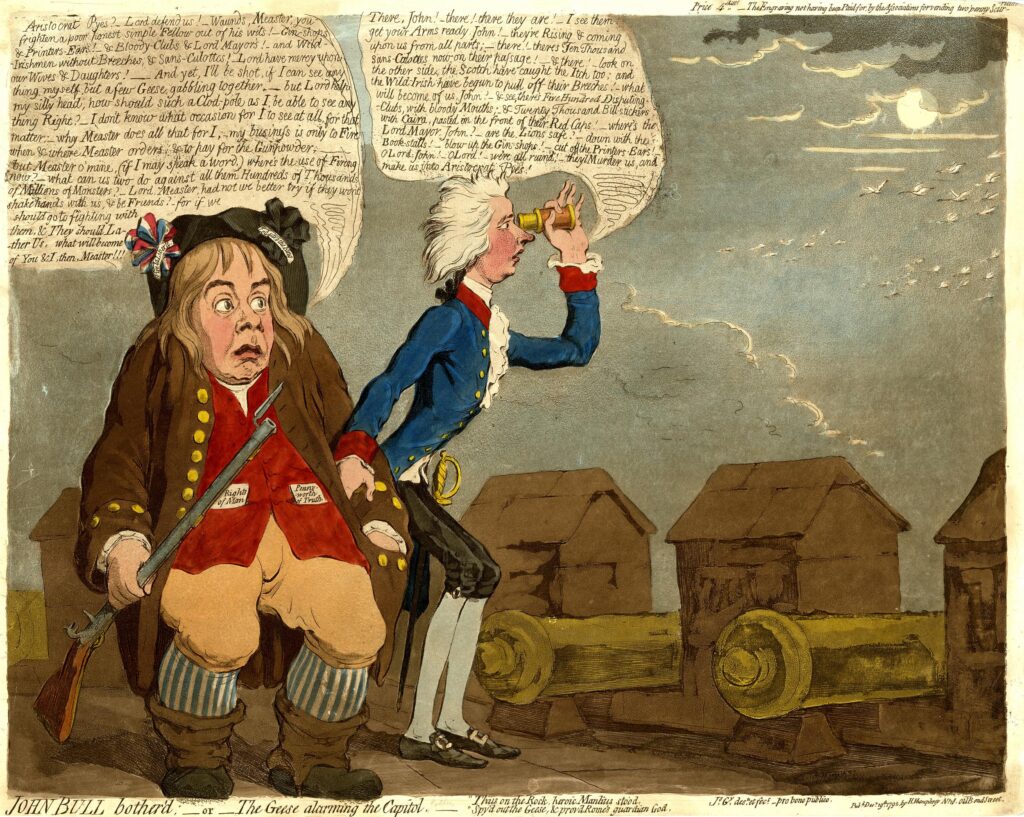
The first illustration with this post offers a taste of Gillray. With the French Revolution at full tilt and a rebellion brewing in Ireland, the Prime Minister, William Pitt, called up the militia. The leader of the opposition, Charles James Fox, accused Pitt of stoking fear to confuse and oppress the people. Gillray depicts Pitt atop a coastal fort, clinging to the personification of England, John Bull, who is depicted as a yokel with symbols of both the French Revolution and the British monarchy attached to his hat.

James Gillray, John Bull bother’d:-or-the geese alarming the Capitol (1792) Copyright British Museum. Creative Commons

Watching geese through binoculars, Pitt cries, “There, John! – there! there they are! – I see them – get your Arms ready, John! – they’re Rising & coming upon us from all parts.” He claims he sees French revolutionary mobs, “the Scotch [who] have caught the Itch too; and the Wild-Irish have begun to pull off their Breeches!” He issues panicked orders to address the crisis: “down with the Book-stalls! – blow up the Gin-shops! – cut off the Printers Ears!”

John Bull answers, “Wounds, Measter, you frighten a poor honest simple Fellow out of his wits! – Gin-Shops & Printers-Ears! – & Bloody-Clubs & Lord Mayors! – and Wild-Irishmen without Breeches, & Sans-Culottes! Lord have mercy upon our Wives & Daughters! – And yet, I’ll be shot, if I can see any thing myself, but a few Geese, gabbling together – But Lord help my silly head, how should, such a Clod-pole as I, be able to see any thing Right?”

The gabbling geese might be a metaphor for the “public sphere” of political debate, treated as powerless. This is a satire of conservative nationalism and propaganda, by an artist who was equally adept at mocking radical ideas–and who accepted money to design cartoons for and against both parties at various times.

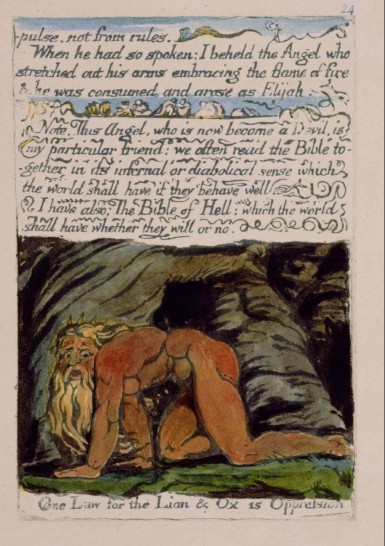
And here is an image by Blake from just about the same moment.

William Blake, Plate from Marriage of Heaven and Hell (1793), depicting Nebuchadnezzar, via Wikimedia Commons

The Devil has just said, “I tell you, no virtue can exist without breaking these ten commandments. Jesus was all virtue, and acted from impulse, not from rules.” The text in the image reads, “When he had so spoken, I beheld the Angel, who stretched out his arms embracing the flame of fire, and he was consumed, and arose as Elijah.”

Blake appends a “Note.—This Angel, who is now become a Devil, is my particular friend; we often read the Bible together in its infernal or diabolical sense, which the world shall have if they behave well. I have also the Bible of Hell, which the world shall have whether they will or no. One law for the lion and ox is Oppression.” The next section is entitled “A SONG OF LIBERTY” and offers numbered points, beginning:

  1. The Eternal Female groan’d; it was heard over all the earth:
  2. Albion’s coast is sick silent; the American meadows faint.
  3. Shadows of prophecy shiver along by the lakes and the rivers, and mutter across the ocean. France, rend down thy dungeon!

It’s likely that Blake really did experience a devil as his particular friend and read the Bible with him; mystical experiences influenced him as strongly as partisan cash motivated GIilray. Here Blake sings the very song that terrifies Pitt, the song of radical liberation.

Both Gillray and Blake incorporate their own handwritten text into their etchings or engravings. In both cases, the dialogue is fevered, histrionic. Neither has patience for the stuffed shirts of their day or any allegiance to “rules,” whether artistic, social, or sexual.

(Supposedly, Gillray and his business and personal partner, Hannah Humphrey, were on their way to church to be married when he remarked, “This is a foolish affair, methinks, Miss Humphrey. We live very comfortably together; we had better let well alone.” Blake and his spouse were once found stark naked in their garden, doing a dramatic reading of Paradise Lost.)

Those are similarities, but Blake was intensely earnest, whereas Gillray seems to have been a manic cynic (unless he was a canny subversive). I’d love to know what they said to each other when they were studying drawing and history-painting under Sir Joshua Reynolds.

See also: the role of communications in the French Revolution

Statistics

(Apologies to Wislawa Szymborska)

Attentive to all in a conversation:
Ten percent of the population. 
Someone's shame provokes a laugh:
Often true for over half. 
Ready and willing to reconcile:
Rare below the top quintile. 
Twenty percent, plus-or-minus three:
Those who’ll let an eccentric be. 
Almost three out of every four
Are quick to pity the sick or poor,
But doing something to counter hate: 
No more than one in any eight. 
Scoring high on all these measures:
We've found no such human treasures.
Of compassion, pure examples?
One or two in all our samples. 
But needing someone’s forgiving love:
Ninety-nine percent thereof.

See also: Cuttings: A book about happiness

Private investments in clean energy, batteries, or biomanufacturing leveraged by the Biden-ere spending bills

federal spending for both climate and democracy

Two huge problems may have the same solution. If this is true, it makes a powerful case for the main strategies of the Biden Administration.

The first problem is climate change, disastrous for both natural ecosystems and human lives and welfare. Underlying that problem is the fact that many constituencies around the globe benefit from burning carbon: not only authoritarian governments and powerful corporations (although they deserve the most criticism), but also regular communities and the parties and unions that represent them. As long as people who benefit in the short run from burning carbon have preponderant political weight, it is hard to pass truly satisfactory policy solutions.

The second problem is the marked tendency of poorer people to vote for the right, not only in the USA but in many other countries—in an eerie echo of the 1930s. Parties of the right that have lower-income constituencies cannot offer their voters tax cuts or deregulation. Instead they typically promise to strengthen the state to the exclusion of–or even against–minority groups or foreign populations. Unlike libertarianism, this form of politics has no natural limits; state power can keep ratcheting up until it reaches genuine fascism. Meanwhile, the center-left parties that are left with relatively upscale voters may try to defend individual rights, but they won’t address deep social inequities.

Federal finding authorized by Congress in Biden’s first two years addresses both problems. It tilts toward poorer districts (including those that are predominantly white and nowadays Republican) and green industries. The “theory of change” might be: 1) use federal funds to 2) “leverage” private investments in new industry that 3) mitigate climate change while 4) providing good jobs, thereby 5) building constituencies for green policies.

I am all for also using other strategies simultaneously, such as regulating or taxing carbon and divesting. I just think the Biden theory of change may be a necessary complement.

The map with this post (from the White House website) shows the locations of private investments in clean energy, batteries, and biomanufacturing that have been leveraged by new federal spending in the Biden years. Many observers have noted that a majority of this money–perhaps two-thirds–goes to districts represented by Republicans, who generally voted against the bills. I would draw attention to the concentration of projects along the Appalachian spine and in the heart of the Rust Belt. These are poor regions that happen, today, to be dominated by Republican representatives.

The effects are not yet evident in polling. In Pew’s June survey, 62% of all Americans disapprove of Biden, 41% very strongly. He receives net approval from college graduates but the disapproval of 66% of people with high school diplomas or less. He performs best among those who classify themselves as upper income and faces 2-1 disapproval among everyone else. Fifty-six percent of whites without college strongly disapprove of him, as do 57% of rural people.

This political strategy will take several years to work. People will have to see clear and sustained benefits from state action that is both equitable and green. The argument must begin now, but it will take time to change minds.

Energy Secretary Jennifer Granholm and some of her cabinet colleagues are visiting the locations of major new investments, most of which are in Republican districts. If Granholm were trying to affect the 2024 election, this trip would probably be a waste of her effort, since many of these districts are very safe for the GOP. For instance, she recently visited the district of Rep. Patrick McHenry, who won his last reelection by 45 points. Transportation Secretary Pete Buttigieg is going to Kentucky’s fifth district, which GOP Rep. Hal Rogers won by 65 points last time and which has been Republican since 1962. These trips may generate some social media calling out Republicans’ hypocrisy, but that won’t change minds. However, I do think actual jobs can shift people’s fundamental beliefs about both government and climate. For that purpose, both the federal spending and visits by Democratic leaders to tout it can be seen as highly promising.

See also: the major shift in climate strategy; Civic Engagement in American Climate Policy: Collaborative Models; social class inversion in the 2022 US elections; class inversion as an alternative to the polarization thesis; the social class inversion as a threat to democracy; investing in the Appalachian cities

benefits of virtue-signaling: professors’ antiracist tweets predict private behavior

(Dayton, OH) Deivis Angeli, Matt Lowe, and a group called The Village Team sent emails requesting informational meetings about graduate school to 18,514 academics in the USA, none of whom were Black. Half of the requests were signed by a prospective student with a “distinctively Black name,” and half with “a distinctively White name.”*

Overall, the professors did not discriminate, accepting 30-31% of the requests from people whose names sounded Black or White. In a separate survey of graduate students, most of them predicted that professors would discriminate in this situation, and it turns out these students were too pessimistic.

However, there were differences among the professors. Those who had tweeted at least once between January 2020 and March 2022 with a “racial justice-related word or phrase (e.g. racism, George Floyd)” were 1.9 percentage points more likely to accept a meeting with a person they might assume was Black, whereas those who never used a racial-justice word in their tweets during that period were “5.3 percentage points … less likely to accept a meeting with a Black student than with a White student.”

In other words, an academic with a Twitter handle who never tweeted about racism in those years would be somewhat likely to discriminate against a Black prospective student, whereas an academic who had tweeted about racial justice would be more prone to meet with a prospective student who is Black than with one who is White. For a prospective student, a tweet–which is a cheap expression of opinion–provides a meaningful signal about the professor’s likely personal behavior. Even though academics as a whole would not discriminate, there is some anti-Black bias, and it is concentrated among those who never take a public stance against racism.

I take Musa al-Gharbi’s points that “very public demonstrations of morality” typically have “impure motives” and that “the whites who seem most eager to condemn ‘ideological racism’ … and who are most ostentatious in demonstrating their own ‘wokeness,’ also tend to be the people who benefit the most from what sociologists describe as ‘institutional’ or ‘systemic’ racism.”

For instance, we college professors hold valuable, protected social roles in institutions that disproportionately serve white people, and many (like me) also benefit from policies like zoning, policing, and school-district boundaries that we rarely work to change. Writ large, the Democratic Party’s coalition tilts toward advantaged people, even as the party expresses rhetorical commitment to equity.** These are troubling phenomena at the group level. They help to explain our failure to achieve deeper change.

Al-Gharbi quotes an apt warning from the New Testament:

Beware of practicing your righteousness before men to be noticed by them; otherwise you have no reward with your Father who is in heaven. So when you give to the poor, do not sound a trumpet before you, as the hypocrites do in the synagogues and in the streets, so that they may be honored by men. Truly I say to you, they have their reward in full… When you pray, you are not to be like the hypocrites; for they like to stand and pray in the synagogues and on the street corners so that they may be seen by men. Truly, I say to you, they have their reward in full.

Matthew 6: 1-16

But it is also interesting that public expressions of anti-racism correlate with private acts that promote equity–more so than most students believe. Angeli et al. can reject a hypothesis about individual hypocrisy among the people they investigated. In this context, “virtue-signaling” may serve both to reinforce valuable group norms and to convey genuine information about an individual’s likely behavior.

We do suffer from contradictions at the group level–in other words, from systematic failures to address social inequities that benefit the people who denounce them. It’s perhaps no surprise that people are willing to put their beliefs into practice by, for example, taking half an hour to talk to a prospective student online, yet they won’t transform institutions that benefit them. But it is actually difficult to change systems, or even to know how to start. It may be that people are not so much hypocrites as bad at making systemic change.

*Angeli, Deivis and Lowe, Matt and Team, The Village, Virtue Signals (2022). CESifo Working Paper No. 10475. ** Social class inversion in the 2022 US elections. See also how intuitions relate to reasons: a social approach.