Religious Pluralism and Robust Democracy in Multiracial Societies

It’s not for me, as the chief organizer, to assess how this year’s Frontiers of Democracy went, but I loved every minute of it. I am deeply grateful to all the people who made it happen, from the plenary presenters to people who joined the conversations, plus my Tufts colleagues who supported the event.

Our theme in 2023 was “Religious Pluralism and Robust Democracy in Multiracial Societies.” I believe that explicit attention to religion helped to make the participants more diverse than they have been in the past and allowed us to talk in frank, personal, and existential ways that might otherwise be missed or even suppressed.

Just for example, on the first plenary panel, Rev. Cristina Moon, a Zen priest and activist, recalled how renouncing the self had helped her to take better care of herself, and Sharon Stroye, who is an associate pastor as well as an academic leader and activist, responded with a memory of giving herself over to Jesus–with similar results. Although I can’t speak for either of them or know what they believe about religious matters, I suspect that their metaphysical premises are very different, yet their psychological needs and journeys are similar; and the human bond between them was palpable.

I am not sure that anyone really articulated an account of how the concepts named in our conference title–religion, pluralism, democracy, and race–might all fit together. Anyone’s theory would be that person’s alone, and most of the other 125 participants would disagree. Of course, this diversity of opinion is an asset.

For myself: I happen not to be religious in any of the major senses of that word. I don’t identify with a faith, belong to or participate in any religious-defined community, believe things that are coded as explicitly religious, or practice religious observances. But I hold abstract beliefs that cannot be demonstrated empirically, such as the intrinsic value of all human life. Some of these beliefs derive from religions, or at least they have been articulated in religious terms that I have absorbed. I belong to communities that matter deeply to me and that are organized around ideas and rituals as well as human ties. And I practice–although I wish to practice more–exercises for self-improvement, self-discipline, self-care, and connection to others.

Meanwhile, I observe that all around me are people who articulate their identities, memberships, activities, and beliefs in explicitly religious terms, often professing one of the global faiths, such as Christianity or Islam. And among those who are hostile to all of such faiths, many seem to be just as committed to abstract metaphysical and moral premises and are just as likely to draw boundaries around their respective communities of belief, whether those are labeled science, socialism, free enterprise, nationalism, or something else.

A democracy is a society in which people freely form their own views about who they are, what they want, and what is right and then make some decisions collectively–on an equal basis–while also creating the social world by acting in a whole range of diverse smaller groups.

Our actual society is very far from this ideal because people are not even roughly equal and we often do not even try to make collective decisions fairly or wisely, in part because some of us are hostile to others. But we have democratic impulses and opportunities.

The explicitly defined religions are relevant because they help people to make sense of who they are, what is right, and what they want. Religions recruit individuals into public life and educate and organize them for effective participation. Although they reflect and reinforce the characteristics that make our society unequal, such as race and class, they also break those boundaries on occasion. They provide vocabularies and conceptual materials for thinking relatively deeply about justice. And they connect the inner life to action in the world.

Religions certainly have mixed records, causing or reinforcing many forms of cruelty and injustice. Their adherents blatantly violate their most explicit principles in the name of those principles themselves. Violent Buddhist priests and Christian denominations battling over inches of the Church of the Holy Sepulcher are just two examples of human folly expressed religiously. Then again, the major anti-religious movements also have poor records, and religions have often been helpful at moments of progress.

In any case, I would not distinguish sharply among the religions or between religion and secularism. It is not true, as John Rawls and many other modern thinkers have presumed, that “A modern democratic society is characterized … by a plurality of reasonable but incompatible comprehensive doctrines.” (Rawls explains: “A reasonable doctrine … covers the major religious, philosophical, and moral aspects of human life in a more or less consistent and coherent manner. It organizes and characterizes recognized values to that they are compatible with each other and express an intelligible view of the world.”)

Rawls imagines society as divided among namable groups like the Protestants, the Catholics, the Muslims, the Confucians, the Marxists, the libertarians, and the nationalists (my examples), each with core assumptions that explain all their other beliefs. Since their assumptions are incompatible, a fair government is one that treats them all impartially.

But we don’t have neatly organized systems of beliefs. (Perhaps a few of us do, but those people tend to be the fanatics.) Most of us have many beliefs, some organized, some disconnected, some in mutual tension. We get them from all kinds of sources. Stories, maxims, practices, and forms of organization tend to migrate from one faith community to another, as the story of Siddhartha Gautama’s childhood morphed into the Book of Bilawhar and Budhasaf in 8th century Muslim Baghdad, turned into a Georgian Christian epic written in Greek in Constantinople, turned into the Latin story of the monkish saints Barlaam and Josaphat, became La vie de seint Josaphaz in Anglo-Norman and the German medieval romance of Barlaam und Josaphat, supplied a plot motif for Shakespeare’s Merchant of Venice, and fueled anti-Reformation propaganda in the 16th century.

This kind of story does not suggest that we are all alike. An early Mahayana Buddhist believed very different things from a counter-Reformation Catholic. But the fact that they told the same story shows that they were connected.

Separated, unequal, but connected is our condition, and we need to talk about all of that.

Source: Rawls, John. 1993. Political Liberalism. New York: Columbia University Press. See also the relevance of American civil religion to K-12 education; notes on religion and cultural appropriation: the case of US Buddhism; when political movements resemble religions; are religions comprehensive doctrines? the political advantages of organized religion etc.
The Democratic Mission of Higher Education

Newly published: Peter Levine, The Democratic Mission of Higher Education: A Review Essay, Political Science Quarterly, 2023; https://doi.org/10.1093/psquar/qqad068.

Abstract: Controversies about speech on college campuses attract intense popular attention. Three recent books analyze campus speech as one of the ways that academia affects American democracy. In The Channels of Student Activism, Amy J. Binder and Jeffrey L. Kidder argue that college-student activists respond to incentives. Progressive students have opportunities to engage closely with their universities but often end up frustrated, while conservative students get support from national organizations to work off-campus and endorse conservative visiting speakers as a way of influencing their own institutions. Among other recommendations, Binder and Kidder suggest that universities should promote democratic values by adopting more persuasive positions about controversial speech. In Cancel Wars, Sigal-Ben Porath defends one such position: universities should avoid censorship and punitive responses to speech while actively ensuring that all members of their community are valued. In What Universities Owe Democracy, Johns Hopkins University President Ronald J. Daniels argues that higher education affects democracy in many ways beyond explicit political speech, and he presents recommendations that involve admissions, curricular reform, and research. Levine finds many helpful insights and suggestions in these books but adds reasons to doubt the democratic potential of prestigious colleges and universities. He advocates serious public investment in democratic education for children and for adults who are not students.

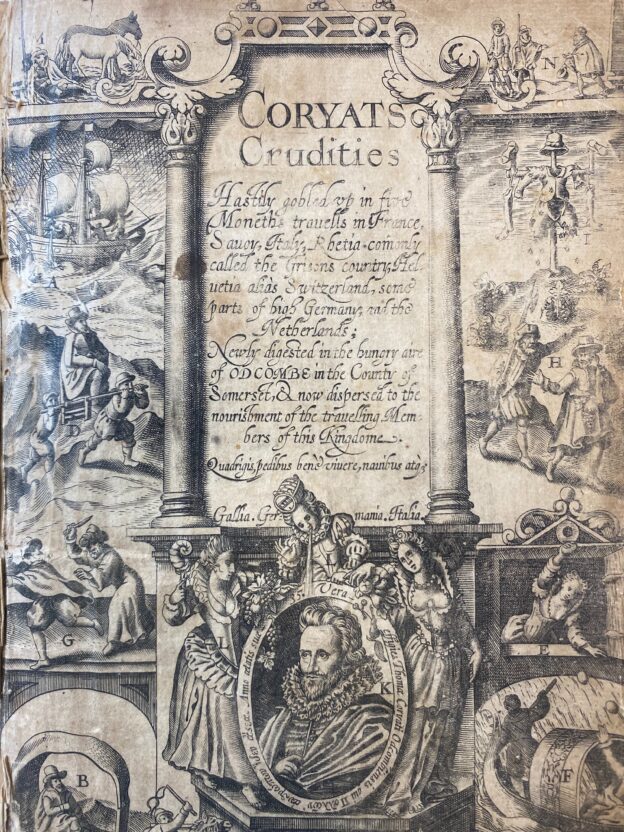
Frontispiece of Coryat's Crudities, London 1611

Coryat’s Crudities (note #1 from the Levine library)

For reasons that Angela Nelson describes in this article, my office at Tufts contains about 2,000 books printed before 1800 that my late father collected. Recently, I brought a ladder to campus so that I can see what’s on the upper shelves. I’m planning to pull down a book or two at a time and blog occasionally about what I find.

For instance, I found a 1611 edition of Coryat’s Crudities. It is in characteristically poor condition, split into two parts along its spine, with its cover loose. As a result, its market value is just about zero. However, the split reveals some considerably older, Gothic printed text that was used to repair it.

A previous owner has hand-written a kind of index on five blank pages at the front. I am not certain, but I think this owner was the Obadiah Cookson who signed his name on the title page in 1754. If that’s true, it’s fascinating, because the Obadiah Cookson known to Google lived nearby in the Massachusetts Colony. My Dad bought most of his books in London, so possibly this one has made three Atlantic crossings.

As for the book: Thomas Coryat or Coryate was an eccentric, a courtier who seems to have been more laughed at than laughed with–most popular as a butt of jokes. In 1608, during a period of peace, he traveled in Continental Europe and published his Crudities as an anthology of notes, letters, anecdotes, and poems that he ostensibly collected along the way. It was the first work in English to tell the story of William Tell and the first to describe the implement that we call a fork:

The Italian and also most strangers that are commorant in Italy, doe alwaies at their meales use a little Forks when they cut their meat. … so that whatsoever he be that sitting in the company of any others at meale, should unadvisedly touch the dish of meate with his fingers from which all at the table doe cut, he will give occasion of offence unto the company, as having transgressed the lawes of good manners, insomuch that for his error he shall be at the least brow-beaten, if not reprehended in wordes.

Coryat adds that he still uses a fork in England, and a friend has nicknamed him “Furcifer”–fork-bearer.

The first pages of the book are headed, “Certain opening and drawing dystiches [two-line poems] to be applyed as mollifying Cataplasmes [poultices] to the Tumours, Carnosities, or difficult Pimples full of matter appearing in the Author’s front …”

In other words, if the author’s main text offends, you can apply his rhyming couplets for relief. For example:

Our Author in France rode on horse without stirrup
And in Italie bathed himself in their syrrop. 

These lyric gems are all attributed–falsely–to B[en] Jonson, who is also credited with an introductory poem in honor of Coryat. A different “charitable friend” purportedly wrote the character-sketch that comes next in the volume. This text describes the “famous … Traveler and Gentleman Author of these … Crudities” thus:

He is an Engine, wholly consisting of extremes, a Head, Fingers, and Toes. For what his industrious Toes have trod, his ready Fingers have written, his subtle head dictating. He was set a-going for Venice the fourteenth of May Anno 1608 and returned home (of himself) the third of October following.

We’re told that he absolutely loves to travel:

The mere superscription of a letter from Zurich sets him up like a top: Basil or Heidelberg makes him spin. And at seeing the word Frankford, or Venice, though but on the title of a Booke, he is readie to break doublet, cracke elbowes, and overflowe the roome with his murmure. Hee is a mad Greeke, no lesse then a merry, and will buy his Egges, his Puddings, his Ginger-bread, yea, cobble his shoes in the Atticke dialect …

This fellow seems to have been a sort of Yorick, or a Jacobean Edward Lear, or a bit like Anthony Bourdain in his enthusiasm for travel and food and his self-deprecating humor. I think I would have liked him, although at times he may have talked too much about himself.

See also: a seventeenth-century Englishman inside the Great Pyramid

Civically Engaged Research in Political Science

Today begins the 2023 Institute for Civically Engaged Research (ICER) at Tisch College, a project of the American Political Science Association that I am co-directing with Valeria Sinclair-Chapman. Seventeen committed political scientists have gathered here to develop their skills for “collaborating in a mutually beneficial way with people and groups beyond the academy to co-produce, share, and apply knowledge related to power or  politics, contributing to self-governance.” (Cabrera Rasmussen, Lieberman, Levine, Sinclair-Chapman, & Smith 2022).

Civically Engaged Research in political science is not sharply distinct from Community-Based Participatory Research (CBPR), Transdisciplinary Research, or Participatory Action Research (PAR), all of which we will discuss during the institute. Why then work to develop a specific approach for political science?

I see two reasons. One is that the discipline of political science is a community composed of thousands of people who have some influence. If engaged approaches to research have value, then it’s worth developing them in this community–as in other fields. CBPR and Transdisciplinary Research are more deeply rooted in public health than elsewhere. Sociologists have developed Public Sociology. We seek to bring similar change to political science–not to supplant other methods but to expand the toolkit.

The other reason is that political scientists may have distinctive ways to practice engaged research, because we focus more than other disciplines do on governance, political acts, and power.

See also: civically engaged research in political science; how to keep political science in touch with politics; methods for engaged research; engaged theory and the construction of community; bootstrapping value commitments

philosophy of boredom

This article is in production and should appear soon: Levine P (2023) Boredom at the border of philosophy: conceptual and ethical issues. Frontiers of Sociology 8:1178053. doi: 10.3389/fsoc.2023.1178053.

(And yes, I anticipate and appreciate jokes about writing yet another boring article–this time, about boredom.)

Abstract:

Boredom is a topic in philosophy. Philosophers have offered close descriptions of the experience of boredom that should inform measurement and analysis of empirical results. Notable historical authors include Seneca, Martin Heidegger, and Theodor Adorno; current philosophers have also contributed to the literature. Philosophical accounts differ in significant ways, because each theory of boredom is embedded in a broader understanding of institutions, ethics, and social justice. Empirical research and interventions to combat boredom should be conscious of those frameworks. Philosophy can also inform responses to normative questions, such as whether and when boredom is bad and whether the solution to boredom should involve changing the institutions that are perceived as boring, the ways that these institutions present themselves, or individuals’ attitudes and choices.

An excerpt:

It is worth asking whether boredom is intrinsically undesirable or wrong, not merely linked to bad outcomes (or good ones, such as realizing that one’s current activity is meaningless). One reason to ask this question is existential: we should investigate how to live well as individuals. Are we obliged not to be bored? Another reason is more pragmatic. If being bored is wrong, we might look for effective ways to express that fact, which might influence people’s behaviors. For instance, children are often scolded for being bored. If being bored is not wrong, then we shouldn’t—and probably cannot—change behavior by telling people that it’s wrong to be bored. Relatedly, when is it a valid critique of an organization or institution to claim that it causes boredom or is boring? Might it be necessary and appropriate for some institutions … to be boring?

I have not done my own original work on this topic. I wrote this piece because I was asked to. I tried to review the literature, and a peer reviewer helped me improve that overview substantially.

I especially appreciate extensive and persuasive work by Andreas Elpidorou. He strikes me as an example of a positive trend in recent academic philosophy, also exemplified by Amia Srinivasan and others of their generation. These younger philosophers (whom I do not know personally) address important and thorny questions, such as whether and when it’s OK to be bored and whether one has a right to sex under various circumstances. They are deeply immersed in relevant social science. They also read widely in literature and philosophy and find insights in unexpected places. Srinivasan likes nineteenth-century utopian socialists and feminists; Elpidorou is an analytical philosopher who can also offer insightful close readings of Heidegger.

Maybe it was a bias on my part–or the result of being taught by specific professors–but I didn’t believe that these combinations were possible while I pursued my BA and doctorate in philosophy. In those days, analytical moral and political philosophers paid some attention to macroeconomic theory but otherwise tended not to notice current social science. Certainly, they didn’t address details of measurement and method, as Elpidorou does. Continental moral and political philosophers wrote about the past, but they understood history very abstractly, and their main sources were canonical classics. Most philosophers addressed either the design of overall political and economic systems or else individual dilemmas, such as whether to have an abortion (or which people to kill with an out-of-control trolley).

To me, important issues almost always combine complex and unresolved empirical questions with several–often conflicting–normative principles. Specific problems cannot be abstracted from other issues, both individual and social. Causes and consequences vary, depending on circumstances and chance; they don’t follow universal laws.

My interest in the empirical aspects of certain topics, such as civic education and campaign finance, gradually drew me from philosophy into political science. I am now a full professor of the latter discipline, also regularly involved with the American Political Science Association. However, my original training often reminds me that normative and conceptual issues are relevant and that positivist social science cannot stand alone.

Perhaps the main lesson you learn by studying philosophy is that it’s possible to offer rigorous answers to normative questions (such as whether an individual or an institution should change when the person is bored), and not merely to express opinions about these matters. I don’t have exciting answers of my own to specific questions about boredom, but I have reviewed current philosophers who do.

Learning to be a social scientist means not only gaining proficiency with the kinds of methods and techniques that can be described in textbooks, but also knowing how to pitch a proposed study so that it attracts funding, how to navigate a specific IRB board, how to find collaborators and share work and credit with them, and what currently interests relevant specialists. These highly practical skills are essential but hard to learn in a classroom.

If I could convey advice to my 20-year-old self, I might suggest switching to political science in order to gain a more systematic and rigorous training in the empirical methods and practical know-how that I have learned–incompletely and slowly–during decades on the job. But if I were 20 now, I might stick with philosophy, seeing that it is again possible to combine normative analysis, empirical research, and insights from diverse historical sources to address a wide range of vital human problems.

See also: analytical moral philosophy as a way of life; six types of claim: descriptive, causal, conceptual, classificatory, interpretive, and normative; is all truth scientific truth? etc.