young campaign volunteers in 2008: the numbers

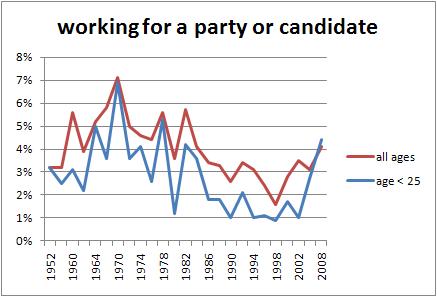
In 2008, for the first time in history, more young people than older people said that they had volunteered for a campaign. That tells an important story about how the Obama campaign in particular–and perhaps other political campaigns as well–engaged young people. The 2008 election was also a much more inclusive one than we had seen for some time, based on the proportion of Americans who said they had “done any work for a party or candidate.”

On the other hand, the long-term trend is a decline in political volunteering, as campaigns have evolved from broad, grassroots, labor-intensive efforts requiring many willing volunteers to highly professionalized enterprises driven by fundraisers, media consultants, and pollsters. Politicians are now more dependent on donors and less reliant on popular support. A very important question is whether 2004-8 was a blip or the beginning of an upward trend. (Source: American National Election Studies, analyzed by me.)

the rise of an expert class and its implications for democracy

Civil society is increasingly dominated by people who have received relevant professional training or who officially represent firms and other organizations. In local discussions about schools, for example, a significant proportion of the participants may hold degrees in education, law, or a social science discipline or represent the school system, the teacher’s union, or specific companies and interest groups.

Such people can contribute valuable sophistication and expertise. But if my arguments here are correct, we should not be satisfied with public discourse that is merely technical or that reflects negotiations among professional representatives of interest groups. We should want broad deliberations, rooted in everyday experience, drawing on personal experience and values as well as facts and interests, and resistant to the generalizations of both professionals and ideologues.

Technically trained professionals already intervened powerfully in public policy and institutions a century ago. The ratio of professionals in the United States doubled between 1870 and 1890, as society became more complex and urbanized and scientific methods proved their value. More than 200 different learned societies were founded in the same two decades, and learned professionals specialized. For example, physicians split into specializations in that period. The historian Robert L. Buroker deftly describes the implications for politics and civic life: “By 1900 a social class based on specialized expertise had become numerous and influential enough to come into its own as a political force. Educated to provide rational answers to specific problems and oriented by training if not by inclination toward public service, they sensed their own stake in the stability of the new society, which increasingly depended upon their skills.” At best, they offered effective solutions to grave social problems. At worst, they arrogantly tried to suppress other views. For instance, the American Political Science Association’s Committee of Seven’s argued in 1914 that citizens “should learn humility in the face of expertise.”

One of the great issues of the day became the proper roles of expertise, specialization, science, and professionalism in a democracy. The great German sociologist Max Weber interpreted modernity as a profound and unstoppable shift toward scientific reasoning, specialization, and division of labor. One of Weber’s most prominent students, Robert Michels, introduced the Iron Law of Oligarchy, according to which every organization–even a democratic workers’ party–would inevitably be taken over by a small group of especially committed, trained, and skillful leaders. In America, the columnist Walter Lippmann argued that ordinary citizens had been eclipsed because of science and mass communications and could, at most, render occasional judgments about a government of experts. Thomas McCarthy, author of the Wisconsin Idea, asserted that the people could still rule through periodical elections, but expert managers should run the government in between. John Dewey and Jane Addams (in different ways) asserted that the lay public must and could regain its voice, but they struggled to explain how.

Thus the contours of the debate were established by 1910. If dominance by experts is a problem, it was already evident then. But even if the conceptual issue (the role of specialized expertise in a democracy) is the same today as it was in 1900, the sheer numbers are totally different. This is a case in which quantitative change makes a qualitative difference.

Just before the Second World War, the Census counted just one percent of Americans as “professional, technical, and kindred workers”: people who according to, Steven Brint’s definition, “earn[ed] at least a middling income from the application of a relatively complex body of knowledge.” This thin slice of the population was spread fairly evenly. There was usually a maximum of one “professional” per household, and even in a neighborhood association or civic group, there might just be one physician, one lawyer, and one person with scientific training. Often these people (mostly men) had been socialized into an ethic of service. They had valuable specialized insights to offer, but they were obliged to collaborate with non-experts on an almost daily basis to get anything done. Without romanticizing the relationship between professionals and their fellow citizens, I would propose that the dialogue was close and reciprocal.

Today, in contrast, there are so many “professionals” (and they are so geographically concentrated) that particular neighborhoods, and even whole metropolitan areas, can be dominated by people who make a good living by applying specialized intellectual techniques. As holders of professional degrees, these people possess markers of high social status that were much more ambiguous a century ago, when gentlemen were still expected to pursue the liberal arts, and the professions still smacked slightly of trades. When wealthier and more influential communities are numerically dominated by people with strong and confident identities as experts, the nature of political conversation is bound to change.

In 1952, of all Americans who said that they had attended a “political meeting,” only about one quarter held managerial or professional jobs. Many more (41 percent) worked in other occupational categories: clerical, sales and service jobs, laborers and farmers. The rest were mostly female homemakers. In short, professionals and managers—people trained to provide specialized, rational answers to problems—were outnumbered three-to-one in the nation’s political meetings. By 2004, however, 44 percent of people who attended political meetings worked in managerial or professional occupations, and 48.5 percent held other jobs. The ratio nationally was now almost even, and professionals were the dominant group in affluent communities.

These are crude categories that do not tell us how people talk in meetings. A clerical worker could argue like a technocrat; a physician could tell rich, personal stories, laden with values. But I think the increasing proportion of professionals and managers in our meetings tells a story about a society dominated by people with specialized training and expertise.

Theda Skocpol notes that traditional fraternal associations like the Lions and the Elks, which once gathered people at the local level who were diverse in terms of class and occupation (although segregated by race and gender), have lost their college-educated members. But non-college-educated or working class people remain just as likely to join these groups. It is not so much that working-class people have left civic groups, but that professionals have left them–moving from economically diverse local associations to specialized organizations for their own professions and industries.

The proportion of all Americans who are professionals or managers has roughly doubled since the 1950s. That is a benign shift in our workforce, reflecting better education and more interesting jobs. It largely explains why highly educated specialists have become more numerous in meetings. They bring sophistication and expertise to community affairs. Still, two thirds of people do not classify themselves as professional or managers, and it important for their values and interests to be represented. The steep decline in traditional civil society leaves them poorly represented, to their cost and to the detriment of public deliberation.

[works cited here: Burton Bledstein, The Culture of Professionalism (New York, 1976), pp. 84-6; Robert L. Buroker, “From Voluntary Association to Welfare State: The Illinois Immigrants’ Protective League, 1908-1926,” The Journal of American History, vol. 58, no. 3 (Dec, 1971), p. 652; APSA Committee of Seven (1914, p. 263, quoted in Stephen T. Leonard, “‘Pure Futility and Waste’: Academic Political Science and Civic Education,” PSOnline (December 1999); Steven Brint, In an Age of Experts, The Changing Role of Professionals in Politics and Public Life (Princeton: Princeton University Press, 1994), p. 3; Theda Skocpol, Diminished Democracy: From Membership to Management in American Civic Life (Norman, OK: University of Oklahoma Press, 2003), pp. 186-7. Statistics on political meeting participation are my own results from the American National Election Studies.]
a grand bargain on voting rules

For what other activity would you be required to register and then wait more than a month before actually doing the thing? Today is the last day to register to vote if you live in 17 states and the District of Columbia.* The actual election is in November. In most states, you may only vote within a limited span of hours, at one particular site in your neighborhood.

I mention this because I happened to hear the host and callers on local Boston conservative talk radio expressing astonishment that you don’t have to show a photo ID to vote. The tenor of the discussion was a series of rhetorical questions: Would you be able to take money out of a bank without ID? Would you be able to check into a hotel?

Well, maybe: ATMs don’t require photo ID, although they do take and store your picture. But certainly there are ATMs all over the place, open 24/7, and ready to use as soon as you put money in the bank. Voting in Massachusetts is possibly easier than other transactions in one respect (no ID is required)–but it is far more difficult in other ways.

I am not personally concerned about voter fraud in the form of people pretending to be other people at the polling place. Doing so would risk a felony conviction, and for what?–to cast a single extra vote for the candidate you prefer hardly seems worth the risk. Lori Minnite found no evidence that it happens.

That said, I’d be willing to enter a grand bargain with the folks I heard on talk radio. Let’s make voting really like a secure financial transaction. You’d have to prove who you were, but you could vote at your convenience, 24/7, with no pre-registration or re-registration when you moved.

In fact, this is the roughly deal in some jurisdictions. Twenty-six states offer unrestricted absentee voting. Thirty-one states permit in-person early voting. And nine states offer Election Day registration. Several of these reforms have been found to raise turnout, especially same-day registration. See our fact sheet for a summary.

*Arkansas, Arizona, Colorado, DC, Florida, Georgia, Hawaii, Indiana, Kentucky, Louisiana, Michigan, Montana, Ohio, Pennsylvania, Tennessee, Texas, Utah, Washington, Wyoming.

Ben Franklin’s tips for nonprofit development and fundraising

From the Autobiography:

    The Rev. Gilbert Tennant came to me with a request that I would assist him in procuring a subscription for erecting a new meeting-house. … Unwilling to make myself disagreeable to my fellow-citizens by too frequently soliciting their contributions, I absolutely refused.1 He then desired that I would furnish him with a list of the names of persons I knew by experience to be generous and public-spirited.2 I thought it would be unbecoming in me, after their kind compliance with my solicitations, to mark them out to be worried by other beggars, and therefore refused also to give such a list.3 He then desired that I would at least give him my advice. “That I will readily do,” I said I4; “and, in the first place, I advise you to apply to all those whom you know will give something; next, to those whom you are uncertain whether they will give any thing or not, and show them the list of who have given5; and lastly, do not neglect those who you are sure will give nothing, for in some of those you may be mistaken.” He laughed and thanked me, and said he would take my advice. He did so, for he asked everybody,6 and he obtained a much larger sum than he expected, with which he erected the capacious and very elegant meeting-house that stands in Arch-street.

Summary:

1Don’t fund-raise for other people.

2Try to get other people’s lists.

3Don’t share your own list.

4Give advice; it’s cheap.

5Make giving seem cool.

6Ask everyone

The result:

what our social studies teachers think

The American Enterprise Institute has released a new survey called “High Schools, Civics, and Citizenship: What Social Studies Teachers Think and Do.” I know four of the authors and respect their work in general as well as this particular survey.

Ideology is inescapable when we consider civic (a.k.a. political) education. AEI is generally seen as a conservative organization, but that does not mean that the report is biased or designed to reach conclusions convenient to conservatives. On the contrary, it rebuts the kind of sharp conservative critique represented by Chester Finn and colleagues in a 2003 Thomas B. Fordham Institute report entitled Where Did Social Studies Go Wrong?. Finn claimed that students emerged “from K-12 education and then, alas, from college with ridiculously little knowledge or understanding of their country’s history, their planet’s geography, their government’s functioning, or the economy’s essential workings.” The underlying problem, he asserted, was that social studies teachers had bad values. By the year 2001, he wrote:

    in the field of social studies itself, the lunatics had taken over the asylum. Its leaders were people who had plenty of grand degrees and impressive titles but who possessed no respect for Western civilization; who were inclined to view America’s evolution as a problem for humanity rather than mankind’s last, best hope; who pooh-poohed history’s chronological and factual skeleton as somehow privileging elites and white males over the poor and oppressed; who saw the study of geography in terms of despoiling the rain forest rather than locating London or the Mississippi River on a map; who interpreted ‘civics’ as consisting largely of political activism and ‘service learning’ rather than understanding how laws are made and why it is important to live in a society governed by laws; who feared that serious study of economics might give unfair advantage to capitalism (just as excessive attention to democracy might lead impressionable youngsters to judge it a superior way of organizing society); and who, in any case, took for granted that children were better off learning about their neighborhoods and ‘community helpers’ than amazing deeds by heroes and villains in distant times and faraway places.

This assertion was not based on any data whatsoever. In contrast, the new AEI survey finds:

    83 percent of the teachers surveyed [see] the United States as a unique country that stands for something special in the world. At the same time, 82 percent of survey respondents say students should be taught to ‘respect and appreciate their country but know its shortcomings.’ Despite all of the concerns about anti-American sentiment in schools of education, just 1 percent of teachers want students to learn ‘that the U.S. is a fundamentally

    flawed country.’ This sounds, to our ears, like a near pitch-perfect rendition of what parents, voters, and taxpayers would hope for–schools where students learn that America is exceptional even as they learn about its failures.

In the AEI survey, 60% of teachers think it is “absolutely essential” to teach students to “follow rules and be respectful of authority.” Many fewer (37%) think it’s absolutely essential to teach students “to be activists who challenge the status quo of our political system and seek to remedy injustices.” Four out of five consider it absolutely essential to know the components of the Bill of Rights and to have “good work habits such as being timely, persistent, and hardworking.” One in five think that education professors are overly critical of the US; eight percent think those professors are overly appreciative.

The AEI results are consistent with our own finding that many more young Americans recall studying “great American heroes and virtues of the political system” than “racism and other forms of injustice.” I don’t necessarily object to the balance that exists in most American classrooms, but I do think leftists critics have more empirical basis for their complaints than conservatives have. If the ideological valence in our schools is wrong, it’s not that students receive an overly cynical account of American history but rather than real injustices are ignored.

On most of the questions about values and goals, public school and private school teachers respond similarly. But their actual practices are different. For example, 86% of private school students say they expect their students to keep up with the news, compared to 44% of public school teachers. That could be in part because laws and policies that govern public schools make no place for current events. Forty-five percent of public school teachers in the survey–but only 9 percent of private school teachers–say that “social studies has been deemphasized” because of No Child Left Behind.