is immigrating to the US bad for your health?

In general, young immigrants (ages 18-44) have much better health than people who were born in the USA. But the more years pass after they immigrate, the worse their health becomes.
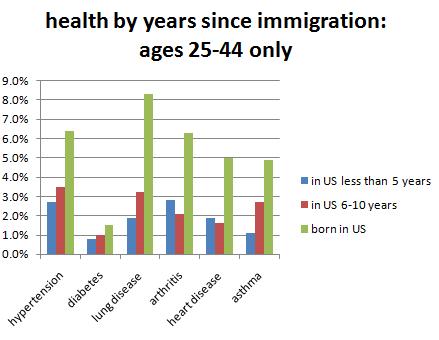
(adopted by Peter Levine from Guillermino Jasso, Douglas S. Massey, Mark R. Rosenzweig, and James P. Smith, “Immigrant Health and Acculturation,” in National Research Council, Critical Perspectives on Racial and Ethnic Differences in Late Life, 2004, table 7-6.)

I wouldn’t make too much of the above graph all by itself, but I was separately told by a well-informed colleague that there is a well documented “immigrant paradox.” Even as individuals grow more likely to have health insurance, stable employment, and stable housing, their health status falls towards the levels of native-born Americans of the same age.

It seems important to understand the reasons for this “paradox” so that we can improve the lives of large numbers of younger immigrants. Also, understanding why exposure to America seems to worsen health might reveal some important, general facts about life in America.

Not Even Past, from the historians at UT-Austin

I am impressed by “Not Even Past,” a brand new online history magazine that will present some new content every day. It is meant for lay readers but is produced by the History Department of the University of Texas-Austin: about 60 professors and their graduate students. Some appealing features include feature articles, mini-reviews of classic works of history, which explain their enduring relevance, and audio interviews. It is stylishly designed and well written.

I like the fact that it’s a collaborative effort by a whole academic department: that represents a different kind of work for professors, although fully compatible with their traditional practices. I like the relationship it creates between the public and a profession (for it reflects professional historians’ interests and methods but is meant for all intelligent readers and permits them to comment). Finally, although we are used to everything being free now, I like the fact that public employees have created material that is free of cost and of other barriers. They are contributing to the knowledge commons.

upside-down Foucault

Hypothesis: every space where Michael Foucault discovered the operation of power is also a venue for creativity, collaboration, and a deepening of human subjectivity.

By way of background: I respect Foucault as one of the greatest thinkers of the 20th century. Although deeply influenced by other writers and activists, he made his own crucial discoveries. In particular, he found power operating in places where it had been largely overlooked, such as clinics, classrooms, and projects of social science. Further, he understood that power is not just a matter of A deliberately making B do what A wants. It rather shapes all of our desires, goals, and beliefs. Its influence on beliefs suggests that knowledge and power are inseparable, so that even our understanding of power is determined by power. Despite the skeptical implications of Foucault’s epistemology, he struggled in an exemplary fashion to get the theory right, revising it constantly. He traveled a long intellectual road, directed by his own conscience and experience rather than any kind of careerism.

So it is as a kind of homage to Foucault that I suggest flipping his theory upside-down. Just as close, critical observation of people in routine settings can reveal the operations of power, so we can detect people developing, growing, reflecting, and collaborating voluntarily. To be sure, social contexts fall on a spectrum from dehumanizing to humanizing, with prisons at one end (not far from office cubicles), and artists’ ateliers at the other. But it would be just as wrong to interpret a whole society as a prison as to view it all as a jazz band. And, I would hypothesize, even in the modern US prison system–swollen in numbers, starved of resources for education and culture, plagued by rape and abuse, and racially biased–one could find evidence of creativity as well as power.

my blogaversary

I published my first blog post on January 8, 2003. Sunday will therefore mark my eighth full year of blogging. Today’s post is number 1,967. That’s equivalent to five posts per week for forty-nine weeks each year. I never post on weekends, so the actual blogaversary will pass in silence.

The medium has changed somewhat. In the early years, the only responses were emails, comments posted on my actual site (www.peterlevine.ws/mt), and other people’s blog posts that referred to mine. Locating such responses required ego-surfing, with search engines like Technorati.

Now my posts go forth in several ways: on my site, on my Facebook page, via Twitter, and via RSS feed. I also publish my more ambitious entries that have political themes on Huffington Post, where the number of comments is much higher. Facebook draws the most frequent and most civil and helpful comments. Twitter and RSS reach relevant audiences.

Fewer peers’ blogs now refer to mine, and I think that may be because fewer people are operating their own free-standing blogs. A higher proportion of the dialogue now is quasi-private–Facebook friends posting comments on my personal page–rather than blogs as an imitation of a “public sphere.”

I like Facebook, but I will hold onto my personal site because I want to control the archive of more than 1,900 entries. The vast majority of people who read anything on my blog are reading old entries that they find with Google searches. “Black dentists,” “Nabokov heroine,” and “Was Velazquez left-handed? are some frequent queries that land people on my site. (He was.)

Meanwhile, I think my content has been pretty consistent: the same mix of youth civic engagement, general politics from a “civic” angle, and bits of philosophy and literature. I generally try not to be self-referential, but the annual blogaversary is an excuse for summing up.

connoisseur of spam

CIRCLE’s website is not a blog, but it uses blogging software (WordPress) and accepts comments. “Comment spam” means inappropriate and irrelevant comments, usually with embedded advertisements for other people’s sites or products. WordPress automatically blocks most comment spam, but every day, at least a half dozen spam comments reach the queue and I have to block them by hand. Often, they make generically flattering remarks to encourage us to allow them to stay. I actually appreciate some of the creative efforts. E.g.:

“Your web-site has 100 % exceeded my expectations. From when I begun reading through your webpage I have acquired completely new facts and had old information reinforced. Let me recommend many folks i know.”

From Travel Deals: “Hi I like this article and it is so informational and I am definetly going to save it. One thing to say the Indepth analysis you have done is trully remarkable.No one goes that extra mile these days? Well Done! Just one more suggestion you can install a Translator for your Global Readers !!!”

“Thanks a lot for sharing. Your article is truly relevant to my study at this moment, and I am really happy I discovered your website. However, I would like to see more details about this topic. I’m going to keep coming back here.”

A website that provides football statistics comments on our research about the civic opportunity gap in high school: “This seems rather unsurprising – there is an obvious link between $ and education.” (Link to the NFL stats provided.)

Commenting on a youth turnout rate of 52% in 2008: “How true. Wish things could be better.”

“This post includes all information that I have always required.”

(You can’t do much better than that.)