John Gaventa on invited and claimed participation

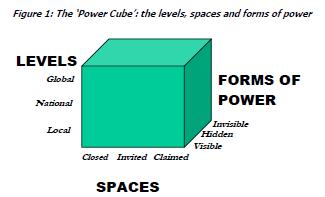
Today, I will be interviewing John Gaventa at a Tisch College forum to which all are welcome. Gaventa has been a major figure in democracy and popular education since his student days in the early 1970s. One of his recent contributions is the PowerCube, a simple device that activists can use for analysis and planning:

I am especially interested in the dimension that runs from “closed” to “invited” to “claimed.” Much of my work has involved trying to get powerful institutions to “invite” public participation by, for example, reforming elections to make them more fair, enhancing civic education, advocating changes in journalism, or recruiting citizens to deliberate about public policy. Increasingly, I believe that democratic processes must be claimed, not invited, if they are to be valid and sustainable.

For instance, in 2009, angry opponents of health care reform deliberately disrupted open “town meetings” convened by Democratic Members of Congress. The Stanford political scientist James Fishkin published an argument for randomly selecting citizens to discuss health care instead of holding such open forums. That was a classic proposal for “invited” democracy. The New York Times chose to give his essay the headline, “Town Halls by Invitation.” I would now say that democratic participation cannot be by invitation–it must be a right claimed or created by ordinary people, whether elites like it or not.

On the other hand, when officials do invite participation, that is often in response to public pressure or demand. In such cases, formally “invited” spaces are actually claimed ones. One of the most important innovations is Participatory Budgeting (PB). As I understand it, the Labor government of Porto Allegre, Brazil, invented PB to reduce political pressure on itself as it faced hard budget choices. But PB became so popular that it survived changes of party control in Porto Allegre and spread to many other municipalities around the world. In such cases, reform begins with an invitation but becomes an expectation.

my testimony in favor of lowering the voting age to 17 in Lowell, MA

Students in Lowell have fought to get the city council to support lowering the voting age to 17 for municipal elections. They persuaded the Lowell Sun newspaper to change its position from opposing the reform to supporting it (pdf). Today, scores of them traveled to the Massachusetts State House to testify before the committee that must review Lowell’s petition. I testified in support of their efforts.

Testimony of Peter Levine before the Joint Committee on Election Laws, April 13, 2011

Chair Finegold, Chair Moran, members of the Joint Committee on Election Laws, thank you for giving me the opportunity to testify in support of bill H01111 (“persons seventeen years of age or older be authorized to participate in certain elections in the city of Lowell”). I will speak briefly because the effective advocates and real experts are the students who have already talked today.

I direct CIRCLE (the Center for Information & Research on Civic Learning & Engagement), which is part of Tufts University in Medford. CIRCLE is the nation’s leading nonpartisan research center devoted to young people’s civic education and political participation.

The research evidence suggests that it may be very beneficial to lower the voting age to 17. People from around the United States and other countries are constantly asking CIRCLE whether that reform would work. I commend the students from Lowell, the City Council, and other Lowell leaders for wanting to experiment with it. I believe that its effects would be positive, but I also think it is an excellent idea to try the reform in one city where there is enthusiastic support and then evaluate the impact. We have an existing partnership with UTEC in Lowell and would be happy to help study the effects of lowering the voting age there.

I would be happy to answer any questions about the research, but in my allotted time, I will mention briefly that:

• Today, we expect young people to vote for the first time when most are living away from older adults who could remind them to participate, help them with the mechanics, and discuss issues with them. They are living with other people who have never voted before. That is a recipe for low turnout, and the effects are lasting, because research shows that voting is a habitual behavior.

• Voting for the first time while they are still in school would allow students to learn the mechanics of registration and voting (which many find intimidating) and to experience nonpartisan discussions of important issues before their first election. In one experiment, teaching young people how to vote raised their turnout in a local election by 17 points, even though that election occurred months later. Lowell has a strong commitment to civic education in its schools.

• Seventeen-year-olds are ready to vote. Americans at age 17 score about the same on questions about political knowledge, tolerance, political efficacy, perceived civic skills, and community service as 21-year-olds. I know of no evidence that they score lower than 50-year-olds.

• You may have read that adolescents’ brains differ from older people’s brains in ways that affect their decision-making. But voting is not like steering a car. The kinds of premeditated, abstract decisions that people make in the ballot box are not affected by age. On the contrary, adolescents are just as capable of making those decisions wisely as older people are.

Sources:

Elizabeth Addonizio, “Reducing Inequality in Political Participation: An Experiment to Measure the Effects on Youth Voter Turnout,” presented at the American Political Science Association, 2004.

Mark N. Franklin, Voter Turnout and the Dynamics of Electoral Competition in Established Democracies since 1945, Cambridge University Press, 2004.

Daniel Hart and Robert Atkins, “American Sixteen- and Seventeen-Year-Olds are Ready to Vote,” Annals of the American Academy of Political and Social Science, vol. 63 (January 2011), pp. 201-221

Eric Plutzer, “Becoming a Habitual Voter: Inertia, Resources, and Growth,” The American Political Science Review 96/1 (March 2002), pp. 4
defunding civic education

From what I am hearing, the budget deal negotiated by Congress and the President had the following effects on civic education:

Learn & Serve America, the program within the Corporation for National and Community Service that funds “service-learning” in k-12 schools, colleges and universities, nonprofits, and Native American communities, was eliminated completely–after 21 years of work.

The Center for Civic Education, a national nonprofit whose primary source of funds for decades has been the United States Department of Education, was allocated no money. I think the entire civic education portfolio in the Department was zeroed out.

The Teaching American History grant program (which mainly supports educational opportunities for teachers of k-12 history) was cut by about 36 percent.

I have been critical of the way some of these funds were used in the past; improvements are possible. But for the national government to invest nothing in the civic education of young people is unacceptable.

For other cuts that affect democratic processes in the United States, see the Campaign for Stronger Democracy.

ideology affecting market behavior

You might think that ideology affects what you say, but not where you put your dollars. Nothing like an investment decision to clear the head and focus your mind on empirical data. But just before the federal shutdown was averted last Friday, CNN reported that investors weren’t concerned. “The shutdown talk is noise,” said Jeffrey Saut, chief investment strategist for Raymond James in St. Petersburg, Fla. “It really won’t have a major effect on the economy. The government is unproductive. Everybody already knows that.”

I thought that story was good news at the time. I expected a shutdown and was glad to read that markets wouldn’t fall. But Mr. Saut’s literal claims are very debatable. First, even if the government were totally unproductive, it is a massive consumer and employer. If it fails to pay any bills, that will have a deleterious impact on the parts of the economy that Mr. Saut thinks are productive (including his own financial services sector). Second, government can be productive. It funded the invention of computers, founded the Internet, and built the interstate highway system. Even some routine services have impressive payoffs. A random-controlled study of an educational program called Quantum Opportunities found that its net benefits were $28,427 per student, a pretty good return. I have no stake in claiming that the government is more productive than other economic sectors, such as banking. But it seems purely ideological to dismiss its positive impact impact on the economy as zero on the basis that “everyone knows” it isn’t productive.

I wrote a post in fall 2010 about how investment advisers were bullish, claiming that divided government would bring “stability.” That claim seemed un-empirical to me. Various forms of turmoil and unpredictability were likely to follow from Republican control of the House, not the “stability” that investment banks wrote about in their prospectuses.

So I return to two rival hypotheses:

1. These people really believe what they literally say, and it affects their behavior. They think that a market shutdown won’t affect markets because the government is unproductive, and therefore it won’t affect markets.

2. These people find palatable ways to convey what they actually think–not that Republican control will bring stability or that a shutdown will have zero impact on markets, but rather that Republican control means lower taxes for them, and a shutdown could strengthen Republicans’ hands in negotiating fiscal policy.

the MIT Global Challenge

Amos Winter is a Tufts grad (2003) who has invented the Leveraged Freedom Chair, a cheap, rugged, three-wheeled chair that people can use to get around the dense cities and countryside of the developing world. He will be speaking (with a bunch of others, including me) at the Tisch College 10-year anniversary celebration tomorrow.

Winter studied at MIT, which is the host of the MIT Global Challenge. Student teams develop solutions to profound human and environmental problems and compete for prizes in an open online vote. Near the top of the competition right now are the Indian Mobile Initiative, which will engage Indian engineering students in developing socially useful applications for cell phones; the InnoBox Science and Engineering Kit, which is a cheap and portable kit for doing science experiments, meant for classrooms in South Africa; and BodyNotes, a tool that allows an amputee (in the US, Sierra Leone, or anywhere else) to communicate with a distant expert about fixable problems–like soreness and infection–by emailing photos.

The most obvious benefits of projects like these are the tools themselves, devices and projects that markets would not generate because the end-users are too poor. There may be benefits for the designers as well: technical skills, understanding of the world, and moral growth. Finally, many of the projects build strong and reciprocal partnerships among very different groups of people. For example, the Indian Mobile Initiative doesn’t propose any particular applications, but rather a process by which Indian students will collaborate to develop software. These dialogues and exchanges take more-than-technical skills to create and should produce more-than-technical benefits.