where do you turn if you mistrust the government and the people?

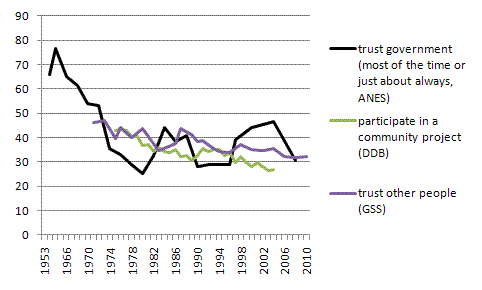
If you mistrust the government but trust your fellow citizens, you may be drawn to political changes (such as referenda, campaign finance reform, or electoral reform) to increase the power of “the people,” collectively. That was the main trend of reform between 1890 and 1914. If you mistrust many of your fellow citizens but trust some version of the government, you may be convinced to expand the power of technocrats or charismatic politicians, as has happened in many countries, especially the most divided ones. But the clear trend in America for the last several decades has been growing distrust for both.

If one distrusts both the public and the government, a consistent response would be individualistic libertarianism: asking to be left alone to the greatest possible extent. (I distinguish this philosophy from communitarian libertariansm, which means devolving power to localities.)

Individualistic libertarianism has been a growth stock during the period depicted above, when–not coincidentally–people have also become less likely to work together with their neighbors. But without arguing its merits, I would note that most Americans don’t buy all the tenets of individualistic libertarianism. In particular, they are concerned about negative externalities (whether from smokestacks or from drug sales) and want to regulate other people’s behavior to prevent them. They are also at least somewhat concerned about economic equality.

So where will Americans turn if they want to regulate society but distrust both the government and their fellow citizens and are not working with their neighbors? That seems to me a great underlying issue of our time.

assessing the president

Right now, everyone on the left seems to want to criticize President Obama’s leadership or else rise to his defense–yielding a vast flow of commentary. (See, for example, Drew Westen, Matt Miller, or Tom Philips for the prosecution; Kevin Drum or Jonathan Chait for the defense.) We know things are going badly: the economy barely sputtering along, the 2012 election in doubt, the political system reaching depths beneath satire’s reach, and public opinion pretty strongly against any federal activism that might help. I think the interesting questions are:

  1. Could pursuing different policies in 2009-10 have substantially changed the situation today?
  2. Could the administration alter the situation now with substantially different policy proposals or legislative strategies?
  3. Could the president change public opinion by talking differently?

There are two reasonable sides to each of these questions, but for what it’s worth, my answers would be: no, no, and no. We now know that the US economy shrank by 5.1 percent from 2007-9 and unemployment doubled. The recovery was going to be hard and slow, and Obama took office well before a cyclical rebound was possible. (In contrast, FDR won the presidency after three years of depression, once the economy had already begun to turn the corner.) I am enough of a Keynesian to think that a gigantic stimulus might have helped, but that was not in the cards. Also, the money would have to be well spent or the political backlash would have been tremendous. A modestly larger stimulus could have mitigated suffering, but we would be in the same “macro” situation as we are now.

In 2011, even a relatively modest stimulus might prevent a double dip. So we should do that! But proposing or requesting a stimulus does not cause one to pass Congress. Indeed, the chances of its passing are near zero. So if there is an underlying strategy behind the many calls for tougher or better rhetoric, it must be the hope of changing public opinion in time for the 2012 elections.

That strategy raises the much-debated question of whether presidential rhetoric can change public opinion on matters as deeply rooted as basic trust in government. I see no examples of success. As has been widely noted, the public throughout FDRs administration favored spending cuts to balance the federal budget, and he even opted for that policy in 1937. Substantial economic growth from 1932-6 made him a popular president, and his social innovations were good–as is Obama’s health care reform. But FDR did not persuade Americans to be Keynesians. Since then, trust in government has eroded slowly but profoundly, making Keynes’ case even harder.

Two additional challenges stood in Obama’s way: substantial public money had to be spent on bailouts (very bad for public trust), and the 2010 electorate was bound to be smaller and more Republican than the 2008 electorate, because it was an off-year election. Given this combination of factors, I think no other rhetoric, narrative, strategy, or bargaining posture would have made a whole lot of difference. One of the most remarkable facts about today’s political situation is the president’s relatively high approval rating, a surprising asset for an incumbent in such terrible times.

I could certainly endorse criticisms of particular bargaining decisions and particular rhetorical choices. On the other hand, if “everyone’s basically had it with the president,” then let me say that my anger is directed elsewhere. The list includes corrupt kleptocrats, Congressional partisans who don’t care about collateral damage, and liberal pundits and opinion-leaders who reacted so tepidly to the legislative achievements of 2009-10 that they probably reduced Democratic turnout that November. I can’t prove that booing the health care plan caused the 2010 electoral shellacking, any more than I can prove that the president’s sometimes centrist rhetoric has hurt the progressive cause. But my instinct tells me the biggest fault was not his.

The main line of criticism seems to be: the administration’s legislative agenda should have been, and should remain, much more ambitious, and bolder rhetoric would persuade the public to support it. My view was and remains: the political system is broken, little can be expected from it, and the public doesn’t help because they–understandably–have no faith in better policy. As I wrote in a Democratic Strategist article:

Americans’ distrust of government is deep and poses a fundamental obstacle to progressive reform. …. When only six percent of Americans trust the government to have created any jobs by spending almost one trillion of their dollars, the problem is much deeper than Fox News or the communications strategy of the White House. The underlying relationship between people and their government is fundamentally broken.

Candidate Barack Obama seemed to understand that rhetoric could not change this situation, but engaging the public in the substance of governance would begin to restore the relationship. His administration’s failure to do that has been a deep disappointment to me, but that is an entirely different critique from the one being discussed today.
Liberal Education special issue on civic engagement

I have a piece in the latest issue of Liberal Education that looks at civic engagement very broadly. I claim that efforts to increase or improve youth civic engagement are motivated by several different projects or goals–from using young volunteers to provide services to reducing gaps in political power. I quickly assess the merits of each project. The issue as a whole also contains articles by Barry Checkoway (former CIRCLE advisory board member and still a close colleague), Connie Flanagan (CIRCLE board member and frequent collaborator), Jim Youniss (frequent co-author), and Shawn Ginwright (CIRCLE board member).

the decline effect

A fascinating article in the New Yorker by Jonah Lehrer explores the phenomenon of scientific findings that seem to “wear off.” They are proved in a series of initial studies that cannot be replicated later.

For example, “second generation” antipsychotic drugs worked well in double-blind experimental trials when they were first developed, but now perform worse than the first generation drugs. The phenomenon of “verbal overshadowing” (in which describing something degrades our memories of it) was well demonstrated in experiments that, when replicated today, find much smaller effects. Symmetry was found to attract mates in numerous species, from insects to people, but recent studies no longer find that pattern as strongly, if at all. Even in physics, “the weak coupling ratio exhibited by decaying neutrons … appears to have fallen by more than ten standard deviations [if one compares experiments conducted] between 1969 and 2001.”

It’s not clear that we should expect one explanation for all these examples. In fact, it’s not clear that one phenomenon is occurring–rather than a series of anecdotes plucked from a vast and diverse literature. But the article drew my attention to a specific problem that may, indeed, be widespread.

In statistical studies, we usually say that the effects are significant if there is no more than a 5% chance that they arose as the result of a random bias in the sample. That means that 5% of all “significant” statistical results are false. This error rate should not be a problem if studies are replicated and knowledge is built cumulatively. False results should become outliers and have little effect on the literature.

But most studies are not published, either because the researchers don’t think they have found anything interesting and try a different approach before they submit their articles, or because they submit drafts that are rejected. A study is more likely to be published if it is interesting (meaning counter-intuitive), if it supports the researchers’ bold hypotheses, and if their hypotheses reflect beliefs that are either popular or interestingly controversial. So an erroneous result that arises from random sampling error–which is no one’s fault, by itself–is much more likely to be published than a valid but boring null result. For instance, if you raise students’ test scores with a simple and quick new intervention, journals will be delighted to publish your study; but if you show that this new idea didn’t work, you will be hard pressed to publish. Also, if you show that a conventional form of teaching modestly raises students’ skills, your study may be rejected as dull.

Once a study is in print, none of the incentives (money, fame, and promotion) encourage replicating it exactly to make sure it wasn’t a fluke. Instead, researchers are encouraged to try similar studies in different contexts–and those are most likely to be published if they again confirm the hypothesis. If, by predictable luck, 5% of studies falsely confirm a faddish new theory, they will have decent odds of being published and dominating the literature. It is only once a theory becomes well established that the incentives shift and one can make a mark by disproving it. That could explain why particularly well-established findings are suddenly subjected to replication, decades after they first arose, and are shown to be false or exaggerated.

There is nothing particularly spooky about this process. The fault lies not with nature but with how we organize the institutions of science. Lehrer’s subtitle asks: “Is there something wrong with the scientific method?” I think the right answer may be a little like Gandhi’s purported comment about Western civilization: “It would be a good idea.”