Margaret Mead’s quote is trademarked

I like to start seminars and talks by quoting Margaret Mead: “Never doubt that a small group of thoughtful, committed citizens can change the world. Indeed, it’s the only thing that ever has.” Almost everyone in my audience recognizes the quotation, and many have been using it in their email signatures or posting it over their desks. I provoke them by claiming that the statement is incorrect on several levels. Yet we should admire the inspirational intention behind it. We need to go “beyond Margaret Mead” by asking when, how, and under what circumstances small groups can change the world, and when, why, and under what circumstances such change is good. Last year’s Summer Institute of Civic Studies had rich discussions on that topic, captured humorously in this graphic by Joshua Miller:
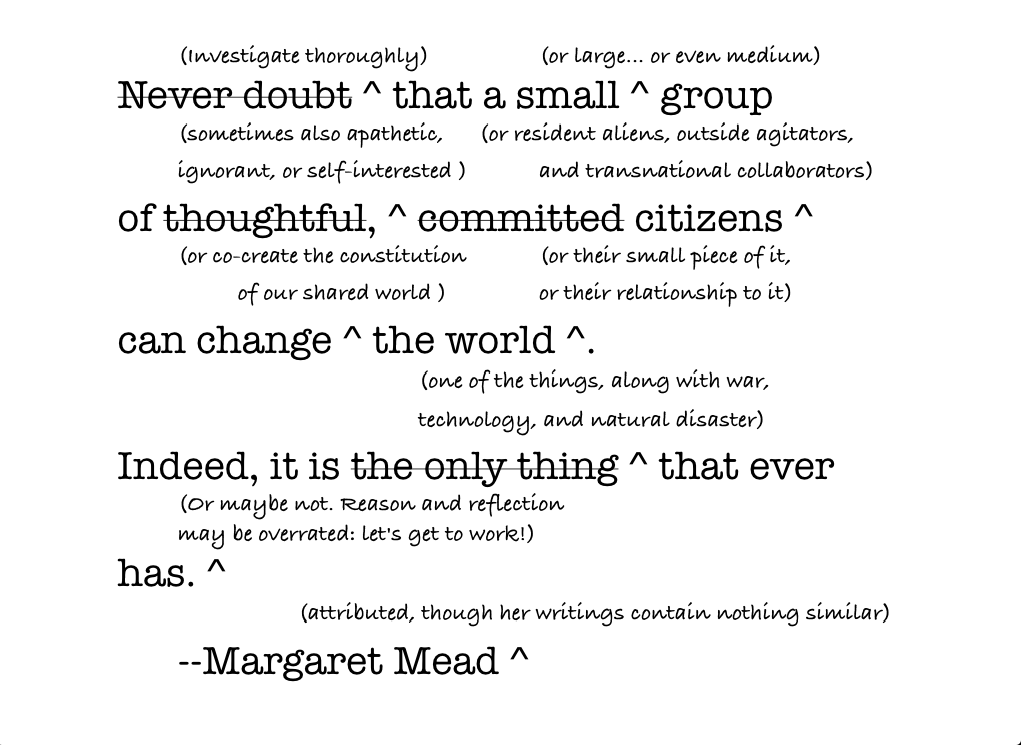
It has never been clear that Margaret Mead actually uttered the quote in question. But a friend alerts me to this page on the Institute for Intercultural Studies website.

What is the source of the “Never doubt…” quote?

Although the Institute has received many inquiries about this famous admonition by Margaret Mead, we have been unable to locate when and where it was first cited, becoming a motto for many organizations and movements. We believe it probably came into circulation through a newspaper report of something said spontaneously and informally. We know, however, that it was firmly rooted in her professional work and that it reflected a conviction that she expressed often, in different contexts and phrasings. …

The “Never doubt” challenge is sometimes quoted in a longer form, with the coda, “indeed, it’s the only thing that ever has.” We decided on the shortened form both for brevity and because the exaggeration in the coda may, in print, weaken the basic concept rather than reinforce it.

Can my organization use the “Never doubt …” quote?

… If you wish to use the quote for non-commercial and non-partisan purposes, including the trademark sign where noted above, please do so with no charge and our good wishes. Following the quotation and the name Margaret Mead, you may put “Used with permission.”

This quote is now trademarked, and the trademark is held by Sevanne Kassarjian, New York. …

It seems to me that the motivation to trademark the phrase is benign: the Institute for Intercultural Studies is not charging anything and mainly wants to prevent partisan or commercial uses.

I don’t know much about intellectual property but find it surprising that one can trademark a quotation that a Google search finds 809,000 times (almost never with an ® after it) and that has appeared in published texts for decades. If I ever say something pithy and worthwhile, I won’t expect to be able to prevent partisan or commercial readers from quoting it–nor are partisan and commercial uses necessarily contrary to the spirit of the Mead quote. (Couldn’t a movement within a political party be a small group of thoughtful, committed citizens? How about a social enterprise?)

For now, I think I will continue to cite the following as my source for Mead’s remark: Nancy C. Lutkehaus, Margaret Mead: The Making of an American Icon (Princeton, NJ: Princeton University Press, 2008), p. 261.

Strong Women Across America

My Tufts colleague Professor Miriam Nelson is a distinguished nutritionist, a scientist who has been leading federally funded research studies on food and exercise for almost 20 years. She has written many books and articles and serves on official expert bodies, such as the 2010 Dietary Guidelines Advisory Committee for the US Department of Agriculture.

Those are conventional measures of success and impact. But Mim Nelson knows that a whole range of factors beyond our individual choice affect our health: for instance, what food is available locally, whether the sidewalks are walkable, and how friendly local governments are to bicycles. These factors are tough to change, but people can address them collectively, and in doing so, they can gain friendships, skills, and confidence.

Instead of exhorting people to make better choices, Mim Nelson and colleagues are organizing communities for social change. We see that shift in some other fields as well–for example, the family therapy professor Bill Doherty has moved away from treating stress as a treatable personal problem; he now organizes suburban families to fight the causes of stress.

Mim has organized Change Clubs across America, mostly in rural communities and mostly composed of women. She and colleagues are now on a national tour called “StrongWomen Across America: Change Yourself, Change the World.” It is really an exercise in community-organizing, with a focus on nutrition and exercise and an emphasis on rural women. You can follow their progress through videos, photographs, and reflections on their tour blog page.

Owen Flanagan, The Bodhisattva’s Brain: Buddhism Naturalized

After proposing my own interpretation of a Buddhist doctrine recently, I enjoyed Owen Flanagan’s book about Buddhism. Flanagan (a proponent and practitioner of analytical philosophy and natural science) read a lot of classical Buddhist texts, interviewed the 14th Dalai Lama on several occasions, talked to many other Buddhists, reviewed the results of brain research on Buddhist monks, and explored scholarly literature from East and West. He concludes that:

  1. The Buddha’s own metaphysics and epistemology are strikingly consistent with modern science–a point made by Einstein and others but worked out here in more detail;
  2. Buddhist ethics is appealing from a modern liberal’s perspective, complementing liberalism with its deeper account of a good inner life, but offering a thin account of justice that needs development;
  3. Buddhist philosophy and practice might have some bearing on personal happiness, but that is a complex matter, and the causal link is by no means automatic. Becoming a Buddhist won’t just make you happy, but Buddhism has interesting things to say about happiness (what it is and how to pursue it).
  4. The brain science related to Buddhism is interesting and worth pursuing but has been hyped beyond recognition. The most straightforward causal hypothesis is not about Buddhism and happiness but about the impact of particular forms of meditation on mental health. The studies on that question are inconclusive. In Flanagan’s view, there are also empirical questions regarding the impact of Buddhism on happiness, but they cannot be settled by brain science alone, because Buddhism is much more than meditation, and happiness is a contested term requiring normative analysis.

Continue reading

Syracuse University: slide or rise?

(Cincinnati) Although I grew up in Syracuse as a professor’s child, have visited the university as recently as last week, and know more than a dozen SU faculty, I am not really in a position to evaluate the administration of Chancellor Nancy Cantor. She has tried to reorient the university to serving “the public good.” That means making it more accessible to poor and minority students, supporting the redevelopment of the city of Syracuse in partnership with local citizens, and emphasizing scholarship that engages public issues. Her strategy has become a leading national example of “engagement” in higher education. Therefore, the debate about her administration (see, for example, this critical article in the Chronicle of Higher Education) has national implications.

Some results at Syracuse:

  • The proportion of US-born minority students has risen from 18.5 percent to 32 percent.
  • The proportion of incoming students whose family incomes qualify them for federal financial aid has risen from 20 percent to 28 percent.
  • According to the Chronicle of Higher Education, “the institution has spent tens of millions of dollars—and attracted much more—to revitalize this sagging Rust Belt city. It has helped refurbish parks, taken over an abandoned building where drug dealers once grew marijuana, and turned an old furniture warehouse into a new home for academic programs in art, drama, and fashion design. The university is encouraging professors to focus their research on the city, while giving free tuition to local high-school graduates.”
  • But the University has slipped from 40th to 62nd on US News and World Report‘s ranking of national universities. The Chronicle quotes some SU professors (all of whom I happen to know) who feel that the investments in financial aid and local redevelopment and the change in admissions standards come at the cost of academic excellence.

I hesitate to make my own judgment because everything depends on quality. Serving the public good is not a matter of intention alone, but requires intellectual excellence–a point very well argued in an Imagining America report by Nancy Cantor and several colleagues. I am too far removed from the scene to be able to assess the quality or impact of SU’s work. But I would make the following broader points:

1. The fate of Syracuse University is inextricably linked to the fate of Syracuse, a hard-hit, post-industrial city. The city’s condition affects the University in the most tangible ways. For instance, talented young faculty will not teach at SU unless the city offers them amenities and feels vibrant.

2. Addressing the condition of our shrinking, post-industrial cities is an immense intellectual challenge, requiring the very highest quality of scholarship across many disciplines. If SU can contribute to that effort, it will distinguish itself intellectually. Moreover, by focusing some of its attention on one great, complex, multifaceted public issue, the university can integrate knowledge and perspectives, becoming more than a shopping mall that offers miscellaneous courses and research products.

3. The diversity of a student body or faculty does not trade off against excellence. Diversity is an educational asset. To be sure, admitting a more diverse class (by race, ethnicity, and economic background) will mean admitting students who start with a wider range of academic skills–including some who are less prepared. But that means they can progress further while they are in college. The ultimate measure of excellence is not whether you admit the smartest kids, but what you teach them. US News & World Report makes little effort to measure “value added,” yet that is what every college should strive for. Competing to admit the students who least need higher education is no way to achieve excellence.

4. The potential dangers I see are: (1) harmful effects on the city if investments are misconceived; (2) failure to support a more diverse student body; and (3) reduced support for forms of scholarship, such as ancient or medieval cultural history or pure mathematics, that feel remote from public concerns. Sometimes these disciplines address live public causes–as in this example from the field of classics. But we do them a disservice if we assess them only on that basis. They have intrinsic rather than pragmatic value.

I raise these potential dangers not because I see them playing out at Syracuse, but because they require vigilance.

For a response to the Chronicle article, follow this new blog by SU graduate students.

should we be talking about non-college youth?

(Cincinnati) I was in Dayton today for a meeting about “non-college youth” and their civic and political participation.  CIRCLE defines this population as all Americans between the ages of 18 and 29 who have never attended college (including community college). They represent about 43% of their age cohort. Studying how they engage–or don’t engage–in all forms of civic and political life is our major focus. We care because they should have a voice in government and civil society and because engaging as citizens gives them skills, networks, and motivations that help them to flourish in life. I doubt very much that the college attendance rate will rise substantially; therefore, offering young people opportunities outside of college is an important and neglected policy issue.

Yet treating “non-college youth” as a category is problematic for several reasons. First, it’s a negative definition, using a deficit as its basic criterion.

Second, it’s a very large category, encompassing enormous diversity. Just for example, 52% of this group is white, 16% is African American, 27% is Latino, and 3% is Asian or Pacific Islanders. Some are “inner-city” youth, but many live in suburbs, and nearly 20% are rural. (See our fact sheet for details.) The question, given this diversity, is whether any research program or policy should be directed at “non-college youth” as a category. Note also that non-college youth may closely resemble peers who happen to be in college or have some college experience.

Third, “non-college” does not define disadvantage. You can be wealthy and powerful without going to college: Paris Hilton is a non-c0llege youth. On the other hand, you can be deeply disadvantaged and yet in college–especially given our broad definition of the term. The most marginalized and oppressed people have other problems (such as disease, incarceration, or criminal victimization) that make college attendance seem almost beside the point. More than half of “non-college youth” are white, yet young white people are not afflicted nearly as much by poverty, violence, preventable disease, and discrimination as are young people of color.

Yet I continue to see reasons to focus on the non-college 43%. They are almost invisible in a society whose formal leaders and opinion-makers usually hold college degrees. Reporters still routinely equate college students with young people. College attendance itself is a powerful predictor of many important outcomes. For instance, people with any college experience vote at more than twice the rate of their non-college peers. Just because you are not in college, you may need different opportunities and supports. Finally, there can be strength in numbers, and talking about 43% of the population may carry extra weight.