understanding public deliberation as a field

In the current Journal of Public Deliberation (which, by the way, is a free, open-access, peer-reviewed publication), Caroline W. Lee has an article entitled, “Five Assumptions Academics Make About Public Deliberation, And Why They Deserve Rethinking.”

Her first major contribution is to see that public deliberation is not just a philosophy or a set of practices; it is a bunch of people and organizations whose actors “interact with knowledge of one another under a set of common understandings about the purposes of the field, the relationships in the field (including who has power and why), and the field’s rules” (quoting Fligstein and McAdam). If you have been to as many “D&D” (dialogue and deliberation) meetings as I have, you know that this is true, and you will recognize some of Lee’s anonymous informants:

The professional consultant from California, the non-profit executive from Connecticut, the minister from Texas, the rural development expert from North Dakota, the academic from Colorado, the foundation executive from New York City, the think tank staffer from DC, the therapist from Virginia, the EEO officer from Nevada, the deliberation organization staffer from Ohio …

Her empirical analysis of these people and their relationships challenges many common assumptions about the field.

To begin, “much of the activity in the field is driven by elite actors—a fact that practitioners readily acknowledge.” (She cites me as one source.) Although some of the leaders in the field emerged from participatory democracy in the 1960s and retain left-of-center political views, they are more heterogeneous than that:

Deliberation draws on many fields, including alternative dispute resolution in legal systems, workplace participation reforms in private companies, psychological counseling and therapy, personal recovery movements, and New Age and New Thought religious practices …

Relatedly, issues of equity and diversity only concern some in this field. To be sure, sessions on equality and diversity draw overflow crowds, but that can obscure the fact that many other participants in the “D&D” field are actually quite uncomfortable with these topics. As one leader wrote, “Topics like ‘race’ and ‘gender’ by themselves create an exclusive, divisive, and even demeaning frame. (Do people really want to be defined genetically rather than by their choices?)” The most sympathetic interpretation would be that issues of identity and equality are hotly debated within the deliberation field, but I fear that what really happens is division into separate conversations: the passionate proponents are in one room, the quiet critics in another.

Turning to the methods that D&D practitioners employ, Lee finds, “despite the apparent heterogeneity …, many methods involve routine combinations of a limited palette of practices. The heterogeneous engagement techniques described by Girard and Stark (2007) are in fact standard elements of deliberation practitioners’ toolkits.” She is insightful about common elements that might be overlooked, such as a tendency to use “Appreciative Inquiry” or something very much like “its explicitly positive and opportunity-focused philosophy.”

Just as the various methods are more similar than they might at first appear, they also have much in common with widespread practices used in corporations and government. Practitioners of D&D reported that they had also participated in such approaches as “Stanford T-group training,” “IBM Jam,” “Plowshares,” “Encounter Programs,” “federal mediation training, “Transactional Analysis training,” “AT&T University,” “Quality Circle,” “Community Dispute Resolution Training,” “activist trainings,” “advanced facilitation for Covey 7  Habits of Highly Effective People,” “Gestalt Intervener Certificate,” and “Environmental Stakeholder dialogue.” One claimed “extensive in-house government and corporate facilitator training.”

Not only are techniques similar in grassroots community settings and in corporate offices, but companies employ many of the experts on deliberation. “Private clients represent a small, but important—and unusually remunerative—part of practitioners’ client base. At conferences, many practitioners report that work with private clients is typically easier than dealing with the thicket of agencies involved in public sector processes, and can expose deliberative principles to greater numbers of stakeholders.”

This finding is not necessarily a critique. Working in the corporate sector can be smart and beneficial. But it deserves critical scrutiny since, as Lee notes, “There is a substantial literature starting with Habermas (1989) documenting general trends in incursions of private enterprise into the public sphere and their negative consequences on democratic politics and deliberative possibilities.”

Overall, the paper sets a hugely valuable agenda for research aimed not at understanding how deliberation affects participants or communities, but what it is as a field of practice–including its composition, the dominant incentives and power structures, and potential for change.
the importance of the inner life to moral philosophy

It can be seen that there a huge gap, at present unfillable as far as we are concerned, which needs to be filled by an account of human nature, human action, the type of characteristic a virtue is, and above all of human ‘flourishing.’

— Elizabeth Anscombe, “Modern Moral Philosophy,” 1958

The dominant question in modern moral philosophy is “How should we get along?” I am increasingly interested in a different question: “What is a good (enough) life?”

I wrote, “How should we get along?” a little flippantly, but it is actually a very serious question that provokes huge follow-up questions, such as “What kind of government should we have?” “Who deserves what?” and “May I, under any circumstances, lie/break a promise/harm another?” These examples merely hint at a long agenda.

But the agenda isn’t long enough unless it also addresses the question of how we should live our own lives, including our inner lives of thought and emotion. One can see this by observing the limits of the main philosophical schools:

Utilitarianism teaches that we must maximize the happiness, welfare, or satisfaction of all people (including ourselves; but each of us is outnumbered about 7 billion-to-one by the rest of the species and therefore hardly counts). Anscombe said, “it is a bit much to swallow that that a man in pain and hunger and poor and friendless is ‘flourishing.'” True, and plenty of people are needlessly in such condition because of my sins of omission and commission. So I ought to do or give much more. But the links that connect my potential acts of welfare, other people’s material conditions, and other people’s flourishing are hardly certain or straightforward. Some people who know no physical pain and have plenty of money and friends are nevertheless miserable to the point of suicide; others are stupidly happy but not are living worthy lives. Material welfare may be a necessary condition of a good life, but it is not a sufficient condition. If the question is whether we are living well, then how we get along (our duties and rights vis-a-vis others) is only part of the story. We could make the distribution of rights and goods perfectly just and yet all fail miserably as human beings.

Kantianism teaches that we must develop our own rational autonomy and that of others. Everyone must live his or her own life, but we have a duty to enhance other people’s ability to do so. The emphasis now is more on freedom than on welfare, but I can’t just stand by while 3.5 billion people live on less than $2/day, because destitution and illiteracy interfere with living autonomous lives governed by choice and reflection. I mention the problem of global poverty for a second time not only because it is hugely important, but also because I want to explore the same problem in relation to both Kantianism and to utilitarianism. The practical conclusions of the two theories are not necessarily different even though the premises are. In any event, the limits of the two theories are similar. It’s all very well to say that I must honor and defend other people’s rights to live autonomously and support them in doing so. But what is the point of an autonomous life–for them or for me? Or (if we take autonomy to be self-evidently good), then what makes a life autonomous? Unless we can say something about the content of an autonomous life–what the autonomous person thinks, feels, and does–the theory is radically incomplete.

Virtue ethics, which Anscombe helped to revive in the essay quoted above, might offer a much richer account of the good life. A good life could be one in which certain desirable traits are habitual, becoming virtues. However, despite Anscombe’s hopes, my sense is that actual virtue ethics is mostly concerned with “How should we get along?” The virtues of greatest interest involve our relations with other people and are understood in terms of effects on them. Besides, even though virtue ethics may have value for illuminating the good life, it doesn’t seem obvious that a good life just is a virtuous one.

Perfectionism” is a word for any ethical theory that is primarily concerned with what make a life good. It seems to me a somewhat unfortunate title, evoking competitive striving, super-human standards, “achievement of human excellence in art, science and culture” (Rawls), or even disdain for other people. Perhaps a good inner life is primarily oriented to promoting the welfare and/or autonomy or others. Perhaps a good inner life requires modesty: acceptance or even embrace of limits. Conceivably, not being a “perfectionist” (in the ordinary sense of that word) is a necessary condition of being a fully good person. Leaving aside the unfortunate terminology, I think we need to ask “How should a person live?” and “What duties to we have to ourselves?” if we want to know how people should get along.

the growing distance between people and schools

(Washington, DC) Liberals are often dismissive of local control in education. For example, in the current New York Review of Books, Christopher Benfey remarks on Mitt “Romney’s obligatory kowtowing to local and parental control of school systems (meaning, presumably, more school prayer and less evolution) …”*

Local control may mean more prayer and less evolution–in some districts–but it may also increase people’s stake in public education.

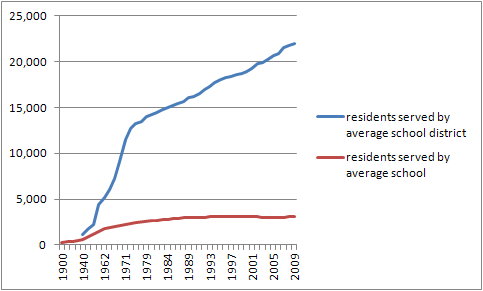
In 1940, each school district in the United States served only 1,117 people, and usually the district had an elected board. Today the average school board serves almost 20 times as many residents, and often it has an appointed leader. Meanwhile, the number of residents served by each school has grown tenfold since 1900. While these trends have unfolded–as the deliberate result of consolidation, undertaken in the name of efficiency–standardized testing has become more important, and state and federal mandates have proliferated. As a result, fewer people are involved in local school governance, which has become less consequential.

To be sure, districts can be too small for efficiency. And many of the important state–and especially federal–mandates have been enacted to protect vulnerable minorities and have had positive effects.

However, if it is true that people want accountability that is relational rather than informational, then Americans are going to perceive schools as less accountable the bigger the districts get. And they are not likely to fund or otherwise trust schools that they consider unaccountable.

This would be not be an essential problem if people generally trusted government and were involved in public life in other ways, such as on juries. But the trends of distrust and disengagement are evident across the government.

*In the same issue of the NYRB, Michael Greenberg interviews an Occupy Wall Street participant who extolls “direct democracy,” saying, “as you can see for yourself [it] works beautifully here on the whole.” Greenberg “mention[s] Proposition 8 in California, an instance of direct democracy that overturned a state supreme court ruling that had legalized same sex marriage.” Apparently, local control implies creationism, and direct democracy means overturning gay marriage. So much for democratic vistas.

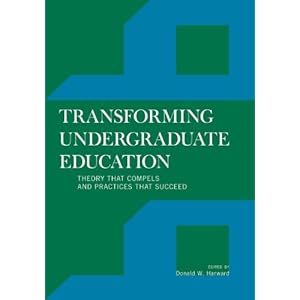
Transforming Undergraduate Education: Theory that Compels and Practices that Succeed

Donald Harward, former president of Bates College and now director of Bringing Theory to Practice (BTtoP), has edited a newly released book about undergraduate education. The 41 authors tackle the interrelated problems that students often disengage from learning, professors are alienated from teaching, and students are disconnected from communities in ways that harm them psychologically.

University of Michigan Professor Barry Checkoway, Wagner College President Richard Guarasci, and I contribute a chapter on “Renewing the Civic Purposes of Liberal Education.”

In his introduction, Don Harward cites four major themes that run through the volume. In my paraphrase, these are:

  1. Campus cultures can be changed.
  2. Liberal education has epistemological, psychosocial, and civic aspects. The three must be considered together.
  3. Certain troubling behaviors of students can be ameliorated by engaging them better academically.
  4. We have a base of effective programs and centers, but we must move toward deeper and more systematic change.

species of educational reformer

(Washington, DC). Whom have I forgotten or mischaracterized?

The Testing Liberal: Argues that we have failed to educate our least advantaged children because we haven’t believed they can succeed, haven’t cared about them, and haven’t dedicated valuable resources–such as the best teachers–to them. Wants to monitor every child’s progress with standardized tests and respond rapidly to signs of failure.

The Crunchy Liberal: Believes that the most important and effective aspects of education include play, the arts, service, and open discussion. These cannot be measured and are being lost because of testing pressures. May or may not see small schools and charter schools as helpful.

The Social Context Liberal: Presumes that schools have only a small impact on educational outcomes. More important are external factors, ranging from nutrition and racism to crime and parenting styles. May want to devote much more money to schools serving poor children to compensate for their social contexts. May also want to defend the performance of schools as they are.

The Resource Equalizer: Like the Social Context Liberal, primarily concerned that we don’t spend enough money on the children who need it most. May be primarily concerned with funding formulas and mechanisms.

The Modernizer: Cannot believe that we still educate kids in classrooms with fraying textbooks and black- (or white-) boards. Wants everyone playing digital games and creating digital media, possibly from home instead of school. Some in this group are less interested in technology than in teaching 21st century skills or applying recent research on brain science to improve pedagogy.

The Efficiency-through-Consistency Maven: Cannot believe that 98,706 schools, 14,841 school districts, and 50 states are all separately developing curricula, lesson plans, professional development programs, manuals, and reading lists. Sees the potential for huge economies of scale and improvements in quality if teaching is standardized.

The School Choice Libertarian: Favors either charter schools or vouchers to break monopolies seen as inefficient, corrupt, static, and unresponsive to families–especially poor families. Some in this group are more concerned about the education schools’ monopoly on teacher certification than the schools’ monopoly on kids.

The Traditionalist: Admires and would like to return to the neighborhood school of 50 years ago, with prayer, corporal punishment, and high respect for teachers. Is more concerned about perceived declines in mores than about preparation for the 21st century labor market.

The Teacher Organizer: Believes that teachers have been downtrodden by most of the other reformers and wants to empower them collectively to reform schools or systems from the bottom up. May or may not see the teachers’ unions as helpful agents.

The Community Organizer: Emphasizes the importance of social capital, parental engagement, and cooperation between schools and neighborhood associations–including religious congregations. Wants to get the community involved in educating kids, and may distrust external forces (such as markets, state and federal mandates, and textbook companies). Should be concerned that we have only 14,000 school districts, sharply down from 119,001 districts in 1937, when the country was much smaller–because that is a sign of consolidation.