Last Monday, I gave a talk at Colgate University. I claimed that if you read a lot of mainstream survey research, you’re likely to conclude that “people are stupid and they hate each other,” but this negative assessment reflects some bias. A student, Colgate senior Clementina Aboagye, told Maddie Koger of the Colgate Maroon-News:
“I think it was important that we had someone like Peter Levine who comes from an institution like Tufts University to present us [with the idea] that as much as we may disagree with each other, we still have complexities in how we think — that it’s important we search for gray areas because politics isn’t so black and white,” Aboagye said. “Those gray areas are important for us to not only converse about, but also to give each other space to speak — even when we don’t agree, because we can’t always agree — and we live in a world where people’s experiences and access to things determine what kind of ways in which they think — that deserves consideration.”
The very next day, a majority of American voters chose Donald Trump, concluding a campaign marked by polarized media, misinformation, hostility, and attacks (from one side) on basic liberal norms. Yet I still think there’s truth in the argument I offered at Colgate, which you could watch in full here.
The previous week, I had givenAmerican University’s annual Lincoln Scholars Lecture on “What Should We Do? A Theory of Civic Life.” Although my topic was quite different, this talk also offered a more positive view of civic life than one would glean by focusing only on an ugly and dangerous national election. According to Ridha Riyani’s summary in the AU Eagle newspaper, I said,
“We disagree because we care, and we need to do it better. …
[Levine] ended with a call to action, reminding attendees that civic life extends beyond national politics and requires thoughtful collaboration.
“In conversation, we can move towards greater wisdom,” Levine said. “We communities are capable of changing the rules.”
I would not argue now that all we need is to listen generously across differences and explore the complexity of other people’s views. We must also stand up against injustice. Confrontational nonviolent civil resistance was a major theme in my AU talk, and I have been preparing for a Trump victory for several years. Still, there remains a place for listening, bridge-building, and collaboration, and I strive to offer useful concepts and skills for those purposes.
My colleagues at CIRCLE (The Center for Information & Research on Civic Learning & Engagement) have already produced an incredible body of analysis of the 2024 youth vote. Overall, they find that youth turnout was higher than in past decades but lower than in 2020, and young adults supported the Democrats, but much more narrowly than previously.
I recommend all their work, but I’d like to discuss one pattern. It appears that being working-class predicted support for Donald Trump when holding race and gender constant, with the exception that young women of color supported Harris by the same amount, regardless of their social class. These trends are stronger for older Americans but still evident among the 18-29s.
(I interpret education as an indicator of social class. Especially for younger people, income is much less revealing. An MBA student might earn less current personal income than a mechanic of the same age.)
Young adults who have not attended college favored Trump by two-to-one, whereas those with postgraduate educations preferred Harris by 14 points. Nearly half (42%) of young Latinos without college experience chose Trump. Thirty-four percent of all young Black men favored him, a pretty remarkable increase that may also be related to social class.
I would be reluctant to explain this pattern by citing any specific policies of the Biden Administration or proposals of the Harris-Walz campaign, nor by criticizing the candidates or their rhetoric. This is because the same pattern–working-class voters supporting the right–has been evident recently in France, Germany, and the UK–the other democracies that I’ve studied–and was already strongly present in the USA in 2022.
My pet theory is that liberal or progressive parties prefer to regulate, because they can shift the costs to private entities and local governments. The regulated organizations then pass mandates on to workers and consumers, and the rules that originate in legislation are mixed together with all the things that companies require or prohibit for their own profit. The same department that tells workers not to use polluting chemicals also warns them not to take unauthorized work breaks. As a result, regulation that has social benefits looks like corporate monitoring, and progressives sound like the nation’s HR department or legal office. It doesn’t help that almost all Democratic elected officials are, in fact, lawyers or former managers.
My preferred alternative would be to spend public money to benefit workers, because that is a more direct and transparent way to achieve public purposes. However, the Biden Administration and congressional Democrats did authorize $1.9 trillion of new spending on green manufacturing (and microconductors) and reaped no apparent political gain.
Perhaps contingent factors interfered, such as the pandemic and the end of pandemic-related benefits, global inflation, and Joe Biden’s inability to make the case when it mattered. But the failure of nearly $2 trillion to move working-class opinion requires reflection. Unless something changes fast, the formative experiences of our rising generation will not incline them to progressive values.
The Internet is saturated with explanations of the 2024 election. Some of these “quick takes” are dispassionate, while others take the form: If only Harris had done what I know is right, she would have won.
The challenge is epistemic: it’s virtually impossible to explain a single past event that involves many decision-makers (in this case, about 150 million of them).
Explaining the decisions of a few powerful people is hard enough, but at least then we can use evidence about their individual values, goals, and personalities. For instance, we can investigate why Napoleon ordered the main assault at the Battle of Borodino in 1812. However, says Tolstoy,
It was not Napoleon who directed the course of the battle, for none of his orders were executed and during the battle he did not know what was going on before him. So the way in which these people killed one another was not decided by Napoleon’s will but occurred independently of him, in accord with the will of hundreds of thousands of people who took part in the common action. It only seemed to Napoleon that it all took place by his will (War and Peace, 10:28)
It’s easier to explain the pattern displayed in a large set of cases (inductive reasoning). John Burn-Murdoch observes that every incumbent government in the world that has faced an election in 2024 has suffered major setbacks. John Sides argues that inflation lowered Biden’s approval rating, and the incumbent’s approval predicts reelection.
But these generalizations cannot explain the single event of the 2024 US presidential election. Generalizations inevitably involve variance, and 2024 is obviously anomalous. Should we even categorize Harris as the incumbent, when she was a vice president stepping in for a president and running against the previous president?
We can also look at patterns within the population to try to explain why individuals voted. For instance, Michael Tesler assembles evidence that few American women vote from gender solidarity and race consistently trumps gender as an explanation of voting.
This is a valid approach that will yield more precise insights once we have voter files and better survey analysis for 2024. But this method also has limitations for the purpose of explanation. As the (true) cliché reminds us, correlation is not causation. Besides, individuals vary in ways that are not captured in generic surveys. And we must distinguish carefully between two tasks: explaining why large numbers of people voted for each candidate, versus explaining the marginal change since 2020. Big blocs of the electorate vote predictably, yet much of the conversation is about changes at the margin. Our whole discussion would be different if Harris had won by 4 points instead of losing by less than one point, but either way, most people would have voted the same.
To emphasize the last point: I strongly suspect that a male Democrat would have fared no better than Kamala Harris, or even possibly worse. One of many pieces of supportive evidence is the fact that people whose survey answers indicated sexism already tended strongly to oppose Joe Biden in 2020 (Spencer 2021). I doubt that sexism explains the marginal change between 2020 and 2024, yet that hardly makes sexism irrelevant, since it helps to explain the 2020 baseline. Whether you feel that sexism is at stake may reasonably reflect your own depth of concern about misogyny in our society; this is not simply a statistical question. Put another way, whether you explain the result in terms of sexism depends on whether you are trying to a) combat misogyny or b) win an election. The explanation is relative to its purpose.
We might conclude that it is fruitless to make a model to explain any particular case. But that is exactly what we must do before we act. Even if there is no way to know now what would have happened had Harris acted differently, Harris and her team had to do something. In September, they needed a prospective model of the single case that confronted them: the election.
In 1903, Charles Sanders Peirce coined the term “abduction” (or “abductive judgment”) for the logic that explains a single case. Abduction is a pragmatic necessity because we always act in specific circumstances. In my view, valid abduction never depends on a single claim. There is no way to test whether one premise caused a given outcome in a given case. Rather, a good abduction consists of many linked components: a whole model. And it is appropriate for the model to contain facts, values, and strategies.
Thus, if you were Kamala Harris in September, you needed a coherent account of the current US electorate (facts), what you sought to achieve as a president (values), and how various messages and methods would affect the outcome (strategy). You had to guard against biases (believing facts because they confirmed your values), but you were entitled to bring your self into the analysis. For one thing, this was a model for how you should act, so it had to motivate you and your team and sound authentic coming from you.
We cannot tell which parts of Harris’ implicit model were right or wrong–and it remains possible that her model was as good as it could have been. But what we need now is a model to guide our own next steps.
Since I am not running for president, my model should not be designed for that purpose–although I might start armchair strategizing in 2026 or so. For now, I need a model that guides my actions as a concerned citizen during the Trump Administration. To a limited extent, my model might be guided by my retrospective assessment of the 2024 presidential campaign–but not by much. The main question, as always, is what should we do?
This is from a Twitter thread posted yesterday by University of Pittsburgh historian Lara Putnam:
When highly-engaged people who had voted against him came out of their initial shock in wake of Trump’s first election and tried to figure out how to push back on Trump and his GOP majorities, a few templates were offered them:
Guidance # 1: Tea Party in Reverse — or at least those parts of the Tea Party visible from the congressional offices where its anger hit. More or less, the Indivisible playbook. Which included….
A. Hold large protest marches B. Build local groups or networks, drawing on those who attend C. Contact incumbent politicians to pressure them to act against Trump policy efforts D. Conduct targeted actions to drive earned media against Republican incumbents E. [Run primaries against] Democratic incumbents who were not sufficiently active, oppositional, or ideologically aligned
Guidance # 2: Trust the Professionals; Be Their ‘Grassroots Engagement’
A. Donate to existing Democratic candidates B. Participate in the “ground game” of anonymous voter contacting for them (doorknocking, textbanking, phonebanking… & the slightly rogue postcards to voters)
Guidance #3: Movement Voter Project & similar
A. Give money to support organizing by paid staff w/in disadvantaged communities, [especially] communities of color, which will empower & mobilize the members of those communities to push progressive policy by voting more & voting Left.
Putnam comments, “I don’t think anyone can look at the last four years of results, culminating in last night’s outcomes, & say that any of these theories of change looks vindicated. & I say this very much as someone who has put mileage in on each route, alongside others who’ve done so much more.”
I wouldn’t make the counterfactual claim that Harris would have won if the organizing had been more effective. Who knows? But I do think we would be in a better position to resist Trump’s policies in 2025 and beyond.
In a 2024 New York Review article and elsewhere, Putnam has advocated building local Democratic Party organizations that consistently engage and involve people, not only during campaigns. Her advice is consistent with research by political scientists like Eitan Hersh, Dan Shea, and others, and it’s valid. But for some of us, it’s not perfectly on point, because our roles and missions are not partisan. We want or are obliged to organize for democracy, not necessarily for Democrats. For us, the same general advice applies, but it implies building effective grassroots organizations outside of parties.
Why did so much of the spontaneous grassroots opposition to Trump in 2016-17 prove evanescent? Why did relatively few groups that formed in 2017 survive, and why didn’t they turn into one more powerful movement? I would offer three reasons:
These grassroots groups never received significant investment. Kamala Harris raised more than $1 billion between her nomination and Election Day. I don’t begrudge her that money. I happen to think she ran an excellent campaign against strong headwinds. But her fundraising success reminds us that there is a lot of money on the center-left and left. Paltry sums flow to grassroots organizing efforts between elections. Local groups can’t hire paid staff or pay rent. If there were much more total investment, we wouldn’t have to make painful choices between funding groups that organize vulnerable people of color and those that have suburban and middle-class constituencies (and larger numbers of voters). We could support both and help them to collaborate.
Progressive money flows to apolitical institutions. Amy Binder and Jeffrey Kinder show that wealthy people with progressive objectives often donate to universities. That makes sense if they are trying to support research and development. But often they are trying to educate, inform, and empower students. As a result, college students are drawn into well-funded campus-based programs that are not (and should not be) free to participate in actual politics. Along with the the young staff and faculty who work most closely with them, these students then find themselves in opposition to the very institutions that also purport to serve them–denouncing their own universities for failing to act politically. Meanwhile, conservative donors, who don’t trust universities, tend to fund and employ conservative young people directly to work on state and national issues. This is a much better youth-development strategy, giving students leadership experience and helping them to develop career networks. I mention Binder’s and Kinder’s book on higher education, but I suspect that public broadcasting and other nonpartisan nonprofits are also absorbing funds that should be spent on organizing.
We are not good enough at organizing at scale. When the Civil Rights movement got fully underway in the mid-1950s, people like Martin Luther King, Jr. and Rosa Parks had an effective template for building and expanding organizations. They naturally founded new membership groups that used Roberts’ Rules of Order in their face-to-face meetings, elected officers (a president, vice-president, secretary, and treasurer), and printed regular newsletters. When they observed similar groups forming in other communities, they federated, sending representatives to regional or statewide or even national meetings, where officers were elected. Today, we don’t act this way because we have lost some experience and skills, but also because the models of the 1950 will not suffice in an era of social media, working parents, multiple simultaneous social movements that compete for attention, and decreased deference to authority. We need new modes of organization, but we can’t function without any structures at all.
For the last year or more, I have been trying to use my own modest venues, such as last summer’s Frontiers of Democracy conference and various classrooms, to explore and train people in the nuts-and-bolts of nonviolent civic action. I never tell people what causes to support or whom to oppose, but only try to develop their skills and offer them templates for effective organizing. Of course, other colleagues do the same and better. But many more people and groups with much deeper resources than mine must invest now in a robust civic infrastructure that can defend and even improve our republic.
In July, Heritage Foundation President Kevin Roberts said, “We are in the process of the second American Revolution, which will remain bloodless, if the left allows it to be.” His statement reflected some bluster and hype, and Trump distanced himself from Heritage. Nevertheless, Roberts expressed a mood that will be shared by many–perhaps more than 1,000–new White House staff, senior federal appointees, allied members of Congress and staff, and ideological lobbyists. They will all be thinking hard about what to do to advance their “revolution.”
To plan a response, we should imagine what such people will do. Here is a SWOT (Strengths, Weaknesses, Opportunities, and Threats) assessment of the situation from the perspective of the second Trump Administration:
Strengths: Ability to make appointments, issue executive orders, negotiate with foreign governments, and command attention. Immunity from prosecution for all official acts and the power to pardon people who follow illegal orders. A compliant congressional GOP, a friendly Supreme Court, and some fawning media platforms. A claimed mandate from the election, and tens of millions of actual supporters.
Weaknesses: At this moment, the House remains in play. Democratic control would mean no laws or budgets without Democratic support. Even if Democrats lose the House, they will be able to filibuster legislation in the Senate. The economy looks healthy right now, but Trump’s tariffs and other economic proposals would cause inflation and/or contraction. MAGA true-believers will be tempted to introduce bills that are clearly unpopular.
Opportunities: Picking fights to establish dominance, discourage opposition, motivate supporters, and dare opponents to promote positions that many voters consider radical. If the opposition looks radical, many voters will perceive that politics is polarized, not that the president is extreme, and they may accept authoritarianism to “restore order.”
Threats: Trump voters include substantial subgroups who don’t really share his ideology but who believe that he is competent to deliver prosperity and order. (According to the exit polls, 31% of voters chose the economy as their top issue, and of those, 78% voted for Trump.) If he causes chaos and controversy, and many voters abandon him, he will become toxic for GOP candidates looking toward 2026. If a small group of GOP defectors in Congress join the Democrats, they can block Trump. If he loses the appearance of influence and momentum, he could quickly become a lame-duck (especially if he continues to display cognitive decline). If momentum swings strongly to the opposition, there will be opportunities to make the Supreme Court and other institutions more democratic, rather than less so.
Next, we might brainstorm specific moves that Trump may make in the early stages of his administration and think about counter-moves.
Their most pragmatic option would be to avoid prominent controversies while turning the quieter processes of the executive branch against immigrants and environmental programs. If Trump took that path, he might be able to avoid an energetic resistance and claim credit for the positive economy that he will inherit. He could play golf and retire in four years. But he and his people will be tempted to take riskier actions:
Appoint numerous radical supporters to senior positions. Perhaps give them all “acting” titles and not even request Senate confirmation, thus defeating the norm that political appointees require approval. They will cancel grants and contracts, slow-walk appropriations, fire civil servants, and direct funds to friendly groups and legislative districts. Much of this activity will be unreported, since the executive branch gets little coverage.
Negotiate privately with Putin, without a readout or meaningful public declaration. Offer Russia free scope in Ukraine and promise to block or sabotage US aid. Likewise, communicate privately with Netanyahu and encourage Israel to operate without limits in both the West Bank and Gaza.
Pardon all the January 6th insurrectionists. Convene them on the White House lawn. Possibly deputize them as federal agents or at least encourage them to organize as a private militia. If any of them commit violent crimes against protesters, journalists, or residents, immediately pardon them again. Deploy them to break up marches and demonstrations and to patrol the capital.
Order federal law enforcement and perhaps state national guards to detain immigrants in large numbers, hold them, and physically move them across the southern border.
Some counter-moves:
Large, regular, orderly marches that, as Bayard Rustin would recommend, are aimed at winning mass public support. At first, the main message should not be that Trump is illegitimate, since he won the election. Nor is this an opportunity to advance progressive policies, including those that I passionately support. Rather, the message should be opposition to specific things that Trump does that are both unpopular and illegal. The aim is to establish a legitimate counter-force in support of the Constitution and the rule-of-law. The priority is to preserve a system within which progressives (and others) are able to advocate their goals, not to accomplish those goals immediately. The larger and more diverse the protests, the better.
A mass walkout like the one that defeated the Kapp Putsch in Berlin in 1920 and preserved German democracy for more than a decade. That story makes important reading right now. I could envision Trump provoking a self-coup, much like the Kapp Putsch, even if he doesn’t really plan to do so. This could begin to happen if armed MAGA supporters exercise violent control in DC, perhaps in reaction to peaceful marches. However, a similar attempt failed in 1920 when Berliners refused to work in the face of a coup, the city shut down, and civilian resistance spread to regular military units. The Berlin work-stoppage did not begin with a formal strike but happened organically when frightened Berliners just stayed home.
Building organizations that allow many Americans to take concrete steps to protect democracy in a coordinated fashion.
Finally, some points about the movements that should form:
There should be no expectation that the opposition will coalesce into one big organization. For one thing, the Democratic Party will constitute part of the opposition, but not everyone will want to–or be able to–coordinate with any party. Besides, diversity and choice are valuable. We should expect opponents of Trump to hold diverse beliefs, from radical leftist ideals to genuinely conservative or libertarian values. It is important for people to be able to find groups in which they can feel reasonably comfortable.
On the other hand, the opposition will be weak if it consists of lots of evanescent, hyper-local, voluntary groups that have loose and shifting memberships. Such groups simply cannot accomplish much. In turn, a grassroots opposition will quickly lose momentum and confidence unless it enlists many Americans in tangible work that accomplishes victories.
The middle ground between one big organization and lots of ad hoc meetings is a widespread commitment to organize at medium scales. People need templates for forming small organizations that function and survive, including processes for selecting accountable leaders, making concrete decisions, and recruiting new members. Leaders of small groups should then seek each other out and form coalitions that, in turn, make decisions and elect accountable leaders for larger scales.
A healthy, broad-based nonviolent resistance movement will have leaders, but not just one or a few. It will be “leaderful,” and its best-known representatives will demonstrate some diversity.
I am in the camp that says that Kamala Harris ran a nearly flawless campaign, and she will make a plausible case to be renominated in 2028. But she cannot be the leader of a whole broad-based movement, if only because she is a potential presidential candidate. I would not be surprised to see a range of people from various sectors and walks of life gain prominence as part of a civil resistance. There is no need for them to agree in detail, but we will benefit if they communicate and come together at key moments.
As I have argued, successful movements need scale (lots of people), unity (the ability to coalesce), depth (some activists who develop impressive skills and networks), and pluralism (disagreement and dissent about many issues).
SPUD is hard to attain because combining unity with pluralism requires tolerance and patience within the movement; and combining scale with depth means finding ways for committed activists and peripheral supporters to collaborate. Nevertheless, good movements build SPUD.
One pitfall to avoid right now is debating whether Kamala Harris lost because she didn’t stand for what you believe–whatever that may be. Maybe you’re right (although it is always hard to prove such counterfactuals). If you’re planning a partisan political campaign for 2026 and 2028, you should think about why Trump won this time. But retrospective arguments will not help to build a citizens’ pro-democracy movement that includes people who both agreed and disagreed with Harris on key points.
To put it more bluntly: it’s alienating to be told that Trump won because Harris took a stance that one agrees with, and why alienate people whom we need? This was an election season of shifting “vibes,” and now we need the vibe to shift to unified resistance.
When brainstorming concrete actions for people to take, one option that is always worth considering is to send everyone out to conduct one-to-one meetings. In the tradition of relational organizing, these are not mainly about persuading individuals to endorse, support, or join the group. They are about genuine listening: learning what a range of people believe, experience, and care about. That said, whenever anyone demonstrates enthusiasm for the organization’s current vision, that person should be recruited to join.
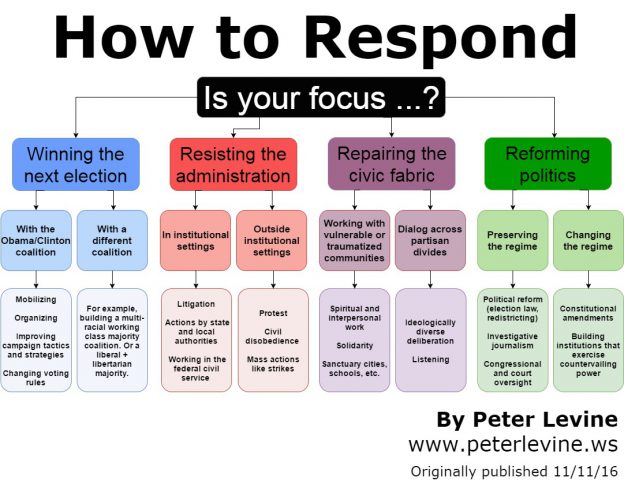
I posted the graphic that accompanies this post immediately after the 2016 election, and it went a bit viral. (Thanks to my colleague Alberto Medina for improving its appearance.) Although the name “Obama” should be changed to “Biden,” and some other minor tweaks might apply, I think the diagram remains pertinent and is perhaps even more urgent today.