global citizenship and justice

Oxfam provides some excellent resources for civic education. Among its products is a guide for schools on “global citizenship” (pdf). This document says:

Oxfam sees the Global Citizen as someone who:

  • is aware of the wider world and has a sense of their own role as a world citizen
  • respects and values diversity
  • has an understanding of how the world works
  • is outraged by social injustice
  • participates in the community at a range of levels, from the local to
    the global
  • is willing to act to make the world a more equitable and sustainable
    place
  • takes responsibility for their actions.

By the way, a Global Citizen (so defined) can also be a good national citizen. But what interests me is the mix of principles on this list, many of which are logically separable. You could value diversity, be outraged by injustice, and take responsibility for your actions, but not think of yourself as a “world citizen” or operate at the global level. Or, if you run a multinational oil company, you could very much take a global perspective, understand how the world works–and even value diversity–but not care a fig for injustice.

In the 1800s, progressive nationalists, like Abraham Lincoln and Charles Dickens, were concerned with profound injustices–slavery and urban poverty–and saw advantages to a strong national consciousness. As I argue here, Dickens thought that British nationalism was a means of enlarging human sympathies, and Lincoln argued that preserving the Union as a democracy would serve human-kind. But other nationalists of the 1800s tried to develop nation-states as a means to wipe out hated minorities and dominate their regions.

Nationalism was a means, not an end. I am inclined to think the same of globalism today.

In the 1800s and early 1900s, political thinkers often romanticized “the people” as a homogeneous and progressive force. Marxists assumed that working people were beginning to share class-consciousness that would prevail in a revolution. Democratic populists assumed that the people would vote for justice if they achieved genuinely equal political power. In fact, the working people of Europe supported slaughtering other working people on the battlefields of World War I and then splintered into left and right.

I fear we risk romanticizing the people of the world in the early 2000s. If they all saw themselves as global citizens and wielded equal power in global forums, that does not mean that they would unite. In Canada, for example, climate change may mean an improved standard of living as the extent of arable land expands and oil and gas reserves become even more valuable. If Canadians (who are already quite cosmopolitan) become more active and influential at the global level, that’s not necessarily good news for Bangladeshis.

All of which is to say that fighting injustice is the important part. Being a global citizen is only desirable to the extent that it promotes justice.
under the Wikipedia hood

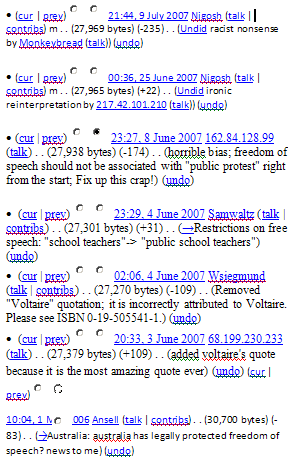
Intrigued by a work of art by Allan Chochinov, I went looking at the Wikipedia entry on “Freedom of Speech” and opened the behind-the-scenes page where you can see all the revisions to that entry. It has been revised 2,551 times, almost once per day, since 2005, by people sitting at 1,142 different computers (or IP addresses, to be precise).

The Freedom of Speech article itself is only about 6,000 words long. It strikes me as a little miscellaneous (frankly), with extensive citations from well-known authorities like J.S. Mill as well as minor figures. Its opening sentence, “Freedom of speech is the political right to communicate one’s ideas via speech,” is actually controversial. (Political right–or moral right? Should you only be free to communicate ideas?)

But what I appreciate most is the large array of obsessive, pseudonymous, multinational, uncivil, unregulated discourse that is collectively generating the 6,000 words about “Freedom of Speech.” Samples:

the changes in voting laws

Craig Newmark has a nice graphic illustrating the rapid changes in state voting laws since 2010, most of which make voting more restrictive. I’ve been thinking about this issue in various ways all week, meeting with key experts in DC on Monday, writing a short op-ed for the Tufts student paper, addressing the issue on a public panel today, and thinking about various forms of useful research we might do during this cycle.

We should worry about the effects of the new photo ID laws and other new restrictions. Perhaps most troubling to me is Florida’s requirement to be licensed before you can register voters; the state also threatens high fines if you don’t submit your lists on time. As a result, a lot of nonpartisan voting organizations are withdrawing from Florida. CIRCLE’s contribution will be some research on the effects of these new policies.

But we shouldn’t allow the new restrictions to occupy our whole attention, because the state laws already varied enormously before 2010. Some were friendly to voting. Election Day Registration is allowed in some dates and has been found to raise youth turnout by some 14 percentage points. Other rules were already very onerous, far more so than in other democracies. As I wrote in my op-ed, “our system is complicated, cumbersome, uneven and easy to tweak for partisan gain.”

It needs a fundamental overhaul, and we should be challenging  basic assumptions. Why, in this day and age, should individuals have to register at all? (There are other ways to verify eligibility.) Why should partisan elected officials get to administer local elections? Why should the voting age be 18?

unhappiness and injustice are different problems

The ancient sources do not specify which specific miseries flew out of Pandora’s box, but I would suggest they came in three groups.

Some forms of suffering happen to human beings because of the kinds of creatures we are. We can postpone death, aging, disease, pain, and fear, but they are inevitable. These are the natural woes. Our very existence requires the death of other people, or else the earth would be too crowded for the living.

Injustices are miseries for which we rightly blame our fellow human beings. What counts as an injustice (as opposed to a natural phenomenon), is a matter of dispute. I would include sins of omission, such as my own failure to help people even though I own superfluous resources. I would include both unjust actions and inequitable states of affairs. Those are controversial claims, but no one doubts that some kinds of injustice exist.

The third category, unhappiness, is a failure to flourish, thrive, enjoy, and achieve equanimity or satisfaction.

These three categories of woe are empirically related. For example, even though death is inevitable, injustice causes millions to die early. It is difficult to be happy if one is suffering from disease and pain, or if one is a victim.

Yet the connections are loose, not logical or inevitable. In a wealthy suburban subdivision where injustice is absent and natural afflictions are normally remote, people may still be miserable to the point of suicide. In a poor village under a repressive government, people may be happier.

Even if injustice does not necessitate unhappiness, it is still an evil, not to be excused. But unhappiness is evidently a separate problem.

We pay far more attention to mitigating or postponing natural afflictions than to fighting injustice–and even less to unhappiness. Also, European and American philosophy since 1800 has much more to say about injustice than about unhappiness.

A just society harnesses science to reduce suffering. Science is also beginning to give attention to positive states of mind, like flourishing and equanimity. That opens the possibility that we could develop new methods of enhancing happiness. But if freedom is also valuable, or is a component or aspect of happiness, then the idea of engineering happiness is disturbing.

Politics is a tool for mitigating natural afflictions and preventing injustice. In liberal democracies, happiness is not seen as a political objective. A government cannot make people happy and may threaten their freedom if it tries.

Some authors (Nietzsche, Emerson) have said something like this: My duty is limited to avoiding injustice. I cannot make other people happy. At best, I can contribute to the happiness of children or partners in intimate relationships. Thus I should concern myself with achieving equanimity for myself and perhaps serve as a model for others.

I can’t accept that such a high degree of self-involvement is either ethically acceptable or compatible with happiness, properly understood. So then the question becomes how to achieve happiness while helping other people to be happy without abridging their freedom.

the real Rosa Parks

(Washington, DC) I have long known that Rosa Parks was not a tired secretary who just decided one day to sit in the front section of the bus because there were no open seats in the back. I knew that the Montgomery bus boycott was a planned and laboriously organized social action; Rosa Parks was a highly trained and experienced activist. Telling the false story has long seemed to me a form of “civic education malpractice”: we are teaching students that reform happens automatically and randomly, when the real story is about skillful, courageous, long-term organizing.

But I didn’t really know the most important story about Rosa Parks until I heard a brilliant presentation in Detroit by Professor Danielle McGuire, author of At The Dark End of the Street: Black Women, Rape, and Resistance–A New History of the Civil Rights Movement from Rosa Parks to the Rise of Black Power. McGuire shows that Parks was already one of the most effective and respected civil rights leaders in the whole South by the 1950s. Specifically, she had focused for almost two decades on white men’s sexual aggression and violence against black women. One of her great battles was the Recy Taylor case. In 1944, a gang of racists had raped Taylor and dropped her in the middle of town; Parks investigated the case on behalf of the NAACP and organized a national publicity effort to get the rapists prosecuted.

Parks’ background is directly relevant to the Montgomery Bus Boycott because the most salient injustice on the buses was not the segregated seating pattern. Most of the black riders were female domestic servants traveling to White neighborhoods to work in private homes where sexual harassment was routine. The drivers, who were white men, armed and deputized as police officers, routinely sexually harassed and sometimes sexually assaulted these African American women on their way to and from work. That injustice was the impetus for the boycott, conducted and organized by female domestic workers.

Making all black people sit in the back of the bus was profoundly unjust, but it’s part of a story that now feels comfortable, which may explain why Rosa Park has become an uncontroversial national icon, featured on stamps, awarded a state funeral, used as the name of avenues and boulevards.

Imagine how difficult it would be to digest and discuss this story: White men rape or sexually humiliate black women. Rosa Parks fights that violence, drawing on militant theories about race and sex (e.g., Marcus Garvey’s black nationalism) to develop her own views. The Montgomery buses are particular sites of sexual violence. Women organize to withdraw their business from the bus system and create their own alternative transportation network. Their boycott is taken over by black male leaders who choose to downplay the sexual aspect of white supremacy so that they can attract wider support for their main agenda, which is to end de jure racial segregation.

Here are some of the uncomfortable aspects of that–real–story: Rosa Parks was angry and radical. Unjust policies changed only because she and others were organized and politically effective. Certain injustices did yield to pressure; we no longer have white sections of public buses. But other injustices remain unacknowledged and have diminished only slightly (if at all): rape is an example. The reform movement began with women working on an explicitly sexual issue. They yielded the stage to men because a different issue (racial segregation in public services) was easier to deal with. Finally, integration, or the mixing of people, is not necessarily beneficial, because the original problem was not separation but the direct exposure of black women to white men. A separate transportation system run by black women for black women–which began during the boycott–may actually have been more just than an integrated public system.