what did young voters know and understand in 2012?

Many people assume that young adults are not prepared to vote knowledgeably. Only 24% of 12th graders scored at the “proficient” level on the most recent National Assessment of Educational Progress (NAEP) in civics. But, as CIRCLE explains in a new fact sheet (one of two that we released today), the NAEP Civics assessment only measures certain kinds of knowledge, and its definition of “proficient” is open to debate. The proficiency level looks like a precise statistical finding but is actually a value judgment.

Therefore, starting on the day after the 2012 Election, we surveyed 4,483 young Americans (ages 18-24), including oversamples of African American and Latino youth. We asked the entire sample whether they had voted (and for whom) and posed some general factual questions about the US political system.

We also asked respondents to choose one issue of particular interest to them. They were then asked to express their own opinion on this issue and to answer two factual questions about where President Obama and Governor Romney stood on the issue. Detailed information is here, but these are some major findings:

  • On some topics, young people were informed. More than three in four young voters could correctly answer at least one out of two factual questions about the candidates’ position on a campaign issue that they had chosen as important. And on many questions about the structure of the US government, they performed as well or better than older adults who have been asked similar questions in other polls.
  • On other topics, most young people were misinformed. For instance, a majority (51.2%) believed that the federal government spends more on foreign aid than on Social Security, when in fact Social Security costs about 20 times more. But again, older adults have also been found to be widely misinformed on the same topics.
  • About one quarter of young voters were poorly informed about the campaign’s issues, and young people who did not vote were generally uninformed.
  • Young people who recalled that they had received high-quality civic education in schools were more likely to vote, to form political opinions, to know campaign issues, and to know general facts about the US political system.That does not mean that civics causes higher turnout and more knowledge, because students who experience better civics may also have other advantages in their schools and communities. But the correlations are very strong and at least demonstrate that active and informed citizens tend to be people who had good civic education. Civics education was not related to partisanship or choice of candidate, and that may allay concerns that civics affects young people’s ideologies.
  • The level of misinformation was almost identical among young Romney supporters and young Obama supporters. But many more Romney voters held positions on issues that they knew contradicted the candidate’s positions. More than one quarter of Romney supporters chose the liberal position on the issue that they considered very important for the country. Even though Romney was defeated among 18-24s by 54.7%-28.1%, according to our poll, he got some of his votes despite his stance on issues.

The survey was funded by the Spencer Foundation, and the accompanying fact sheet was funded by the S.D. Bechtel, Jr. Foundation. Both foundations, along with the W.T. Grant Foundation and the Chicago Community Trust, are supporting CIRCLE’s Commission on Youth Voting and Civic Knowledge, which will consider the data released today as well as other research on the 2012 election in developing its recommendations for how to enhance young people’s informed voting.

(Most of this post is cross-posted from CIRCLE’s site).
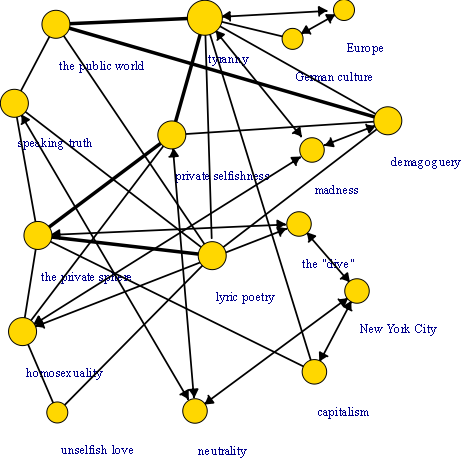
moral network mapping and literary criticism: a methodological proposal

A moral worldview is a set of beliefs or values connected by various kinds of relationships. For instance, one belief may imply another, or may subsume another, or may be in tension with another even though both are truths. If analyzed that way, a whole worldview can be mapped as a network, with the beliefs viewed as nodes, and the relationships as ties.

Using that method, we can map the moral network implied by a work of literature, such as a lyric poem. Previously, I wrote some notes on W.H. Auden’s poem “September 1, 1939” (notes here; full text here.) I then mapped the moral network of that work. I think my first effort was a bit off, so here is a revised map:

What assumptions underlie this method?

1. The moral evaluation of literature is a valid and useful mode of criticism. It is not just about judging the values of the text (pro or con), nor is it merely a matter of elucidating what the author meant or what the text implies about moral issues. It is rather a critical engagement with the moral perspective of the work, a kind of joint investigation into what is really good and right that is informed by both the text and the reader’s critical response. Although I think that remains a rare mode of literary criticism, it has prominent defenders.*

2. Formal network analysis, a branch of graph theory, offers insights about the structure of any system that is composed of objects and relationships. Tools from network analysis, such as calculating the centrality of nodes or the density of relationships, can help to elucidate and assess the moral worldview of a work of literature.

Underlying this premise is a deeper assumption that moral worldviews should not be assessed only (or mainly?) by evaluating the correspondence between their separate ideas and truths about the world. It’s also (or more?) important to ask how the whole worldview hangs together. The question is not whether Auden should be against tyranny, but how that stance fits into his overall thinking. When people argue for assessing a whole worldview instead of individual principles, their next step is usually to look for internal consistency. But consistency is not the main virtue of a well-structured worldview. Better a mentality that incorporates valid and fruitful tensions than one that avoids all inconsistencies at the cost of narrowness or oversimplification.** Network analysis reveals density and other virtues that are more helpful than consistency. (See also “ethical reasoning as a scale-free network.”)

3. Abstract and general principles are overrated. I do not claim that they should be expunged from one’s moral thinking (that would be an over-radical form of “particularism”), but rather that there is no good reason to assume that a well-ordered moral mentality can be arranged like an organizational chart, with the abstract principles at the top and all one’s concrete beliefs and commitments as mere implications. That would be one kind of moral network map, and some people do think that way. Other people are much more concrete, or they mix concrete particularities with abstract generalities in interesting and complex networks. For instance, I think New York City and the “dive” bar where Auden sits in this poem are just as important to his moral vision as tyranny or selfishness.

One reason not to try to make the abstract principles fundamental to one’s whole network is that certain crucial ideas, such as love, will then be distorted. These ideas have the feature that they are sometimes good and sometimes bad, depending on the circumstances. If you try to organize your thinking around abstract and general principles, you will be compelled to divide love into the good and bad kinds, and that is false to the experience of what love is.***

Turning the map above back into a written analysis of “Sept 1, 1939” would take some space, but I think a few key points emerge:

  • Auden has a dense moral network, not dependent on just one or two ideas. It’s robust. For instance, he later came to hate the line, “We must love one another or die.” But the poem does not rest on that.
  • Love, art, and politics are densely interconnected.
  • Homosexuality is not mentioned in the poem but is alluded to at least twice. It is hard to know whether Auden would connect it to “unselfish love.” I would. So I am either in disagreement with the poem or sympathetic with Auden (a gay man in the 1930s) because he could not draw that connection openly.
  • Much depends on a polarity between public and private, but poetry occupies an uneasy space between. Consider declamatory statements like this: “There is no such thing as the State /  And no one exists alone.” Are they incursions of public demagoguery into a poem, which should be private? Or should the poem speak truth to power?

*See David Parker, Ethics, Theory and the Novel (Cambridge: Cambridge University Press, 1994); Todd F. Davis and Kenneth Womack, Mapping the Ethical Turn: A Reader in Ethics, Culture, and Literary Theory (Charlottesville, University Press of Virginia, 2001), Amanda Anderson, The Way We Argue Now: A Study in the Cultures of Theory (Princeton, 2006)

** Simon Blackburn, “Securing the Nots,” in W. Sinnott-Armstrong and M Timmons, eds., Moral Knowledge (New York, Oxford University Press, 1996), p. 95

*** This is basically my thesis in Reforming the Humanities: Literature and Ethics from Dante through Modern Times (Palgrave Macmillan, December 2009).

Gerald Taylor on property, populism, and democracy

The entire last issue of The Good Society is devoted to populism. It offers a powerful positive appraisal, building on the important scholarship of the last quarter century. The scope of the special issue is global, but I came away with a reinforced sense that American populism is a distinguished tradition of its own. In 1906, the German sociologist Werner Sombart wrote a book with the title Why is there No Socialism in the United States? This is not a dumb question, but if it is our only question, it presumes that the political spectrum must always run from socialism to laissez-faire. That is the European scheme. Well before Sombart wrote, a different orientation had developed in the US, and the radical end of our spectrum has serious merit.

One of the articles that supports that view is Gerald Taylor’s “Prometheus Unbound: Populism, The Property Question, and Social Invention.” Taylor is Southeast Regional Director of the Industrial Areas Foundation, the great community-organizing network, and this article is a brilliant scholarly contribution by someone who doesn’t happen to make his living as a professor. Instead, he is an intellectual leader of a populist organization.

Taylor offers this account of populism, which makes it incompatible with European socialism:

A property-owning consciousness is centered in an understanding by citizen workers, artisans, and farmers that in order to be free of employers, landlords, creditors, and possibly the organs of state power, one must assemble and own enough productive assets to guarantee liberty and independence. The means by which citizens attempted to accomplish this freedom included both individual and collective acts and instruments. Thus, workers and farmers joined together to negotiate better terms with purchasing agents, and employers that could yield them enough income and resources to allow their individual households to assemble productive assets to become “free.”

Hannah Arendt weaves a similar argument through The Human Condition (1958), claiming that private property is a precondition for participation in a democracy. “What is important to the public realm … is not the more or less enterprising spirit of private businessmen but the fences around the homes and gardens of citizens” (p. 72). To have standing in public, you don’t need the right to accumulate as much wealth as possible, but you do need a private space that you alone control.

At first, the invocation of property as a source of liberty sounds most compatible with markets and neoliberalism. But Taylor shows that Americans have long used collective grassroots power and social reform to spread private property. In the first 50 years of our republic, Congress passed 375 “land laws” that were mainly about distributing real property to citizens. Left out were Black people, 97% of whom were slaves in 1860–and only 11% of the free Blacks then owned land. After Reconstruction, the proportion of Black Americans who owned land fell again because of discriminatory legislation and anti-Black terrorism. But Blacks organized popular movements in response:

Ex-slaves clearly understood that in a predominantly agrarian society, ownership of land (productive property) would be central to their struggle for independence from white domination. There was a deep property owning consciousness among the freed persons of color, who had long nurtured a vision of the “promised land,” predicated on independence. Thus freed slaves sought in a myriad of ways to gain ownership of land. …

The elements of the movement varied over time but eventually coalesced and reached its pinnacle of organizing in the formation of the Colored Farmers Alliance in 1886. At the peak of its organizing, it is estimated that between two hundred fifty thousand and one million African Americans were members of the Alliance. …

Taylor spells out the violence and effectiveness of White opposition and the defeat of some Black strategies, such as a failed general strike of agricultural workers. Yet:

Through new individual and collective strategies and policies, some initiated during the black populist movement itself, black land ownership increased to over 13 million acres in the United States by the mid 1900’s. The new seeds of the next phase in the black freedom struggle were planted.

The next stage was the rise of Black “knowledge artisans,” lawyers, doctors and others, who used their own property and skills to launch the Civil Rights Movement.

After that, the story turns for the worse. Now we live in a time when everyone pays homage to property consciousness, but that means giving people completely individual opportunities that also bring high risk:

Everyone can have their own unmediated relationship with their employer, their stock portfolio, and their credit card. Anyone can start a business if they have the courage to take risk. The individual, in an Ownership Society, is able to independently negotiate contracts with corporate entities and hold them “accountable.”

The subprime loan crisis epitomizes the result: individuals borrow to buy homes in exurban developments that lose their value in the recession, leaving their families bankrupt and isolated and their former property abandoned.

The authentic populist response–which has roots in Colonial times and has informed groups like the Colored Farmers Alliance–is collective action to protect genuine and secure property for all. Because it is a movement for property, it is not socialism; and because it is a collective movement, it is not neoliberalism. See also Community-Wealth.org for some 21st century strategies.

what a libertarian commune says about political socialization and freedom

The Citadel will be a community of 3,500-7,000 families, surrounded by walls and towers amid Idaho’s mountains. Its organizers say it will be devoted to “Our proud history of Liberty as defined by our Founding Fathers.” The “patriotic Americans” who choose to live there will pledge to own, bear, and train in the use of firearms. It’s optional to move there, of course, but “Marxists, Socialists, Liberals, and Establishment Republicans may find that living within our Citadel Community is incompatible with their existing ideology and preferred lifestyles.” This comes on the same day that the Dallas Observer reports, “Glenn Beck is Planning a $2 Billion Libertarian Commune in Texas.”

Conor Friedersdorf, who’s an excellent, libertarian-leaning writer, thinks that Americans have the right to create such communities, whether “made up of extreme gun enthusiasts or hippies or Scientologists or Trappist monks.” But he denies that The Citadel would embody libertarian values. Real freedom is compatible with, and generates, pluralism. If you want to see a libertarian community, Friedersdorf says, look not to The Citadel but to LA County, with its

happy residents from most nations on earth; people of most every ideology; mountain and desert and city and rural people; the religious and secular; and parents whose kids are different kinds of people than they are, but live close by because all kinds of people are happy here, except perhaps the types that feel impelled to order the lives of everyone around them to correspond to their own preferred lifestyles.

I think this opens a deep and serious point. Our beliefs, values, and identities are profoundly shaped by our parents and other formative influences. Even if we rebel (as many people do) we still structure our thoughts in response to our parents and other influences from our childhood.

As Americans are raised today, they do not turn out libertarians. Less than one percent voted for the Libertarian Party, and on policy questions, most libertarian positions do not poll well. Libertarians might like to think that the state uses the public schools to brainwash kids, but the evidence suggests schools have very limited influence on ideology.* Also, schools are not mere arms of the state; they are assemblages of teachers who reflect the values in their communities and have some latitude to present politics as they see it. If young people are being raised to be non-libertarians, that is not the state’s doing; it is the people’s.

So what is to be done, from a libertarian perspective? You can secede from the corrupt, liberty-forgetting society around you and raise your kids in a setting where they will turn out to be libertarians (unless they rebel against you and define themselves as anti-libertarians, but even then you will have shaped them). If you succeed, you will have forced them to be free.

That is obviously a contradiction. It points to a deeper problem about freedom. Individual liberty is a high principle, not to be neglected or negotiated. But the liberty of embodied, evolved, social animals like homo sapiens cannot be defined in a way that ignores the overwhelming influence of parents and communities on individuals. We are what our predecessors make us.

The best classical thinkers on liberty, people like J.S. Mill and Alexis de Tocqueville, recognized that peer pressure, parental influence, and majority opinion were threats to freedom–probably worse dangers than the state is, if the state is limited by law and popular votes. There is no such thing as a neutral setting for growing up; Los Angeles may be more pluralist than The Citadel, but both teach their own implicit lessons. But LA broadens the mind more than The Citadel will by offering a greater variety of lifestyles and perspectives. Friedersdorf is right to see the advantages for freedom.

*E.g., Yates and Youniss find that a powerful dose of Catholic social doctrine does not convert predominantly Protestant African American students, but provokes them to reflect on their own values. McDevitt and colleagues (in a series of papers including this one) find that political debates in school stimulate critical discussions in the home. Colby et al. find that interactive political courses at the college level, although taught by liberal professors, do not move the students in a liberal direction but deepen their understanding of diverse perspectives. Evidence of the effects of college climates is ambiguous because of students’ self-selection into friendly environments.

(See also “schools’ role in enhancing liberty,” “why libertarians need a theory of political socialization,”and David Friedman on education.”)

public speaking this winter

Just in case anyone can attend or wants to spread the word, I will be making the following public presentations during the next three months:

Jan. 24, Seventh Annual Summit of the Overseas Vote Foundation and U.S. Vote Foundation, “Featured Keynote: The Effect of Policy on the Youth Vote.” At George Washington University, Washington, DC.

Jan. 25, “Using Evidence to Promote Engaged Learning and Student Well-being,” panel at the American Association of Colleges and Universities annual conference, in Atlanta, GA

Feb. 9, 5th Annual Rhode Island Student Summit: “Re-Imagining Citizenship” (keynote speech), Providence, RI

Feb. 12, North Carolina Campus Compact Civic Engagement Institute, opening plenary and workshop, Elon University (NC)

Feb. 13, PACE (Pathways to Achieving Civic Engagement) conference, opening plenary, Elon University (NC)

Feb. 19 and Feb. 20, informational dinner meetings for the California Democracy School Civic Learning Initiative (featured speaker on both nights), Pasadena, CA

April 3, YMCA of the USA National Leadership Symposium (keynote), Claremont, CA