games, digital badges, and alternative assessments in civics

Badges are portable credentials that demonstrate that someone possesses a specific skill. They differ from diplomas, which signify the completion of a whole course of study. Critics worry that adopting badges widely would undermine the holistic value of a traditional degree, which is supposed to stand for more than the sum of its parts. That’s a valid concern, but I see huge advantages to badging for civics. For one thing, civics is now very poorly served by curricular mandates and tests; at best, students are required to learn and demonstrate very low-level, individual academic knowledge, rather than the interactive skills we need from citizens. But adding more elaborate assessments would just put new burdens on students and schools. Meanwhile, some young people do obtain advanced civic skills; but without specialized qualifications, they can’t demonstrate their abilities to college admissions officers, prospective employers, or citizens’ groups that might be looking for leaders.

To explore the pros and cons, CIRCLE’s Felicia Sullivan has written “New and Alternative Assessments, Digital Badges, and Civics: An Overview of Emerging Themes and Promising Directions” (published yesterday). She’s also produced a Prezi presentation to summarize the key themes:

(See also “the movement to badges in education, and what it means for democracy,” “badges for civic skills,” “the controversy over badges,” and Peter Levine, “Education for Civil Society,” in David Campbell, Meira Levinson, and Frederick M. Hess [eds.], Civics 2.0: Citizenship Education for a New Generation [Cambridge, MA: Harvard Education Press, 2012], pp. 37-56.)

new information on youth voting in 2012

For national stats on the 2012 youth turnout, CIRCLE is a good place to start. But here are two important specialized studies by colleagues:

1. The California Civic Engagement Project at UC Davis finds “dramatic disparities in voter turnout rates” in their state. In particular, they say, “California counties with the lowest eligible youth turnout are geographically clustered together, creating regional patterns of underrepresentation for youth.” The regions with the lowest turnout (the San Joaquin Valley, Los Angeles and the Northstate) also have the highest poverty and high school dropout rates in California. In a separate brief that focuses on the state’s new online voter registration system, CCEP shows that 18-24-year olds represented 30% of the online registrants; and “seventy percent of  young people who “registered online turned out to vote–25 percentage points higher” than the rate for those who did not register online. By itself, that doesn’t show that online registration increases voting (nor does CCEP claim it does), but it at least suggests that an online system is attractive to young people.

2. The Fair Elections Network’s Campus Vote Project has issued a report summarizing the state of election laws that might restrict student voting as of November 2012, along with the various efforts that they and others made to push back on these laws or to help students overcome barriers. For example, “schools in the University of Wisconsin system and private universities in the state took extraordinary measures to distribute newly required ID documents before the law was ultimately struck down in state court.” It may because of efforts like these that it’s hard to detect the effects of the new laws on aggregate youth turnout rates:


a social media war room for civic renewal

Big companies track mentions of their brands and products in social media and interject rebuttals or enthusiastic responses that lead consumers to buy their stuff. Upwell is a great organization that uses exactly the same techniques to promote its “client”–the ocean. Although supported by philanthropy, Upwell works for the ecosystems of the seas. For instance, when National Shark Week caused a lot of chatter about sharks, Upwell confirmed that most of the tweeters liked sharks and interjected information about conservation efforts, organizations, and legislation. Below is a cute illustration of their methods from their site, but they use a lot harder data than this.

We need an Upwell for civic renewal. Some smart young people should spend all their time in a war room, reading Tweets, Facebook posts, and other social media and identifying topics and events that connect to civic themes. They should work on behalf of a whole array of civic organizations–the kind I mapped here–and insert suggestions to join the most relevant groups, to support reform legislation, or to connect with people of like mind.

See also a video of me describing civic renewal and posts on “political reform on a base of civic renewal,””the folklore of communications and messaging,” and “against ‘messaging.’

six-ten

I am not forty-six. It’s not six-ten.
I have no appointments and no inbox.
I am just a head pinned to a pillow,
An eye watching the shade turn from black
To a grey rectangle with pale white rims,
The same shape an infant would see before
It cried, or an old man on his last bed,
Or a cat on its side with its legs stretched.
The clock ticks until it buzzes, but while
It ticks, it ticks, and I am just a head.

the limits of putting yourself in their shoes and looking with their eyes

Yesterday in Jerusalem, the president told the story of Israel, much as mainstream Israelis understand it, and then asked his audience to see the Palestinians’ side of the story. Those passages in his speech drew applause. I used to think that the ability to see the other side was an unambiguous moral gain that would increase the chance of peace–because, as Obama said yesterday, “peace begins, not just in the plans of leaders, but in the hearts of people; not just in some carefully designed process, but in the daily connections, that sense of empathy that takes place among those who live together.”

But this is what I experienced last summer in Israel and the West Bank that complicated that assumption for me. Senior members of the Israeli establishment–diplomats, politicians, and officers in the IDF (up to Lieutenant General rank)–are all excellent at explaining “the Palestinian narrative.” They are quick to tell you that Israelis and Palestinians are two wounded peoples, with the Holocaust on one side and Al-Nakba (the Palestinian Catastrophe of 1948) on the other. They express views much like Obama’s on Thursday:

It is not fair that a Palestinian child cannot grow up in a state of their own — (cheers, applause) — living their entire lives with the presence of a foreign army that controls the movements, not just of those young people but their parents, their grandparents, every single day.
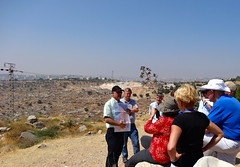
DSC00126

Me and others being shown the “Security Barrier” by the IDF Colonel who chose the locations.


They will say this kind of thing in plain sight of the security fence (a.k.a. West Bank barrier) that they have built to separate themselves from Palestinian neighborhoods–choosing where it lies and who can cross it, and governing both sides.

I am convinced that they do not merely repeat but actually believe in their hearts the kinds of sentiments to which the President called them in this part of his speech:

But I — I’m going off script here for a second, but before I — before I came here, I — I met with a — a group of young Palestinians from the age of 15 to 22. And talking to them, they weren’t that different from my daughters. They weren’t that different from your daughters or sons.

I honestly believe that if — if any Israeli parent sat down with those kids, they’d say, I want these kids to succeed. (Applause.) I want them to prosper. I want them to have opportunities just like my kids do. (Applause.) I believe that’s what Israeli parents would want for these kids if they had a chance to listen to them and talk to them. (Cheers, applause.) I believe that. (Cheers, applause.)

They cheered Obama in Jerusalem, and last summer I observed a moving encounter between an Israeli intelligence officer and a Palestinian businesswoman–mother to mother, wishing each other the best. I think this kind of recognition has grown over time. Mrs. Netanyahu summarized the old popular view when she claimed, “When the Jews came to this area, there were no Arabs here. They came to find work when we built cities. There was nothing here before that.” That is not PC any more; now the kinds of people I talked to know all about the Palestinians under Turkish and British rule and what they lost in ’48.

But … that doesn’t lead to action. You can be sincerely empathetic but not willing to do anything to remedy a situation in which you are complicit. Americans are like that every day. To name a timely example, we were involved in killing between 150,000 and 1 million Iraqis over the past ten years, and not many of us did anything to stop that. Detroit now encompasses a contiguous abandoned urban area larger than Manhattan, and not many Americans lift a finger. I am not equating Iraq, the West Bank, and Detroit–merely noting that empathy doesn’t often cause action.

But I worry about something worse. Being able to express empathy, even if it is perfectly sincere, makes one feel better and also wins the trust of third parties. I was disarmed hearing Israeli leaders tell me the “Palestinian narrative.” When an Israeli settler leader failed to acknowledge the Palestinian perspective, he lost me completely. When the Fatah representatives whom we met in Ramallah refused to acknowledge that Israelis believe they have a historic link to the land, I marked them down a notch in my own mental estimation, thinking they were narrow-minded.

This means that empathy not only fails to produce justice; it can be an asset in an unjust conflict. In the Israeli case, empathy is the kind of asset that comes from being fairly secure day to day and from having a wealthy, highly educated, cosmopolitan population. Israelis recently voted on the basis of the kinds of consumer-oriented, domestic issues that usually move US voters; peace was a side issue, just as it was in the US in 2o12. The Tel Aviv real estate market is booming. Its citizens can afford to hope that Palestinian kids succeed. But will they let them?