a translation for spring

Dante sought his last refuge in Ravenna at the invitation of Count Guido Novello da Polenta (?-1320). According to Boccaccio, Guido was a person “well tutored in liberal studies” who honored “worthy men and especially those who exceeded others in knowledge.” Dante served Guido in various important capacities, including possibly as professor of rhetoric. He died as a member of the count’s household, having just completed a crucial diplomatic mission to Venice on Ravenna’s behalf. Guido organized a solemn funeral for Dante and had the poet buried in a classical sarcophagus in the local monastery of San Francesco.

Dante chose Guido’s own aunt, Francesca da Rimini, as a major character in the Inferno. Romantic-era critics saw Francesca as a doomed heroine, suffering because her love had violated arbitrary conventions and oppressive rules. I argue (along with several modern critics) that she is supposed to be a real sinner. Dante has placed her in hell because she deserves her punishment for adultery, and besides, she doesn’t really love Paolo, whom she describes with a pastiche of slight misquotations taken from love poetry. She is a 14th-century Madame Bovary, in love with the literary concept of love, not with the individual man.

But back to Guido: Intriguingly, he wrote a minor poem that contains a striking phrase that Francesca also utters (almost verbatim) in her last lines to Dante in hell. Either Guido borrowed the phrase that was spoken by his own dead-and-damned aunt in Dante’s already-famous poem, or else Dante read Guido’s poem before he wrote the Inferno and had Francesca quote it. Since almost everything else Francesca says in the Divine Comedy is a slight misquotation, I am inclined to think the latter is true: Dante took a line from his friend’s naive ingenuous sonnet and assigned it to a sinner in hell.

I make no great claims for Guido’s poem, and less for my translation, but I offer it today because the Boston weather reminded me of it. It’s in my Dante book, pp. 17-18:

The air was serene and the sky was clear
And the birds by the river sang.
That day was the first that felt like spring
When I saw you, my joy, so fair.
Your face wore an unaccustomed blush
That never leaves my thoughts today
And whenever I travel far away
Your pleasing smile seems to rush,
Gently launched toward my heart
By the look that comes to your pretty eyes,
And the smile that so sweetly flies
To blend with mine and never part.
Now she can never be torn away;
Joy shall spare me from misery.

Era l’aer sereno e lo bel tempo
et cantavan gli augei per la rivera
et in quel giorno apparve primavera
qand’io te vidi prima, bella gioia.
Ben fosti gioia, chè tal m’apparisti
e col novo color nel tuo bel viso
che già da la mia mente non se parte.
E quando sono in più lontana parte
più mi sovvien del tuo piacente riso.
Sì dolcemente nel mio cor venisti
per un soave sguardo che facesti
dal tuoi begli occhi, che mi mirar fiso
sì che già mai da te non fia diviso,
tanta allegrezza mi dà fuor di noia.

(cf. “che non mai da me no fia diviso”: Inferno v, 133-5).
putting facts, values, and strategies together: the case of the Human Development Index

Amartya Sen, the Nobel laureate economist and philosopher who spoke recently at Tufts, helped design the Human Development Index, which ranks all countries on a single list based on life expectancy at birth, years of schooling, and gross national income per capita. Sen seemed a bit chagrined that he is famous for this. The work took him only a few hours, he said. The formula was extremely simple. He called it a “vulgar index,” because it lumps together diverse variables in a potentially misleading way. He said that he agreed to do it mainly at the urging of his very old friend Mahbub-ul-Haq, who believed that an ordinal ranking for all nations would win media attention and help to undermine the tyranny of GNP growth, too often treated as the only measure of development. Mahbub-ul-Haq was correct, because the HDI gets global attention and has even been a central issue in some countries’ election campaigns. A set of separate indicators wouldn’t get much notice.

In my own small way, I have tried to do something similar by creating the Index of National Civic Health (INCH) for the National Commission on Civic Renewal in the 1990s, which led to the Civic Health Index, which continues today. Our idea was to challenge the dominance of economic growth by adding a measure of civic engagement that could also be tracked. Like the HDI, it was a “vulgar” measure, designed for subversive purposes–or, to put our objective more positively, to provoke a good discussion.

One interpretation of such efforts would go like this: There are facts about the world. A full picture of the world would be very complicated, but we can strive for it. Once we have “the data,” we can choose what to emphasize and whether to use positive or negative adjectives to describe reality. That is a matter of imposing values, opinions, or preferences on the data. Finally, once we have an informed opinion about what to do, we can try to change the world by persuading other people to agree with us. Creating an index is an example of a rhetorical tactic that may prove persuasive. This, then, is the “positivistic” model:

facts > interpreted by opinions > transmitted by strategies > changes in the world

I assume Sen would reject this model. He knows that one can reason about values as well as data, so selecting and morally evaluating information is not just a matter of imposing subjective preferences or opinions on reality. For instance, it is right to see an increase in lifespan as a good thing (all else being equal). Further, what we call “data” is always imbued with norms. Education, for example, is a component of HDI–but what is education? Years spent in school looks like a hard number, but no one believes it’s worth measuring unless it is a proxy for education, rightly understood. In fact, you can’t even tell what counts as “school” without some basic value-judgments. Defining education requires a moral theory of the human good.

Sen knows all of the above, and I interpret his model like this:

reasoning about facts and values (taken together) >> transmitted by strategies >> changes in the world

For instance, Sen reasoned for a long time about human development–a rich and complicated topic–before Mahbub-ul-Haq gave him a strategy to influence the public debate: generating a “vulgar index.” The index changed the world, at least modestly.

I would push the critique of positivism further. A moral theory is no good unless it has beneficial strategic consequences. We can announce that everyone should be equal, but unless we have a plan for making everyone more equal without producing a tyranny or chaos, that statement is worse than no theory at all. Further, the information and ideas (including moral ideas) with which we reason come from somewhere. They are produced by people and institutions. By communicating strategically, we influence the process that produces the data and arguments with which we reason. Thus I would connect all of the following with two-headed arrows: facts, values, and strategies. And I think people in influential positions, like Amartya Sen, should be held accountable for having good strategies, not just good values and data.

(see also Why political recommendations often disappoint: an argument for reflexive social science, Is all truth scientific truth?, Bent Flyvbjerg and social science as phronesis, A real alternative to ideal theory on philosophy and Abe Lincoln the surveyor, or the essential role of strategy)

the most important thing citizens should know

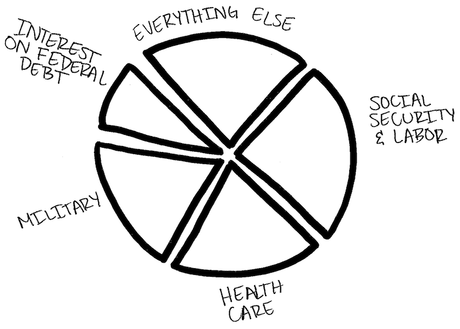
If I had to pick one thing that a citizen of the USA should know, it would be the allocation of money in the federal budget. A simple pie chart is shown below. It’s a static image from the National Priorities Project‘s website, which is rich with interactive graphs and even provides a “Build a Better Budget” simulation. Along with the pie chart, another critical graph shows the basic historical trends over recent decades.

The NPP is helping with public education, but the problem is serious. Right after the election, we asked almost 4,500 young adults, “Does the government spend more on Social Security or foreign aid?” The right answer is Social Security (by a ratio of about 26:1, if we define “aid” as economic assistance, or about 20:1, if we include military assistance). A majority (51.3%) of the young adults chose the wrong answer–foreign aid–and just 29% got the question right.

This is not a youth problem only. In 2011, CNN and the Opinion Research Corporation asked adults how much of the budget the federal government allocates to various programs. The median estimate was 20% for Social Security (which is close to the correct proportion), but 10% for foreign aid (which is far too high).

It’s hard to have a debate about what should happen if people don’t understand what is happening. We don’t teach this kind of material in schools, the mass media don’t explain it regularly or helpfully, and politicians have incentives to obfuscate.

there is a state constitutional right to public deliberation

(Chicago) “The people have a right, in an orderly and peaceable manner, to assemble to consult upon the common good; give instructions to their representatives, and to request of the legislative body, by the way of addresses, petitions, or remonstrances, redress of the wrongs done them, and of the grievances they suffer.” — Constitution of the Commonwealth of Massachusetts, Art. XIX (1780)

Todd Gitlin, who spoke at Tufts on Wednesday, said that provisions like this one exist in about 30 states. It is the phrase “to consult upon the common good” that interests me (and Gitlin). It is different from a right to speak; in consulting upon the common good, one must also listen to peers in some structured way. These provisions testify to a deep tradition of public deliberation in American ideals and practices. And perhaps they create enforceable rights. When local authorities decided to clear “Occupy” encampments, did anyone ask whether the participants were being denied their rights under state constitutions to “assemble to consult upon the common good”?

what to do about k-12 civic education

(Chicago) These are my remarks for tonight’s Illinois Civic Mission Coalition “Annual Convening.” 

When Americans turn their attention to civic education in k-12 schools, very frequently they make the following claims:

  1. Kids today don’t know anything about government and civics!
  2. Kids today don’t vote!
  3. Schools today don’t teach civics the way they used to when I was a kid. What happened to civics classes!?

A couple of additional assumptions are buried under those claims. Civics is seen as the name of a course in high school, rather than a broader set of opportunities. And success in that course is defined as knowing some information (the kind that we test) and acting in particular ways, above all, by voting

I see the political value of this argument—it is easy for people to grasp, it fits into their preconceived ideas that civics is in decline, and it grabs attention. When the United States Department of Education released the 2011 National Assessment in Education Progress (NAEP) Civics results, the New York Times story was entitled “Failing Grades on Civics Exam Called a ‘Crisis.’”  The story began, “Fewer than half of American eighth graders knew the purpose of the Bill of Rights.”

Maybe getting that story was a win for the civics field.

But I want to complicate matters a bit. All the claims I started with are at least a bit inaccurate and misleading—just as factual matters. From a strategic point of view, they are problematic, too. Since they present the wrong diagnosis, they naturally lead to the wrong cure. Adults are liable to say: Let’s require a year of civics in high school and test kids on the US Constitution! But that is not a good reform plan, as I’ll explain.

Continue reading