three upcoming talks

Here are three speeches or lectures I’ll be giving soon:

“The Moral Core of Citizenship: Deliberation plus Collaboration and Civic Relationships.”
April 26, 2013, 12:00-5:00, Miner 224, Tufts University (Medford, MA)
Part of day-long symposium on “Philosophy and Civic Engagement” sponsored by the Jonathan M. Tisch College of Citizenship & Public Service and the Tufts Philosophy Department. The other two speakers are Anthony Laden (University of Illinois at Chicago), whose subject is “Taking the Engagement in Civic Engagement Seriously,” and Meira Levinson (Harvard University), who will discuss “Redefining Civic Action.” More information here.

“How Can Engagement Drive Economic Growth?”
Social Capital Inc.’s Social Capital Forum: “How Can Engagement Drive Economic Growth?” (with a special guest appearance by Somerville, MA Mayor Joe Curtatone)
Boston, MA, Friday, May 3, 2013 from 8:00 AM to 10:30 AM (EDT)
Register here.

Plenary Session: “A Defense of Higher Education and its Civic Mission”
American Democracy Project National Meeting
Denver, CO, Friday, June 7, 2013, 9 a.m. – 10:30 a.m.

Although I won’t literally read from the manuscript, these are three chips off the big block of my forthcoming book, We are the Ones We Have Been Waiting For: The Promise of Civic Renewal in America, Oxford University Press (fall 2013).

does workplace stress lower civic engagement?

The Los Angeles Times’ Alana Semuels reports, “The relentless drive for efficiency at U.S. companies has created a new harshness in the workplace. In their zeal to make sure that not a minute of time is wasted, companies are imposing rigorous performance quotas, forcing many people to put in extra hours, paid or not. Video cameras and software keep tabs on worker performance, tracking their computer keystrokes and the time spent on each customer service call.”

In a companion piece, she argues that the rising stress and longer hours also push down community engagement. She quotes me:

Political engagement often declines when the workplace is a harsher place. Unions were once a driving force behind civic engagement at work, said Peter Levine, director of the Center for Information & Research on Civic Learning and Engagement at Tufts University. Now that they’re such a small part of the private workforce, there’s no one at work encouraging employees to go out and vote, he said.

When people don’t like their jobs, or feel stressed at them, they’re also not predisposed to volunteer in the community, give blood, or participate in food drives organized through their employer (if, indeed, their employer still organizes food or blood drives or community activities).

“If they don’t like their employer, it’s not going to be a path to engagement,” he said.

I think the key issue here is the quality of work and the degree to which the employer empowers its workers (or they organize against the company). The sheer number of hours of work is less important.

In Bowling Alone (2000, p. 202) Robert Putnam argued that working more did indeed reduce hours spent on civic activities–but not by much. He estimated that rising economic pressures and the voluntary entry of women into the workforce had accounted for “less than one tenth of the total decline” of civic engagement that he found from 1970-2000.

Of course, Bowling Alone measured unpaid, after-hours work. If we’re fortunate, our paid work can serve public and democratic purposes, even if our employer is a for-profit corporation.

Besides, employment can raise civic and political engagement outside of work. We can be recruited at work and can find peers with similar needs and concerns. Skills that we acquire at work may translate into the civic and political domains. And just getting out of the house can give a person momentum. An old maxim says that if you want something done, you should ask a busy person. That could be because some people are just energetic and effective (a psychological explanation), or because busy people obtain networks and resources that make action rewarding and effective.

One would think that attending college while working substantial hours per week would force individuals out of civic life. However, in “The Political Participation of College Students, Working Students and Working Youth” (CIRCLE Working Paper 37, 2005), Sharon E. Jarvis, Lisa Montoya & Emily Mulvoy find that “student workers report higher levels of political interest, political skills, political mobilization and political participation than their college student and working youth peers.”

Having said all that, I think Semuels is onto an important story about the suppressive effects of work today. It’s not so much the longer hours as the lack of workers’ organizations, the fragmentation of the workforce, the weakening civic mission of many firms and organizations, and the atmosphere of surveillance that likely reduces civic and political participation.

Semuels writes, “Civic engagement has been proved to help people flourish, Levine said. They develop skills that help them at work, they’re less depressed and they live longer, he said.” Work that involves public problem-solving can therefore be good for the worker as well as the society. When work lacks a public dimension, unpaid civic engagement can be a partial antidote, giving the worker a sense of purpose and value (and also imparting skills and network ties that can lead to better careers). But if a job suppresses civic participation outside of work, then the negative psychological impact may compound. It will then be even harder for a person to get engaged in order to improve her community, her work environment, and her personal well-being.

See also: soft skills for the 21st century workplace: empowered teamwork or emotional labor?
remembering Thatcher

Opposition MP: If the Rt. Honourable Prime Minister had spent 20 years on Robben Island —
Opposition backbencher: As she SHOULD!
(Jeers, cheers)
Speaker: Order! Order!

That’s a snippet from a parliamentary debate on South Africa ca. 1990, as I recall it. By then, I was a graduate student living in England, and Margaret Thatcher was soon to be deposed by her own party; the country was tired of her. Eleven years earlier, I had been a schoolboy in London. It was then the Winter of Discontent, with whole sectors on strike, more than 1 million non-striking workers temporarily laid off because of disruptions in the supply chain, inflation at 13.4%, the National Front calling for “repatriation for all coloured immigrants,” the IRA embarked on its “Long War” strategy, and even nature contributing blizzards. My family was against Thatcher–and rightly so–but a change in her direction felt inevitable.

Her rise and fall framed my own adolescence and early adulthood and was probably formative for me, not in the sense that I agree with her, but because she set the terms of the debate. From 1980-1992, I moved back and forth across the Atlantic and watched in freeze-frame action as two countries experimented with Thatcherite reforms.

Overall, I share the Guardian‘s appraisal:

Much was wrong with the Britain she inherited in 1979, undemocratic union power among them, and many things, though not wrong in themselves, were unsustainable without radical change, including some nationalised utilities. Britain would have had to alter radically in the 1980s and 90s, and the process would have been hard and controversial. But, as Germany and other northern nations have shown, economic dynamism has been possible without the squandering of social cohesion that Mrs Thatcher promoted.

The first quoted sentence is important. I have nothing in principle against strong unions and a social welfare state, but nations must engage their people in building a just and good society. When the British first constructed the National Health Service, high-rise public housing, and other aspects of their post-War welfare state, many could feel that they were engaged in a constructive project. By 1979, I don’t think anyone really believed that the British public sector was improving or that citizens could use it for idealistic purposes. The general feeling that I recall was pessimistic and deeply zero-sum. The best case that could be made for the welfare state was Burkean: it existed, people were accustomed to it, and Thatcherite reforms were radical and untested. As I have argued before, the parties of the left have been deeply conservative (in the Burkean sense) since about 1970.

Thatcher saw the need and opportunity to change, and I would acknowledge that she gave quite a few Britons the sense that they could build something valuable together (through the market rather than the state). But she changed the country too much, too fast, too much from the top and the center, with too little attention to social cohesion, equity, agreement, and sustainability. Again, to echo the Guardian, “There can certainly be no going back to the failed postwar past with which Margaret Thatcher had to wrestle. But there should be no going back to her own failed answer either.”

taxing the college vote in North Carolina

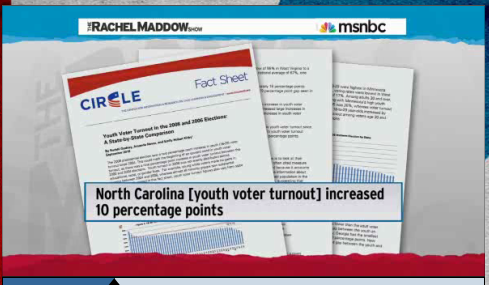
MaddowHere is a CIRCLE Fact Sheet, as prominently displayed on Rachel Maddow’s MSNBC show (April 4). She is reporting on pending bills in North Carolina that would require the parents of  students enrolled in the state to pay a state tax if their children opt to vote in their college town instead of at home.

Specifically, North Carolina residents would lose the dependency deduction of up to $2,500 per dependent if the child chose to register at her college address. I am sure the sponsors would argue–and perhaps believe–that the bill is fair because a student who chooses to vote away from home is not a dependent. I have argued that the decision about where to vote is indeed a weighty one; students should not simply choose the address where their vote will count more. Deciding to register in a given place is an expression of citizenship there that comes with responsibilities.

However, from a legal perspective, the Supreme Court has found that students have a right to register at college.* Choosing to register at college can be the most civic decision and does not imply that one is financially independent.

Considering that Mitt Romney won North Carolina by two points, but lost the 18-24 vote in the state by more than two-to-one (67%-31%), it is worth asking why the Republican legislature would raise taxes on these young people’s parents. Maddow simply describes the bill as a “tax hike” intended to “curb the college vote in North Carolina, to lower college turnout.” This legislation bears the Orwellian title of “Equalize Voter Rights.”

*See Symm v. U.S – 439 U.S. 1105 (1979), but the majority summarily affirmed a Texas District Court decision, so the Supreme Court provided no legal or theoretical basis for the conclusion that voting in one’s college town is a constitutional right.

the generational politics of Turgenev’s Fathers and Sons

Novels of multiple generations provide excellent vehicles for exploring changes in politics and culture. That is certainly true of Turgenev’s Fathers & Sons (more literally, “Fathers & Children”), published in 1862. Two friends return from college to the rural province where they were children and move together from one household to the other. That creates a set of about 10 relationships between the young friends and the older people in their two families. Nearby is a third country house that belongs to two lovely and available young women. A marriage plot–or even a dual marriage–seems likely, but I will not spoil the conclusion by revealing whether the novel turns into the comedy that the beginning promises.

Turgenev actually belonged to the parents’ generation in the novel. In his youth, the only opponents of the Czarist regime and critics of serfdom had been liberal aristocrats. The middle class had been too small and weak, and the peasants too oppressed, to resist. The liberal aristocrats of Turgenev’s generation were brutally suppressed and achieved little politically. But by the sixties, the regime was loosening and real reforms seemed attainable. Serfdom was actually abolished in 1861. Meanwhile, a new political class arose: commoner sons of priests and lawyers who could obtain university educations. They were angrier, more alienated, more drawn to radicalism, and more ambitious than members of Turgenev’s generation has been.

In Fathers & Sons, Yevgeny Vasil’evich Bazarov represents the new cohort. He is a self-described “nihilist,” having no elaborate positive vision but much resentment, irony, and anger. He is a scientist who believes–if he believes in anything–in facts. He comes from humble origins and likes to think he can relate to the peasants, although they laugh at him behind his back. He is attracted both to an heiress and to a servant girl. His admiring young friend Arkady Nikolaevich Kirsanov comes from the gentry and has no political views of his own. One question is whether he will follow Bazarov or return to the life that is expected of him: marrying a respectable lady and presiding over a country estate.

Fathers & Sons is unusual in depicting the passionate love of parents for their grown children. In romantic fiction, a suspenseful question is whether the protagonist’s love will be requited. In this novel, the same question arises for the fathers and the surviving mother. Will their sons give them attention and affection and choose to live in their homes, or will these young men disdain their old-fashioned beliefs and ride away? Perhaps Turgenev is asking the same question about the whole generation that follows his.

Turgenev was strongly criticized by both the moderates of his generation and the radicals of the next. Neither faction liked the way it was exemplified in Fathers & Sons. That is because all the characters escape simple stereotypes, positive or negative. Bazarov, for example, could be cursorily described as an angry young sophisticate who returns from college to mock the bourgeois old folks in his home town. Except that he really loves his parents and has as much contempt for himself as for them.

I see Fathers & Sons as “liberal” in the sense promoted by Lionel Trilling, Vladimir Nabokov, Isaiah Berlin, Richard Rorty, and others in their tradition. Depicting subtle and unpredictable characters is a political statement, because this is Turgenev’s view of a good society: one in which all people (including the peasants) are able to develop their individuality and in which each person appreciates the others for who they are. On one hand, that stance made Turgenev a bitter critic of Czarism and serfdom; he suffered imprisonment and exile for his politics. On the other hand, it prevented him from satirizing or stereotyping anyone in order to make a political point. The novel is suffused with the empathy and kindness that its author wants for his country.