the public purposes of the humanities (a brief history)

Shrinking enrollments and subsidies lend the humanities an air of crisis. Several states are considering cutting public support for majors that do not lead directly to jobs. North Carolina governor Pat McCrory discussed that idea on the radio with former NEH director Bill Bennett, who himself holds a philosophy PhD. During the conversation, Bennett “made a joke about gender studies courses at UNC-Chapel Hill. ‘If you want to take gender studies that’s fine, go to a private school and take it … But I don’t want to subsidize that if that’s not going to get someone a job.’” Although gender studies includes a lot of social science, the other departments that would suffer the most from cuts would likely be in the humanities.

This moment is particularly difficult, but the debate about the public value of the humanities is a perennial one. The word “humanist” derives from the informal name for a new kind of tutor who emerged during the Renaissance. Medieval universities had offered a curriculum that strongly emphasized abstract, theoretical, and technical subjects—above all, philosophy and theology. The main purpose was to prepare senior churchmen. Young men interested in secular, public roles—as courtiers (in monarchies) or office-holders (in republics)—sought a different kind of education that was more practical, concrete, and likely to make them persuasive in public. They attended universities and paid private “humanists” to tutor them on the side, or else they simply studied with humanists, whose curricula began to influence the grammar schools and then the universities of Europe.

The original purpose of the humanities, in short, was to prepare young men to be effective public speakers and to have secular public virtues. The mainstay of humanistic education was the study of narrative, both historical and fictional. Humanists also taught philosophy, but they shifted the focus from abstract arguments to characters like Socrates and the literary form of works by authors like Plato, Seneca, Erasmus, and Montaigne.

Shakespeare received a humanistic education in his grammar school, and he nicely summarizes its goals at the beginning of The Taming of the Shrew. Young Lucentio hopes to “deck his fortune with his virtuous deeds”—and to accomplish that, he needs an education. He sets off for the great medieval university of Padua–the first university in all of Europe–where he plans to “plunge … in the deep” by studying philosophy. The form of philosophy that he would encounter at Padua would be scholasticism, the impressively developed and refined offshoot of Aristotle’s thought. He is rather like a young person today who wants to study economics: a difficult, highly technical discipline that promises professional career opportunities and that pretends to explain important general questions. Lucentio’s servant (and perhaps his tutor) Tranio politely suggests that he should mix that diet with some literature and rhetoric:

Mi perdonato, gentle master mine,
I am in all affected as yourself;
Glad that you thus continue your resolve
To suck the sweets of sweet philosophy.
Only, good master, while we do admire
This virtue and this moral discipline,
Let’s be no stoics nor no stocks, I pray;
Or so devote to Aristotle’s cheques
As Ovid be an outcast quite abjured:
Balk logic with acquaintance that you have
And practise rhetoric in your common talk … (I.i)

Although the humanities originated as preparation for public life and “common talk,” in the century after Shakespeare, humanistic scholars became increasingly sophisticated about the texts they taught and the historical contexts in which those texts originated. The original idea was to inspire young men with the examples of heroes from the classical past. But the more that humanistic scholars understood classical civilization, the more remote, complex, and varied it appeared. They pursued the truth with the most sophisticated available research tools, treating their impact on students as secondary. The Battle of the Books that broke out in England around 1700 appeared to be a humorous debate between the “wits” and the “pedants,” but in part it was a conflict between amateur enthusiasts of classical texts and professional classicists. Insofar as the amateur enthusiasts—the “wits”—made a serious case for their side, they argued that the humanities should support public life. The pedants retorted that the amateurs did not really understand the texts they appreciated. (I draw this example and much of my argument from the work of my father, Joseph M. Levine.)

The debate about the public role of the humanities has never been resolved, and perhaps never will be, because there is enduring merit in both sides. But as long as we expect the public to fund the humanities with their taxes, it will be essential to make a persuasive case to voters. That case must somehow honor both rigor and relevance, both scholarly excellence and some kind of “common talk.”

[References: Kevin Kiley, Another Liberal Arts Critic, Inside Hiigher Ed, Jan 30, 2013; Joseph M. Levine, The Battle of the Books: History and Literature in the Augustan Age (Ithaca, NY: Cornell University Press, 1991). See also “Joseph M. Levine,” “the future of classics,” “humanistic versus technical philosophy,” and “the place of social impact in a university.”]
the pathos of snapshots

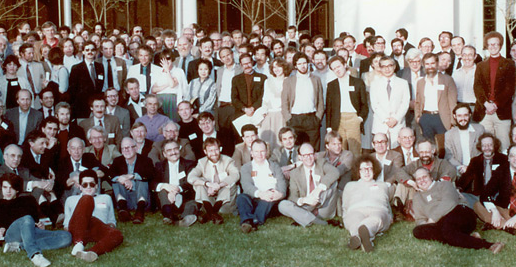
(Washington, DC) On the New York Times’ “The Stone” blog, Rutgers philosopher Ernie Lepore recently posted a photograph from a philosophy conference in 1984. It was a meeting on the work of Donald Davidson, and many famous philosophers attended. I was in high school at the time and nowhere nearby, but not long afterwards, I was working on my BA and then my PhD in philosophy, so I remember the general scene. Here is a detail (the whole photo can be explored in large scale on the Times site):

Screen Shot 2013-06-02 at 3.49.17 PM

I find that snapshots in general–and not just pictures of geeky philosophers from my youth–are often sad. The smiling, posed subjects present themselves to be remembered and somehow assessed. Because they are regular humans, they don’t measure up to their own hopes. Oil paintings from the 1700s and glossy photos from the old LIFE magazine  idealized their subjects so that we can still view them with respect–as people whose presence outlived their time. But in regular snapshots, the first thing we realize is that time has passed since the shutter clicked, and everyone in the image must look older now (if they’re still kicking at all). They present themselves in ways that they considered normal or natural, but we observe the faintly risible fashions of their day. That is true of their clothes and haircuts. The merciless camera suggests that it may also be true of their ideas.

Today, amateur photographs are so ubiquitous and so widely shared (Flickr is offering you a free terabyte of space just for your own snapshots) that I wonder whether our reactions will change. Or will the pathos of old photographs simply mount as their numbers swell?

Frontiers of Democracy 2013

(Washington, DC) The 2013 Frontiers of Democracy conference (“Innovations in Civic Practice, Theory, and Education”) is coming together nicely. It’s scheduled for July 18-20, 2013 in Medford, MA. Detailed information and the registration form are available on the conference website. As samples of what you will experience, here are four of our “Short Takes” speakers:

  • Jeff Coates is Strategic Initiatives Associate at the John S. and James L. Knight Foundation. He has worked extensively on the measurement of civic health, including the foundation’s “Soul of the Community” research. Coates previously worked with the Greater New Orleans Disaster Recovery Partnership, where he collaborated with more than 50 nonprofits to develop strategic plans for long-term recovery.
  • Michael Davis is the Chief of Police for Brooklyn Park, Minnesota. He has been in law enforcement for twenty years and is a passionate advocate of community engagement in crime prevention. Chief Davis is one of a handful of police chiefs from around the United States to be a member of the 2011-2014 Harvard Executive Session on Policing and Public Safety. Chief Davis was also the recipient of the 2012 Gary P. Hayes Award from the Police Executive Research Forum.
  • Dan Moulthrop is the new Executive Director of the City Club of Cleveland. He was previously the “Curator of Conversation” and a co-founder of Civic Commons, a project aimed at using the Internet and social media to create productive, civil dialogue on public issues. A longtime media veteran, Moulthrop was the founding host of “The Sound of Ideas,” ideastream’s award-winning public affairs program.
  • Teresa Younger is the Executive Director of the Connecticut General Assembly’s Permanent Commission on the Status of Women (PCSW).  Prior to joining the PCSW, Younger was the Director of Affiliate Organizational Development at the American Civil Liberties Union National Office, where she assisted affiliates throughout the country with organization and management issues.  Before that, Younger became the first woman and the first African American to serve as Executive Director of the ACLU of Connecticut.

These speakers and others will provoke the audience with 10-minute talks, and there will be plenty of time for discussion.

Also, here is the agenda for the “Mini-Conference on Civic Studies,” which is one track of activities for July 19 (running opposite other discussions). It has been organized by alumni of the Summer Institute of Civic Studies at Tufts:

8:30    Opening Remarks

  • Karol Soltan and Peter Levine, Co-directors and Co-founders of the Summer Institute of Civic Studies

8:45    Civic Studies: What is it? What can it become? What research questions are pressing? What do we need to know? How do we find it out?

  • Tim Shaffer – Director, Center for Leadership and Engagement, Wagner College
  • Peter Levine – Director, CIRCLE, Tufts University
  • Ian Ward – Assistant Professor of Political Science, University of Maryland

Moderated discussion including discussants and attendees

Closing Remarks

  • Moderator: Elizabeth Gish, Assistant Professor, Honors College, Western Kentucky University

10:15    Break

10:30    Prisons and crime as venues of civic work and topics for civic research/social scientific phronesis

  • Andrew Nurkin – Executive Director of Princeton AlumniCorps, Princeton
  • Peter Pihos – doctoral candidate, University of Pennsylvania
  • Additional discussant to be announced

Moderated discussion including discussants and attendees

Closing Remarks

  • Moderator: Joshua Miller

12:00    Lunch

12:45    The Theory and Practice of Civic Studies: What do we mean by theory/practice, practitioners/academics? How can we think and write better at these intersections?

  • Karol Soltan – Associate Professor, The Department of Government and Politics, University of Maryland
  • Jen Sandler – Director, University Alliance for Community Transformation, UMass Amherst
  • Elizabeth Gish – Assistant Professor, Honors College, Western Kentucky University
  • Moderated discussion including discussants and attendees

Closing Remarks

  • Moderator – Tim Shaffer

2:45    Break
3:00    Interactive Capstone: Advancing Civic Theory and Practice

Reflecting on today’s panels and discussion, what do we need to move forward?

Who is this “we”? What networks or actions will sustain this work?

Fifty years in the future, what would a healthy Civic Studies look like?

  • Facilitators – Liza  Pappas, City University of New York and Alison Staudinger, University of Wisconsin-Green Bay

character understood in network terms

In a random network, like (a) below, each node has an equal chance of being linked to any other, and the number of links per node will show a normal distribution. However, in most real networks (see “b”), a few nodes hog most of the links; the distribution is skewed. A rule of thumb–not a law of nature–is that 20% of the nodes draw 80% of the links in a naturally occurring network.

Two phenomena, among others, explain the tendency for links to cluster. First, some nodes are simply more important than others for reasons independent of the network’s structure. For instance, if an asteroid hit South Dakota, web pages devoted to asteroids would get more incoming links because the topic would be timely.

Second, the rich get richer. A node that already has a lot of links is easy to find and provides short pathways to other nodes, so there are reasons to link to it. In the case of websites, that phenomenon may be artificially exaggerated by Google, which uses the number of links to rank search results. But in a naturally occurring human network, it is smart to connect to people who are already well-connected. Regardless of their intrinsic merits, they draw more attention because they have more attention.

Now, consider one’s worldview as a set of ideas connected in various ways to each other. This network changes constantly. It tends to grow as you learn new things. You also forget or reject things that you once knew, but growth is the main tendency, at least for the first 25 years of life. Every time you are confronted with a new idea (from other people or direct observation), you will be inclined to connect it to existing ideas.

The two phenomena introduced earlier will encourage you to link the new idea to nodes that are already well-linked.

First, you will believe (rightly or wrongly) that some of your existing ideas are important, and you will link your new ideas to those. For instance, if you believe in God, that’s pretty important, and you will be inclined to ask of any new idea whether it connects to God. Perhaps it is evidence of His will or a sign of His glory.

Also, you will prefer ideas that you have already used to support other ideas. In network terms, you will look first to your high-traffic nodes as potential links to the new nodes that you are bringing into your map. They are more salient, and they allow you to connect the new idea to many old ideas.

This tendency to cluster has its dangers. It can be a cognitive bias, limitation, or “heuristic” in the bad sense of that word. It locks people into their current views. A fancy term for one relevant form of bias is asymmetric Bayesianism. Whenever a new idea or observation seems relevant to one of your favorite beliefs, you connect them and make the original belief even more central to your network. Whenever a new idea conflicts with an existing belief, you find reasons to shunt it off to the edge of the network. All your experiences reinforce your original idea.

But although clustering has dangers, I would defend it to a degree. For one thing, some ideas deserve more links than others. Whether a given moral belief deserves a lot of links is an important question. For example, it is true and bad that millions of children are hungry. But it is a different question whether that idea is linked to enough of our other beliefs. Their hunger should be relevant to many other questions, such as what I do with my own surplus income. To take a different example: the Holocaust was unthinkably bad. And it is relevant to the existence of the state of Israel. But I believe that the Holocaust is connected too often to other issues involving the contemporary Middle East, such as Israel’s relationship with Palestinians. It is not that each link is false or illegitimate, but the network is centered in the wrong place.

So your moral network should skew in favor of the right things. That is not question-begging: it rather poses an important question. Which beliefs should be central nodes?

Your moral network will also skew because of the rich-get-richer principle: ideas that you have already linked to many other ideas will attract new connections because of their prominence. I would like to challenge the premise that this is pure bias, a mere limitation.

If morality could be truly rational, then one of its hallmarks would be a lack of bias toward existing beliefs. All your ideas would also be mutually consistent. And there would be a reason for everything. You would not just believe P, you would always be able to give a reason for P.

I am afraid that I see morality differently from that. I think it is a tissue of beliefs and commitments that is relatively hard to construct and sustain. Each piece is easy to reject if we ask “Why?” But if we tear away at the tissue, we have nothing keeping us from just doing what we want. Morality is “faith-based,” whether the faith is in God or in the equality of human beings (a moral assumption not at all suggested by science).

Morality is also a means of building up a common worldview with other people. It is “socially constructed,” and constructing it allows us to live together, not merely in parallel. Again, if we ask “Why?” about each component of morality, we will just weaken the common tissue that we have spun together.

This does not mean that any moral beliefs will do, or that we needn’t be concerned about justification, consistency, logic, and other hallmarks of rationality. An inconsistency should be a source of concern and reflection. Automatically returning to a few well-traveled ideas is not satisfactory; we should strive to broaden our minds. On the other hand, we know that strongly clustered networks are robust. They work better and last longer than random-looking networks. Thus, even if two people endorse the same list of moral beliefs, I would wager that the one whose beliefs cluster will act better. I hope that my moral worldview does not center on false or bad nodes, but I do seek beliefs to which I can frequently turn. Those centers of my network map define my character or moral identity.

the new civic education article in the Stanford Encyclopedia of Philosophy

(Washington, DC) I am proud to announce that a new article on “Civic Education” is online on the Stanford Encyclopedia of Philosophy, which is a peer-reviewed, free resource that I use regularly for a wide range of topics. Jack Crittenden originally wrote the article and did a very good job with it. At his request, I have thoroughly revised it, so that it now has two authors. Here are the philosophical questions that the article poses at the outset:

  • Who has the full rights and obligations of a citizen? This question is especially contested with regard to children, immigrant aliens, and individuals who have been convicted of felonies.
  • In what communities ought we see ourselves as citizens? The nation-state is not the only candidate; some people see themselves as citizens of local geographical communities, organizations, movements, loosely-defined groups, or even the world as a whole.
  • What responsibilities does a citizen of each kind of community have? Do all members of each community have the same responsibilities, or ought there be significant differences, for example, between elders and children, or between leaders and other members?
  • What is the relationship between a good regime and good citizenship? Aristotle held that there were several acceptable types of regimes, and each needed different kinds of citizens. That makes the question of good citizenship relative to the regime-type. But other theorists have argued for particular combinations of regime and citizen competence. For example, classical liberals endorsed regimes that would make relatively modest demands on citizens, both because they were skeptical that people could rise to higher demands and because they wanted to safeguard individual liberty against the state. Civic republicans have seen a certain kind of citizenship–highly active and deliberative–as constitutive of a good life, and therefore recommend a republican regime because it permits good citizenship.
  • Who may decide what constitutes good citizenship? If we consider, for example, students enrolled in public schools in the United States, should the decision about what values, habits, and capabilities they should learn belong to their parents, their teachers, the children themselves, the local community, the local or state government, or the nation-state? We may reach different conclusions when thinking about 5-year-olds and adult college students. As Sheldon Wolin warned: “…[T]he inherent danger…is that the identity given to the collectivity by those who exercise power will reflect the needs of power rather than the political possibilities of a complex collectivity” (1989, 13). For some regimes—fascist or communist, for example—this is not perceived as a danger at all but, instead, the very purpose of their forms of civic education. In democracies, the question is more complex because public institutions may have to teach people to be good democratic citizens, but they can decide to do so in ways that reinforce the power of the state and reduce freedom.
  • What means of civic education are ethically appropriate? It might, for example, be effective to punish students who fail to memorize patriotic statements, or to pay students for community service, but the ethics of those approaches would be controversial. An educator might engage students in open discussions of current events because of a commitment to treating them as autonomous agents, regardless of the consequences. As with other topics, the proper relationship between means and ends is contested.