civic studies at Frontiers of Democracy 2013

Former members of the Summer Institute of Civic Studies and their colleagues have put together a track of discussions for this summer’s Frontiers of Democracy Conference. They have designed an exciting mix of theory, practice, and applications to particular topics–notably, the incarceration crisis. To attend part or all of this mini-conference, you must register for Frontiers.

Friday, July 19, 2013. Tufts University campus in Medford, MA

8:45    Civic Studies:  What is it? What can it become? What research questions are pressing? What do we need to know? How do we find it out? This session explores the state of civic studies as a field. Four years after the inaugural Summer Institute of Civic Studies, where is the field today and where is it going?

Opening Remarks

  • Karol Soltan and Peter Levine, Co-directors and Co-founders of the Summer Institute of Civic Studies

9:00    Civic Studies: What is it? What can it become? What research questions are pressing? What do we need to know? How do we find it out?

  • Tim Shaffer – Director, Center for Leadership and Engagement, Wagner College
  • Peter Levine – Director, CIRCLE, Tufts University
  • Ian Ward – Assistant Professor of Political Science, University of Maryland

Moderated discussion including discussants and attendees

Closing Remarks

  • Moderator: Elizabeth Gish, Western Kentucky University

10:15    Break

10:30    Prisons and crime as venues of civic work and topics for civic research/social scientific phronesis

  • Andrew Nurkin – Executive Director of Princeton AlumniCorps, Princeton
  • Peter Pihos – doctoral candidate, University of Pennsylvania
  • Albert Dzur (Bowling Green) and John Gastil (Penn State), via remote presentation

Crime and its aftermath exists at the uneasy boundary between egalitarian civic engagement and expert-led public work. Crime calls for a coordinated civic response, yet routinely criminal justice is institutionalized and bureaucratized, placing it out of the realm of amateur citizen action. How can citizens bend the course of the system that costs hundreds of billions of dollars annually and involves difficult legal, economic, and psychological issues?  In this panel, we will explore the efforts of scholars in the burgeoning field of civic studies to detail the history and promise of antiviolence campaigns, citizen-led police oversight, prison education, and the participatory politics of the jury.

Moderated discussion including discussants and attendees

Closing Remarks

  • Moderator: Joshua Miller, Morgan State University

12:00    Lunch

1:00   The Theory and Practice of Civic Studies: What do we mean by theory/practice, practitioners/academics? How can we think and write better at these intersections?

  • Karol Soltan – Associate Professor, The Department of Government and Politics, University of Maryland
  • Jen Sandler – Director, University Alliance for Community Transformation, UMass Amherst
  • Elizabeth Gish – Western Kentucky University
  • Moderated discussion including discussants and attendees

Closing Remarks

  • Moderator – Tim Shaffer

2:45    Break
3:00    Interactive Capstone: Advancing Civic Theory and Practice

In the study of democracy, ethics, and politics, there is often a perceived tension between theory and practice. Or a divide between “academics” and “practitioners.” This conversation explores these distinctions and tensions in the context of civic studies, asking how we can think and write better at these intersections.

Reflecting on today’s panels and discussion, what do we need to move forward?

Who is this “we”? What networks or actions will sustain this work?

Fifty years in the future, what would a healthy Civic Studies look like?

  • Facilitators – Liza  Pappas, City University of New York and Alison Staudinger, University of Wisconsin-Green Bay

In this session, we’ll reflect on the work of the day, as well as build networks and concrete plans to tackle the key problems for civic studies going forward. Moderators will lead participants through individual and paired reflection exercises and will model a “one on one” organizing technique that will help us connect our reflections to our stories, develop our relationships, and gauge what we share in common. We’ll end the session examining what the future of civic studies might hold.

4:30    Break

Albert O. Hirschman on exit, voice, and loyalty

Jeremy Adelman’s recent biography of the recently deceased Albert Hirschman has prompted good writing: see Malcolm Gladwell in The New Yorker, Cass Sunstein in the New York Review, and a nice discussion at the Reality-Based Community.

For me, Hirschman’s Exit, Voice and Loyalty is a touchstone. The insight of this book is that we have two potential responses when we don’t like an institution or community. We can leave it (“exit”) or we can advocate change (“voice”). When both options are available, what causes us to choose voice over exit is loyalty.

I study citizenship, which has a lot to do with voice and loyalty. I happen to think that Hirschman’s emphasis on voice omits work as another means of improving situations. That said, his scheme is powerful and illuminating. It usefully challenges laissez-faire economics, civic republicanism, and socialism.

Hirschman believed in exit. It saved his life, since he was a refugee from tyranny. And he endorsed exit from businesses as a means of improving them. Exit is the fundamental market mechanism: owners must either produce good services or lose their customers. Because Hirschman understood the value of exit, he was not a classical republican or a socialist.

But he saw that exit will not solve all our problems …

For one thing, monopolies actually like people to exit. It helps them maintain their power without changing their behavior. For instance, if there really is no alternative to the cable company, then disgruntled customers will make a fuss, using their voices to cause trouble. The cable company prefers the angriest people to leave (albeit at some cost and inconvenience). Non-murderous dictatorships, like today’s People’s Republic of China, use the same strategy, encouraging their toughest dissidents to go into exile.

Bureaucrats in governments and corporations are not necessarily constrained or chastened by exit. Why should they care if some employees or customers leave? One of the limitations of standard public choice theory (a la James M. Buchanan) is its attribution of the same motives to bureaucrats as entrepreneurs. Both are assumed to want bigger operations. But this is only true of some bureaucrats. At least as many would like to see people leave. The workload shrinks and the most troublesome individuals depart. For instance, leaders of urban public school systems do not suffer because some kids leave for private schools and charters. At the extreme, they could lose their jobs–but senior bureaucrats are the last to go. In the meantime, exit just makes their jobs easier.

Besides, exit confers no information. You can count the people leaving, but that doesn’t tell you why they’re exiting or what would make them stay.

Hirschman quotes Milton Friedman’s argument for school vouchers. “Parents [with vouchers] could express their views about schools directly, by withdrawing their children from one school and sending them to another, to a much greater extent than is now possible. In general they can now take this step only by changing their place of residence. For the rest, they can express their views only through cumbrous political channels” (p. 16).

Hirschman responded (with dry sarcasm):

I am not interested here in discussing the merits of the Friedman proposal. Rather, I am citing the above passage as a near perfect example of the economist’s bias in favor of exit and against voice. In the first place, Friedman considers withdrawal or exit as the “direct” way of expressing one’s unfavorable views of an organization. A person less well trained in economics might naively suggest that the direct way of expressing views is to express them! Secondly, the decision to voice one’s views and efforts to make them prevail are contemptuously referred to by Friedman as a resort to “cumbrous political channels.” But what else is the political, and indeed the democratic, process than the digging, the use, and hopefully the slow improvement of these very channels? (p. 17)

If exit is the only means of improvement, then human organizations and communities are like species in a Darwinian struggle for survival. They just do what they do, and the ones that lose their customers or employees die off. But Darwinian struggle is incredibly wasteful, slow, and inconsistently beneficial. (Cockroaches are much “fitter” than tigers, but which is more impressive and beautiful?) We humans can do a lot better than that, but it takes thinking, communicating, and listening. In a word, it takes politics.

One of the commentators on the Reality-Based Community (“Ebenezer Scrooge”) puts the point well:

I work as a bureaucrat in a bureaucratic business organization. I therefore know a little something about bureaucratic employment practices. … Any management that primarily relies on exit information is way behind the curve. When the cost of exit is high (as it is in most employment), almost all forward-looking information comes from voice. Employment exit is only useful for upper levels of management, who need some accessible metric to evaluate lower levels. There is a way to generalize this. The invisible hand is–ultimately–the invisible hand: incentives matter. Lousy monopolists ultimately collapse. But the force and fingers of the invisible hand are often social structures … .

If you are trying to set the rules of the game at a very high level, e.g., by writing a constitution, you should allow exit, both to preserve human rights and to create competition. But if you actually work in an organization or a community, you’d better encourage and listen to voice. That is what will determine your success and survival. Strengthening markets may increase the incentive to promote voice, but people must still learn to communicate and listen.

Finally, the choice between exit and voice is fundamentally ethical and relates to the question of a good life. I am not saying that voice is always better. The right thing to do can be to resign from a committee or go into exile as a matter of conscience. (“Ich kann nicht anders.”) And sometimes exit is fine just because the moral stakes are very low–you are entitled to walk out of one pizza joint and into another because the slices there are better.

But there are important situations in which staying and speaking is the right thing to do. That idea is invisible if we imagine that market competition is the only means for improving institutions. Not only is voice in some circumstances the more honorable choice, but it creates the potential for various forms of satisfaction and fulfillment that are lost if one casually exits. As Hannah Arendt wrote, the Americans of the Revolutionary era “knew that public freedom meant having a share in public business, and that the activities connected with this business by no means constituted a burden but gave those who discharged them in public a feeling of happiness that they could acquire nowhere else.”

Another weakness of Chicago School economics is defining incentives too narrowly. The opportunity to speak and be heard, the satisfaction of responding well to someone else’s thoughts, and the reputation one can acquire from effective speaking–those are powerful as well as honorable human motives.

tell it straight? the advantages and dangers of parody

This is the fourth in a series of blog posts by CIRCLE, which evaluated several initiatives funded by the Democracy Fund to inform and engage voters during the 2012 election. Our posts discuss issues of general interest that emerged from the specific evaluations. Join CIRCLE for an ongoing discussion of the posts using the hashtag #ChangeTheDialogue, as well as a live chat on Tuesday, June 25th at 2pm ET/1pm CT/11am PT.

Parody is powerful. Scholarly papers by Young Mie Kim and John Vishak, Dannagal Goldthwaite Young, Amy Becker, Michael Xenos, Xiaoxia Cao, and others have found that late-night comedy influences viewers’ political belief and attitudes. Presumably, parody works by motivating viewers to pay attention (when they might tune out less amusing material) and by provoking strong emotions, such as disdain for the person being parodied. In turn, those basic emotional framings strongly affect how people collect and interpret factual information. A parody can also spread “virally” if people enjoy it and choose to share it. The popularity of shows like the Colbert Report demonstrates the appeal of satire.

The challenge is that some people do not get the joke. For example, Flackcheck produced a parody video entitled “Could Lincoln be Elected Today?” that purported to be a television ad from the 1864 election. Its purpose was to teach viewers to shun deceptive advertising from real, modern campaigns.

Other experiments seem to suggest that these parodies were just as effective at informing viewers as more traditional fact check articles found at places like Factcheck.org.

However, we found that substantial numbers of people did not understand the parodic purpose of this video. Two-thirds (67.4%) of all respondents thought that it was reminiscent of real campaign ads shown today. That was the intention of the parody, and two-thirds “got” it-but the remaining one third did not.

Three quarters (76.2%) thought that the Lincoln video was deceptive in that it would have been unfair to compare President Lincoln to Benedict Arnold, as the video did. Again, that means that most of the respondents understood and agreed with the premise of the video. But about one quarter did not.

A few thought that Lincoln is overrated; they were pleased that the video would reduce his popularity, which they took to be its intent. About two percent of the respondents saw a partisan purpose to the video, e.g., “Well done video. An obviously very pro Obama video,” or “This video was obviously made by left wing nuts.”

Some other responses:

“It was disrespectful to our 16th President. Negative ads should be banned from all government elections”

“I think it was stupid and who ever used it, or if it was used, should never hold an office in this country and the public should have been outraged.”

“Anyone who believed this video was and is a traitor to the USA.”

Overall, we can conclude that most people understood the video, but there was substantial “leakage” in the form of people who missed its parodic intent, thought that it was fair to compare Lincoln to Benedict Arnold, were furious at it, or otherwise drew the wrong message from it.

Anyone working to educate the public about politics in a nonpartisan way faces a choice. Very straightforward messages may come across as boring or preachy and may not be viewed willingly, let alone shared. Funny messages spread further, but a significant proportion of the recipients miss the point–and they may be the very people who would most benefit from a deeper insight into politics and public affairs.

This post is cross-posted on the Democracy Fund blog. Stay tuned for more analysis in the upcoming weeks. The previous entries in the series can be accessed at:

  1. Educating Voters in a Time of Political Polarization
  2. Supporting a Beleaguered News Industry
  3. How to Reach a Large Scale with High Quality Messages

activist forms of civic education are traditional

(Washington, DC) One of my refrains is that we have not recently invented the idea that students can learn to be citizens by practicing citizenship. That is a traditional concept, rooted in Aristotle, de Tocqueville, Mill, and other theorists, but, more importantly, built on deep and continuous experience in schools.

In 1915, for example, the U.S. Bureau of Education (the forerunner of today’s Department of Education) formally endorsed an approach called “community civics.” The Bureau’s guide for teachers named “action … as the end of all good citizenship and of all good teaching.” The guide drew the implications for pedagogy: “A lesson in community civics is not complete unless it leaves with the pupil a sense of his personal responsibility and results in right action.” As an example, students might make an

appeal … to public officials …, as, for example, in regard to the establishment of a playground. But such appeals should be made under proper supervision. The good citizen should be able to write a courteous letter to the public official. Practice in writing such letters should be given to pupils, preferably relating to actual conditions observed by the pupils, or containing practical suggestions by them.

Moreover, the manual advised, “It is sometimes desirable for the class to undertake a special piece of work of direct use to the community.” In an elaborate real example that the manual described, students were concerned about the impact of a snowstorm on their city, learned about the ordinance that required homeowners to shovel, and noted that many residents were out of compliance. The students considered various responses, including “speak[ing] personally to offenders,” but decided that would be “slightly officious and perhaps offensive to older citizens.” Finally, they created a paid snow-shoveling service that they offered to seniors.

If this example sounds like service-learning, plus social entrepreneurship, with a dose of “action civics,” that’s because it is. And it was the official recommendation of the federal government in 1915.

how to reach a large scale with high-quality messages

(Washington, DC) This post–cross-posted on the Democracy Fund blogis the third in a series about CIRCLE’s  evaluations of the Fund’s initiatives to inform and engage voters during the 2012 election. These posts discuss issues of general interest that emerged from our specific evaluations. The previous entries in the series are: “Educating Voters in a Time of Political Polarization” and “Supporting a Beleaguered News Industry.” Join CIRCLE for discussion of the posts using the hashtag #ChangeTheDialogue, as well as a live chat on Tuesday, June 25th at 2pm ET/1pm CT/11am PT.

Since 2012, the Democracy Fund has invested in projects and experiments intended to inform and engage voters. Several of these efforts sought to change the way citizens respond to divisive and deceptive rhetoric. To succeed, an organization would have to (1) create an experience that altered people’s skills, attitudes, and/or habits, and (2) reach a mass audience.

In this post we focus on the second issue: scale. Since adults cannot be compelled to undergo civic education, and about 241 million Americans were eligible to vote in 2012, engaging citizens in sufficient numbers to improve a national election is challenging. Democracy Fund grantees used at least four different strategies to reach mass audiences with nonpartisan education.

First, the Healthy Democracy Fund’s Citizens Initiative Reviews convened representative groups of citizens to deliberate about pending state ballot initiatives in Oregon. The citizens’ panels wrote summaries of these ballot initiatives that the state then mailed to all voters as part of the Oregon voter guide. Although only 48 people were directly involved in the deliberations, the results of their discussions reached hundreds of thousands of Oregon voters. Penn State Professor John Gastil found that nearly half of Oregon voters were aware of the statements that these deliberators had written and that a significant portion of the voting public found the statements to be useful. In an experiment that Gastil conducted, citizens who read the statements shifted their views substantially and showed evidence of learning. So, in this case, a small-scale exercise in deliberative democracy led to mass public education.

Second, Flackcheck.org produced videos ridiculing deceptive campaign ads. The videos were free, online, and meant to be funny. A major reason to use parody and humor was to increase the odds that viewers would voluntarily share the videos with their friends and relatives. We asked a representative sample of Americans what would generally encourage them to share a political video, and 39% said that they would be more likely to share it if it was funny. The only attribute that attracted more support was the importance of the topic. We also asked respondents to watch one of three Flackcheck parody videos, and 37% thought the one they saw was funny, although 20% did not.

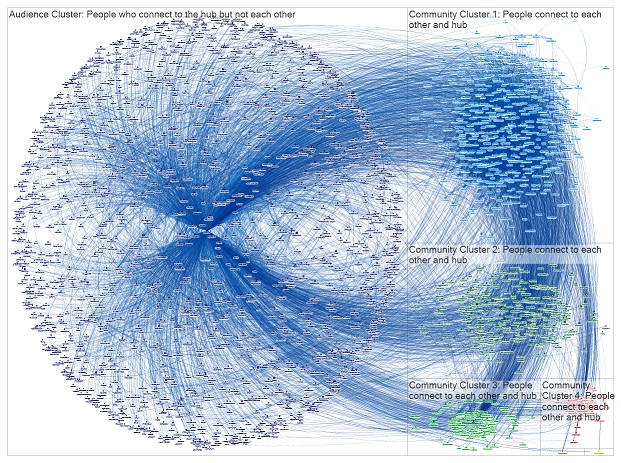
In the end, the Flackcheck parody videos attracted some 800,000 views. That is a relatively large number, although a small proportion of the electorate. On a subcontract from CIRCLE, Marc Smith is analyzing the dissemination network created by the sharing of Flackcheck videos online. Below are shown the people and organizations that follow Flackcheck’s Twitter account and their mutual connections. It is a substantial online community.

Third, AmericaSpeaks recruited individuals to deliberate online as part of Face the Facts USA. AmericaSpeaks is best known for large, face-to-face deliberative events called 21st Century Town meetings. Although they convene thousands of people, often in conference centers, their scale is small compared to the national population. The Face the Facts project provided an opportunity for AmericaSpeaks to recruit participants to low-cost and scalable Google Hangout discussions. That is a model that could be replicated as an alternative or a complement to more expensive, face-to-face discussions.

Finally, several projects involved influencing professional journalists or media outlets as an indirect means of educating the public. These projects took advantage of the fact that millions of Americans still receive information and commentary from news media sources. The Democracy Fund grantees strove to improve the quality of their coverage and thereby reach a substantial portion of the voting public.

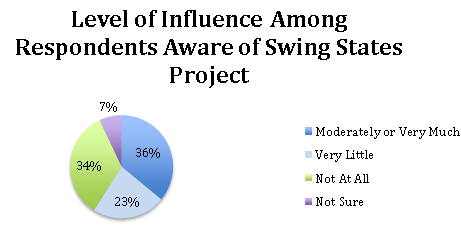
The Columbia Journalism Review’s “Swing States Project” attempted to improve the quality of local media coverage by commissioning local media critics to critique the coverage . We interviewed political journalists in the targeted states. Among respondents who were aware of the project, 59% responded that it had influenced them. Thirty-six percent indicated that it had a moderate influence or influenced them “very much.” Although we cannot estimate how this influence on journalists affected voters’ understanding of the issues, the findings suggest that a fair number of journalists whose work is being read and watched by voters in swing states were taking steps to improve their coverage.

The Center for Public Integrity’s “Consider the Source” provided in-depth reporting on campaign finance issues that newspapers, broadcasters, and other news sources could use. CIRCLE interviewed 13 prominent experts who report on money and politics. Nearly half of these interviewees felt that CPI resources had influenced the conversation among media professionals, and that consequently the media now offers more comprehensive stories about money in politics. Although only 200,000 people read the CPI stories at the CPI website, the organization’s media tracking service estimated that the stories reached a potential circulation of 48 million people through pick up by other media organizations.

Although CIRCLE’s evaluations did not yield recipes for changing mass behavior, the following conclusions are consistent with our findings:

  1. Distributing recommendations from a credible public deliberation can have significant influence on the public, if the deliberation is reflected in an official vehicle, such as a state voter guide.
  2. “Providing resources to the media can be an effective means of reaching scale, if the source is viewed as fair and providing them with relevant and valued content
  3. It’s hard to get to scale by trying to become a destination site.