pigeon-guided missiles and ancient Chinese paddleboat gunships

I read Wikipedia so that you don’t have to. You can just stop by here to learn that …

1. During WWII, the behaviorist psychologist B.F. Skinner put pigeons inside missiles. The view in front of each missile was projected via a camera obscura onto the wall, and the pigeon was trained to peck at images of ships. Because the bird had an electrode attached to its beak, its pecks steered the missile toward its naval target. Skinner demonstrated that his prototype worked using the following film. The Navy brass, however, refused to fund the implementation stage.

2. Speaking of naval war, during the Battle of Caishi (1161), the Song forces successfully deployed ships described thus in Hai Qiu Fu (“Rhapsodic Ode on the Sea-eel Paddle Wheel Warships”):

The men inside them paddled fast on the treadmills, and the ships glided forwards as though they were flying, yet no one was visible on board. The enemy thought that they were made of paper. Then all of a sudden a thunderclap bomb was let off. It was made with paper (carton) and filled with lime and sulphur. (Launched from trebuchets) these thunderclap bombs came dropping down from the air, and upon meeting the water exploded with a noise like thunder, the sulphur bursting into flames. The carton case rebounded and broke, scattering the lime to form a smoky fog, which blinded the eyes of men and horses so that they could see nothing. Our ships then went forward to attack theirs, and their men and horses were all drowned, so that they were utterly defeated.[38]

3. On a more peaceful note, the family who served as Grand Vizirs to the great Abbasid Caliphs of Baghdad (including the most famous Caliph, Harun Al-Rashid) came from a long line of respected Buddhist abbots from the city of Balkh, now in Afghanistan.

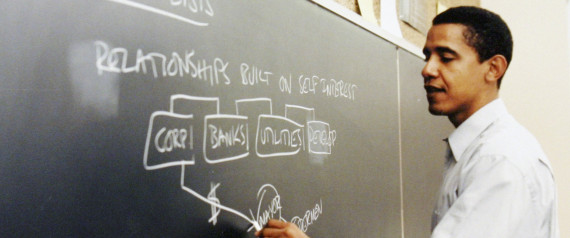
Obama faces the new organizers

Peter Dreier has a great piece on President Obama’s background as a community organizer. The priceless photograph above comes from Dreier’s article. I also explore this aspect of the president’s past in We are the Ones We Have Been Waiting For, pp. 152-161.

Dreier writes, “But Obama seemed to abandon his affinity for organizing soon after he entered the White House. He tried to be a consensus-builder, eschewing conflict, even with those in Congress and in corporate boardrooms who pledged not only to defeat his policy agenda but also to undermine his legitimacy as president.”

Indeed, Obama’s consensus-building contrasts with the confrontational style of community organizing that he employed on occasion in Chicago in the 1980s and that he faced recently when he met a group of young leaders in the White House. As movingly recalled by Phillip Agnew, the White House meeting was a frank exchange between “a community in active struggle against state sanctioned killing, violence and repression” (on one side) and the leader of that very state, the former community organizer turned POTUS (on the other). Agnew concludes:

We walked out of that meeting unbought and unbowed. We held no punches. There was no code-switching or bootlicking; no concessions, politicking or posturing. The movement got this meeting. Unrest earned this invite, and we can’t stop.

If we don’t get what we came for, we will shut it down. President Obama knows that and we know it. No meeting can stop that.

I’d only complicate the contrast in one way. Obama was trained in confrontational tactics but also in relational organizing. Frank C. Pierson, who is an Industrial Areas Foundation organizer in Durham, NC, says that the IAF network’s “relational culture is characterized by positive valuation of relationships themselves as well as the capacity for collaborative action they generate.  Relationships tested in the crucible of public action when sustained over time can forge lasting political friendships within, between and outside IAF organizations.” Scott Reed, the executive director of the PICO organizing network, told me recently that he and his colleagues strive “to develop relational capital.” The veteran organizer Gerald Taylor recalls the reason that a Maryland IAF affiliate called BUILD defeated the NRA:

Thousands of people were talked with and listened to. Questions about the nature of community and the relative merits of a law that was not perfect were discussed. In short, people were taken seriously as citizens.

BUILD members met with Senator Paul Sarbanes, who asked them their “demands.” “‘None,’ they responded, to the senator’s amazement. ‘We came here to find out what your interests are: Why you ran for this office and what you hope to achieve.”

Relational organizers do not value all relationships equally, but they treat the development of a new relationship as an asset even if it involves an adversary. This is why the relational approach is sometimes called “broad-based” (as opposed to “issue-based”) organizing. Obama likewise observed in 2007 that “politics” usually means shouting matches on TV. But “when politics gets local, when the person talking to you is your neighbor standing on your front porch, things change.” In that speech, he called for “dialogues” in every community on Iraq, health care, and climate change.

Note that the diagram that a younger Barack Obama is drawing on the chalkboard (above) is a relationship map. It shows problematic relationships among banks, utilities, and other powerful entities; but if he applied relational organizing techniques, he was about to add citizen groups to the same diagram. After all, he wrote at length as a young organizer about the “internal productive capacities, both in terms of money and people, that already exist in communities.” He was, in fact, a practitioner of Asset Based Community Development, which emphasizes the power and resources already present in marginalized neighborhoods.

Confrontation is not incompatible with relationship-building or a positive assessment of community assets. Any robust movement will combine these approaches and will debate the relative importance of each at every moment. I believe that confrontation is necessary and helpful at the current juncture. But I think that Obama has used something of a mix himself, as president. And when he has elected to build consensus, that too comes from his experience as a community organizer.

*Frances Moore Lappe, “Politics for a Troubled Planet” (1993), pp. 175-6

the Civic 50: companies that are civically engaged

Points of Light has released its list of 50 companies that are most civically engaged, the Civic50. The idea is to move beyond hours of voluntary service by employees to consider: 1. other forms of investment (such as cash, or paid time by skilled employees who are assigned to public projects); 2. the integration of a company’s philanthropic efforts with its main business strategies; 3. its policies and incentives for community engagement; and 4. its impact, meaning whether and how the company assesses the effects of its civic engagement on communities.

I was one of many advisers and believe that this is a worthy effort. One question is whether the net impact of these companies is positive. A hypothetical firm might put significant investments into (say) reducing obesity in its community while also massively polluting, or removing investment from a deindustrialized city, or manufacturing harmful products. One response would be to put the positives and the negatives together into a single index. I have come to think it is better to make the “civic” activities a separate category so that we can see which companies are doing that well. We can then weigh their civic engagement along with our judgment of their effects in other domains.

A related question is how to think about policy work. The Civic50 celebrates the fact that Aetna “worked with legislators to help pass a more meaningful mental-health parity law that allows for better coordination of coverage for physical and mental health care services” and that FedEx FedEx “has also played a leadership role in advancing a social issue into which it has keen insight – pedestrian safety.” Here again, I think it’s useful to identify efforts that the firms regard as purely public-spirited so that citizens and consumers can weigh them along with (or against) other lobbying efforts that might be more controversial or downright harmful. One is also entitled to assess the ostensibly public-spirited advocacy efforts critically. Maybe FedEx’s work on pedestrian safety was helpful; maybe it wasn’t.

The main question I would like to add to the assessment of corporate civic engagement is whether a company consults with, and is held accountable by, representatives of the communities that it engages. I welcome the step from counting service hours to measuring impact, but the next step is to share the responsibility for deciding what counts as beneficial means and ends.

subtle gender bias affects girls’ leadership

My colleagues at Tisch College, the National Education Association, and the American Association of University Women recently released a report entitled Closing the Leadership Gap: How Educators Can Help Girls Lead. Gail Bambrick summarizes it well. A key finding, as she notes, came from a small experiment:

The teachers taking the survey, 76 percent of whom were female, were asked to analyze a statement by a student running for student council president. The statement remained unchanged, except half were told it had been written by “Jacob” and the other half thought it was by “Emily.”

When asked to choose adjectives that described the attributes they saw in each candidate, many chose some of the same words to describe both Jacob and Emily: collaborative, competent, ambitious and determined.

But the differences in teachers’ assessments of Emily and Jacob were significant, according to the study. Jacob was “confident,” “aggressive,” “arrogant” and “charismatic.” Emily was “bubbly,” “hard-working,” “compassionate” and “feminine.” Among Jacob’s challenges: being “overly confident.” Among Emily’s: she “showed no authority.”

These teachers generally expressed support for gender-neutral classrooms and boosting girls’ leadership. But most students actually end up in gender-stereotyped roles in high school. “One big takeaway for us is that even enlightened, experienced teachers with progressive views about leadership can have stereotypes and biases creep up,” says [CIRCLE Deputy Director Kei] Kawashima-Ginsberg. “And this is really what affects behavior the most. It is really hard to control, but if you are aware, you can actively combat those behaviors by making sure girls are given roles as leaders and are exposed to positive role models—women leaders—within the curriculum.”

disadvantaged youth most likely to credit the rich for their own success

My friend Connie Flanagan reports on her study of 600 US adolescents:

It was adolescents in the least privileged circumstances (whose parents had lower levels of education, whose schools were located in low-income communities, and whose classmates reported few discussions of current events at home) who were more likely to admire the wealthy for making it and contend that people were poor because they lacked motivation or hadn’t applied themselves in school. In fact, the connection between working hard in school and succeeding in life was palpable [for poor kids, whereas privileged students were more likely to cite structural inequalities.]

This is a deeply important fact about the US, one that helps explain the weakness of economic populism. We just had an election in which the Democrats won the segment of voters with postgraduate degrees and the Republicans won the people whose educations stopped at high school–the working class. Connie proposes that more advantaged kids may have more “opportunities to learn about society,” for instance, in more demanding social studies classes or through media. She also thinks that

It may be easier to attend to the structural roots of inequality from a position of advantage since one’s own group is less likely to suffer the consequences of an unequal system. In other words, the freedom to criticize the system reflects, in part, the safety net of privilege.

In contrast, for those youth who remain in schools where half of their classmates will drop out, an ardent commitment to self-reliance and a belief in the efficacy of individual effort may keep them going. The imperative of self-reliance and the lack of safety nets also seem to be messages that they hear at home: it was youth in the least privileged families who were most likely to report that their parents admonished them that they should work twice as hard as others if they wanted to get a job; that people have to create their own opportunities since nobody hands them to you; that they couldn’t blame others for their problems; and that if they didn’t succeed in life, they would have only themselves to blame.