is our constitutional order doomed?

Mathew Yglesias has brought renewed attention to Juan Linz’ thesis that our constitutional order is doomed. The basic idea is that if the chief executive and the legislature are elected separately, they can belong to different parties. In such cases, the legislature has every incentive to undermine the president, who will respond by expanding executive power. That situation will degenerate until the constitution fails, as it has in almost every presidential system outside the USA. See Yglesias’ Vox piece, “American Democracy is Doomed,” Jonathan Chait’s response (“There’s a Chance American Democracy Is Not Doomed“), and my own post “Are we seeing the fatal flaw of a presidential constitution?

The Linz thesis requires an explanation for why the US system has not already collapsed after more than two centuries. The leading explanation is that we have never actually had two parties in Congress, notwithstanding the labels. Internal party splits have caused us to have at least three–and often four or more–effective parties. Thus presidents have been able to construct governing coalitions even when they face a majority of the opposite party. Reagan, for example, got most of his agenda through Tip O’Neil’s Democratic House because Southern Democrats voted with Republicans on key issues.

Our current situation looks unprecedented because the two parties are now perfectly polarized, with all the Democrats to the left of all the Republicans. Thus the Linz thesis explains paralysis and executive unilateralism under Obama and predicts worse to come.

But then we observe the Department of Homeland Security funding bill pass the Republican House with unanimous Democratic support. Democrats are also saying they would protect Speaker Boehner from a Tea Party effort to unseat him. (The Speaker is chosen by majority rule, so Boehner could hold his gavel with a mix of Republican and Democratic votes). These two examples suggest that Boehner is in the same place as O’Neil during the Reagan Administration. He leads a caucus that formally and rhetorically opposes the president. But sometimes the governing coalition in the House consists of 75 Republicans plus all the Democrats. Boehner is like a Prime Minister whose own party (the Center-Right) is smaller than its coalition partner (the Center-Left) but who alone can command more than 50% in votes of no confidence.

This situation only applies some of the time. Boehner does not like (and will not even acknowledge) his dependence on Democrats. It poses a serious problem for all Republicans, not just for Tea Partiers, because it cedes considerable power to the other party. Thus Republicans will make creative and sustained efforts to change the situation. But to the extent that it prevails, we will return to the classic US pattern instead of dissolving into a Linzian nightmare.

in what ways are Millennials distinctive?

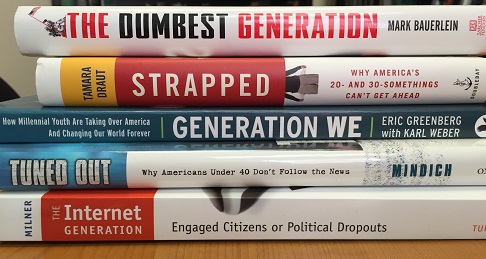
There is a thriving market for generalized portraits of Millennials, whether positive or negative. These are just some examples from my own bookshelf:

Millennial books small

There are interesting things to say about this generation–and about generational change as a phenomenon. But if you look closely, the picture is pretty complicated. Differences among people born at the same time are usually much greater than differences among generations–a point that my colleagues and I have emphasized in much of our work. Also, trends over time rarely point to sharp and stable differences among generations.

So many beliefs and behaviors have been measured regularly over 40 years that it’s hard to generalize, but I’ll pick two trends just to illustrate the complexity.

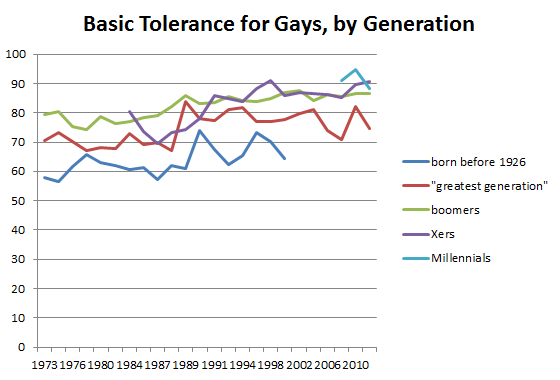
First, it is widely believed, and reasonably so, that attitudes toward gays are generational, changing (for the better, in my view) with each new age cohort. The longest relevant survey time-series that I know is from the General Social Survey, which asks whether a list of types of people should be allowed to speak in one’s community. One person on the list is an “admitted homosexual” man–the terminology itself reflecting a more prejudiced era. The question is imperfect for our purposes because it conflates attitudes toward free speech with views of homosexuality. (Someone might be homophobic yet a First Amendment absolutist.) Nevertheless, the pattern is interesting.

Millenials1

Each generation does enter the adult population with successively more positive views of speech by a gay man–until the Xers, who are no different from, and perhaps slightly less tolerant than, the Boomers who preceded them. Each generation grows slightly more tolerant over its life course, but the main reason for increasing tolerance in the population as a whole is generational replacement. A nation of Millenials will support speech by gay men much more than a nation of people born before World War II.

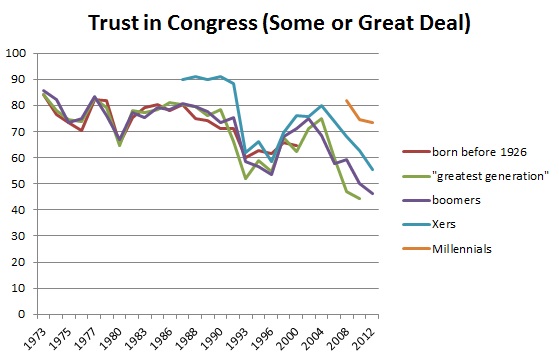
It is also widely believed that younger generations have less trust or confidence in government. This general construct can be measured in many ways. One useful time-series is a GSS question about confidence in the US Congress to do the right thing.

Millennials2

In this case, I see lots of change but little evidence of a generational thesis. The older three generations move in lockstep. Their confidence falls sharply after the Reagan/Tip O’Neil era, recovers from the Gingrich speakership and late Clinton era through 9/11, and falls subsequently. They are all seeing the same political situation and reacting similarly. Generation X does start at a much higher level in the 1980s. They also rise more in the middle of the George W. Bush administration. I would chalk this up to partisanship (since Xers have been somewhat more Republican than other cohorts), but the question concerns trust in Congress, and the Xers’ early trust is in a Democratic House. As for the Millennials, they enter with higher confidence than their parents show at the present time, but with similar views to older generations when those were young.

Overall, I would not describe this graph as evidence of a generational story but as an illustration of a “period effect”: everyone, regardless of age or birth year, has similar views of the current situation in Congress, and everyone is prone to fairly rapid changes depending on their perception of recent news from DC.

See also: a generational shift leftward?support for abortion rights: a generational storytolerance & generational changetalking about this generation; and young people and trust in government.

exemplary civic science: the CAFEH project

Highways produce very fine particles as pollutants. These particles concentrate close to the roads and are seriously dangerous for the people who live in range.

Neighborhood activists who were concerned about pollution from I-93 (which cuts through Somerville, Boston’s Chinatown, and Dorchester in our metro area) approached my colleagues at the Tufts University School of Medicine to study the problem. That began an elaborate, multi-year collaboration called CAFEH, the Community Assessment of Freeway Exposure and Health Study.

As an example of the scientific work, an especially equipped RV drove a fixed route close to and then away from I-93, collecting air samples for more than 50 days. Individuals both close to and further from the highway were interviewed in their homes (in many languages) and asked for blood samples. The resulting dataset showed conclusively that highway exposure is dangerous. In subsequent stages, the CAFEH team has been exploring strategies for mitigating these effects, including new filtration units.

This was civic science because neighborhood activists identified the topic and the hypotheses. They also played an essential role in recruiting human subjects. They were at the table throughout the project, deliberating about essentially normative or political questions. (For instance, would it be better not to build housing near highways at all, or would that give up on valid objectives, such as affordable housing and urban density?) The project built strong partnerships among the university, community organizations, local elected officials, and even developers, some of whom are now actively committed to filtration. Those are all signs of civic work or, in Albert Dzur’s terms, “democratic professionalism.”

At a public event on CAFEH today, I said that Tisch College has been proud to support the project throughout. We are not experts on pollution, health, or urban planning. We are a college of “citizenship and public service.” We recognize that institutions like Tufts, the NIH and EPA (which contributed funds to this study), and science writ large are powerful. Their power leaves ordinary citizens feeling marginalized. Thus to strengthen our democracy and civic life, we must make science more democratic. But how to do that? Not by asking laypeople to vote on whether ultrafine particles cause cardiovascular disease or by erasing the distinction between science and lay knowledge. The best way is the kind of painstaking collaboration that CAFEH exemplifies. Scientists really had to learn communities’ needs, values, and interests. And laypeople really had to learn the science of air pollution. They held each other accountable for demanding work. Greatly expanding the scale and scope of such projects seems to me one path to civic renewal in America.

how judgment is structured

Everything is judged

As you walk through the supermarket, your senses absorb data from tens of thousands of objects. Each presents a binary choice: buy or don’t buy. That is a value judgment, even if the only value consideration is whether you happen to like the item’s taste. But most likely, other considerations are relevant as well. Is it healthy? Would your toddler eat it? Is it worth the price, the weight in your basket, and the space on your shelf? And perhaps: were animals harmed in making it? Were people exploited? How much carbon was used to make it? Does the picture on the box objectify the human subject?

You can widen the lens, too, and ask not about individual items on the supermarket shelves but about the supermarket as a whole: Should you be spending your time there? Should your money flow to its owners? Should our systems of production and exchange be organized this way? Who cannot shop here?

And the choices are not really binary: buy or don’t buy. For each object, you could also appreciate it, recommend it, make a note to buy it another time, disparage it, steal it, throw it out the window. You could even act like Allen Ginsberg in “A Supermarket in California” (1955):

I saw you, Walt Whitman, childless, lonely old grubber, poking among the meat in the refrigerator and eyeing the grocery boys.

I hear you asking questions of each: Who killed the pork chops? What price bananas? Are you my angel?

I wondered in and out of the brilliant stacks of cans following you, and followed in my imagination by the store detective.

We strode down the open corridors together in our solitary fancy tasting artichokes, possessing every frozen delicacy, and never passing the cashier.

These lines remind us that we experience more than goods in a store. There are also the other shoppers and workers, real and imagined, alive and dead, with their words and desires. We can walk past anyone or anything without making a judgment; but that, too, is a choice and it implies a judgment.

Everything is structured

It is a familiar observation that experience presents us with too much data, and it all flows together without clear separations in space or time. William James, The Principles of Psychology, 13:

The law is that all things fuse that can fuse, and nothing separates except what must. … The baby, assailed by eyes, ears, nose, skin, and entrails at once, feels it all as one great blooming, buzzing confusion; and to the very end of life, our location of all things in one space is due to the fact that the original extents or bignesses of all the sensations which came to our notice at once, coalesced together into one and the same space.

Therefore, we organize, categorize, simplify, select. We don’t consider each box of Kellogg’s Cornflakes but the whole product line, or perhaps breakfast cereals taken as a class.

Aristotle began the discussion of categories with his book of that name, in which he argued that any thing could be classified in ten ways: where it is, when it is, its relation to other objects, its action, its being acted on, etc. In Kant’s version, the categories were not features of nature but tools of reason—by which he meant not merely human reason, for any animal, angel, or alien would have to use the same tools if it reasoned. Parting with Aristotle and with Kant, we could instead attribute these categories to human psychology (treating them as phenomena of our evolved, physical brains) or of language, which has a deep structure shared by all human beings.

But what matters most to moral judgment in a supermarket are not these fundamentals of location, duration, action, etc., but a more evident type of classification. Objects in a store are for sale or not, expensive or not, healthy or not. Such categories are not features of nature, reason, psychology, or the deep structure of language. They are constructed. Objects in a store have been designed and labeled so that they fit in various categories, for reasons determined by their owners and influenced by governments. Even the people wear various kinds of labels that intentionally classify them. The building as a whole also has marked boundaries and a location on an organized street plan. Although these categories have been constructed, no one controls them completely, for nature intrudes (an object isn’t healthy just because someone says it is) and because each observer has some individuality. I may think a given product is desirable even if you do not.

Some of these categorizations are morally neutral or unexceptional. Some are helpful. But some may be unethical or even evil: for instance, if they encourage us to buy products that gradually kill us or that have required murder and expropriation to create. The typical object is not actually lethal but it does have bad as well as good features. The same is true of each socially constructed category of objects, such as all the breakfast cereals or all the vegan items. And it is true of each institution that has constructed and maintained these categories.

But how can we tell how to judge right? From early school days, we are taught to distinguish between facts, which can be demonstrated or disproved, and opinions, which belong to the person who holds them. Moral judgments seem more like opinions than facts, hence not demonstrable or disprovable. Some people also argue that science is the only path to truth, and science has nothing to say about which objects are good or bad. There is not one “scientific method,” but many methods that scientists use: observation, measurement, classification, model-building, experimentation. But all scientific methods involve rigorous efforts to insulate the facts—to the greatest degree possible—from the observer’s value-judgments.

Such efforts are necessary because we have affective reactions to objects—positive or negative emotional surges that come faster than articulate thought. Francis Bacon already observed that “human understanding when it has once adopted an opinion (either as being the received opinion or as being agreeable to itself) draws all things else to support and agree with it.” Recent psychology insists that our emotional surges–what we find agreeable or disagreeable–explain the thoughts that follow them. We have a feeling and then we rationalize it with conscious ideas.

Thus we need not worry that we are morally apathetic, but we should worry that we are morally wrong. Consider, for example, the experimental evidence that most White Americans (and not a few African Americans) have immediate negative responses to Black faces. That is an example of a strong affective response that is relevant to such everyday experiences as shopping in a supermarket, where both the real people and some of the images on the goods appear to modern Americans to have racial identities. If, after science sifts out the facts, we are left only with instinctive reactions–including some invidious ones–which we then justify with moralizing rationalizations, we are in deep trouble.

Judgment, too, is structured

Individual moral claims are indeed untrustworthy, whether they are instinctive and inarticulate affective reactions or carefully constructed moral propositions. Taken one at a time, they do appear to be nothing more than opinions. We know that people’s opinions differ, and so we have grounds to be skeptical that any are better than others.

But moral claims do not come alone. We connect each one to others. I favor marriage equality–why? Because gay marriage is like heterosexual marriage. Because people want to love and be loved exclusively and durably. Because marriage tends to benefit the children. These are connections among pairs of ideas. They start to form a network. The network is much more persuasive than any particular idea.

First, the network bridges facts and values. Many of the claims in the previous paragraph are empirical, or partly so. Yet the same sentences that make empirical claims also embed deeply moral concepts.

Second, the network has formal features that cannot be attributed to individual ideas. For example, it is more or less consistent and coherent. Those are the most frequently cited criteria of good moral thought, and I believe they are overrated. (Evil fanatics are often highly consistent.) But we can add other formal criteria: networks of ideas ought to be rich, complex, and dense.

Third, a network permits interaction with other people. If I believe X and you do not, there is not much to discuss. But if I believe X because of Y, and Y because of Z, and Z because it resembles A, there is probably some node or connection in what I’ve said that you can lock onto.

My own structured network of ideas reflects the influences on me so far. If I had been born a gentile German ca. 1900, I probably would have favored Hitler in 1939 (if I had lived that long). Because I was born to an American Jewish father in 1967, it was easy for me to see that Nazism was evil. Still, I was correct in that judgment. The quality of the moral network with which we begin to reason is a matter of luck (“moral luck“). It is up to us, however, whether we test our structured ideas with people differently situated and motivated and revise it accordingly.
Peter Railton on why meetings are essential

The American Philosophical Association’s John Dewey lectures are autobiographical remarks by senior philosophers who draw lessons from their whole lives as scholars and people–much in the spirit of Dewey. University of Michigan Professor Peter Railton exemplifies the genre with his 2015 lecture, Innocent Abroad: Rupture, Liberation, and Solidarity, which is a wonderful reflection on a life of thought integrated with action.

What I want to quote is his defense of “meetings,” which is strikingly similar to the arguments I offer in We Are the Ones We Have Been Waiting For. Railton writes:

Oscar Wilde is still right—because the cost of building a society where the people have more say in how their lives are run is still many, many meetings. What is a meeting, after all, but people deliberating together with a capacity to act as a group that is more than just a sum of individual actions, and this sort of informed joint action is a precondition for significant social change. Come together, decide together, act together, and bear the consequences together. We must own our institutions or they will surely own us. As Aristotle told us, one becomes a citizen not by belonging to a polity or having a vote, but by shouldering the tasks of joint deliberation and civic governance. And there is no civic or faculty governance, no oversight of discrimination in hiring and promotion, no regulation of pollutants, no organization of faculty or students to initiate curricular reform, no mobilization by professional associations to protect their most vulnerable members or to promote greater diversity, no increased humaneness in the treatment of animals and human subjects, no chance to offset arbitrariness and bullying within offices and departments, no oversight of progress and revision of plans in response to changing circumstances, without actual people who care spending long hours in the work of planning, meeting, and making things happens. The alternative is for all these decisions to be made at the discretion of those on high—or not at all. …

Of course, I am using ‘committees’ and ‘meetings’ as stand-ins for countless forms of joint deliberation and action. It needn’t fill the streets with banners or occupy buildings—sustainable activism is the work of a lifetime, not just of youthful bravado. What most impresses me about the activism of today’s youth is that it persists, indeed, flourishes, in countless ways that are more integrated with the ways of working of the world. As I look around me from the vantage point of Philosophy, I see colleagues and students investing countless hours trying to enhance the inclusion of women and other under-represented groups, or to build collective bargaining for graduate student instructors and term lecturers, or to reach out beyond the university to promote equitable trade, or to support humane and ecological practices in agriculture, or to bring new resources to under-served communities. These efforts involve personal sacrifice, and often made by those within the academy whose positions are the least secure. Moreover, they are making these sacrifices without a movement at their backs, or a Zeitgeist to buoy them from below. So it behooves those of us who are more secure to revive our spirit of activism. To lend a hand, and to use whatever leverage we might have to provide badly-needed support.

I agree with every word above. I’d only add that opportunities to talk, listen, and work with fellow citizens have weakened. The proportions of Americans who said that they attended community meetings, worked with neighbors to address problems, and belonged to organizations fell between 1975 and 2005.

These trends were not accidental but reflected intentional moves to sideline citizens. For instance, jury trials were replaced with plea-bargaining. The proportion of Americans who served on public boards declined by about 75 percent during the second half of the twentieth century, due to consolidation of local governments and the replacement of lay bodies with professional managers. The decline of unions meant many fewer union meetings and collective bargaining sessions; it also meant that labor was no longer a force that could demand public discussion of issues.

It follows that democracy not only takes a lot of evenings. It also requires a fight for the right to use our evenings to govern ourselves–against people who would rather govern us.