community organizing between Athens and Jerusalem

Mark Readhead weaves the more philosophical arguments of my book We are the Ones We Have Been Waiting For into his recent Polity article entitled “Reasoning between Athens and Jerusalem.” I won’t do justice to Readhead’s complex and subtle position here, but a quick précis would go something like this: Habermas advocates “post-secular public reasoning,” in which both religious believers and non-theists (liberals, scientific naturalists, Kantians, Marxists) open themselves up to real mutual learning. “Secular and religious citizens must meet in their public use of reason at eye level. For a democratic process the contributions of one side are no less important than those of the other side.” But Habermas develops this ideal in ways that actually require the religious to “translate” their views into secular terms while not troubling the secular very much. Furthermore, the philosophical dialogues that Habermas envisions can’t build real solidarity among people who disagree about foundational matters. In accounts of faith-based community organizing by Jeffrey Stout and others, Readhead finds more genuine and promising examples of dialogue that is connected to work and relationships:

Contra Habermas, the actors whom Stout describes promote not an impersonal democratic process, but very personal democratic experiences fuelled by passion. Organizers plan intimate “one-on-one conversations, neighborhood walks, and house meetings,” as well as broader assemblies of diverse constituencies. All of these activities illustrate an under-resourced and under-appreciated genre of politics that Levine has called open-ended politics. Open-ended politics have no predetermined goals. Instead, citizens decide what to do as they work together.


why we miseducate children to think of values as opinions

In “Why Our Children Don’t Think There Are Moral Facts,” Justin P. McBrayer observes that his second-grade son has been taught to distinguish between facts (which can be “tested or proven”) and opinions (which are just what “someone thinks, feels, or believes”).

In the category of “opinions” are placed all moral claims, including “Copying homework assignments is wrong,” and “All men are created equal.” Presumably, if a child says it is wrong to kill someone for the fun of it, that is labeled an opinion.

McBrayer notes that the same school that teaches his son to view moral claims as opinions also insists that it is really is wrong to cheat and really important to protect other students’ rights. I assume that the school not only proclaims these ideas explicitly but also builds them into its “hidden curriculum” of norms, expectations, punishments, and rewards. By teaching moral values while defining them as opinions, the school contradicts itself.

McBrayer has not just discovered an educational fad or a politically controversial agenda being pushed lately by a small group of adults under our noses. The fact/opinion distinction, as it is taught to his son, is a troubling hallmark of our age.

For instance, education is deeply influenced by standardized testing. What is tested will determine what McBrayer’s son learns in school for the next decade. I have been involved in writing exams, such as the federal government’s National Assessment of Educational Progress (NAEP) in Civics. This is an excellent instrument, supported by impressive science. Much skillful effort is devoted to identifying questions that yield good statistical results. Proposed questions that produce anomalous scores get cut. Based on their scores, the higher-performing students are labeled as “proficient” or “advanced.”

But each item on the NAEP is fundamentally a value-judgment. Should a citizen know the text of the Second Amendment, how many votes it takes to pass a law, or the history of racist violence in the US? Is a young person who understands half of these topics a “proficient” citizen, or “below basic”?

There are no scientific answers to those questions. They are matters of value, on which the entire edifice of testing rests. Yet all the official discourse about standardized tests skirts value questions and dwells on the statistics.

A Nazi civics test could be scientifically valid and reliable. It could work beautifully to identify young Nazis. It would be evil, whereas our standardized tests are at least reasonably decent—but the difference is not scientific. It is a moral matter.

Going beyond tests, the whole educational system that serves Prof. McBrayer’s son is built on techniques and practices scrutinized by science. The No Child Left Behind Act (still the governing federal law on k-12 education), favors forms of instruction supported by “scientifically-based research.” Randomized experiments count as the most scientific.

Thus, for example, experiments endorsed by the federal government show that paying teenagers to stay in school can cut their dropout rates. Another approach that also seems to lower dropout consists of “weekly after-school discussion groups … on personal, family, and social issues,” such as those arranged by a program called Twelve Together.

These very different programs are both presented as proven by science. But it is not self-evident that completing high school is a valid target, especially given the kinds of schools we actually provide. To identify graduation as the goal is a judgment. If such judgments are mere opinions, then there is nothing more to be said about them. But surely we can reason about the ends of education.

We should also reason about means. Could paying teenagers to stay in school “work” (boosting their graduation rates) yet still be wrong? Could it be an example of treating human beings as objects rather than autonomous subjects?

Finally, nothing just “works.” Ideas that are ready to be scientifically evaluated have always been designed, advocated, funded, implemented, tweaked, and refined. That implies effort by teachers or other front-line practitioners, administrators, and social scientists. A wide range of ideas can be made to work if the investment is sufficient and skillful.

But what we should invest in is a value question. We could start by paying teenagers to stay in school and work to make that a highly effective program. Or we could start by teaching them philosophy and refine our methods until that keeps them in school. Which approach we should try to make work is again not a scientific question but a moral one. All the scientific data on “effective practices” follow from our fundamental moral choices.

I have used educational examples here to connect to McBrayer’s article, but the same modes of thinking will be found in health, environmental protection, labor—indeed, all domains of policy and practice. A simplistic fact/opinion distinction influences sophisticated scholars and policymakers as much as 2nd graders and their teachers.

To be sure, budding social scientists are taught that values matter; they influence people’s behaviors and actions, and they influence social science itself. But this influence is treated as a problem. In the “limitations” section at the end of a scholarly article, the authors may confess that they have a “bias” in favor of certain values.

But moral commitments are not limitations; they are preconditions of decent scholarship. The difference between valuable and harmful social science is that the former manifests good values.

Science has achieved prodigious successes in understanding and controlling nature. It can also debunk certain assertions that are morally problematic, for example, that white people are biologically superior. But science cannot demonstrate most moral claims.

For instance: every child in second grade has the same moral value and importance. Looked at from a scientific perspective, that statement makes no sense because value is not a scientific idea. Or perhaps the statement is scientifically false, because science translates “value” into something like capacity or functioning, and not every second-grader does function at an equivalent level. We can try to equalize their capacity by devoting care and resources to the children who need it most—but science provides no reason to do that.

The influence of a simplistic fact/opinion distinction is not the fault of philosophers, who have always viewed the topic as complex. But it is philosophy’s responsibility to challenge the distinction that is so prevalent today. Otherwise, not only will we teach second-graders to view morality as mere opinion, but we will build massive social institutions on the same untenable premise.
generational change and the state of the press

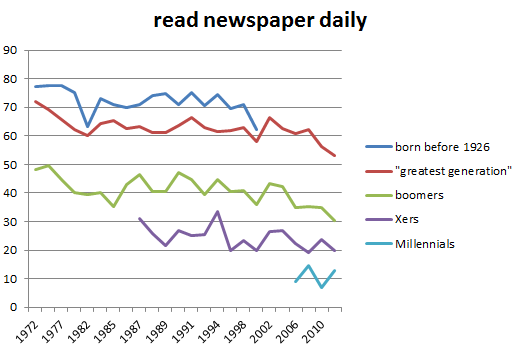
Reading a daily newspaper is a classic example of a generational habit. Since 2002, members of the “Greatest Generation,” Baby Boomers, and Gen-Xers have all reduced their reading of daily newspapers a bit. But the real reason for declining readership is generational replacement. Going back to the 1970s, we see a strong pattern that each generation reads the newspaper much less than its predecessors. That means that as succeeding generations compose larger shares of the population, total readership falls.

newspaper

(Unfortunately, the GSS doesn’t provide a lengthy time series on Internet news, which would make an interesting comparison.)

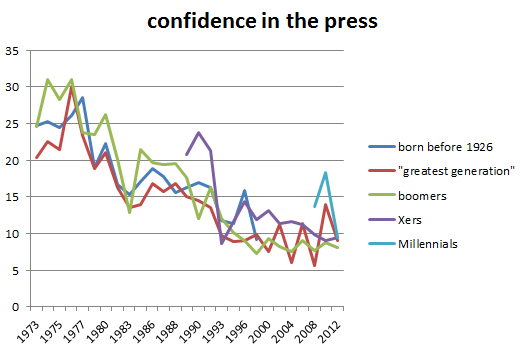
On the other hand, people’s confidence in the press is not a generational story at all. Everyone lost confidence, with the biggest decline occurring between 1977 and 1993. The generations that were old enough to be surveyed during those years sang in unison. Millennials were at first slightly more confident than other generations, but now they have the same views as all the older people.

trustthepress

Basically, this is a story of an industry losing the public’s trust (fairly or not)–it is not about the Millennials or any other generation.

Hannah Arendt and philosophy as a way of life

In “Martin Heidegger at Eighty” (1971), Arendt recalled:

The rumor about Heidegger put it quite simply: Thinking has come to life again. … People followed the rumor about Heidegger in order to learn thinking. What was experienced was that thinking as pure activity–and this means impelled neither by the thirst for knowledge, nor the drive for cognition–can become a passion which not so much rules and oppresses all other capacities and gifts, as it orders them and prevails through them. We are so accustomed to the old opposition of reason versus passion, spirit versus life, that the idea of passionate thinking, in which thinking and aliveness become one, takes us somewhat aback.

I first read this passage many years ago. Lacking any enthusiasm for Heidegger, I thought that Arendt was just celebrating her former teacher’s excellence and originality. “Thinking has come to life again” meant that someone as important as Kant or Hegel was again developing a philosophy, and one could study with him.

Now, having read works like Pierre Hadot’s Philosophy as a Way of Life, I think I understand Arendt better. People called “philosophers” have made at least three kinds of contribution over the millennia; Arendt was seeking a union of the three and believed that Heidegger offered it. That’s what she meant by “Thinking has come to life again.”

First, philosophers have interpreted other people’s thought in valuable ways. In this mode, philosophy is form of cultural critique or intellectual history. Describing the rumors about Heidegger’s seminar, Arendt recalled: “the cultural treasures of the past are being made to speak, in the course of which it turns out that they propose things altogether different from the familiar, worn-out trivialities they had been presumed to say. There exists a teacher; one can perhaps learn to think. …”

Second, philosophers have offered arguments: chains of reason that carry from a premise to a conclusion. If you hold the premise and the reasons are valid, you should endorse the conclusion. Following the argument to its end should change your store of beliefs, because now the conclusion should join the list of things you consider true.

Third, philosophers have taught reflective practices, methods of introspection or even meditation. These are different from interpretations of texts, because the process is more personal and creative. If a text is used it all, it is a prompt for introspection. These reflective techniques are also different from arguments, because they can begin with a range of premises and go in unexpected directions. They tend to require practice and repetition to yield their outcomes, which are changes in mental habits, not just lists of beliefs. You can read an argument once and evaluate it. You must introspect many times to have any impact on your psychology.

It makes sense to put these three contributions together because we are reasonable creatures (capable of offering and sharing reasons for what we do), but we are also habitual creatures (requiring mental discipline and practice to change our thinking) and historical creatures (shaped by the heritage of past thought). Reason without acquired habits of self-discipline is empty. But self-discipline without good reasons is blind and can even lead in evil directions. Both are rootless without a critical understanding of the ideas that have come before us.

Hadot argued that the schools of Greek philosophy between Aristotle and Christianity offered reflective practices more than arguments or readings. We misread a work like Marcus Aurelius’ Meditations if we assume that it is a set of conclusions backed by reasons. Instead, we will find there a record of a Stoic’s mental exercises, beginning with his daily thanks to each of his moral teachers. He lists his teachers and other exemplary men by name because he would actually visualize each of these people in turn. The Meditations shows us how.

Martha Nussbaum (in The Therapy of Desire, p. 353) and others have argued that Hadot exaggerated. The ancient Greek philosophical schools all took argumentation very seriously. (I would add that they were serious about interpreting older works, such as those of Plato and Aristotle.) But Hadot’s thesis strikes me as interesting even if he overstated it. The Greek schools combined argumentation with repeatable mental exercises and saw the two as closely linked. In this respect, they resembled the early Buddhist teachers who flourished at the same time. Today, the latter are often stereotyped as merely offering mental exercises (such as yoga), but they excelled at exacting formal argumentation. Indeed, the Buddhists and Hellenistic philosophers were in close contact in Northern India and learned from each other. (I see a distinction between Eastern and Western philosophy as useless, because each tradition encompasses enormous diversity, and the two have been closely linked.)

Hadot claimed, however, that Christianity ruptured the combination of argument and mental exercise that had been common in the Mediterranean and in Northern India before the Christian Era. Christians adopted all the major ideas of the classical Stoics but parceled them out. Abstract reasoning went to the medieval university, where Arendt’s “thirst for knowledge” and “drive for cognition” were prized. Hadot wrote, “In modern university philosophy, philosophy is obviously no longer a way of life or form of life unless it be the form of life of a professor of philosophy.” Meanwhile, the reflective practices went to monasteries.

Arendt perceived Heidegger as putting these parts back together. Reading classical works in his seminar (or in a reading group, called a Graecae) was a creative and spiritual exercise as well as an academic pursuit. Karl Jaspers held different substantive positions, but he had a similar view of philosophy, the discipline to which he had moved after a brilliant career in psychiatry. Elisabeth Young-Bruehl writes that Jaspers’

new orientation was summarized in many different ways, but this sentence is exemplary: ‘Philosophizing is real as it pervades an individual life at a given moment.’ For Hannah Arendt, this concrete approach was a revelation; and Jaspers living his philosophy was an example to her: ‘I perceived his Reason in praxis, so to speak,’ she remembered (Hannah Arendt: For Love of the World, pp. 63-4).

Arendt fairly quickly decided that “introspection” was a self-indulgent dead-end and that Heidegger’s philosophy was selfishly egoistic. Then the Nazi takeover of 1933 pressed her into something new, as she assisted enemies of the regime to escape and then escaped herself. She found deep satisfaction in what she called “action.” From then on, she sought to combine “thinking” (disciplined inquiry) with political action in ways that were meant to pervade her whole life.

That combination is hard to find today, if it can be found at all. Moral philosophy is dominated by an argumentative mode that doesn’t take seriously mental exercises and practices. Meditation is increasingly common but usually separate from formal argumentation and moral justification. Meanwhile, “therapy”–the ancient Greeks’ word for what philosophers offered–has been taken over by clinical psychology. That discipline does good in the world but misses the ancient objectives of philosophy. Modern therapy defines the goals in terms of health, normality, or happiness (as reported by the patient). Therapy is successful if the patient lacks any identifiable pathologies, such as depression or anxiety; behaves and thinks in ways that are statistically typical for people of her age and situation; and feels OK. Gone is a restless quest for truth and rightness that can upset one’s equilibrium, make one behave unusually, and even bring about mental anguish. To recover that tradition, we would need thinking to come alive again.

is our constitutional order doomed?

Mathew Yglesias has brought renewed attention to Juan Linz’ thesis that our constitutional order is doomed. The basic idea is that if the chief executive and the legislature are elected separately, they can belong to different parties. In such cases, the legislature has every incentive to undermine the president, who will respond by expanding executive power. That situation will degenerate until the constitution fails, as it has in almost every presidential system outside the USA. See Yglesias’ Vox piece, “American Democracy is Doomed,” Jonathan Chait’s response (“There’s a Chance American Democracy Is Not Doomed“), and my own post “Are we seeing the fatal flaw of a presidential constitution?

The Linz thesis requires an explanation for why the US system has not already collapsed after more than two centuries. The leading explanation is that we have never actually had two parties in Congress, notwithstanding the labels. Internal party splits have caused us to have at least three–and often four or more–effective parties. Thus presidents have been able to construct governing coalitions even when they face a majority of the opposite party. Reagan, for example, got most of his agenda through Tip O’Neil’s Democratic House because Southern Democrats voted with Republicans on key issues.

Our current situation looks unprecedented because the two parties are now perfectly polarized, with all the Democrats to the left of all the Republicans. Thus the Linz thesis explains paralysis and executive unilateralism under Obama and predicts worse to come.

But then we observe the Department of Homeland Security funding bill pass the Republican House with unanimous Democratic support. Democrats are also saying they would protect Speaker Boehner from a Tea Party effort to unseat him. (The Speaker is chosen by majority rule, so Boehner could hold his gavel with a mix of Republican and Democratic votes). These two examples suggest that Boehner is in the same place as O’Neil during the Reagan Administration. He leads a caucus that formally and rhetorically opposes the president. But sometimes the governing coalition in the House consists of 75 Republicans plus all the Democrats. Boehner is like a Prime Minister whose own party (the Center-Right) is smaller than its coalition partner (the Center-Left) but who alone can command more than 50% in votes of no confidence.

This situation only applies some of the time. Boehner does not like (and will not even acknowledge) his dependence on Democrats. It poses a serious problem for all Republicans, not just for Tea Partiers, because it cedes considerable power to the other party. Thus Republicans will make creative and sustained efforts to change the situation. But to the extent that it prevails, we will return to the classic US pattern instead of dissolving into a Linzian nightmare.