against fatalism: responding to Krugman and Sunstein

(Washington, DC) Harry Boyte, Albert Dzur, and I have a letter in the latest New York Review of Books that is pertinent to today’s column by Paul Krugman. Krugman’s piece, entitled “Economics and Elections,” is deeply depressing and depressed, exemplifying the very mode of thought that Harry, Albert, and I wanted to challenge in our letter about Cass Sunstein and Michael Walzer, which we wrote more than a month ago.

Krugman argues today that the British Tories did immense and unnecessary damage to the UK economy by enforcing austerity policies. However, the British economy has grown of late, and “a large body of political science research” finds that what determines the outcome of a national election is economic growth during “the last two quarters before the election.” That factor is much more important than any behavior or rhetoric by politicians or anything that the media can say or do. It explains why the Tories may win.

For politicians, the lesson is to ignore the good of the country if you want to be reelected. In fact, “the politically smart thing might well be to impose a pointless depression on your country for much of your time in office, solely to leave room for a roaring recovery just before voters go to the polls.” Scholars and public intellectuals can do little to change this reality, Krugman argues, but they should commit to the truth anyway, like geeky existentialists. Our duty as intellectuals:

Try to get it right, and explain our answers as clearly as we can. Realistically, the political impact will usually be marginal at best. Bad things will happen to good ideas, and vice-versa. So be it. Elections determine who has power, not who has the truth.

(By the way, this is an interesting reversal for Krugman, who early in the Obama years was quick to accuse the president of not using the Bully Pulpit effectively. As he now notes, political scientists basically don’t believe in the Bully Pulpit.)

Cass Sunstein, a distinguished and often insightful political scientist, has collected evidence along similar lines to the “large body” of research cited by Krugman today. Sunstein and his co-author Reid Hastie argue that individuals and groups reach irrational conclusions because of hard-wired cognitive limitations, such as a tendency to “groupthink.” The behavior of voters in a national election is just an example.

Such evidence should be taken seriously. But Michael Walzer offered an important critique in the New York Review of Books that could also apply to Krugman’s article today. Walzer argued that problems (like groupthink) that bedevil discussions inside Congress, the Supreme Court, or any committee room may not be as serious as “powerlessness and inequality.” He concluded:

Organizing, agitating, demonstrating—these are ways of bringing the powerless to the attention of the powerful. They can contribute importantly to democratic decisions, even if they seem nondeliberative. … Sometimes we will want the people outside the room actually to win—to organize and agitate so successfully that they take over the small groups who dominate decision-making, with the result that they change the political conversation. … So, yes, we need to be wiser in the ways described by Sunstein and Hastie; but we also need a radically different kind of decision-making than what they describe, involving a larger number of people inside and outside the rooms where small groups sit.

We concur but would push the argument further. Political institutions can be changed. This is not only a matter of adjusting the rules that govern, for instance, parliamentary districts in the UK or campaign finance in the US. It is also about achieving cultural change within major institutions, such as legislatures, newspapers, and schools and colleges. It is about changing us (the citizens), not just them (the rulers). We wrote:

Sunstein, like Habermas and many others, sees major institutions as largely fixed and unchangeable, not subject to democratizing change. This assumption generates fatalism, which has shrunk our imaginations about decision-making, politics, and democracy itself. The challenge is to recognize that institutions of all kinds are human creations that in turn can be recreated, reconnected to questions of civic and democratic purpose. For this task we need to bring in Max Weber as well as Machiavelli and Marx [whom Walzer had recommended in his review]. Weber described the “iron cage” that results from technical rationality. In his essay “The Profession and the Vocation of Politics,” Weber also evocatively termed the pattern “the polar night of icy darkness.” Thawing the polar night is a frontier of democracy in the twenty-first century.

The evidence that Krugman and Sunstein cite is empirical. By definition, it derives from the past. In the case of Krugman’s column today, it derives from quantitative studies of US presidential campaigns since World War II. We should pay attention to trends in the recent past so that we know what to change. But we cannot allow the past to become a dead hand so that we surrender our political agency.

I addressed the very same topic in We Are The Ones We Have Been Waiting For (pp. 26-7):

The outcome of presidential elections in the United States is strongly correlated with the performance of the economy in the previous year. That means that all the deliberate work of campaigns, parties, and independent advocacy groups matters less than the blind, impersonal force of the business cycle.

Nevertheless, working together in small groups is morally important—it is what we should do and should care most about. To be a good person is to do this work well. That is reason enough to make it a central question for reflection and research. In addition, deliberate human action has significant impact. Small groups of thoughtful, committed citizens do make a difference under appropriate circumstances, as shown by the civil rights movement, the women’s movement, the conservative legal movement, and numerous other examples. … Elinor Ostrom won the 2009 Nobel Prize in Economic Sciences for demonstrating that the organization and governance of voluntary groups affects whether they can solve social problems. These findings suggest that “small groups of thoughtful, committed citizens” matter, even if other factors matter too.

If the leaders of the South African freedom movement reviewed the scholarly literature on democratization during the apartheid years, they must have found it depressing. Prosperity, economic equality, and ethnic homogeneity were the factors that had been found to increase the odds of a successful transition to democracy. These structural factors were all evidently absent in South Africa. … Thus, if the African National Congress and other democratic reformers had been guided by hard-nosed, empirical research, they would have chosen a goal short of democracy, something like a negotiated arrangement among separate authoritarian communities. But they were right to ignore the scholarly literature because it was based on empirical data—in a word, on the past—and the past can never determine the future. So far, their peaceful revolution appears a monumental work of deliberate human agency.
Discovering Justice and civics for young children

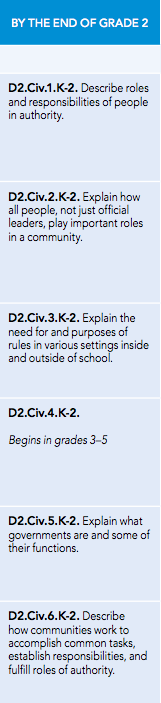
Screen Shot 2015-04-02 at 11.33.00 AM The Annual Benefit dinner for Discovering Justice is this evening, and I’d like to take the opportunity to highlight the organization, on whose board I serve. It is the most significant and effective group in the US that supports the civic education of younger children, grades k-8.

Relatively little is known about the lasting effects of civics at the lower grades–or even about what works best. Certainly, “civics” for younger children overlaps with character education, interpersonal skills, and personal behavior. It’s not all about laws, systems, and social issues. Discovering Justice takes a holistic approach. Still, even if we define “civics” narrowly, it is an appropriate topic for elementary students. The C3 (College, Career, and Citizenship) Framework identifies fairly specific civics content for grades k-2, shown at the right.

Kids are definitely able to learn these things. I cannot demonstrate that if they do, it will make a difference once they’re 30–especially if they get no reinforcement in between. But I’d be willing to bet that teaching these topics in elementary school is one component of an effective civic education. And the only way to find out is to develop, refine, improve, and test k-8 civics, which is the role that Discovering Justice has taken on.

from soft skills to agency

I’m very pleased to see a blog post by Andy Calkins, Deputy Director of the Next Generation Learning Challenge, entitled “It’s Time to Trash the Terms ‘Non-Cogs’ and ‘Soft Skills.'”

Partly in response to the hegemony of standardized testing, some organizations and individuals have been pushing for “non-cognitive” or “soft” skills (e.g., collaboration, grit, participation) as important measures and goals of education. Theirs is a valid goal, but I agree with Calkins’ critique of the terminology. The kinds of skills that have been named “non-cognitive” actually require advanced cognition; the skills that have been labeled “soft” are, in every sense, quite hard.

But it’s not his critique of terminology that makes me recommend Calkins’ post. Rather, it’s the alternative master term that he recommends to replace “non-cog” and “soft.” Calkins chooses “agency,” which is indeed an apt word for the individual student outcomes that have been overlooked in the era of narrow assessments. Agency comprises an individual’s ability and motivation to interpret and change the world. But it is not an only individual matter. Agency has to be political (in the broadest sense), because individuals are truly effective as agents when they work together.

Thus we can say that citizens have agency; and people who exhibit agency in public contexts are citizens. Doris Sommers, who visited Tisch College earlier this week, would argue that citizenship is “cultural agency”: intentionally shaping the common world together. And Harry Boyte and Blase Scarnati write, “Agency can be understood as a form of empowerment that has conscious political dimensions, or as effective and intentional action that is conducted in diverse and open settings in order to shape the world around us.”

In We Are the Ones We Have Been Waiting For (pp. 27-8), I write:

A master question for social theory during the twentieth century was structure versus agency: whether people’s voluntary choices made any difference in politics, or whether underlying “structures” determined everything. This question divided, for example, French existentialists (who preached the value of intentional political acts) from French structuralists (who thought that political events, including major elections and revolutions, were superficial perturbations on the permanent structures below). But the question for the twenty-first century should be different: not how much impact agency has, but how that impact can be expanded. The reason to expand it is not that agency is intrinsically good. Hitler was an effective political agent. Rather, deliberate and effective human action is one necessary condition of a worthwhile human life. If there is no agency, life can have no point.

In the context of education, “agency” moves us from a purely individualistic framework to a recognition of collaboration, social capital, networks, public discourse, and other outcomes for groups and communities.

This argument is important coming from the Next Generation Learning Challenge, which is influential, hard-nosed about measures and methods, and involved with enhancing students’ success as currently measured. (For full disclosure, the NGLC funded us for a randomized experimental test of iCivics’ Drafting Board module, which we found to be effective.) It would be easy and unremarkable for me–a civics and democracy guy–to endorse agency. For the NGLC to choose it as a master term is much more valuable.

See also: “from the achievement gap to empowerment

religious liberty and discrimination

If we set aside the invidious motivations for–and the details of–the Indiana Religious Freedom Restoration Act, it does raise some fairly complex constitutional questions. Here are five theories that one might adopt in response:

1. The law should ban private discrimination on the basis of sexual orientation. To deny a regular service to a citizen because she or he is gay is hurtful and cruel and reinforces a whole system or culture of domination that also has serious economic and civic consequences. Therefore, such discrimination can and should be banned.

I endorse the whole premise. The questions are (a) whether the state and law are the appropriate instruments for remedying this problem, and (b) whether a conflicting interest (religious freedom) should be given any weight. We must allow individuals to do some things that we are certain are bad and wrong in order to limit government in the interest of liberty. It is not a free society that permits only good actions. Not any liberty counts, but the establishment and free exercise of religion are two explicit freedoms named in the First Amendment. To deny their relevance not only ignores the constitutional text but suggests that other forms of religious discrimination should also be illegal–for instance, that the Catholic Church should be required to ordain women. This seems a problematic implication.

2. The law should ban private discrimination on the basis of sexual orientation, with a special exception for religious freedom. The defendant in a discrimination suit would be required to demonstrate that her or his religion was clearly and stably committed to such discrimination. The defendant’s denomination would then be revealed to hold discriminatory views, with a potential cost to its reputation. If other members of the denomination were moved to contest its position on gay rights, that would be a benefit. Yet the religious liberty of the defendant would be honored.

I endorse some of this argument, but a lot rests on the definition of religion. It seems unjust to give special rights to people who believe in the existence of one or more deities. Just yesterday, the First Church of Cannabis declared its interest in selling marijuana in Indiana under the protection of the Religious Freedom Restoration Act. Why not? Also, this approach will involve the state in inquiries into religious doctrines and traditions. Is it really wise to ask a secular court to decide whether, for example, discrimination against gays is rooted in the Talmud or in some specific Protestant tract?

3. Jacob Levy’s suggestion: “private businesses should be free to refuse customers, subject to two categories of exceptions: (a) if the firms are common carriers or (in the common law sense) public accommodations rather than ordinary private retailers and (b) in the United States, due to the constitutional and historical distinctiveness of Jim Crow and its melding of public and private discrimination, discrimination on the basis of race.”

This is a more libertarian view, more protective of individuals’ rights to choose their own contracts and relationships. It carves out a special exemption for racial discrimination in the US. (Levy teaches in Canada and is thinking about these issues globally.) I am not hostile to his position, because liberty is a very high principle and because the state is not our only instrument for changing private behavior. I would also agree that race is a unique case in the US. But a lot hangs here on the seriousness of discrimination based on sexual orientation. It’s easy for me–a straight man–to write as if religious freedom can simply be balanced against equality. If I were gay and denied a service on that basis, I would probably feel that my very personhood had been assaulted, not merely as an individual act but as part of a system or culture of oppression that also costs lives. Homophobia is a deadly problem, and perhaps the state should intervene even in private contracts to address it.

4. Forbid discrimination in certain kinds of business. Levy hints at this kind of solution when he mentions “public accommodations,” about which there is a large body of case law, legislation, and scholarship. The basic idea is that McDonald’s should be forbidden from discriminating on the basis of sexual orientation (both in hiring and in service), because it operates a mass, transactional enterprise. You pay your money; you get your burger and fries. But Elane Photography (a small New Mexico business) is not running a public accommodation. A more-or-less solo photographer may choose whom to photograph. If she chooses only to photograph opposite-sex weddings, that is allowable under the First Amendment.

I find this distinction somewhat helpful, but there is no bright line between Elane’s and McDonald’s. Furthermore, the mere fact that Elane is a small business does not make its discrimination any less hurtful.

5. Honor the small-r republican principle that the people should govern themselves by deliberating and making law. Let the people decide whether or not to ban discrimination.

I am a small-r republican and believe that collective political freedom is too often overlooked. But who is “the people?” You will get very different laws if Bloomington can decide, if Indiana decides, or if Washington takes up the issue (and probably deadlocks, leaving the status quo in place). Also, the most important reason to restrain the rights of the people to govern themselves is to protect individuals’ rights. But then again, both non-discrimination and free exercise are individual rights. The republican principle doesn’t say which one should trump popular rule.

bad does not imply worse

Christopher Jencks makes a characteristically wise point (after displaying a graph that shows that real poverty has declined a lot since 1959, and a bit since 2009):

The equation of “bad” with “worse” is so tight in American political discourse that when I tell my friends or my students that “there is still a lot of poverty, but less than there used to be,” they have trouble remembering both halves of the sentence. Some remember that there is still a lot of poverty. Others remember that there is less than there used to be. Few remember both.

I observe the same phenomenon constantly. The problem, for example, with our students’ civic knowledge is not that it has declined. Scores on civics tests have been remarkably stable over a long period. It’s just that civic knowledge is (and used to be) too low. The same is true of voter turnout: quite flat since the 1970s, but at a problematically low level. I offer additional examples from social policy in “why do we feel compelled to argue from decline?” It seems that you cannot get attention for a problem unless you pose it as a recent and alarming deterioration from a previously superior state. That is an obstacle to taking our most stubborn problems seriously.