pay-for-success in government

Let’s say you represent a program that would really save the government money as well as serving a social need. For instance, your program can cut the number of felonies, thereby saving $31,000 per person/per year in incarceration costs while reducing human suffering and injustice.

You’d like to ask the government for funds. You can’t get money from the executive branch at any level, because government budgets are committed to specific current activities, such as incarcerating a predicted number of inmates or fielding a certain number of police officers. Most agencies lack discretionary budgets for prevention, even if an investment would save them money later.

You could get funding from a legislative appropriation, but legislatures are not well set up to distinguish between truly effective preventive programs and those that just lobby well. In a crowded environment with tight budgets, your odds aren’t especially good.

You could offer the executive branch a contract that would commit the government to pay you from the savings that you actually achieve later on. They could measure the size of the savings using the most rigorous methods, such as random control groups. Then they could afford to pay you out of the savings in their planned budgets in future years.

But how can you operate your program until you deliver the savings and get paid? That apparent conundrum may have an answer: private third parties could invest in your program and get their money back–with a profit–once the government pays you for saving it money.

This is the pay-for-success model. Last week, we heard about it at a Tisch College panel with Jeffrey Liebman of the Harvard Kennedy School (the intellectual leader of this movement, who also provides technical support to governments); Molly Baldwin, Founder and CEO of Roca Inc., which has a pay-for-success contract to cut incarceration among highly at-risk young men in Massachusetts; Jeff Shumway of Social Finance, who sets up these deals; and Brian Bethune of the Tufts Economics Department and a Tisch College Faculty Fellow for 2015-16.

The evidence seemed compelling that Roca will save Massachusetts money while helping young men get on a better track. But I am a civic engagement/democratic participation guy, so I am supposed to ask, “Where are citizens in all of this?” I would say the following:

First, pay-for-success is value-neutral. It is an efficiency measure that could be used for a wide range of purposes. A dictatorship could use it to round up human rights protesters more effectively. Reducing incarceration in Massachusetts sounds much better than that, yet it could possibly legitimize the prison system. I don’t really agree with that critique, but I would acknowledge that any social intervention is a value choice. As such, it should be informed and reviewed by the public.

We already have the power to elect the high officials who preside over Massachusetts’ state government. But an election presents a binary choice (the Republican or the Democrat), which is a crude device for influencing subtle choices, such as whether to fund Roca, Inc. We can lobby and advocate on such matters, but there is an inevitable tendency for most advocates to be biased by self-interest or strong ideology. So we need more deliberative forms of civic engagement that get a wider range of people involved in making difficult value choices.

But increasing civic engagement seems fully compatible with using a pay-for-success model to get the government’s own job done. In fact, pay-for-success is wonderfully transparent. If citizens are asked to pay for 10,000 jail cells, we have no way of knowing how that will affect crime, safety, or fairness. But we can review the Roca, Inc. agreement and decide whether it offers what we want. And we don’t pay a dime unless it delivers.

A different question is how citizens should be involved in the programs themselves. I would hypothesize that in general, programs that produce good results have been designed and built through collaborations that involve the affected communities. Social policy is not like medicine, where chemical compounds that were invented in labs can cure (some) diseases in the real world. Social interventions operate in complex contexts with lots of conflicting values and interests, so they typically work only if they have been co-constructed. That is true, by the way, of Roca; Molly Baldwin emphasized that youth in the program have influenced its design.

Finally, if you want a robust democracy, one element has got to be a reasonably effective government that is capable of delivering what the people choose after due reflection. Eighty years after the New Deal, the US welfare state is not well designed for that purpose. It can’t, for example, make sensible investments in prevention. Even when it pays for activities that should have preventive effects (such as education), it doesn’t pay for success; it just funds the activities, some of which are ineffective. So I believe that pay-for-success is one step toward restoring confidence in government as the people’s instrument. Confidence is not an end in itself, but it is an important means to reengaging citizens in public life.

But see also: “qualms about a bond market for philanthropy”,can nonprofits solve big problems?” and “innovation and civic engagement.”
the Millennials’ political values in context

The General Social Survey asked a set of questions about political values or principles twice, in 2004 and 2014. The questions were phrased, “How important is it ….?” and the items included: always to obey the law, always to vote, never to try to evade taxes, and always to understand other people’s reasoning. Respondents were also asked how important it is for people to be able to participate in making decisions. It’s a nice mix of conventional civic obligations and deliberative and participatory values.

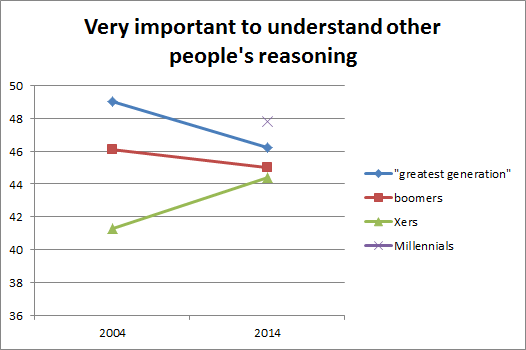
As is my wont, I have looked at the changes generationally. Graphs are helpful for visualizing these changes. For instance, the first graph below displays an interesting pattern in attitudes towards understanding other people’s reasons. Generation Xers have become substantially more committed to this value as they (or I could say “we”) have aged, although we still lag a bit behind our elders. Older Americans have lost their commitment somewhat, especially the group that was born between 1926 and 1945. Millennials enter the picture with the highest levels of support currently, although they rate listening as less important than their grandparents did a decade ago.

GSSothersreasons

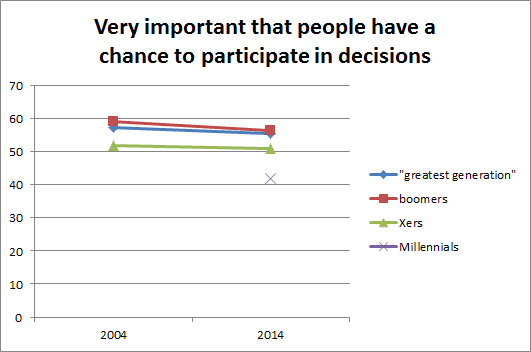
I’ll display a second graph that shows quite a different pattern. The younger you are today, the less likely you are to believe that it’s very important for people to be able to participate in decisions. At least since 2004, the older cohorts have not changed their minds on that topic. Millennials continue the pattern of declining support by entering adulthood with the lowest levels of commitment to the value or principle of participation. This graph suggests that unless we do something to change the trends, generational replacement will gradually lessen our commitment to participation.

GSSparticipation

The pattern for always obeying the law looks like the second graph above, although the gaps are smaller. Millennials seem less committed than their predecessors, which could reflect an openness to civil disobedience.

All the older cohorts have grown to oppose tax evasion more as they have aged. Millennials enter the picture least committed to that ideal, but they are just where the Xers were a decade ago, and it’s possible that people’s focus on this topic naturally grows as they age.

Voting, finally, shows a pattern like participation in decisions (the second graph above). Commitment is lower for each generation, and much lower for Millennials. The older generations did not change their minds between 2004 and 2014, but the shrinking of the pre-War cohort and the growth of Xers and Millennials pushes down the average for the population as a whole. Voting is becoming less of a perceived obligation due to generational replacement. However, it’s important to note that this is a question about the obligation to vote. Actual voting rates have been flat over time. In other words, Millennials vote at similar rates to their predecessors; they are just less likely to conceive of that action as a duty.

America’s Civic Renewal Movement: The View from Organizational Leaders

With support from the William and Flora Hewlett Foundation, Eric Liu—the founder and CEO of Citizen University and executive director of the Aspen Institute Citizenship and American Identity Program—and I interviewed 20 key organizational leaders about strategies to expand civic engagement in the United States. Our new paper is: Peter Levine and Eric Liu, “America’s Civic Renewal Movement: The View from Organizational Leaders” (Medford, MA: Jonathan M. Tisch College of Citizenship & Public Service, 2015).

Interviewees agreed that the nation faces polarization, corruption, and weakened civic capacity. David McKinney from the Alliance for Children and families observed: “Everyone is sick-and-tired of hyper-partisanship,” and we need “stories of leaders and their lives, folks that are doing the work in ways that are trying to cut through.” Anna Galland from MoveOn said, “Right now, our government is captive to lobbyists with money to spend.” Paul Schmidt of Ducks Unlimited observed that “the need and desire for affiliation has eroded.”

Most interviewees thought that citizens would have to play a major role in reversing these declines. John Bridgeland of Civic Enterprises said that we need civic engagement “now, more than ever” because of the paralysis and dysfunction of government and changes in society such as emerging conflicts, gaps in education and social mobility, racial conflict, and divides over immigration.

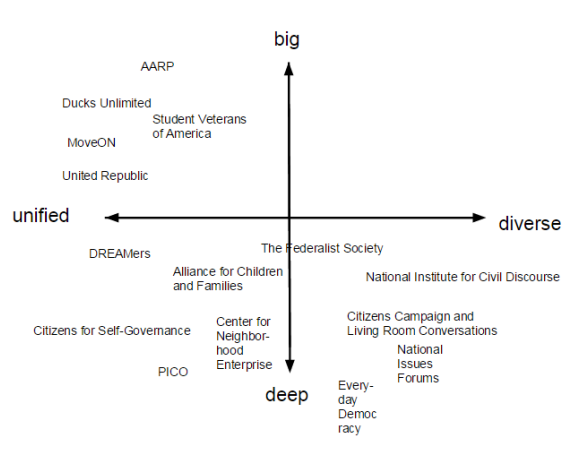
Some organizations included in this study are large, some are ideologically diverse, some have a coherent and focused agenda, and some are deep (engaging their members in learning, growth, leadership, and voice). But no organization has managed to be large, deep, diverse, and focused.

temp

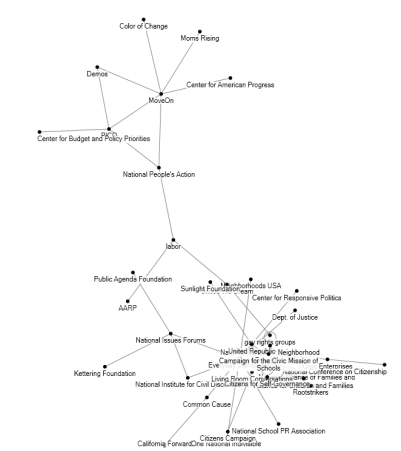
Furthermore, despite some working connections among these organizations, they do not yet form a coherent network. A simple network analysis of the connections that were either mentioned explicitly in the interviews or implied by the interviewees’ bios (for instance, when an individual holds leadership positions in two or more organizations) yielded the diagram below.

temp2

In exemplary episodes from American history, such as the Civil Rights Movement, networks of organizations have managed to be large, deep, diverse, and focused.

The paper concludes with some recommendations for research and convening to strengthen today’s network for civic renewal. You can download the full report here.

Kei Kawashima-Ginsberg to lead CIRCLE

I am thoroughly delighted about this announcement:

Kei Kawashima-Ginsberg has been named the new director of Tisch College’s Center for Information and Research on Civic Learning and Engagement (CIRCLE).

Dr. Kawashima-Ginsberg served as deputy director of CIRCLE since 2013, and has been a senior researcher with the team since 2008. She will be the third director in CIRCLE’s 14-year history, succeeding Peter Levine, who will remain active with CIRCLE while overseeing all of Tisch College’s research in his role as Associate Dean, and founding director William A. Galston, now of the Brookings Institution.

“It’s truly a privilege to serve as CIRCLE’s next director. I look forward to helping deepen our collective expertise and impact on opportunities for civic and political development among young people who are marginalized or disadvantaged,” said Kawashima-Ginsberg. “These young people are virtually shut out of public life, and our research can help identify barriers, test solutions, and transform the dialogue about the engagement of young people in our country.”

Kawashima-Ginsberg brings her extensive experience overseeing CIRCLE’s core research projects and producing resources, scholarly works, and reports for practitioners and researchers alike. With a background in positive youth development and an interest in diverse and marginalized youth, Kawashima-Ginsberg is primed to bring a sharpened focus to this important dimension of CIRCLE’s work. She is ideally prepared to provide organizations, communities, and the public with research that will increase civic and political learning and engagement opportunities.

Among her research projects at CIRCLE, Kawashima-Ginsberg has led studies on the leadership and political development of women and girls, the social class divide in the extracurricular experiences of youth, and the diversity of Millennials.

“Kei is the perfect choice to lead the next phase of CIRCLE’s development,” said Levine. “Her impressive background in youth development brings an important perspective to our work. She has been our lead researcher since 2008 and played an essential role in all of our activities. Many colleagues, both practitioners and scholars, already know her as a superb scholar and leader. I am excited to continue to work with her as she takes CIRCLE in important new directions.”

As Tisch College’s Associate Dean for Research, Levine will remain active in CIRCLE’s research and will support the organization.

Kawashima-Ginsberg earned her Ph.D. in Clinical Psychology with Specialization in Children and Families from Loyola University Chicago and has extensive experience in working with youth of diverse backgrounds both as a researcher and practitioner.

As it says above, I will remain deeply involved with CIRCLE–and more broadly with the research of Tufts’ University’s Tisch College of Citizenship, of which CIRCLE is a key part. In fact, my time commitment will not diminish. At the same time, Kei will be the true leader of CIRCLE, and that represents an enormous opportunity to develop and strengthen the organization in the service of youth civic engagement.

Hillary Clinton should name a VP nominee soon

The 2016 Democratic nominating contest looks unprecedented so far. The party has neither an incumbent president with a VP already in place, nor a competitive field of potential nominees, each ready to step up if anyone else falters. Instead, the Democrats have one candidate who is so far ahead in her own party’s primary race that she resembles an incumbent president, but no one is obviously ready to replace her should she hit a major obstacle.

By the way, I am not predicting that anything will happen to her. She seems healthy enough, and most of her past has already been relentlessly vetted. But she is human and she could face a crisis in the 19 months before Election Day. Democrats have serious grounds to worry that if something does happen to Clinton, they would be left without a plausible nominee at all.

If, on the other hand, she were to name a VP candidate soon, then a strong replacement would be ready should she have to withdraw for any reason. Meanwhile, she would have a second Democratic heavyweight to campaign with her for 19 months (possibly someone who would otherwise have been a competitor). Finally, the announcement could counteract any drawbacks to Clinton’s candidacy, such as her age and her reputation as a classic insider.

There are obvious drawbacks to naming a VP more than a year before the customary date:

1. It would look arrogant. It would indicate that Clinton thinks she is positioned like an incumbent president. But she could address that impression directly, saying that she learned the hard way in 2008 that her nomination is hardly inevitable. There are other likely Democratic candidates, and she realizes that one of them could defeat her. She has simply chosen to share her VP choice with the public early; other candidates can do the same.

2. She would miss the “bounce” that usually follows a VP announcement roughly five months before the election. That is correct, but it’s called a “bounce” for a reason. It doesn’t last. VP nominations have only mattered in a negative way; a few choices have hurt the ticket on Election Day. No one had gotten a clear benefit that has lasted until November.

3. She might make a bad choice. Her prospective VP might prove a weak candidate or have a major vulnerability. But that would also be a problem if she made the choice in the summer of 2016. There is no substitute for choosing wisely.

Finally, a disclaimer: This is a tactical suggestion. It is not an endorsement. I have serious misgivings about Hillary Clinton and am hoping for a real choice in the primary campaign. Here I simply suggest that it’s in her own interest for Clinton to make a VP choice soon.